Home Blog

Part 2: Years before this wedding, before the glittering guests and polished romance, the groom had already been promised to someone else.

0

She was the kind of woman you remember long after she’s gone — soft-spoken, graceful, and utterly devoted to the man who loved her. He came from money and family expectations. She came from simpler roots, the kind his relatives quietly looked down on. None of that mattered to him. He had chosen her, completely and without reservation, and to prove it, he had a pair of diamond earrings custom-made just for her — with a hidden detail no jeweler would know to look for, and no one else would ever understand.

He planned to give them to her on their wedding morning. The first gift she would wear as his wife.

She never got the chance to put them on.

On the day of the ceremony, she disappeared without a word. No note. No goodbye. The story that spread through both families was swift and cruel: she had panicked, gotten cold feet, and run away — leaving him standing at the altar and dragging two families through public humiliation. By the end of that terrible day, her name had become a scandal, whispered in judgment and buried under shame.

But that was never what happened.

Years passed. Decades, really. The man carried the loss in the quiet way people carry things they never fully let go of — not loudly, not dramatically, just always there, tucked beneath the surface of a life he had built without her.

Then one ordinary afternoon, in an upscale salon where his future bride was getting ready for their upcoming wedding, a hairstylist walked in with steady hands and kind eyes — and everything changed.

The hairstylist had grown up without answers. Her mother had raised her in modest circumstances, rarely speaking about the past and never explaining the most confusing piece of their life together: an old velvet pouch, hidden inside a wooden drawer, containing a pair of diamond earrings her mother never wore and never explained.

She only learned the truth at the very end, when her mother, frail and running out of time, finally told her everything.

She had not run away from that wedding.

She had been taken.

Before she could reach the church, certain people — people close to the groom, people with money and influence and a strong opinion about what kind of woman belonged in their family — had intervened. She had discovered she was expecting a child, and that knowledge, combined with the family’s determination to protect their name and their inheritance, had sealed her fate. She was removed from the story quietly, efficiently, and completely. No one came looking. No one was supposed to know.

The earrings were the only thing she was allowed to keep.

She kept them because she knew he would recognize them. He was the one who had them made. He was the one who had added the hidden detail — a tiny engraved letter pressed into the inside of the clasp. Not her initial.

His own.

A private mark. A secret only the two of them were meant to share.

In the salon, as the older makeup artist turned one of the earrings gently toward the light, she found it. That small engraving, pressed into the metal like a whisper from the past. The room shifted. The air changed.

The wealthy client stepped backward as understanding washed over her face — because suddenly this was no longer a story about missing jewelry or old family gossip.

It was about a woman who had been erased.

Then the hairstylist reached into her bag and produced one final thing: a faded photograph, worn soft at the edges from years of careful handling.

In the image, a young woman sat on a narrow bed, exhausted but alive, holding a newborn baby in her arms. The diamond earrings rested in the palm of her open hand, catching the light.

On the back, written in shaking but deliberate handwriting, were the words that had waited decades to be read:

If he sees these again, tell him I was never the one who left.

The groom’s composure collapsed the moment he saw it. Because when he looked again at the hairstylist’s face — her eyes, the shape of her jaw, the way tears moved down her cheeks without apology — he saw her. He saw the woman he had spent a lifetime quietly grieving, looking back at him through another face entirely.

He had been told she abandoned him.

He had believed it, because what else could he do?

And now here was her daughter, standing in a salon full of white flowers and wedding preparations, holding the proof that none of it had been true.

The hairstylist steadied herself and spoke the words her mother had sent her to say:

“My mother didn’t send me here to return your earrings.”

No one in that room breathed.

“She sent me here because the woman you’re about to marry was the one waiting in the car when they took her.”

Some secrets don’t stay buried forever. Some truths are patient. They wait inside velvet pouches in wooden drawers, carried quietly from one generation to the next, until the right moment arrives — until someone walks into the right room, at the right time, and finally says what should have been said long ago.

He had spent a lifetime believing she chose to leave.

She had spent a lifetime hoping he would one day know she never did.

Part 2: Twenty-three years earlier, he had not been a street cleaner.

0

He built an empire from nothing.

No inheritance. No safety net. No one handing him anything on a silver platter. Just raw determination, sleepless nights, and a vision that most people told him was impossible. By the time he reached the peak of his career, he was one of the most powerful real estate developers in the city — the founder of a billion-dollar company that stood as proof of what one man could build with his bare hands.

He had everything a man could want. Three sons who carried his name. A beautiful wife who stood beside him through every storm. More wealth than most families could spend in three lifetimes. And a legacy that seemed untouchable.

But success, as many people learn too late, has a way of attracting the wrong kind of attention.

The more powerful he became, the more dangerous his world grew. Rivals watched from the shadows. Partners smiled to his face and whispered behind his back. And when his wife passed away suddenly — the woman who had been his anchor, his compass, his greatest source of peace — the cracks in everything around him began to split wide open.

Her death changed him. But more than that, it changed the people around him.

Within months, the vultures circled. The people he had trusted most — lawyers, business partners, men who had sat at his table and broken bread with him — began positioning themselves to take what he had built. Documents vanished. Signatures appeared on papers he had never signed. And one by one, the trusted pillars of his inner circle revealed themselves to be anything but loyal.

Then came the discovery that shook him to his core.

Someone inside his own circle — someone who had looked him in the eye and called him a friend — had forged legal documents with the intent to strip his company from his children. His sons. His blood. The inheritance he had spent a lifetime building for them.

He made one decision that would cost him everything: he let the wrong person know that he had found out the truth.

A week later, his car went off the road and burst into flames.

The city mourned. The newspapers ran his photo. His sons buried an empty coffin. And the men who had conspired against him quietly divided the spoils of the empire they had stolen.

But he did not die.

He survived — barely, and at a cost that would break most people completely. Burned. Injured. His identity stripped away by both circumstance and necessity. Before he could recover enough to speak, to fight, to tell anyone what had happened, he understood one terrifying truth: if those men discovered he was alive, they would finish what they had started.

So he disappeared.

Not into a comfortable hiding place. Not into some quiet corner of the world where money could keep him safe. He had no money. He had no documents. He had no name anyone would believe. He moved from shelter to shelter, taking whatever work he could find — odd jobs, manual labor, the kind of work that kept his hands busy and his face out of sight. He watched the city he had once shaped and commanded slowly forget that he had ever existed.

He watched his empire carry another man’s name.

He watched his sons grow older without him.

And somewhere deep inside, he must have wondered if it would have been better to simply let the world keep believing he was gone.

What he did not know — what no one had ever told him — was that his youngest son had never accepted the official story. Had never stopped searching. Had spent years following cold trails and asking questions that made powerful people uncomfortable, driven by a quiet, unshakeable conviction that his father was still alive somewhere.

That son never found him.

But his sons did.

The three young men standing before the old street cleaner were not strangers passing by with a kind gesture and a spare burger. They were his grandsons — grown men with his blood in their veins and their father’s stubbornness written into every line of their faces.

The one who had offered the food had noticed something small. Something that most people would have walked past without a second glance. A crescent-shaped scar near the old man’s temple — faint with age, but unmistakable to someone who had grown up staring at an old family portrait hanging on the wall of their father’s office.

He called his brothers over quietly.

One of them was already crying before a single word was spoken.

The third reached into his jacket with trembling hands and pulled out a photograph — worn at the edges, soft from years of handling. It showed the same old man, decades younger, dressed in a dark suit and smiling in front of a tower that bore his name. A tower that now bore someone else’s.

The old man looked at the photograph.

Then he looked at their faces.

And something behind his eyes — something that had been sealed away for years — began to crack open.

His lips trembled. He could not speak.

One of the grandsons stepped forward and said the words that no amount of time could have prepared him to hear:

“Grandfather… Dad died still trying to find you.”

The broom slipped from his hands and clattered against the pavement.

For a long moment, no one moved.

Then the grandson holding the crushed burger turned and looked in the direction the white sports car had sped away — the car that had nearly struck the old man — and asked the question that would set everything back into motion:

“Do you know who that woman was?”

The old man slowly shook his head.

The grandson’s jaw tightened, and his voice dropped low and deliberate.

“She’s the daughter of the man who stole your empire.”

Some stories do not end with the grave. Some debts do not stay buried. And some men, no matter how hard the world tries to erase them, are simply not finished yet.

Part 2: The rich woman was the first to speak.

0

The little shop had always been the kind of place people walked past without a second glance — tucked between a dry cleaner and a flower stall, its gold chandelier the only thing that made it worth noticing at all. Most days, the old jeweler sat alone behind his glass counter, polishing things that no longer belonged to anyone he loved. But that afternoon, everything changed the moment a small girl pushed open the door.

She couldn’t have been more than seven or eight years old. Her coat was too thin for the weather, and her eyes were red from crying. She wasn’t browsing. She wasn’t lost. She walked straight to the counter with the focused determination of someone who had been given very specific instructions and was terrified of forgetting them.

In her small fist, she clutched a pendant.

A woman standing nearby — dressed in the kind of clothes that made other people feel underdressed just by being in the same room — glanced over and immediately stiffened. She had been in the middle of examining a bracelet, but her attention snapped to the child like a moth to flame. Something behind her polished expression shifted. Something uneasy.

The little girl held up the pendant.

“My mother told me to bring this here,” she said quietly. “She said to show it only to the man who remembers the lullaby.”

The rich woman laughed — a short, brittle sound. “That proves nothing,” she said, shaking her head with the practiced confidence of someone used to being believed.

But no one in the shop was looking at her anymore.

They were all staring at the old jeweler.

His hands trembled so badly he nearly dropped the frame. He looked from the child to the pendant, then back to the child again, with the expression of a man watching twenty years of grief suddenly rearrange themselves into something he couldn’t yet name. The color drained from his face. His lips parted, but no words came out.

The little girl stood in place, confused and frightened, tears still wet on her cheeks.

The old man stepped closer, slowly, as if approaching something fragile.

“What was your mother’s name?” he asked. His voice barely held together.

The girl swallowed hard. She’d clearly rehearsed what came next.

“She said that if I was ever hungry… I should find the shop with the gold chandelier. And show this only to the man who remembers the lullaby.”

The jeweler stopped breathing.

Somewhere near the back of the shop, a woman quietly burst into tears.

The pendant hung in the air between them — small, tarnished at the edges, and carrying the weight of something enormous.

“What lullaby?” the old man asked, his voice now barely above a whisper.

The child looked down. She pressed her lips together, steadying herself the way children do when they’re trying very hard to be braver than they feel. Then she whispered the first line.

Just one line.

The old jeweler made a sound that didn’t belong to ordinary grief — a low, broken exhale that seemed to come from somewhere deep and long-sealed inside of him. He reached for the counter to steady himself. His knees buckled anyway.

It was the lullaby he had written himself. The night his daughter gave birth. A song composed in a cold hospital room, sung once, shared with no one. There were no recordings. No written copies. No one alive on earth should have known those words.

No one.

He sank to his knees on the shop floor, right there in front of everyone, tears running freely down his weathered face.

“My daughter used to sing that,” he whispered, “to her baby. To my granddaughter.”

The boutique erupted. Murmurs became gasps. Someone knocked over a display stand and didn’t bother picking it up.

The glamorous woman backed away so quickly she collided with the glass counter behind her. Her bracelet clattered to the floor. She didn’t reach for it.

The little girl stared at the old man on his knees, trembling from head to toe, unsure whether to run or to stay.

Then the jeweler reached behind the backing of the pendant’s frame — slowly, carefully — and pulled out a folded note that had been tucked there for years. The paper was soft with age. His fingers shook as he opened it.

It was his daughter’s handwriting.

He recognized every curve of every letter.

His voice cracked as he read the first line aloud:

“If this pendant ever returns, the child wearing it is mine.”

The room went absolutely silent. The kind of silence that settles when something irreversible has just been understood.

He looked up at the little girl. She was watching him with wide, searching eyes — the eyes of a child who had been carrying a secret she didn’t fully understand, across distances she couldn’t measure, to a place she’d only been told to trust.

And behind them, the well-dressed woman — now pale, now cornered, now stripped of every layer of composure she’d walked in with — whispered three words that confirmed everything:

“That’s… impossible.”

But her voice told a different story.

Because she had seen that pendant before.

She had seen it the night the little girl’s mother disappeared — and she had never once believed it would find its way back.

Some things, it turns out, are not lost. They are only waiting. Waiting for the right child to carry them home, to the only man who would know the song, in the only shop with a gold chandelier, on the day the truth finally ran out of places to hide.

Part 2: The father was about to call security when the boy took one more step forward and said the words that stopped the entire ballroom cold:

0

The grand ballroom was filled with the kind of people who believed their secrets were safe. Crystal chandeliers cast a warm golden glow over silk gowns and tailored suits. Champagne glasses clinked. Laughter floated through the air like everything in the world was perfectly fine.

But not every secret stays buried forever.

No one expected a child to walk through those doors. And no one — not a single soul in that room — expected what she carried with her.

She was small, maybe seven or eight years old, with wide, unblinking eyes that seemed to see far more than any child should. She hadn’t spoken a single word in years. Not since her mother vanished without a trace. The doctors called it selective mutism brought on by trauma. Her father called it grief. Everyone else simply learned not to ask.

She stood at the entrance of the ballroom, perfectly still, as if the noise and the glitter meant nothing to her. And beside her stood a boy — older by a few years, unfamiliar to nearly everyone in the room, wearing clothes that were clean but clearly not expensive. He did not belong here. Anyone could see that.

The father noticed immediately.

He crossed the ballroom floor in long, deliberate strides, his expression tight with barely controlled anger. He was a powerful man. The kind of man who had spent years making sure the right people asked no questions and the wrong people never got close.

“Who are you?” he demanded, his voice low and sharp. “How did you get in here?”

The boy met his gaze without flinching.

“She knows me,” the boy said quietly.

The father’s face changed in an instant. “That’s not possible.”

But the little girl was already staring at the boy as if she had seen something rise up from the deepest part of a dream she could never escape. Her breathing shifted. Her small fingers curled tightly around the fabric of her dress. Her eyes — those wide, silent eyes — filled with something that had no single name. It was panic. It was recognition. It was the look of a child who had been carrying something unbearable for far too long.

The murmurs around them died down. People were watching now.

The boy reached slowly into his pocket.

Several guests tensed, stepping back, half-expecting something threatening. Instead, he withdrew a tiny silver music key attached to a worn, faded blue ribbon. The kind of ribbon that had once been carefully chosen. The kind of ribbon that had once been tied with love.

The little girl’s body jolted as if something deep inside her had been struck like a bell.

An older woman near the back of the crowd pressed her hand to her mouth. “My God,” she whispered, barely audible. “She used to wear that.”

The father went pale — the kind of pale that doesn’t come from cold. He knew that ribbon. He had seen it before, years ago, in the hands of his wife. She had tied it around their daughter’s small wrist herself, so the little girl would never lose the key to her favorite music box. It was a delicate, old-fashioned thing, that music box — the kind that only one person in the world knew how to open.

Her mother.

His voice dropped to something barely above a whisper.

“Where did you get that?”

The boy looked directly at him. His voice was steady, almost careful, like someone who had rehearsed this moment a thousand times and still wasn’t sure he was ready for it.

“Your wife gave it to my mother the night she disappeared.”

The ballroom erupted. Horrified murmurs rippled through the crowd like a stone dropped into still water. Guests turned to each other. Eyes widened. A few people backed away instinctively, though from what, they couldn’t have said.

The father staggered backward as if the ground itself had shifted beneath his feet. “No,” he said. “No. That’s not possible. That’s not—”

But the boy wasn’t finished.

He turned, gently, toward the little girl. His voice softened in a way that made several people in the crowd go very quiet.

“She didn’t lose her voice because her mother was gone.”

No one breathed.

The chandeliers seemed too bright suddenly. The room felt smaller than it had a moment before.

“She stopped speaking,” the boy said, “because she heard who made her disappear.”

The silence that followed was the kind that presses against your chest. The kind that makes you aware of your own heartbeat.

And then, slowly, the little girl’s lips began to tremble.

For the first time in years — through every doctor’s appointment, every sleepless night, every unanswered prayer — something was moving inside her. Something long locked away was being pulled toward the surface whether she was ready or not.

She lifted her hand. Slowly. Shakily.

She pointed into the crowd.

And she opened her mouth to speak.

Some truths are too heavy for a child to carry alone. But even the smallest voice, when it finally breaks free, can bring down the walls that the most powerful people spend their whole lives building.

That night, in a glittering ballroom full of people who believed their secrets were safe, a little girl finally found her voice.

And nothing in that room would ever be the same again.

Part 2: The rich man stared at his wife as if he had never truly seen her before.

0

The glass slipped from his fingers and exploded across the marble floor in a thousand pieces. Not a single person in that grand, chandelier-lit room moved a muscle. No one rushed to clean it up. No one spoke. The kind of silence that fills a room when everyone instinctively knows that something irreversible is about to happen had settled over them all like a heavy fog.

His wife took a slow step backward, her heels clicking once against the floor before she caught herself. Her eyes were sharp, calculating — the eyes of a woman who had spent decades managing situations like this one.

“You don’t know what he’s saying,” she said quickly, her voice low and clipped. “He’s lying. Whatever this boy told you, he’s lying.”

But the young man standing in the center of the room wasn’t listening to her. He wasn’t even looking at her. His gaze was fixed solely on the older man — the powerful, silver-haired man who had built an empire and a reputation on the foundation of everything he had buried long ago.

The boy reached slowly into the inside pocket of his coat.

What he pulled out was small. Delicate. A thin silver chain, and hanging from it — a ring.

The room didn’t just go quiet. It stopped breathing.

The rich man’s chest seized the moment his eyes landed on it. He would have recognized that ring anywhere, in any light, in any lifetime. It was his family ring. The one he had lovingly placed on the hand of a woman he had truly loved — before the world he knew fell apart. Before she vanished. Before everyone told him she had simply run away and that he needed to move on.

That ring had been reported lost the night she disappeared.

His wife’s face drained of every drop of color.

“No,” the man breathed, the word barely making it past his lips. “That ring… it was buried with her.”

The boy looked at him with eyes that held a grief too ancient for someone his age. The kind of sorrow that doesn’t come from a single wound, but from a lifetime of carrying one.

“No,” he said quietly, steadily. “It was taken from her.”

Somewhere in the crowd gathered in that room, a woman covered her mouth and began to weep softly.

The rich man moved forward, his legs carrying him before his mind could make the decision. His hands were trembling — these same hands that had signed contracts worth millions, that had never once shaken in a boardroom — now trembling in front of a boy he had never met.

“Who was your mother?”

The young man swallowed. His jaw tightened. And then he spoke the name.

The name that had lived in the locked room of the older man’s heart for so many years. The name of the woman he had once loved completely and without reservation. The woman everyone in his circle had dismissed as unstable, as someone who had chosen to abandon the life she had. The woman who was never spoken of anymore — because speaking of her was no longer permitted.

The wife’s composure cracked. She shook her head in wild, frantic denial.

“She was troubled! She left on her own — no one forced her to go anywhere. She was unstable and she disappeared because that’s what she chose to do!”

But for the first time since he had walked into that room, the boy’s voice rose.

“She didn’t disappear.”

He reached into his coat once more and produced a folded letter. The paper was yellowed with age, fragile at the creases, clearly handled many times by careful, grieving hands before it reached this room tonight.

The man took it. His fingers moved across the old paper gently, the way you touch something sacred. He unfolded it slowly, almost afraid of what he would find inside.

And the moment he saw the handwriting, his knees nearly gave out beneath him.

He knew those letters. He knew the way she curled her lowercase e’s, the way her sentences always tilted slightly upward as though she were hopeful even when she was afraid. It was unmistakably hers. After all this time, after all the years of telling himself she was gone and that there was nothing left to grieve, here she was — on a piece of paper, reaching for him across the years.

The wife lurched forward.

“Don’t read that here — not in front of everyone—”

But it was already too late.

His eyes had already found the first line.

And that single line — that one sentence she had written in the final hours of her life — brought his entire carefully constructed world crashing down around him.

If anything happens to me, ask your wife what she did the night she took our son.

He looked up from the letter.

He looked at the woman he had married. The woman who had stood beside him for decades. The woman who had held his hand at every public event, smiled for every photograph, managed every household with iron efficiency.

She did not deny it.

She didn’t have to.

Her silence in that moment said everything that words never could. And in that silence, every lie she had ever told him about that night — every careful, practiced story — collapsed all at once.

The boy was still watching him. Waiting. Patient in the way that only someone who has been waiting their entire life knows how to be.

And the man finally understood what had truly been lost. Not just a woman he loved. Not just years of his life. But a child. A son. A family that had existed, briefly and beautifully, before someone made the decision that it should not.

Some truths stay buried for decades.

But they never stay buried forever.

Part 2: For a few seconds, nobody moved.

0

She walked into that boutique like she owned the world — because in many ways, she did.

The rich woman had always believed that money could buy anything. The finest clothes, the most exclusive addresses, and certainly, a ring worthy of the life she had built. She stood at the glass counter with the kind of quiet authority that comes from never being told no, her engagement ring box resting between her manicured fingers like a trophy.

The young sales assistant across the counter was just trying to do her job. She was polite, professional, and careful with her words. But something about the ring — something only she could recognize — made her hands tremble.

The rich woman noticed. And instead of asking why, she chose cruelty.

A sharp comment. A dismissive wave. The kind of humiliation that wealthy people sometimes deliver without even raising their voice, the sort that leaves a mark deeper than any shouting ever could.

The assistant’s eyes filled with tears she was fighting hard to hold back.

That’s when the elderly jeweler stepped in from the back room. He had worked at this boutique for decades. He had seen trends come and go, watched couples young and old choose symbols of their love, and kept more secrets than most priests ever would. He moved slowly now, the way men do when years have settled into their bones, but his eyes were sharp and deeply troubled.

He asked the assistant a quiet question. She reached into her apron and produced a folded piece of paper — old, yellowed at the edges, the handwriting faded but still legible.

A receipt. From a custom order placed many years ago.

The rich woman looked from the assistant to her fiancé, waiting for him to laugh it off, deny it, say something — anything.

But he said nothing.

His face had gone completely white.

The elderly jeweler unfolded the receipt fully on the counter, his fingers tracing the faded handwriting with the reverence of someone handling something sacred and painful all at once.

“I remember this order,” he said quietly. “The ring was custom made for a different bride.”

A ripple of shock moved through the boutique like a cold current.

The rich woman turned sharply toward her fiancé. “What is he talking about?”

He swallowed hard but still could not find the words.

The assistant wiped her tears and spoke in a voice that barely held together.

“My mother worked here years ago. She was never just an employee.”

The jeweler closed his eyes for a long moment, as if being pulled back into a memory he had spent years trying to bury beneath layers of routine and silence.

“She was the woman he was supposed to marry,” he said.

The boutique went absolutely still. Even the soft music playing in the background seemed to hold its breath.

The rich woman stepped back. “That’s impossible.”

But then the assistant reached into her pocket and placed a tiny velvet pouch on the glass counter. Inside was an old diamond ring setting — incomplete, but unmistakably matching the engagement ring now sitting in the rich woman’s box.

“My mother kept this after the wedding was stopped,” she whispered. “She told me the full ring was remade later, under a new name, for the woman who replaced her.”

The rich woman stared at her fiancé with something shifting in her expression — disbelief curdling slowly into horror.

“You gave me her ring?”

He finally spoke, barely above a whisper.

“I was told she left. I was told she disappeared before the wedding because she wanted money.”

The assistant’s eyes filled again, and this time she did not try to stop the tears.

“No,” she said, her voice steadying with quiet devastation. “She disappeared because she was expecting a child… and because powerful people made sure her name was erased before anyone could ask why.”

The elderly jeweler looked down at the counter, weighted with a shame he had carried quietly for far too long.

“We were ordered to destroy every invoice, every sketch, every record,” he admitted. “But I kept one receipt hidden. I don’t know why exactly. Maybe I always knew this day would come.”

The rich woman’s breathing turned shallow and uneven.

And then the assistant said the words that broke the room completely open.

“My mother told me that if his new bride ever humiliated me in public… it would mean they had learned nothing.”

Her fiancé stared at her, something inside him crumbling.

“Who are you?” he asked, though some part of him already knew.

The young woman looked straight at him through her tears, her chin lifted, her voice quiet and sure.

“I’m the daughter of the woman you were meant to marry.”

The rich woman’s fingers went slack. The ring box dropped softly to the counter.

Around them, phones were still recording. Strangers who had wandered in for an ordinary afternoon stood frozen, witnesses to something none of them had expected to stumble into — a reckoning decades in the making, playing out beneath the warm boutique lighting as if the universe had finally decided that enough time had passed.

No one spoke.

No one moved.

And the elderly jeweler, his own eyes glistening now, whispered the only truth left to say.

“This ring was never cursed… only stolen from the wrong bride.”

Some wrongs take years to surface. Some secrets survive inside folded receipts tucked into desk drawers by old men who cannot quite bring themselves to let the truth disappear entirely. And sometimes, the person a powerful woman chooses to humiliate on a quiet afternoon turns out to be the very person holding the key to everything she thought was hers.

Karma does not always arrive loudly. Sometimes it walks in quietly, wearing an apron, and places a small velvet pouch on a glass counter.

Part 2: The note inside the pendant was not a love letter — it was a warning written the night Sofia vanished.

0

The billionaire’s hand trembled so violently that the paper nearly slipped from his fingers. He read it again, slower this time, as if his mind simply refused to accept what his eyes were seeing. The restaurant around him buzzed with the low hum of polite conversation, the soft clinking of crystal glasses, the murmur of wealth and comfort. None of that mattered anymore. Not after what was written on that page.

He stood completely still in the middle of the candlelit dining room, a man who had built empires from nothing, who had stared down boardrooms and markets and storms that would have broken lesser men. And yet, in that moment, he looked like someone had just reached into his chest and pulled out something vital.

The waitress who had handed him the note stood frozen a few feet away, her tray still balanced in one hand, tears streaming silently down her face. She had carried this secret to this restaurant, to this table, for reasons she was only beginning to understand herself.

“What does it say?” she whispered.

He didn’t answer her. He wasn’t looking at her yet.

He was looking at the elegant woman seated across the room — the one draped in diamonds, the one who had just moments ago humiliated this young waitress in front of the entire restaurant, throwing a scene that left staff and guests alike stunned into uncomfortable silence.

“No,” the woman said immediately, rising slightly from her chair. “Don’t look at me like that.”

His voice, when he finally spoke, was stripped of everything warm. “Sofia disappeared the night I was supposed to meet her at Gare de Lyon.”

The waitress stopped breathing.

“She told me,” he continued, each word measured and deliberate, “that only three people knew about that meeting.”

The room seemed to contract around them, as if the walls themselves were leaning in to listen.

The woman in diamonds shook her head too quickly, her composure fraying at the edges. “You cannot seriously believe this girl over me—”

But the waitress spoke softly, almost to herself. “My mother told me. She said a woman wearing diamonds came before midnight that night.” Her voice was barely above a whisper, yet the room heard every word. “She said the woman told her that you had changed your mind. That you never truly loved her. And that if she stayed… she and the child would be destroyed.”

The color drained from the wealthy woman’s face.

Around them, dinner guests quietly lifted their phones. No one pretended not to watch.

The billionaire looked back down at the note. There was one final line at the bottom, written in hurried, uneven handwriting — the kind a person writes when they are running out of time, or running out of hope:

If our daughter survives, she will have my eyes and your silence.

His breath caught in his throat.

Slowly, as if the movement cost him something enormous, he lifted his eyes to the young waitress standing before him.

Her tears.

Her eyes.

The way she held her chin up even when she was clearly terrified.

It hit him like a physical force. Those were Sofia’s eyes. That was Sofia’s expression — the one she wore whenever the world was falling apart around her and she was determined not to let anyone see it. He had loved that expression. He had been afraid he would never see it again.

The waitress looked back at him with a question she already seemed to know the answer to — and was almost too frightened to hear confirmed.

“My mother passed away last winter,” she said quietly, steadying herself. “Before she died, she made me promise to come to this restaurant on this exact date… and to wear the pendant where you could see it.”

He stepped closer, unable to look away from her face.

The woman in diamonds made one last attempt. “She’s lying. Sofia left because she was ashamed. She ran away.”

The waitress turned to face her, trembling but standing firm. “Then why did my mother write your initials on the back of the photograph?”

The entire room went still.

He flipped the photograph over.

There, faded but unmistakable, were two letters etched in soft pencil on the back of the image. The woman’s initials. Undeniable. The kind of evidence a desperate mother leaves behind because she knows she may not live long enough to speak the truth herself.

His expression changed completely. Not grief. Not confusion. Something harder, and far more certain.

Recognition.

He looked at the crying young woman before him — this girl who had grown up without a father, who had waited tables to survive, who had worn a pendant into a room full of people who never imagined she belonged there.

Then he looked back at the woman in diamonds — at the carefully constructed mask that was finally, irrevocably cracking.

And in front of every witness in that candlelit room, he said in a voice low and unwavering:

“You didn’t throw that tray because you thought she was just a servant.”

He held the woman’s gaze without flinching.

“You threw it because the moment you saw her pendant… you knew exactly whose daughter she was.”

No one moved. No one spoke. The truth had finally arrived — late, painful, and impossible to take back. And for the first time in years, the silence in that room wasn’t the silence of comfort or wealth or polished social grace.

It was the silence of a secret that had finally run out of places to hide.

Part 2: For one long second, nobody in the bakery moved.

0

Nobody in that bakery expected what happened next. Not the customers browsing the glass cases. Not the young worker behind the counter. Not even the small boy standing on his tiptoes, pressing his nose against the display with wide, wondering eyes.

But the owner — the man who had inherited this shop from his late father — felt something shift inside his chest the moment he stepped out of the back kitchen and saw the old woman standing near the door.

She was thin, dressed modestly, with silver hair pinned neatly beneath a floral scarf. Her face carried the quiet dignity of someone who had survived more than most people would ever know. And she was holding the hand of a little boy who couldn’t take his eyes off a strawberry cream celebration cake sitting beneath the lights.

The boy wasn’t causing trouble. He wasn’t asking for anything he shouldn’t have. He was simply looking — the way children look at beautiful things they have never been allowed to touch.

But the worker had already moved toward them.

“Ma’am, if you’re not purchasing anything, I’m going to have to ask you to step aside. You’re blocking the display for paying customers.”

The grandmother nodded gently, no argument, no complaint. She placed her hand on her grandson’s small shoulder and began guiding him toward the door. The boy cast one last look at the strawberry cake — just one — and then turned to follow her without a word.

That was the moment the owner walked out and stopped cold.

He had seen something. Or rather, he had remembered something.

With steps that felt almost involuntary, he crossed the bakery floor and stood before the framed recipe hanging on the wall behind the counter — a piece of yellowed paper, written in blue ink, preserved behind glass for as long as this shop had existed.

Strawberry Cream Celebration Cake.

And at the bottom, a signature. A name his father had spoken many times over the years, always with something that looked like grief behind his eyes.

Anna.

The owner turned slowly. His voice came out barely above a whisper.

“My father said you disappeared the night of the fire.”

The old woman stopped walking. She turned around, and her expression was not one of surprise. It was the look of someone who had been carrying a secret for decades and had quietly accepted that it would never be spoken aloud.

“I didn’t disappear,” she said softly. “I lost everything.”

The entire bakery went still. Conversations stopped. The hum of the espresso machine seemed to fade into the background. Every person in that room turned to listen without fully understanding why.

The owner’s throat tightened. He had grown up hearing the story in pieces — the way his father told it on quiet evenings, always emotional, always incomplete.

“When the old bakery burned, my father told everyone that a woman carried him out before the ceiling collapsed,” he said. “He said she went back inside for one more thing — and after that night, she was simply gone. He searched for years. He never found you.”

The grandmother’s eyes filled with tears she did not try to hide.

“My daughter was still inside,” she whispered.

A sound moved through the room — not quite a gasp, not quite silence. Something in between.

The owner’s face changed completely.

The old woman looked down at the strawberry cake her grandson had been admiring through the glass.

“She loved making birthday cakes more than anything,” she said, her voice steady even as tears slipped down her cheeks. “That recipe hanging on your wall — that was ours. My daughter wrote the cream measurements in the margin herself because she always believed that children deserved cakes that looked happier than real life sometimes felt.”

The little boy’s fingers tightened around his grandmother’s hand.

The owner could barely speak.

“My father never stopped feeling grateful,” he managed. “He said you saved his life.”

The grandmother nodded slowly.

“But after my daughter was gone, I couldn’t bear to come back to this neighborhood,” she said. “I only came today because my grandson had never seen a real bakery cake up close. He saw one in a movie — a beautiful strawberry one at a birthday party — and he talked about it for weeks. I wanted him to at least see it, even if we couldn’t stay.”

Several customers were openly crying now. A woman near the window pressed her hand to her mouth. An older gentleman in the corner quietly removed his glasses and looked at the floor.

The worker stood frozen, unable to meet anyone’s eyes.

Then the owner turned to the little boy and knelt down so they were face to face.

“When is your birthday?” he asked quietly.

The child answered in a voice so small it was nearly a whisper.

“Tomorrow.”

That single word broke the room open entirely.

The owner stood, walked to the display case, and carefully lifted the strawberry cream celebration cake. He placed it on the counter with both hands. Then he added a set of birthday candles. Then a small box of pastries. Then a warm loaf of bread wrapped in paper.

He turned back to his worker and spoke in a low, measured tone that carried more weight than any raised voice could have.

“You asked the woman who saved this bakery — and saved my father’s life — to step aside so she wouldn’t inconvenience the paying customers.”

The worker had nothing to say.

The owner reached up and carefully lifted the framed recipe from the wall. He walked it across the bakery and placed it gently in the grandmother’s trembling hands.

“This should never have hung here without your family being properly honored,” he said.

She broke then — quietly, completely, the way people cry when something they stopped hoping for finally arrives.

The boy looked at the elegant signature at the bottom of the old paper. He looked up at his grandmother.

“You made the cake?” he whispered.

She nodded, tears falling freely.

“With your mama,” she said.

And in that warm little bakery — the very place where they had just been made to feel invisible for being poor — the whole truth finally came into the light.

The child had not been staring at a stranger’s cake through the glass.

He had been looking at a piece of his own family’s love, hanging on someone else’s wall, waiting all these years to come home.

Part 2: No one in the restaurant moved.

0

Nobody moved.

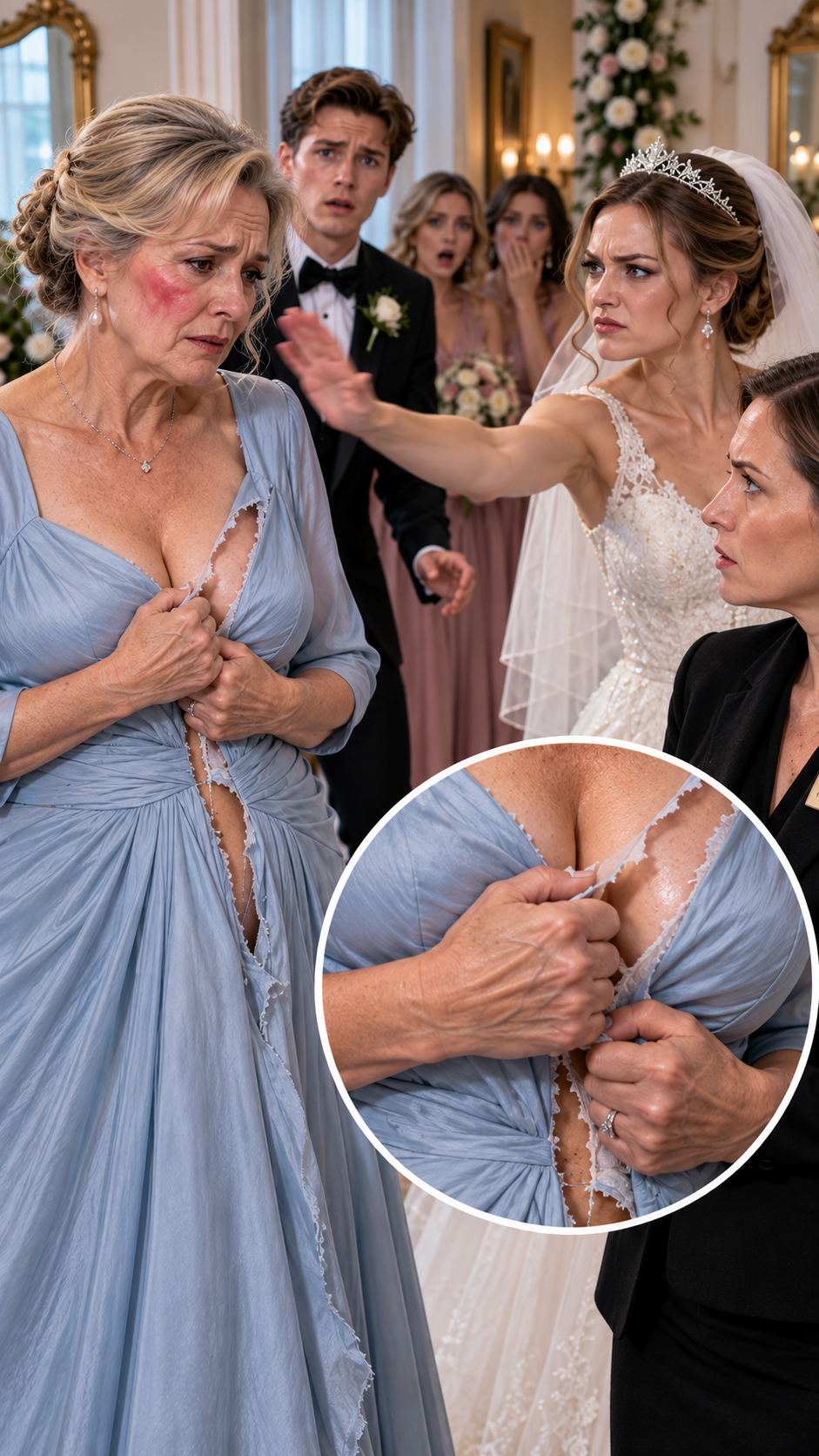
Not the guests seated at their polished tables. Not the servers frozen mid-step with trays in hand. Not even the wealthy woman who had just raised her hand and slapped a young waitress across the face — right there, in front of an entire room full of people who suddenly forgot how to breathe.

The husband stood motionless, his eyes locked on the girl’s face as if he were seeing a ghost step out of the soft glow of candlelight. Something in him had shifted the moment she walked closer. Something old and buried and painful.

His voice came out rough, barely above a whisper.

“What was your mother’s name?”

The girl steadied herself. Her cheek was still red. Her eyes were glassy with tears she refused to let fall. She swallowed hard before she answered.

“Isabella.”

A stunned murmur moved through the dining room like a wave. Spoons clinked against china. A chair scraped the floor. Someone near the window drew a sharp breath.

The wealthy wife covered her mouth with one perfectly manicured hand.

The elderly pianist at the corner of the room quietly closed his eyes.

Because Isabella was not simply the name of someone who had passed away long ago. She was something far more complicated than that. She was the family’s greatest shame — hidden beneath layers of wealth, deliberate silence, and rooms that had been locked for decades. A story too dangerous to tell and too painful to fully bury.

The waitress wiped at her tears with the back of her hand, but her fingers were still trembling when she reached into her apron pocket and withdrew a small, worn photograph.

“My foster mother worked in your family’s private wing,” she whispered, her voice barely holding together. “Before she passed, she gave me this photo. She told me that if your family ever called me shameless — if they ever treated me like I was nothing — I should bring them the face they paid to erase.”

The husband took the photograph. He turned it over slowly, as if some part of him already knew what he would find on the back.

The handwriting was faded. But he recognized it instantly.

It was his mother’s handwriting.

He read the words aloud, though he never meant to.

Take the child tonight. The estate cannot survive two female heirs. Change her name. Burn the record.

The room seemed to tilt on its axis.

His wife stared at him in undisguised horror.

From the corner, the old pianist spoke quietly, his voice heavy with something that had clearly stayed with him for years.

“I remember that night,” he said. “There was smoke coming from the upper hall. Isabella was screaming for her baby. Your mother came downstairs carrying a blanket — but there was no child inside it.”

A collective gasp rippled through every table in the room.

The waitress’s voice cracked entirely.

“My foster mother said Isabella survived long enough to hand me over. She begged her to run — to get me out before your mother’s people came back.”

The husband looked like the ground beneath his feet had simply disappeared.

His family had told him the infant did not survive.

That Isabella herself had passed away not long after.

That there was nothing left — no one left — to save or to grieve.

But the truth was standing right in front of him. In a waitress uniform. Crying beneath the chandeliers of a restaurant where she had just been publicly humiliated by people who had no idea who she actually was.

Then she reached into her apron one more time.

She placed a small object on the table.

A tiny silver heir tag — old, scratched at the edges, dulled by decades. But the family crest was still visible. And beneath it, a single word, carefully engraved.

Claire.

The husband nearly dropped the photograph.

The pianist whispered from his bench, “That was the infant heiress tag…”

The waitress nodded through her tears.

“That was my name before your mother paid someone to erase it.”

His wife took a slow step backward, as if every carefully constructed lie that had held the family together was suddenly becoming visible all at once — and she no longer wanted to be standing too close when it all came down.

Then the restaurant doors opened.

An older woman stepped inside.

His mother.

She saw the photograph in his hand. She saw the silver tag on the table. She saw the young woman’s face — and she stopped where she stood, completely still.

The pianist looked at her with quiet, unmistakable disgust.

“She lived,” he whispered. “The child lived.”

The older woman’s lips parted. But nothing came out.

The husband looked at her the way a person looks at someone they suddenly do not recognize at all.

“You left a living child behind?” he whispered.

When her voice finally returned, it was thin and fractured.

“I was saving this family.”

The waitress let her tears fall freely now.

“No,” she said. “You were saving the money.”

No one in that restaurant could speak after those words landed.

Not after learning about the destroyed record. Not after the truth about the missing heiress. Not after realizing that the young woman who had been slapped and shamed in public — treated as though she were invisible, as though she had no right to even be in the room — was never chasing wealth or status or attention.

She was the daughter they had deliberately erased so the inheritance would pass cleanly to someone else.

And there, beneath the crystal chandeliers, with the whole room as her witness, the truth finally completed itself.

The girl they had humiliated as if she were nothing…

had walked back in carrying the photograph, the name, and the undeniable face of the heiress her own family had been willing to burn out of history.

Some things buried deep enough eventually find their way back to the surface — not loudly, not with warning, but quietly, painfully, and with devastating precision. And when they do, no amount of wealth, influence, or carefully maintained silence is enough to keep them underground any longer.

She Was Called a Thief. Then She Pulled Out a Key That Shattered Everything.

0

Nobody moved inside that boutique.

Not the customers browsing velvet trays of gold and diamonds. Not the staff standing stiffly behind glass counters. Not even the wealthy fiancée who had just raised her hand and slapped a young shop assistant across the face — in front of everyone, without a single moment of hesitation.

The only one who couldn’t move was the groom’s mother.

She stood near the doorway, one hand pressed against the wall, her face draining of every drop of color as though something inside her had finally come loose after years of being held too tight.

The groom turned slowly. Not toward his fiancée. Not toward the stunned crowd. He turned toward his mother, and his voice came out cracked and low, like a man who already sensed the ground beneath him was about to give way.

“Mother,” he said quietly, “why does Elena’s ring recognize this girl?”

The entire boutique seemed to exhale and go still.

The young assistant — the one who had just been accused of handling a ring that wasn’t hers to touch, the one whose cheek still burned red from the slap — reached into the front pocket of her apron. Her hand came out holding something small and old. A tiny, yellowed key, worn smooth at the edges from age.

“I found it,” she whispered, her voice barely holding together, “tucked inside my mother’s burial box. Wrapped beneath the cloth. Right next to the ring.”

The elderly jeweler behind the counter went rigid.

He knew that key.

He had not seen it in decades, but he knew it immediately — the key to the private archive drawer where the original bridal documents for a ring called Elena’s had been sealed away and forgotten.

The groom’s mother took one slow step backward toward the door.

“No,” she breathed. Just that. One word, hollow as an empty room.

The assistant’s tears were falling freely now, but something in her voice had changed. It was steadier. Quieter. The kind of quiet that comes from carrying a secret so long that finally saying it out loud feels like setting down something unbearably heavy.

“My mother passed away last month,” she said. “She raised me under a different name. She never told me everything — not until the very end. Before she closed her eyes for the last time, she made me promise her one thing: that if anyone from this family ever called me a thief, ever humiliated me, ever laid a hand on me, I was to bring the ring back here and let the jeweler open the drawer.”

The groom stared at her as though the walls of the room were slowly peeling back.

The old jeweler moved with trembling hands to the archive cabinet. He slid the key in. The drawer opened. Inside lay a thin velvet file coated in a fine layer of dust — untouched for years. He carried it to the counter and opened it carefully, as though it might dissolve.

Inside were the original order papers for the ring.

Bride listed: Elena V.
The date engraved on the papers matched the engraving inside the band, letter for letter.

But behind the order sheet, folded neatly as though someone had placed it there with great intention, was something that changed everything.

A church certificate.

The groom took it with shaking hands. He unfolded it slowly. He read it twice before his brain could accept what his eyes were seeing.

It was a marriage record. Not planned. Not future tense. Already completed. He and Elena had been lawfully wed in a private ceremony three days before the family had ever announced any engagement celebration.

A sound moved through the boutique — a sharp, collective inhale.

The fiancée pressed her hand over her mouth.

The groom’s mother squeezed her eyes shut.

And the assistant whispered into the silence:

“She was not your first bride. She was your wife.”

No one breathed.

The jeweler turned over one last paper at the bottom of the file, and the room seemed to tilt on its axis.

A burial release form. But the name on the authorization did not belong to Elena. It was the name of an unknown woman — a household maid from the estate — whose identity had been used to close a coffin that was never meant to hold her.

The groom looked at his mother, and his expression was no longer grief. It was horror.

“You buried someone else in her place?”

His mother’s voice came out as barely a whisper, fragile and fractured.

“Elena was expecting a child,” she said. “Your father believed that if the baby came into the world before the arranged marriage could be finalized, the family inheritance would be divided. She had to disappear. It was decided that she had to go.”

The assistant pressed her lips together to keep from breaking apart entirely.

“My mother told me she ran because they warned her the baby would not be allowed to live if she stayed.”

The groom looked at the young woman’s face then — really looked, the way you look at someone when something deep in your memory begins to surface without your permission.

The same eyes. The same gentle curve of the jaw. The same quiet strength underneath the tears.

His voice fell to almost nothing.

“I’m your father.”

The fiancée stumbled backward as though she had taken a physical blow.

The assistant nodded through her tears.

“She said you didn’t know,” she whispered. “She said they locked you away the night they came for her.”

The jeweler lowered his head. The groom’s mother wept, but not one person in that boutique moved toward her with comfort.

Because what stood before them now was impossible to look away from:

A young woman, publicly humiliated, accused of theft, struck across the face in front of strangers — had not come to steal anything.

She had come to return the proof. Proof that her mother had not been a scandalous first bride. She had been a lawful wife, a hidden wife, disappeared so that a family’s wealth could pass cleanly into the next generation without a child no one wanted to acknowledge.

The groom lifted the ring from the display tray. He walked to the assistant, took her trembling hand gently in both of his, and placed the ring into her palm.

Then he turned to face the room, and he spoke clearly enough for every single person present to hear:

“This was never an engagement ring. It was a wedding ring — my wife’s wedding ring. And this young woman standing before you is not a store employee.”

His voice broke open completely.

“She is my daughter.”

The boutique fell into a silence so complete it felt sacred.

And there, beneath the brilliant white light of the diamond cases, in the very place where she had been treated as though she were nothing — the truth that had been buried along with her mother finally rose to the surface and breathed.

The so-called thief had only come to reclaim what had always belonged to her family: the marriage, the memory, and the name they had tried so desperately to bury.