“Move away from this table before you embarrass yourself,” Major Derek Mason said, dragging the empty chair from Margaret Hayes’s hand.
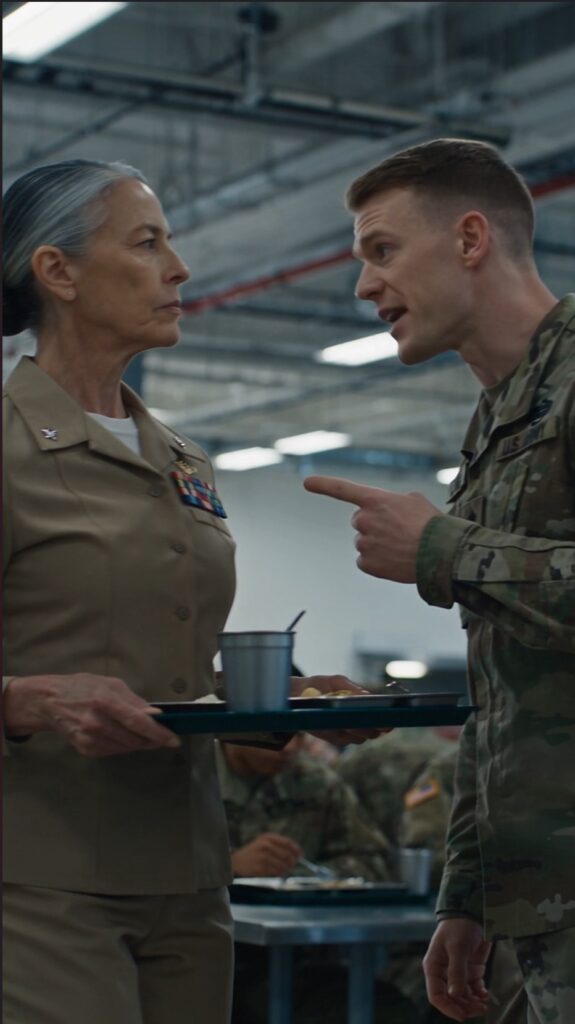
The metal legs screeched across the cafeteria floor, silencing everyone close enough to hear.
Margaret remained standing beside her lunch tray.
Her old brown coat hung loosely over her shoulders.
Nothing on her clothing suggested rank.
Nothing revealed authority.
Derek glanced at her coat, then at the officers seated around him.
His smile sharpened.
“This section is for people who earned the right to sit here.”
Margaret rested one hand against the edge of the table.
“I only need somewhere to eat.”
A captain across from Derek lowered his fork.
Another officer glanced down quickly.
Nobody challenged him.
Derek leaned back and laughed.
“There’s a table beside the trash return.”
He pointed across the bright cafeteria.
“Honestly, that looks more appropriate for you.”
Several younger officers laughed.
One laughed too loudly.
Another smiled because everyone else did.
Margaret looked at each of them without responding.
Her expression remained steady.
A young female lieutenant named Emily Ross suddenly pushed her chair backward.
“You can take mine, ma’am.”
Derek turned instantly.
“Lieutenant, sit down.”
Emily froze halfway upright.
“Sir, there are plenty of seats.”
“I didn’t ask for your opinion.”
His voice became harder.
Emily slowly returned to her chair.
Derek pointed toward the table again.
“Do not turn my officers’ lunch into a retirement-home charity event.”
That sentence killed the remaining laughter.
Margaret’s fingers tightened briefly around her tray.
Emily saw it.
The movement lasted less than a second.
Then Margaret lifted the tray.
“Enjoy your lunch, Major.”
Derek smirked.
“I always do.”
Margaret walked away.
No one followed her.
She crossed the crowded cafeteria while conversations gradually returned.
Forks touched plates.
Boots moved between tables.
Coffee poured from silver dispensers.
Margaret reached the small table near the tray-return station.
A trash bin stood five feet away.
The smell of disinfectant mixed with grilled chicken and coffee.
She sat alone.
Across the room, Derek remained watching.
He raised his voice deliberately.
“Some people retire and still can’t stop pretending they matter.”
Several officers heard him.
Nobody laughed this time.
Margaret picked up her napkin.
She unfolded it carefully.
Then she reached into her coat.
Derek watched for another reaction.
Instead, she removed a plain black phone.
She typed one short message.
Emily noticed.
Derek noticed too.
He leaned toward Captain Luke Harris beside him.
“Probably complaining to somebody’s secretary.”
Luke gave a weak smile.
Derek took another bite of his sandwich.
Margaret placed her phone face down.
Then she began eating.
Emily looked toward Margaret again.
Something bothered her.
Margaret did not look humiliated.
She looked disappointed.
That felt worse.
Emily had seen angry civilians before.
She had seen retired soldiers demand respect.
She had seen angry parents confront commanders.
Margaret behaved like none of them.
She watched the room.
Not nervously.
Professionally.
Her eyes moved toward the serving line.
Then toward the junior officers.
Then toward Derek.
Emily noticed another detail.
Margaret barely touched her food.
She appeared more interested in observing everyone else.
Derek caught Emily staring.
“Something fascinating over there, Lieutenant?”
Emily faced forward.
“No, sir.”
“Good.”
Derek wiped his mouth.
“Because officers who get distracted easily usually stay lieutenants.”
Luke glanced toward him.
The comment sounded casual.
Everyone at the table understood the warning.
Emily had been waiting six months for a recommendation from Derek.
Her next assignment depended partly upon it.
Derek knew that.
He used it often.
Emily lowered her eyes.
Margaret heard everything.
The tray-return station did nothing to hide voices.
Derek continued speaking.
He complained about a sergeant who had challenged a scheduling decision.
He mocked a captain who had requested family leave.
He criticized a warrant officer for refusing an unsafe shortcut during training.
Margaret’s fork stopped halfway to her mouth.
For the first time since she had sat down, something sharper than disappointment crossed her face.
It vanished almost immediately.
She lowered the fork to her plate, reached for the black phone again, and glanced at the screen.
One reply waited beneath the message she had sent.
Margaret read it once.
Then she locked the phone and returned it to her coat.
Across the cafeteria, Derek was still talking.
“The problem now,” he said, loud enough for three tables to hear, “is that everybody thinks caution is leadership.”
Luke shifted in his chair.
Emily looked up.
Derek tapped one finger against the table.
“You hesitate in the field, somebody else pays for it.”
Margaret rose.
The movement was quiet enough that Derek did not notice at first.
Emily did.
So did Luke.
Margaret lifted her tray and carried it to the return station. She slid the plate into the rack, folded her napkin beside it, and stood there for a moment with both hands resting lightly on the metal counter.
Then the cafeteria doors opened.
Conversation near the entrance thinned first.
A colonel stepped inside with two senior officers behind him.
Derek’s voice stopped.
The colonel did not scan the room looking for anyone.
He already knew exactly where to go.
He walked past Derek’s table.
Straight toward Margaret.
Derek slowly put down his coffee.
The colonel stopped several feet from her and came to attention.
“General Hayes.”
The room went silent.
Not gradually.
Completely.
Emily’s eyes widened.
Luke’s face lost its color.
Derek remained motionless, one hand still wrapped around his cup.
Margaret turned toward the colonel.
“Colonel.”
“I’m sorry we kept you waiting.”
“You didn’t.”
Her answer was calm.
The colonel glanced toward the table beside the trash return, then toward the officers across the room.
Something changed in his expression.
Margaret saw it.
“Not here,” she said quietly.
The colonel gave a small nod.
Derek stood so quickly his chair struck the floor behind him.
“General?”
Margaret looked at him.
His smirk was gone.
He opened his mouth, but no explanation came.
Margaret did not rescue him from the silence.
Finally Derek straightened his shoulders.
“Ma’am, I wasn’t informed that you had arrived.”
“No,” Margaret said. “You weren’t.”
A few officers exchanged glances.
Derek swallowed.
“If I had known—”
“That is precisely the problem.”
Her voice never rose.
Derek stopped.
Margaret stepped away from the tray station.
“If you had known who I was, Major, you would have behaved differently.”
No one moved.
“That would tell me nothing about you.”
Derek’s jaw tightened.
Margaret looked toward Emily.
Then Luke.
Then the younger officers who had laughed.
“What tells me something is how you behaved when you believed I had nothing you needed.”
The young officer who had laughed loudest stared at his hands.
Derek tried again.
“General, with respect, this was a misunderstanding.”
Margaret’s eyes returned to him.
“What did I misunderstand?”
He hesitated.
The question left nowhere to hide.
Derek looked toward the colonel as if expecting intervention.
None came.
“I believed this was a designated officers’ section.”
“It isn’t,” Luke said.
The words escaped before he seemed prepared to say them.
Derek turned toward him.
Luke’s face tightened, but he did not look away.
“There’s no designated section, sir.”
The cafeteria seemed to become even quieter.
Derek stared at him.
Margaret watched the exchange.
Then she asked, “Captain, how long have you known that?”
Luke’s throat moved.
“Always, ma’am.”
“And you said nothing.”
“No, ma’am.”
Margaret nodded once.
Luke looked as though that small acknowledgment hurt more than anger would have.
Emily stood.
This time Derek did not order her back into her chair.
“General Hayes.”
Margaret faced her.
Emily’s hands were rigid at her sides.
“I should have stayed standing.”
Derek gave a short breath of disbelief.
Emily continued anyway.
“I knew what he was doing was wrong. I offered you my seat, and when he told me to sit down, I did.”
Her voice trembled on the final word.
Margaret studied her.
“Why?”
Emily’s eyes flicked toward Derek.
“My recommendation.”
Derek’s face hardened.
“Lieutenant, be very careful.”
Emily went pale.
Margaret turned her head toward him.
“Major.”
One word.
Derek fell silent.
Emily drew a breath.
“He controls part of the recommendation for my next assignment.”
Margaret waited.
Emily understood the invitation.
“He reminds me of that whenever I disagree with him.”
Derek shook his head.
“That is not what happens.”
Luke looked down.
Margaret noticed.
“Captain Harris?”
Luke remained silent for several seconds.
Then he pushed his chair backward and stood.
“I’ve heard him do it.”
Derek stared at him.
“Luke.”
“I’ve heard you do it,” Luke repeated.
The familiarity of Derek’s first name made the room feel suddenly smaller.
Margaret looked at the officers seated nearby.
“Anyone else?”
Nobody spoke.
Derek exhaled through his nose.
“There. You see?”
Then a chair scraped near the wall.
A sergeant stood.
“I challenged a schedule because my team had exceeded the rest cycle.”
Derek’s face changed.
The sergeant kept going.
“After that, I was removed from two training rotations.”
Another officer rose.
“The family leave comment was about me.”
Derek looked toward him.
The captain’s eyes were wet, but his voice remained steady.
“My daughter was having surgery.”
Silence followed.
Then, from near the serving line, a warrant officer stepped forward.
Margaret recognized the description before he spoke.
“I refused the shortcut.”
Derek’s shoulders stiffened.
The warrant officer stopped beside an empty table.
“The route crossed a section that hadn’t been cleared. I said we needed to wait.”
Derek pointed at him.
“And nobody was hurt.”
“Because we didn’t take it.”
The words landed without force.
They did not need any.
Derek lowered his hand.
Margaret looked around the cafeteria.
The room that had laughed at her now seemed afraid of its own memory.
She understood that fear.
It was not fear of her.
It was the uncomfortable realization that everyone had been watching the same behavior for a long time and had slowly learned to call it normal.
The colonel stepped closer.
“General, we can move this conversation.”
Margaret shook her head.
“Not yet.”
She turned toward Derek.
“I came here today because I was asked to conduct a command climate review.”
Derek blinked.
The sentence seemed to take several seconds to reach him.
Margaret continued.
“There have been complaints.”
His eyes moved toward the officers around him.
“Anonymous complaints?”
“Some.”
He gave a humorless laugh.
“So this was a test.”
“No.”
Margaret’s answer came immediately.
“I arrived early. I was hungry. I came here to eat.”
Derek stared at her.
“You chose not to know who I was.”
She paused.
“And then you showed me exactly why I was sent.”
The color drained from his face.
He looked toward the colonel.
“Sir, I’d like to speak privately.”
“You will have that opportunity,” the colonel said.
Derek’s gaze returned to Margaret.
“General, I’ve served twenty-two years.”
Margaret’s expression softened, but not in the way he wanted.
“I know.”
“I have an exemplary operational record.”
“I’ve read it.”
“I have led people under conditions most of the officers in this room have never experienced.”
“I know that too.”
Derek’s voice lowered.
“Then you know what leadership requires.”
Margaret took one step toward him.
“Yes.”
Nothing else followed.
Derek’s face tightened.
The colonel spoke.
“Major Mason, you are relieved of supervisory duties pending formal investigation.”
A breath moved through the room.
Derek did not.
For several seconds he looked almost untouched by the words.
Then his eyes shifted toward Emily.
Toward Luke.
Toward the sergeant.
Toward the warrant officer.
The people who had once lowered their eyes were looking back at him.
His power did not disappear with shouting or spectacle.
It broke in the silence.
“No,” Derek said quietly.
The colonel’s expression did not change.
“Major.”
“This is absurd.”
He looked at Margaret.
“You walked in here dressed like that, said nothing about who you were, and now you’re going to destroy a career over a chair?”
Margaret glanced down at her old brown coat.
When she looked up again, her face carried something close to sadness.
“This is not about a chair.”
Derek’s mouth opened.
“It is about the sergeant whose judgment you punished.”
He stopped.
“The captain you mocked for caring for his child.”
His eyes shifted.
“The warrant officer you ridiculed for refusing an unsafe decision.”
Derek’s breathing became heavier.
“The lieutenant whose future you used to purchase her silence.”
Emily closed her eyes briefly.
“And every person who watched you learn that humiliation worked.”
Margaret’s voice remained quiet.
“The chair was simply where you chose to show me.”
Derek looked around the room.
Nobody came to his defense.
Not even Luke.
The colonel gestured toward the door.
Derek remained standing.
For one terrible second, anger flashed across his face.
Then it collapsed into something smaller.
Not remorse.
Recognition.
He finally understood that rank could no longer make the room bend around him.
He picked up his jacket.
When he passed Emily, he slowed.
She tensed.
Derek seemed about to speak.
The colonel stepped between them.
“Keep moving, Major.”
Derek walked out.
The doors closed behind him.
Nobody spoke.
The silver coffee dispenser hissed softly in the corner.
Somewhere in the kitchen, a tray struck a counter.
Emily lowered herself into her chair, but her knees seemed unable to settle.
Luke remained standing.
Margaret looked at all of them.
“Sit.”
Chairs moved carefully.
Margaret did not return to the table.
Instead she pulled the chair Derek had dragged away earlier back into place.
The same metal legs scraped across the floor.
This time nobody laughed.
Margaret sat.
“Now,” she said, “we talk.”
What followed lasted nearly two hours.
At first, answers came cautiously.
Officers watched the colonel before speaking. They watched Margaret. They watched one another.
Margaret noticed every glance.
So she asked the senior officers to leave.
The colonel hesitated.
“General?”
“I want them to talk without calculating who is listening.”
He understood.
When the doors closed behind the senior officers, Margaret removed a small notebook from her coat.
“No speeches,” she said. “No performances. Tell me what happens here when disagreeing with someone senior costs you something.”
The sergeant spoke first.
Then the captain whose daughter had needed surgery.
Then another lieutenant.
Stories emerged slowly, awkwardly, sometimes with long pauses in the middle.
A missed opportunity.
A changed evaluation.
A humiliating correction delivered in front of subordinates.
A legitimate concern dismissed as weakness.
None of the incidents alone explained everything.
Together, they formed a pattern.
Emily spoke last.
Her hands stayed clasped beneath the table.
“When I first arrived, I thought he was hard on me because he expected more.”
Margaret waited.
Emily stared at the tabletop.
“Then I noticed he was hardest on people who pushed back.”
Her thumb rubbed repeatedly across one knuckle.
“I started choosing which things were worth saying.”
She gave a small, embarrassed laugh.
“Eventually I stopped saying almost anything.”
Margaret closed the notebook.
“That happens slowly.”
Emily looked up.
“You’ve seen it before?”
“Yes.”
The answer surprised her.
Margaret leaned back.
“Bad command climates rarely announce themselves. People adapt. They learn the safest sentence. The safest expression. The safest place to look.”
Her gaze moved around the table.
“And eventually silence starts feeling professional.”
Luke lowered his head.
Margaret looked at him.
“You have something to say, Captain.”
He breathed out.
“I enabled him.”
No one interrupted.
“I kept telling myself I was moderating him. If I stayed close, maybe I could keep things from getting worse.”
His mouth tightened.
“But mostly I laughed when he expected me to laugh and stayed quiet when he expected me to stay quiet.”
He looked toward Emily.
“I’m sorry.”
Emily studied him for a long moment.
“Why didn’t you say anything?”
Luke had no quick answer.
Finally he said, “Because it was easier to think I was protecting everyone than admit I was protecting myself.”
Margaret let the silence remain.
There were truths that became smaller when someone rushed to comfort the person speaking them.
This one needed its full weight.
The formal investigation began that afternoon.
It did not depend on Margaret’s cafeteria encounter alone.
Records were reviewed.
Evaluation changes were compared with disagreements documented in emails and training notes.
Scheduling decisions were examined.
Witnesses were interviewed separately.
The warrant officer’s safety objection had been recorded.
So had Derek’s later attempt to characterize him as indecisive.
Emily’s recommendation file contained another piece.
Her draft evaluation had been strong until the week she challenged Derek during a planning meeting.
The revised version was noticeably colder.
Luke confirmed what had happened afterward.
Derek had told him that Emily needed to learn “how careers actually work.”
By the third day, the investigation no longer centered on whether Derek had been rude to an older woman in a cafeteria.
It centered on abuse of authority, retaliation, intimidation, and a pattern of undermining professional judgment when that judgment challenged his own.
Derek was given every opportunity to respond.
At first, he denied the pattern.
Then he described himself as demanding.
Then misunderstood.
Then targeted by officers who resented standards.
But the records remained.
So did the witnesses.
And one by one, people who had spent months believing they were alone discovered that someone else had been standing in the same silence.
The final interview took place in a conference room under hard afternoon light.
Derek sat across from Margaret with a folder closed before him.
He looked older than he had in the cafeteria.
Not defeated.
Just stripped of the certainty that had once entered every room before him.
“You had already read the complaints,” he said.
“Yes.”
“And you let me make a fool of myself.”
Margaret’s gaze remained steady.
“You did that without my help.”
His jaw flexed.
“You think those people will respect whoever replaces me?”
“That will be their responsibility.”
“You think kindness runs units?”
“No.”
He looked almost surprised.
Margaret folded her hands.
“Neither does fear.”
Derek stared at her.
For the first time, there was no audience to impress and no subordinate to silence.
His voice changed.
“I gave everything to this career.”
Margaret looked at the folder between them.
“That does not make everyone beneath you responsible for paying the price.”
He looked away.
A long silence passed.
Then he asked the question that seemed to cost him more than all the others.
“Is there anything I can do?”
Margaret did not answer immediately.
“There are things you can do to become a better man after this.”
Hope flickered across his face.
She continued.
“That is not the same as keeping the authority you misused.”
The hope disappeared.
Derek nodded once.
It was the first time Margaret had seen him accept an answer he could not control.
The findings were sustained.
Derek’s removal from command responsibility became permanent, and the administrative consequences ended the advancement he had spent years protecting.
His reputation could no longer be separated from the documented pattern.
There was no dramatic escort through the cafeteria.
No public celebration.
No applause.
There did not need to be.
The next Monday, Emily walked into the same cafeteria and stopped near the entrance.
The room looked ordinary.
That surprised her.
Sunlight crossed the tile.
Someone complained about the coffee.
Two junior officers argued quietly about a game.
The table where Derek had been sitting was occupied by three lieutenants and a sergeant.
An empty chair waited beside them.
Emily almost walked past.
Then the sergeant looked up.
“Ma’am, you sitting?”
Emily glanced at the chair.
A smile touched her face.
“Yeah.”
She sat down.
Luke arrived several minutes later carrying coffee.
He paused when he saw her.
Emily gestured toward another empty seat.
“You can sit.”
Luke gave a small nod.
He did not mistake the invitation for forgiveness.
That mattered.
Over the following weeks, he began doing something he should have done much earlier.
He spoke before it was safe.
When a junior officer questioned a training assumption, Luke asked him to explain.
When a scheduling problem threatened rest requirements, Luke documented the concern instead of smoothing it over.
When someone made a joke about being “too sensitive,” Luke did not laugh.
None of it was heroic.
That was precisely the point.
Emily’s recommendation was reassigned for independent review.
The officer evaluating her called her into an office one rainy afternoon.
She entered expecting another discussion about the investigation.
Instead, a folder waited on the desk.
“Your next assignment was approved.”
Emily did not reach for it.
She simply stared.
The officer pushed the folder toward her.
“You earned it.”
Her lips parted.
For months, those three words had been tangled with Derek’s approval.
Now they belonged to her again.
She took the folder with both hands.
Outside, she stood beneath the covered walkway while rain tapped against the roof.
Luke found her there.
“Well?”
Emily handed him the first page.
He read it and smiled.
“Congratulations.”
She nodded.
Then, unexpectedly, she cried.
Not loudly.
She turned her face away and pressed the heel of her hand beneath one eye.
Luke said nothing.
He simply remained beside her while the rain fell.
Margaret returned several weeks later.
This time she wore the same brown coat.
Emily recognized it immediately.
She hurried across the cafeteria.
“General.”
Margaret looked up from the lunch line.
“Lieutenant.”
Emily smiled.
“Can I buy you lunch?”
Margaret glanced at the tray in her hands.
“I think technically I already have lunch.”
Emily laughed.
The sound came easily now.
“Then can I offer you a better table?”
Margaret followed her gaze.
There were empty seats everywhere.
Margaret’s expression softened.
“Choose one.”
Emily led her toward the center of the room.
Luke was already there, along with the sergeant and the warrant officer.
Nobody stood at attention.
Margaret had asked them not to.
They simply made room.
For a while, conversation stayed ordinary.
Assignments.
Weather.
Bad coffee.
Emily’s upcoming move.
Then the warrant officer looked at Margaret’s coat.
“General, can I ask you something?”
“You just did.”
He smiled.
“Why that coat?”
Margaret looked down at the worn brown fabric.
Her fingers rested on one of the old buttons.
For the first time that afternoon, her face changed completely.
The authority disappeared.
What remained was quieter.
Personal.
“My husband bought it.”
Nobody spoke.
Margaret rubbed the button once with her thumb.
“He gave it to me the winter before he died.”
Emily’s smile faded gently.
Margaret looked toward the cafeteria windows.
“He hated shopping. Absolutely hated it. But he noticed I kept wearing an old coat with a broken lining.”
A small laugh escaped her.
“He spent three weeks pretending he hadn’t noticed.”
Luke smiled.
Margaret continued.
“When he gave me this one, I told him it was too plain.”
Her eyes brightened.
“He said, ‘Good. Then people will have to notice you instead.’”
The table became still.
Emily looked at the brown coat differently.
Margaret took a breath.
“I almost stopped wearing it after he died.”
“Why didn’t you?” Emily asked.
Margaret looked at her.
“Because eventually I realized it wasn’t reminding me that I lost him.”
Her hand closed gently over the button.
“It reminded me that for thirty-four years, somebody knew exactly who I was without needing the uniform.”
Emily lowered her eyes.
The meaning reached everyone at the table at almost the same moment.
Derek had looked at the coat and seen irrelevance.
Margaret’s husband had looked at it and seen the woman before the rank.
The same piece of cloth had carried both judgments.
Only one had ever mattered.
Emily reached across the table.
Not toward Margaret’s insignia.
Not toward the folder beside her.
Toward her hand.
Margaret let Emily hold it.
“You know,” Emily said quietly, “I thought the worst part that day was that he made you sit by the trash.”
Margaret’s thumb moved once against Emily’s fingers.
“It wasn’t.”
“What was?”
Margaret looked around the cafeteria.
“The worst part was watching good people become smaller because they were afraid.”
Luke absorbed the words without looking away.
“And the best part?” he asked.
Margaret glanced at Emily.
Emily understood before she answered.
“She stood up.”
Margaret smiled.
“Yes.”
Emily shook her head.
“I sat back down.”
“You stood first.”
“But I sat.”
“And then you stood again.”
Emily’s eyes filled.
Margaret squeezed her hand.
“Courage is not measured by never sitting down, Lieutenant.”
The room blurred for Emily.
“It is measured by what you do when you realize you should stand again.”
For several seconds, Emily could not speak.
Then she nodded.
Outside, late sunlight broke through the clouds and spread across the windows.
Lunch continued around them.
Trays moved.
Coffee poured.
Someone laughed near the serving line.
There was nothing ceremonial about the moment.
No speech.
No audience waiting to applaud.
Just five people sitting around a cafeteria table that had once represented fear and now meant something entirely different.
Before Margaret left, Emily walked with her to the doors.
Margaret buttoned the old brown coat.
“Your assignment starts next month?”
“Yes, ma’am.”
“Nervous?”
Emily smiled.
“Very.”
“Good.”
Emily laughed.
“That’s good?”
“It means you understand it matters.”
They reached the doorway.
Emily hesitated.
“General?”
Margaret turned.
“If I ever end up in a position like his—”
Margaret’s expression sharpened gently.
“Don’t promise me you won’t.”
Emily looked confused.
“You’re human. Power will tempt you in small ways before it tempts you in obvious ones.”
Margaret nodded toward the cafeteria behind them.
“Promise yourself you’ll keep people around who are allowed to tell you when you’re wrong.”
Emily looked back at Luke, the sergeant, the warrant officer, and the younger officers moving between the tables.
Then she faced Margaret again.
“I can promise that.”
Margaret smiled.
“Better.”
She stepped through the doorway.
Emily watched her walk down the corridor until the brown coat disappeared around the corner.
Months later, on Emily’s final day before leaving for her new assignment, she entered the cafeteria carrying one cardboard box.
Her office had already been cleared.
Her bags were packed.
Luke had promised there would be no farewell ceremony.
He had lied.
Not dramatically.
There were no banners.
Just coffee, a crooked cake, and more people around the center tables than Emily expected.
The warrant officer handed her a plastic fork.
“You’re required to pretend this tastes good.”
Emily looked at the icing.
“Is that an order?”
“Safety recommendation.”
She laughed.
Then she noticed something beside her plate.
A small package wrapped in plain brown paper.
There was no name on it.
Emily opened it.
Inside lay a single old-fashioned brass coat button.
For a moment, she did not understand.
Then she saw the note.
It contained only one sentence.
For the days when standing up feels expensive.
Emily covered her mouth.
Luke leaned over.
“Who sent it?”
Emily looked toward the cafeteria entrance.
Margaret was not there.
She did not need to be.
Emily closed her fingers around the button.
The beautiful truth of it settled slowly.
Margaret had not kept wearing the old coat because she could not let go of the past.
She wore it because it reminded her what authority was supposed to protect: the person underneath everything the world could pin to a uniform.
Emily slipped the brass button into her pocket.
Years later, it would still be there on difficult days.
Not as a symbol of rank.
As a reminder.
That afternoon, before leaving, Emily carried her empty plate toward the tray-return station.
She stopped beside the little table near the trash bin.
For a second she could see Margaret there again, alone in the brown coat, quietly watching a room that did not yet understand what it had become.
Emily pulled the table away from the wall.
A young officer nearby looked over.
“Ma’am?”
Emily gripped one side.
“Help me with this.”
Together they moved it across the cafeteria.
They placed it beside the other tables.
No corner.
No isolation.
No place reserved for someone considered less important.
Luke watched from across the room.
He understood.
Nobody made a speech about it.
The next morning, people simply sat there.
Years passed.
Emily eventually became the senior officer in rooms where younger people sometimes entered nervously, rehearsing what they wanted to say.
She never became perfect.
She interrupted people sometimes.
She made decisions too quickly.
Once, after dismissing a lieutenant’s objection during a difficult week, she caught herself halfway through the next sentence.
Her hand went instinctively to the brass button she kept in her desk drawer.
She stopped the meeting.
“Start again,” she told him.
The lieutenant blinked.
“Ma’am?”
“I wasn’t listening. Start again.”
So he did.
And she listened.
Margaret heard about that moment much later.
She was retired by then in every sense of the word, living quietly in a small house where morning light reached the kitchen before anywhere else.
Emily visited whenever she could.
On one autumn afternoon, she found Margaret sitting on the back porch with two mugs of coffee.
The brown coat hung over the chair beside her.
It had become thinner with age.
One button was missing.
Emily noticed the empty thread.
She smiled.
“You never replaced it.”
Margaret followed her gaze.
“No.”
“You could.”
“I could.”
Neither woman said anything more about it.
Emily sat beside her.
Leaves moved softly across the yard.
There were no uniforms.
No cafeteria.
No investigations waiting behind closed doors.
Only two women, two cups cooling between their hands, and the comfortable silence that comes when nothing remains to be proved.
Emily eventually reached into her pocket.
She placed the brass button on the little table between them.
Margaret looked at it.
“I think this belongs to you.”
Margaret shook her head.
“No.”
Emily’s eyes lifted.
Margaret smiled.
“It found the right coat.”
Emily laughed softly.
Then she closed her hand around it again.
For a while they watched the leaves fall.
Margaret leaned back, the old brown coat folded beside her, sunlight warming the worn fabric.
And when Emily finally rose to leave, Margaret reached for the coat, slipped it around her shoulders, and stood in the doorway while Emily walked toward her car.
The missing button left a tiny space along the front.
Margaret touched it once.
Then she smiled.
Some things were not missing at all.
They had simply been passed on.






