The moving van was already blocking my garage when I came home.
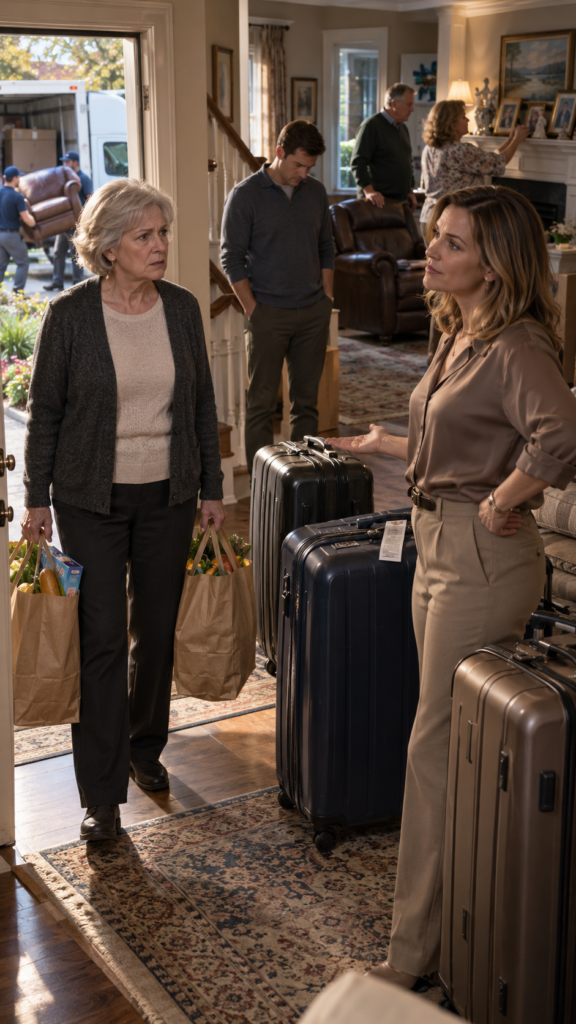
Before I even stepped out of the car, two strangers were carrying someone else’s furniture through my front door—and my late husband’s flower bed had already been damaged by luggage nobody had asked permission to bring inside.
I sat behind the wheel with the engine running.
I knew that leather armchair wasn’t mine. I knew those suitcases weren’t mine. And somehow, before anyone explained anything, I knew a decision about my home had been made without me.
At sixty-seven, I had lived in that quiet suburb outside Philadelphia long enough for every room to hold a memory. That afternoon, I had only gone grocery shopping. Apples. Bread. Coffee. Ingredients for chicken soup.
Instead, I walked into my foyer carrying two grocery bags and found three enormous suitcases on the hardwood floor.
My daughter-in-law, Sarah, stood in the middle of everything.
“Take that straight into the living room,” she told one of the movers. “We cleared out plenty of space.”
We.
The word landed harder than it should have.
Then Sarah noticed me.
“Martha, there you are. My parents are having major issues with their apartment. They’re moving in here for a while. There’s plenty of room, and hey—we’re family, right?”
I looked past her.
Her mother, Linda, was already moving my porcelain figurines across the mantel so she could display her own photographs. Her father, Bill, stood beside my late husband’s recliner, surveying the room as though deciding where his television belonged.
And beside the staircase stood my son.
Lucas had his father’s height, his gentle eyes, and the same instinct to retreat whenever confrontation entered a room.
He stared at the floor.
He didn’t apologize.
He didn’t tell me they should have asked.
Most painfully, he didn’t remind anyone that this was still my house.
I waited until Lucas finally looked at me.
His eyes held mine for barely a second.
Then he looked away.
Something inside me changed.
Not into rage.
Into clarity.
Years earlier, after Lucas and Sarah married and money became tight, I had allowed them to live in the finished upstairs suite. They contributed a modest amount toward utilities—nothing close to actual rent.
I had called it helping family.
Sarah seemed to have interpreted my generosity differently.
“You don’t have to change a thing, Martha,” she said with a small, reassuring smile. “We’ve got this handled.”
I glanced into my living room.
Two of my chairs had been shoved into a corner. My blue rug was rolled halfway back. Linda’s beach photographs covered my coffee table. Bill had settled near the fireplace with the comfortable posture of someone who already belonged there.
I placed my groceries on the kitchen counter.
“I see,” I said.
Sarah blinked.
She had been prepared for anger. Tears, perhaps. An argument she could dismiss as an older woman being difficult.
My calm unsettled her more.
I quietly put the milk into the refrigerator.
Nobody in that house understood that my silence was not surrender.
If they had decided the rules of my home no longer mattered, I would need to understand exactly what I could control.
So while everyone remained upstairs rearranging my life, I walked into the basement.
The familiar smell of cedar and old paint surrounded me. My husband’s tools still hung exactly where he had left them, carefully labeled and maintained.
On the far wall was the breaker panel.
I opened it.
His handwriting remained beside every switch.
Kitchen.
Living room.
Upstairs suite.
Main bedroom.
Garage.
My fingers rested against the metal edge of the panel.
I touched nothing.
I simply studied the labels until I knew exactly what I needed to know.
Then I closed the panel, went upstairs, washed my hands, and waited for dinner.
Except dinner wasn’t really dinner.
It was the moment I discovered just how far they believed they could go.
And what happened around that table made the moving van in my driveway seem almost polite. 👇
A fork scraped slowly across one of my dinner plates.
The sound seemed unusually loud.
I sat at the end of the table where my husband had once sat every Sunday morning with his newspaper folded beside his coffee. Lucas was across from me. Sarah sat beside him. Linda and Bill had taken the remaining places without asking.
The chicken soup I had planned never happened.
Sarah had ordered takeout instead.
Five white cartons covered the table, along with plastic containers of rice and sauce. My groceries remained untouched in the refrigerator.
Bill reached across the table for another carton.
“This room could use a bigger table,” he said.
I looked at him.
He was studying the space behind me.
“Maybe one with leaves,” Linda added. “We had a beautiful dining set in storage, but Sarah said there probably wasn’t room.”
Sarah wiped the corner of her mouth with a napkin.
“We can make room.”
Lucas stopped chewing.
I watched him.
He knew.
Not what I was going to do. I did not know that myself yet.
But he knew that sentence had crossed another line.
I folded my napkin beside my plate.
“How long are you planning to stay?”
Nobody answered immediately.
Linda glanced at Sarah.
Bill kept eating.
Sarah finally gave a little laugh.
“Martha, they just got here.”
“That wasn’t my question.”
Her smile tightened.
“The apartment situation is complicated.”
“How long?”
“A few months, probably.”
Bill looked up.
“Could be longer.”
Lucas’s fork stopped halfway to his mouth.
I turned toward him.
“Did you know that?”
His shoulders lowered.
“Mom—”
“Did you?”
Sarah answered for him.
“We discussed it.”
I kept looking at my son.
“That wasn’t what I asked.”
Lucas set down his fork.
“Yes.”
One word.
Quietly spoken.
Still, it changed the room.
“You knew your wife intended to move her parents into my house for months.”
“I knew they were having trouble.”
“And you knew they were coming here.”
He rubbed his thumb along the edge of his plate.
“Yes.”
“How long have you known?”
“About two weeks.”
I felt something sharp move through my chest, but my voice remained steady.
Two weeks.
For fourteen days, my son had eaten at my table, passed me in hallways, asked whether I needed anything from the store, and watched me water roses planted by his father.
Not once had he told me strangers would soon be carrying furniture through my door.
Linda shifted uncomfortably.
Sarah did not.
She leaned back.
“I think we need some perspective here. They’re my parents. You let us live here.”
“Yes.”
“So why would this be different?”
“Because I invited you.”
Silence.
Sarah’s face changed almost imperceptibly.
“That seems like semantics.”
“No,” I said. “It seems like ownership.”
Bill pushed his carton away.
“Oh, come on.”
I turned toward him.
He gave me the impatient look of a man accustomed to having his irritation treated as authority.
“Nobody’s trying to steal your house.”
“I didn’t say anyone was.”
“Then what are we doing here?”
“I’m asking how four adults decided where two people would live without consulting the person who owns the property.”
Sarah exhaled sharply.
“There it is.”
“There what is?”
“The ownership thing.”
I stared at her.
She continued.
“You always do that when you feel threatened. This is your house. Your kitchen. Your furniture. Your rules.”
I almost smiled at the absurdity of it.
“Yes, Sarah. Those are generally things a homeowner gets to say.”
Linda lowered her eyes.
Bill muttered something beneath his breath.
Lucas remained motionless.
Then Sarah said the sentence that changed everything.
“Well, maybe that needs to change.”
The refrigerator hummed behind us.
Somewhere outside, a car passed over wet pavement.
I could hear the faint ticking of the clock in the hallway.
“What needs to change?”
Sarah looked directly at me.
“This arrangement. You having final say over everything because your name happens to be on some paperwork.”
Lucas turned toward her.
“Sarah.”
She ignored him.
“We live here too. We contribute. We take care of things. At some point, this stopped being just your house.”
I looked at my son.
He had gone pale.
“Is that what you believe?”
“Mom, that’s not what I—”
“I asked you.”
He swallowed.
“No.”
Sarah stared at him.
“Seriously?”
Lucas looked between us.
“I said we should talk to Mom first.”
“You also said she’d never agree.”
“That doesn’t mean we get to decide for her.”
For the first time that day, something resembling uncertainty appeared on Sarah’s face.
It lasted only a second.
Then she stood.
“This is ridiculous.”
“So sit down,” I said.
She froze.
My voice had not risen.
Perhaps that was why she sat.
I placed both hands flat on the table.
“Tomorrow morning, your parents’ furniture leaves my house.”
Linda inhaled.
Bill’s chair shifted hard against the floor.
“You can’t throw us onto the street,” he said.
“I’m not throwing anyone anywhere. You arrived today without my permission. You can arrange a hotel, storage, another apartment, relatives, or whatever solution you would have arranged if my house had not existed.”
Sarah shook her head.
“They have nowhere else.”
“Then you should have discussed that with me before the moving van arrived.”
“Martha—”
“No.”
The word came out softly.
I looked at all four of them.
“For years, I have confused being generous with never requiring anyone to respect a boundary. That was my mistake. I’m correcting it now.”
Sarah stood again.
This time she walked away.
Her footsteps struck the staircase one after another.
A bedroom door slammed overhead.
Bill followed.
Linda remained seated for several seconds, staring at her hands.
Then she whispered, “I’m sorry about the figurines.”
It was the first apology anyone had offered me all day.
She left the room.
Lucas and I were alone.
Neither of us moved.
Finally he said, “Mom.”
I looked at him.
His eyes were wet.
“I messed this up.”
“Yes.”
The answer hurt him.
I saw it.
I also knew that protecting him from the truth was part of how we had arrived here.
He looked down.
“I kept thinking I could fix it before it reached you.”
“How?”
“I don’t know.”
“That’s not fixing something, Lucas. That’s hiding from it.”
His jaw tightened.
For one fleeting second, I saw his father in his face.
Not the gentle part.
The ashamed part.
My husband had once told Lucas when he was sixteen, after the boy had dented our car and hidden it beneath a tarp, that fear became dishonesty when you let someone else pay for your silence.
I wondered whether Lucas remembered.
He did.
“I know what Dad would say.”
My throat tightened.
“Then perhaps you should listen to him.”
I stood, gathered the untouched containers, and placed them in the refrigerator.
Lucas remained at the table.
That night, I locked my bedroom door.
I had never done that before.
The click of the latch sounded strangely final.
I slept badly.
At 6:12 the next morning, voices woke me.
Sarah was downstairs.
She was on the phone.
I pulled on my robe and opened my bedroom door.
Her voice drifted up from the foyer.
“No, Saturday is still happening.”
A pause.
“Yes, here.”
Another pause.
“Everything’s fine. Martha’s just adjusting.”
I stopped on the stairs.
Saturday.
Sarah turned.
The phone remained against her ear.
For half a second, neither of us spoke.
Then she said into the phone, “I’ll call you back.”
She disconnected.
“What’s Saturday?”
Her expression closed.
“Nothing.”
“What is Saturday?”
“A little gathering.”
“In my house?”
She crossed her arms.
“My parents have had a horrible month. Mom wanted some friends around.”
“How many?”
“I don’t know.”
“Sarah.”
“Twenty, maybe.”
I almost laughed.
Not because it was funny.
Because something inside me had finally reached the end of disbelief.
“You invited twenty people to a housewarming party.”
She flinched at the phrase.
“That’s not what it is.”
“What are they warming, Sarah?”
She said nothing.
“My house?”
Her lips pressed together.
Then she made the mistake of becoming angry.
“You know what? Yes. Fine. They wanted to feel welcome somewhere. Is that such a crime?”
“No. But apparently asking the homeowner is.”
“You keep saying homeowner like it makes you queen.”
“No. It makes me the person whose permission you needed.”
She stared at me.
Then her gaze hardened.
“You’re enjoying this.”
That stopped me.
“Enjoying what?”
“Having power.”
I stepped down the last stair.
“No, Sarah. I enjoyed having a family in my home. I enjoyed believing you understood why I opened it to you.”
Her expression flickered.
I continued.
“But you didn’t want generosity. You wanted access without accountability.”
Lucas appeared behind her.
He had heard enough.
“Cancel the party,” he said.
Sarah spun toward him.
“What?”
“Cancel it.”
“You’re taking her side?”
“I’m taking responsibility for something I should have stopped two weeks ago.”
She laughed once, without humor.
“Of course.”
Linda appeared in the hallway.
Bill came behind her.
The house suddenly felt crowded in a way square footage could not explain.
Sarah pointed toward Lucas.
“Your mother has controlled you your entire life.”
Lucas went still.
I said nothing.
He needed to answer that himself.
“No,” he said eventually. “She’s rescued me my entire life.”
Sarah’s face changed.
“And I let that become something I expected,” he continued. “Then I let you expect it too.”
“You’re unbelievable.”
“No. I’ve been a coward.”
That word silenced everyone.
Lucas looked at me.
“I should have told you. I should have stopped the movers at the driveway. I didn’t because I knew Sarah would be angry, and I decided it was easier if you were hurt instead.”
I could not speak.
There are apologies that ask to be forgiven.
This one did not.
That was why I believed it.
Sarah’s eyes filled, but anger held the tears in place.
“So what now?”
Lucas looked at her.
“Your parents find somewhere else to stay.”
“And us?”
He hesitated.
That hesitation mattered.
I walked into the kitchen.
When I returned, I carried a folder.
I had retrieved it from the small fireproof box in my bedroom closet.
Sarah stared at it.
“What’s that?”
“The answer to your question.”
Inside were copies of the deed, property tax records, insurance documents, and the written household agreement Lucas and Sarah had signed when they moved in.
It was simple.
Their monthly payment was described as a contribution toward household expenses.
Not rent.
No ownership interest.
No transfer.
No promise of permanent residence.
Sarah read the first page.
Then the second.
Her face slowly lost color.
“You kept this?”
“Of course I kept it.”
Bill leaned over her shoulder.
“This doesn’t mean you can just put family out.”
I looked at him.
“You’ve been here less than twenty-four hours.”
He stepped back.
But Sarah kept reading.
And then I noticed something.
Her hand had begun to tremble.
Not with anger.
Fear.
Lucas noticed too.
“What?”
Sarah closed the folder.
“Nothing.”
He reached for it.
She pulled it away.
“Sarah.”
“It’s nothing.”
Linda suddenly sat down.
The movement was so abrupt that all of us looked at her.
She covered her mouth.
Bill said, “Linda.”
But she was staring at her daughter.
“You told us.”
Sarah’s face went rigid.
“Mom.”
“You told us the house was going to be yours.”
Nobody moved.
Lucas’s eyes shifted toward Sarah.
“What?”
Linda’s voice broke.
“You said Martha had already agreed.”
Sarah stared at her mother.
Bill stepped forward.
“Linda, stop.”
“No.”
She shook her head.
“No, Bill. I am not doing this.”
She looked at me.
The shame in her face was unmistakable.
“She told us you were transferring the house to them. She said it had basically been settled. That you wanted to downsize eventually and Lucas would inherit it anyway.”
The room became so quiet that I could hear the refrigerator compressor switch off.
I looked at Sarah.
She could not meet my eyes.
Lucas whispered, “Tell me she’s wrong.”
Sarah said nothing.
“Tell me.”
“I was trying to solve a problem.”
“What problem?”
“My parents were losing their apartment!”
Linda flinched.
Lucas stared at his wife.
“So you told them Mom was giving us her house?”
“I said it would eventually be ours.”
“That is not the same thing.”
“It will be yours someday!”
I felt something cold move through me.
Lucas recoiled as though she had struck him.
“She’s standing right there.”
Sarah’s breath caught.
“I didn’t mean—”
“Yes, you did,” I said.
She looked at me.
“You were making plans around my death.”
“No.”
“You were treating my home as an inheritance that arrived early because waiting for me to die was inconvenient.”
Her face crumpled.
For a moment, she looked younger.
Then Linda spoke again.
“There’s more.”
Sarah turned sharply.
“Mom.”
Linda reached into her purse.
Bill grabbed her wrist.
“Enough.”
I watched Linda look down at his hand.
Then at him.
“Let go.”
Something passed between them.
A history I did not understand.
Bill released her.
Linda removed her phone.
She opened an email.
“I thought this came from Martha’s lawyer.”
My stomach tightened.
She handed the phone to me.
The email contained no forged signature, no official document, nothing elaborate enough to be criminally clever.
But it contained Sarah’s words.
She had told her parents that I had “approved the long-term family plan,” that the property would remain “with Lucas and us,” and that Linda and Bill could safely end their current lease arrangement because housing was “handled permanently.”
Lucas read it over my shoulder.
His face seemed to collapse inward.
“When did you send this?”
“Lucas—”
“When?”
“Three weeks ago.”
“Before you told me they were coming.”
Sarah did not answer.
He walked away from her.
Just three steps.
But those three steps changed their marriage.
Sarah followed.
“I panicked. They were going to lose the apartment.”
“Why?”
Nobody answered.
Lucas looked at Linda.
She lowered her head.
Bill’s face hardened.
And suddenly I understood that the apartment problems had never been explained.
“What happened?” I asked.
Linda’s eyes filled.
Bill said, “It’s private.”
“You moved into my home because of it. It stopped being private yesterday.”
Linda closed her eyes.
Then she said, “We stopped paying the rent.”
Sarah whispered, “Mom.”
“For three months.”
Lucas stared.
“Why?”
Linda looked toward Bill.
He turned away.
She gave a small, exhausted shake of her head.
“Bill took money from our savings to cover debts I didn’t know about.”
Bill’s shoulders stiffened.
“They were investments.”
“They were losses.”
“I was going to recover it.”
“You said that the first time.”
The first time.
Sarah sat down.
Apparently even she had not known everything.
Linda continued, each sentence seeming to cost her something.
“They were behind before Sarah offered this house. I thought we had time. Then I found the notices.”
Bill snapped, “We don’t need to discuss our finances with these people.”
These people.
In my kitchen.
After sleeping under my roof.
Linda looked at him.
“No. You don’t get to decide what I’m allowed to say anymore.”
Bill’s mouth opened.
Nothing came out.
The power in the room shifted so quietly I almost missed it.
Linda turned to me.
“I’m sorry.”
She held my gaze.
“I should have called you. Even if I believed Sarah, I should have thanked you. I should have heard your voice before I let movers touch your things.”
Her eyes dropped.
“And yesterday, when I saw your face, I knew.”
I remembered the figurines.
Her apology at dinner.
“You knew I hadn’t invited you.”
“Yes.”
“Why didn’t you leave?”
She pressed her lips together.
“Because I was afraid.”
That answer I understood.
Not excused.
Understood.
I looked at Bill.
“And you?”
He crossed his arms.
“We’re not begging.”
“No one asked you to.”
“You want us humiliated.”
“I want my home back.”
His jaw worked.
“Same thing.”
“No, Bill. Humiliation is what happens when pride matters more to you than the people forced to carry its consequences.”
He stared at me.
For once, he had no reply.
I turned to Sarah.
“You and Lucas will also move out.”
Lucas’s head lifted.
Sarah went completely still.
“Mom,” Lucas said.
“I love you.”
My voice almost broke.
I steadied it.
“But this arrangement is over.”
Sarah laughed shakily.
“You can’t be serious.”
“I have never been more serious.”
“Where are we supposed to go?”
“That is a question two thirty-five-year-old adults can answer.”
“We can’t afford—”
“Then your life will have to become smaller until you can.”
Her eyes flashed.
“You’d really do this to your own son?”
I looked at Lucas.
“No. I’m finally going to stop doing things for him that he needs to learn to do himself.”
Lucas closed his eyes.
Then he nodded.
“Okay.”
Sarah spun toward him.
“Okay?”
“Yes.”
“You’re just accepting this?”
“It’s her house.”
Sarah stared at him as if he had spoken another language.
He looked at me.
“How long?”
“Thirty days.”
He nodded again.
“I’ll find something.”
Sarah pushed away from the table.
“No.”
She grabbed her purse.
“No. Everybody has lost their minds.”
She walked toward the stairs.
Lucas did not follow.
At the bottom step she turned.
“Aren’t you coming?”
He looked at her.
“No.”
Her face hardened.
Then she went upstairs alone.
The party was canceled that morning.
The moving company returned that afternoon.
Bill watched his armchair travel back through my front door with a bitterness that made his entire body rigid.
Linda carried her own photographs from the mantel.
Before leaving the living room, she carefully returned each porcelain figurine to where she remembered finding it.
One was facing backward.
I reached past her and turned it around.
Neither of us spoke.
Linda and Bill moved into an extended-stay hotel.
They did not move together for long.
Three days later, Linda called me.
Her voice sounded small.
“I left him.”
I sat at my kitchen table.
Outside, rain tapped softly against the windows.
“Are you safe?”
“Yes.”
That was all I asked first.
She told me Bill had continued insisting that his financial losses could be recovered if she gave him access to what remained of their savings.
She had refused.
For the first time in forty-one years of marriage, she had opened an account in her own name.
“I should have done it years ago,” she whispered.
“Perhaps.”
There was silence.
“Or perhaps you did it when you were finally ready.”
She cried then.
Quietly.
I let her.
Sarah blamed me.
Not directly at first.
She blamed the moving van, her parents, Bill’s debts, Linda’s decision, Lucas’s weakness, the housing market, the cost of apartments.
Everything except herself.
For two weeks, she barely spoke to me.
Cardboard boxes accumulated upstairs.
Lucas went to work, came home, packed, and searched apartment listings late into the night.
One evening, I found him sitting on the back porch.
My husband’s old sweatshirt was around his shoulders.
He had found it in a storage box.
“You remember this?” he asked.
I sat beside him.
“Your father wore it until the cuffs nearly disappeared.”
Lucas smiled.
Then the smile faded.
“I found an apartment.”
“Good.”
“One bedroom.”
“Good.”
“It’s small.”
“Your first bedroom was small.”
He glanced at me.
“I was a baby.”
“You complained less then.”
He laughed.
It was the first uncomplicated sound I had heard from him in weeks.
Then he rubbed both hands over his face.
“Sarah doesn’t want to go.”
“I know.”
“She says if we leave, you win.”
I looked out toward the garden.
The roses were finally opening.
“This isn’t a competition.”
“I told her that.”
“And?”
“She said that’s exactly what someone says when they’re winning.”
I sighed.
Lucas leaned forward.
“I don’t know who I married anymore.”
“You do.”
He looked at me.
“You’re simply seeing parts of her you spent years avoiding.”
His eyes lowered.
“That sounds worse.”
“It is also more useful.”
For a while, we listened to the evening insects.
Then Lucas said, “I blamed Dad.”
“For what?”
“For never teaching me how to fight.”
I turned toward him.
“He did.”
Lucas frowned.
“He just didn’t teach you to shout.”
The porch light caught the moisture in his eyes.
“Your father could be afraid and still tell the truth. You inherited the fear. The rest is something you have to practice.”
Lucas swallowed.
“I hurt you.”
“Yes.”
“I knew Sarah was wrong, and I let you stand there with those groceries like you were the intruder.”
My throat tightened.
“I keep seeing your face.”
I reached for his hand.
Not to erase what he had done.
Just to remind him that love could survive being honest about it.
“I forgive you,” I said.
He looked at me sharply.
“But forgiveness is not the same as returning to the way things were.”
He nodded.
“I know.”
“Good.”
His fingers closed around mine.
“I don’t want the old way back.”
The final confrontation came nine days before their deadline.
I was in the living room when Sarah walked downstairs carrying the folder from the kitchen table.
My folder.
She placed it in front of me.
“I spoke to someone.”
I looked up.
“About what?”
“My rights.”
Lucas appeared behind her.
His face told me he had not known.
Sarah continued.
“We’ve lived here for years. We’ve contributed financially. You cannot simply pretend that means nothing.”
“I never said it meant nothing.”
“You’re evicting us.”
“I gave you thirty days voluntarily. If formal procedures become necessary, I will follow them.”
Her confidence faltered.
Apparently whoever she had spoken to had told her something similar.
Then she said, “Lucas put money into this house.”
Lucas frowned.
“What?”
“The upstairs.”
“That was Mom’s money.”
“You painted it.”
He stared at her.
“I painted two rooms.”
“You maintained the property.”
“I mowed the lawn.”
Sarah’s voice rose.
“You contributed!”
“So did Mom. She paid for everything.”
I watched Sarah’s face.
Desperation had stripped away the polished certainty she usually wore.
Then Lucas asked quietly, “What are you trying to do?”
She looked at him.
“Protect us.”
“From my mother?”
“From being left with nothing.”
His expression changed.
“Nothing?”
“We have no house. Hardly any savings. Your mother has all this and—”
“And what?”
Sarah stopped.
Lucas waited.
“And someday it comes to you anyway,” she finished.
There it was again.
The sentence she could not stop believing.
Lucas stared at her for a long time.
Then he walked to the fireplace.
He placed one hand on his father’s old mantel.
“When Dad died, Mom let us move in because I was scared.”
Sarah said nothing.
“She gave us years to recover.”
His voice trembled.
“And instead of recovering, I got comfortable.”
He turned.
“You did too.”
“Lucas—”
“No. Listen.”
She went silent.
“This house is not my delayed property. It is not our retirement plan. It is not something we get because Mom is older than us.”
Sarah’s mouth tightened.
“You’re choosing her.”
“I’m choosing to stop pretending love means entitlement.”
She looked as if she had been slapped.
Then her face collapsed.
Not theatrically.
Quietly.
She sat down.
“I was terrified.”
Lucas did not move toward her.
“Of what?”
“Being poor again.”
The words came out barely audible.
She stared at the floor.
“My parents fought about money my entire childhood. Lights got shut off. We moved twice because rent wasn’t paid. Mom hid grocery money. Dad always had some plan that was going to fix everything.”
She wiped at her cheek angrily.
“When we moved here, I thought it was temporary. Then I realized what it felt like not to be afraid every month.”
Her eyes found mine.
“And I started thinking if this house became ours, I would never have to feel that way again.”
For the first time, I saw the shape beneath her greed.
Fear.
Old, untreated, carefully dressed fear.
It did not undo what she had done.
But it made her human again.
“You tried to cure your fear by taking away my security,” I said.
She closed her eyes.
“Yes.”
The word was almost soundless.
Lucas sat opposite her.
“Why didn’t you tell me?”
“Because you would have told me I was becoming my father.”
From the doorway came another voice.
“You were.”
Linda stood there.
None of us had heard her enter.
She had come to collect the last box she had stored upstairs.
Sarah stared at her.
Linda stepped into the room.
“But so was I.”
Sarah’s expression cracked.
Linda sat beside her daughter.
“I taught you that security meant finding someone else’s roof and holding on to it. Your father taught you that admitting fear meant losing.”
Sarah began crying.
Linda took her hand.
“I’m sorry.”
Sarah looked at her mother.
“For what?”
“For letting you grow up believing a house could save you.”
The room remained still.
Linda squeezed her fingers.
“People save themselves by telling the truth before the lie becomes their home.”
Sarah covered her face.
That was the moment her power broke.
Not when I showed her the deed.
Not when the movers returned.
Not when Lucas refused to defend her.
It broke when she could no longer turn what she had done into something righteous.
Three days later, Sarah signed a lease with Lucas on the one-bedroom apartment.
They moved out on a cool Saturday morning.
There was no party.
No shouting.
No final threat.
Just cardboard boxes, the scrape of furniture, and two exhausted adults carrying their own belongings toward a rented truck.
Before leaving, Sarah stood in the foyer.
The pale scrape from her parents’ suitcase was still visible on the hardwood.
She looked at it.
“I’ll pay to have that fixed.”
“You don’t need to.”
“I know.”
She met my eyes.
“That’s why I want to.”
I nodded.
“All right.”
She hesitated.
“I am sorry, Martha.”
I waited.
She swallowed.
“Not because this ended badly for me.”
That mattered.
“I’m sorry because I walked into your life and started measuring what would someday be mine.”
Her voice shook.
“You were alive, and I treated your future like an inconvenience.”
I felt tears rise.
She continued.
“I don’t expect you to trust me.”
“Not yet.”
She nodded.
“Not yet.”
Then she picked up her last box.
Lucas hugged me outside.
For several seconds, he held on like the boy who used to run to me after nightmares.
Then he released me.
“I’ll call Sunday.”
“You can call Saturday too.”
He smiled.
“I might.”
Their taillights disappeared beyond the maple trees.
I stood in the driveway until the street became quiet.
Then I went inside.
The silence was enormous.
For the first few hours, it hurt.
I walked from room to room seeing absences.
No shoes by the stairs.
No television upstairs.
No voices through the ceiling.
The living room seemed larger.
My husband’s recliner was empty again.
I sat in it.
That was when I cried.
Not because they were gone.
Because I finally understood how long I had been arranging my entire life around preventing other people from feeling discomfort.
I had thought that was love.
Sometimes it was.
Sometimes it was fear wearing love’s clothes.
The next morning, I made chicken soup.
The ingredients from that first grocery trip were gone, of course. I bought new ones.
I chopped carrots beside the window.
Steam clouded the glass.
I carried one bowl onto the back porch and ate while looking at the roses.
Nobody interrupted.
Nobody asked for anything.
The quiet no longer felt empty.
It felt like space.
Over the following months, Lucas changed in ways no speech could have accomplished.
He and Sarah paid their own rent.
They budgeted.
They stopped ordering food whenever cooking felt inconvenient.
Lucas learned how much electricity cost when the bill had his name on it.
He called me one evening and said, “Dad would be laughing at me.”
“Why?”
“I walked through three rooms turning off lights.”
I smiled.
“He would be proud.”
Sarah started counseling.
She told me that herself, months later, when she asked if she could come over for coffee.
We sat at the kitchen table.
She did not arrive with Lucas.
That mattered too.
“I keep wanting to explain myself,” she said.
“Then don’t.”
She looked surprised.
“Try listening to what you did without immediately telling yourself why.”
Her eyes lowered.
“That’s harder.”
“Yes.”
She nodded.
Then she listened.
So did I.
Rebuilding trust did not happen in a single conversation.
There were awkward Sundays.
There were moments when Sarah became defensive and stopped herself.
There were moments when I wanted to punish her with old facts and stopped myself.
Lucas learned to speak before resentment had time to become silence.
Linda found a small apartment twenty minutes away.
She furnished it slowly.
The first thing she bought was a blue armchair.
Not Bill’s leather one.
Her own.
She placed it beside a window.
When I visited, she laughed and said, “Nobody gets to decide where this chair goes but me.”
Bill’s story ended differently.
Linda filed for legal separation and protected what remained of her savings.
Without her money and without my house, Bill could no longer disguise financial recklessness as a temporary setback somebody else would absorb.
He moved into a modest rental and sold several things to settle debts.
He called Linda repeatedly at first.
Then Sarah.
Then Lucas.
Nobody gave him money.
That was his irreversible consequence.
Not ruin.
Responsibility.
For perhaps the first time in his adult life, there was no woman standing between him and the cost of his own choices.
By spring, the scrape in my foyer had been repaired.
Sarah paid for it.
I kept the receipt.
Not because I intended to use it against her.
Because it represented the first thing she had broken in my home and repaired without being forced.
Then, one Sunday in May, Lucas arrived carrying a small wooden box.
I recognized it immediately.
It had belonged to his father.
“Where did you find that?”
“In our storage unit.”
He placed it on the kitchen table.
“I thought it was tools.”
My hands began trembling before he opened it.
Inside were envelopes.
Dozens of them.
My husband’s handwriting covered the fronts.
Some had dates.
Some had names.
One simply said Martha.
I sat down.
Lucas did too.
“I haven’t opened yours.”
My fingers rested on the envelope.
My husband had been gone for years.
Yet suddenly the room seemed full of him.
I opened it carefully.
The letter was short.
He had written it during the final months of his illness.
He told me he knew I would try to keep everyone together after he was gone.
He knew I would open the house to Lucas if our son ever needed somewhere to land.
Then came the sentence that stopped me.
Martha, promise me you will remember that giving someone a place to land does not mean you have to give them the ground beneath your feet.
I pressed my hand against my mouth.
Lucas stared at me.
“What?”
I handed him the letter.
He read it.
His eyes filled.
Then he laughed once through his tears.
“He knew.”
“Yes.”
“He knew us.”
I looked toward the back porch.
The roses beyond the window moved gently in the May breeze.
Then Lucas removed another envelope.
His name was written across it.
He opened it.
His father’s message to him was longer.
Lucas read silently for several minutes.
At the end, his shoulders began shaking.
I moved beside him.
He handed me the final paragraph.
If your mother ever helps you after I am gone, never confuse her strength with an obligation to carry you. Build something of your own, even if it is small. Stand beside the people you love, not behind them. And when you are afraid, tell the truth before someone else has to pay for your silence.
I could barely see the words by the end.
Lucas covered his face.
“I remembered part of this.”
“What?”
“He told me something like it at the hospital.”
He looked up.
“I thought I dreamed it.”
I touched his cheek.
“You didn’t.”
That was the beautiful truth hidden beneath everything.
My husband had not left us instructions for preserving the house.
He had left us permission to change.
By summer, Sunday dinners returned.
But differently.
Lucas and Sarah did not live upstairs.
Linda did not assume she could stay.
Everyone knocked.
Everyone asked.
Everyone brought something.
The first Sunday Sarah came carrying a pot of chicken soup.
I looked at it and laughed.
“What?”
“You have no idea.”
She smiled.
“Apparently not.”
We ate outside.
Linda brought bread.
Lucas burned the vegetables on the grill and insisted they were “charred.”
Sarah teased him.
He teased her back.
Then he reached across the table and took her hand.
There was tenderness between them again.
Different tenderness.
Less dependent.
More honest.
Their apartment remained small.
They stayed there even after their finances improved.
One afternoon Lucas told me they had begun saving for a down payment.
“On your own house?”
“Our own house.”
The distinction warmed me.
Sarah added, “A small one.”
“Small houses can hold good lives.”
She smiled.
“I’m starting to understand that.”
Later that year, they bought one.
Two bedrooms.
A narrow kitchen.
A little patch of yard.
Nothing grand.
The first time I visited, Sarah met me at the door.
For half a second, neither of us moved.
Then she stepped aside.
“Welcome to our home, Martha.”
Our home.
This time the words did not take anything from me.
I entered.
Lucas was hanging a picture crookedly in the hallway.
I stared at it.
He sighed.
“Dad would have fixed it already.”
“Your father would have made you fix it.”
Lucas handed me the level.
I handed it back.
“Exactly.”
He laughed.
Sarah laughed too.
And I realized something simple.
A boundary had not destroyed our family.
It had given us the chance to become one without consuming each other.
That evening I drove back through the same tree-lined streets where, months earlier, I had returned from grocery shopping and found a moving van blocking my garage.
My house appeared between the maples.
Quiet.
Warm.
Mine.
I parked in the driveway.
The flower bed my husband had built had recovered from the damage. New growth covered the place where the suitcase wheels had crushed the edge.
I went inside and switched on one lamp.
The porcelain figurines remained on the mantel.
My blue rug lay flat beneath the coffee table.
My husband’s recliner sat beside the fireplace.
And on the small table next to it was his letter.
I walked to the basement one last time.
Cedar.
Old paint.
Tools hanging in neat rows.
I opened the breaker panel.
Kitchen.
Living room.
Upstairs suite.
Main bedroom.
Garage.
His handwriting.
I smiled.
Then I closed the metal door without touching a single switch.
I had once gone down there because I needed to know what power I still possessed.
Now I understood that the most important switch had never been inside that box.
It had been the moment I stopped mistaking silence for peace.
I returned upstairs.
The evening light was fading across the living room.
My phone buzzed.
A photograph from Lucas.
He and Sarah stood in front of their little house, paint on their clothes, smiling beside a newly planted rosebush.
Underneath, Lucas had written:
Dad’s variety. Found one.
I stared at the picture until my eyes blurred.
Then another message appeared.
Sunday at ours. We’ll cook. You just bring yourself.
I smiled.
For years, I had believed keeping my family close meant keeping the doors open no matter how people entered.
I knew better now.
A home was not loving because nobody was ever asked to leave.
A home was loving because the people inside it understood that belonging could never be taken by force.
I set the phone beside my husband’s letter and opened the back door.
The roses moved softly in the evening air.
I stepped onto the porch, sat beneath the fading gold light, and listened as my house settled quietly around me—not empty, not lonely, but peaceful at last.
And for the first time since my husband died, I did not feel like the only person left guarding our home.
I simply felt home.