The first sign that something was wrong wasn’t the packed SUV at my curb. It was the way my daughter-in-law stepped onto my property as though she had already decided my home belonged to her.
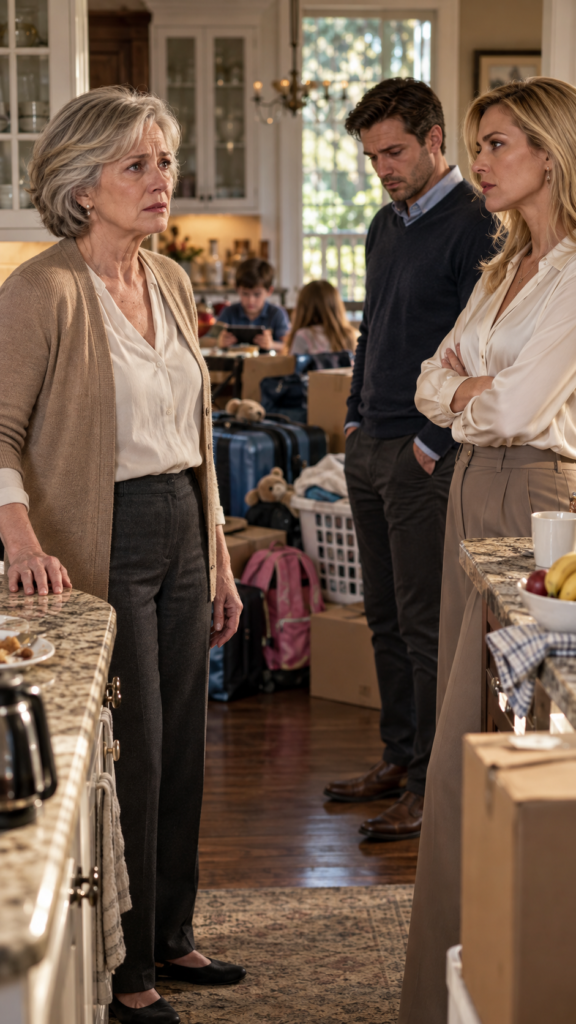
By the next morning, I was expected to cook breakfast, wash dishes, watch the children, and provide a free place to live. When I refused, they called me selfish.
My house sits on a quiet, tree-lined street outside Charleston, South Carolina, where old live oaks bend over the road and the evenings settle gently over brick homes and deep porches.
At sixty-eight, I had built my life around that quiet.
My mornings smelled of coffee, lemon oil, old books, and herbs clipped fresh from the garden. Some days I ate toast standing over the sink. Other mornings, I set the table properly simply because I could.
After forty years of work, marriage, motherhood, widowhood, and family emergencies, I had finally earned the freedom to move through my own home at my own pace.
Then Tuesday evening came.
I was reading in the living room when tires scraped hard against the curb outside.
Not the careful arrival of someone dropping by.
A rushed stop.
I lowered my book and looked through the lace curtain.
Julian’s SUV sat in front of my house, packed almost to the roof. Cardboard boxes crowded the cargo area. Suitcases were wedged beneath a laundry basket. Backpacks hung from the passenger seat.
My grandchildren sat in the back, exhausted and restless, their faces illuminated by a tablet.
Then my son stepped out.
Julian looked drained, like a man who had spent hours driving beside an argument he couldn’t escape. His shoulders sagged as he stared toward the house.
Then Brooke opened the passenger door.
My daughter-in-law always carried herself with expensive precision. Blonde hair perfectly smoothed. Designer trench coat. Sunglasses resting in her hair despite the fading evening light.
But what unsettled me wasn’t how polished she looked.
It was what she didn’t look.
Embarrassed.
Apologetic.
Uncertain.
Brooke surveyed my driveway with irritation, as though my home had somehow inconvenienced her by not already being prepared for their arrival.
No one had called.
No one had asked whether they could stay.
Yet everything packed into that SUV told me this wasn’t a visit.
Within hours, the quiet rhythm of my house disappeared beneath suitcases, children’s belongings, half-open boxes, and expectations nobody had bothered to discuss with me.
By morning, those expectations had become demands.
Breakfast.
Clean dishes.
Childcare.
A roof over their heads.
And somehow, I was supposed to feel grateful for the privilege of providing all of it.
When I finally said no, the atmosphere changed.
Brooke looked at me as though I had violated some agreement I had never made. Julian didn’t defend me. Instead, the word selfish entered my own kitchen and landed between us like an accusation.
I stood there listening to them explain what family was supposed to mean.
Apparently, it meant my time belonged to them.
My house belonged to them.
My money belonged to them.
And my boundaries were merely obstacles they expected me to remove.
Something inside me became very still.
I didn’t scream.
I didn’t argue.
I simply began packing.
Then I drove toward the coast, leaving Charleston—and their assumptions—behind me.
For the first time since they arrived, I could hear myself think.
Later, with the evening light fading outside, I opened my banking app.
There were accounts attached to my name.
Bills I had quietly covered.
Conveniences Julian had stopped noticing because they had always worked.
My thumb hovered over the screen.
Then I made a decision.
By sunset, somewhere miles away, my son tried to use his gas card.
It was declined.
And that was only the first thing they were about to discover. 👇
My phone began vibrating against the wooden table before the sun had fully disappeared.
Julian.
I watched his name brighten the screen, disappear, then return less than thirty seconds later.
I let it ring.
The little cottage I had rented near the coast was nothing elaborate. Two bedrooms, faded pine floors, a screened porch, and windows that carried the salt smell of the marsh whenever the wind shifted. Somewhere beyond the dunes, waves broke with a steady rhythm that asked nothing from me.
The phone stopped.
Then Brooke called.
I turned it facedown.
For several minutes, there was only the ceiling fan clicking softly overhead and the sound of gulls outside.
Then a message appeared.
Mom, my card isn’t working. Call me.
Another followed.
We need groceries.
I stared at those three words longer than I expected.
We need groceries.
Not: Are you safe?
Not: Where did you go?
Not even: I’m sorry.
I opened my banking app again.
The gas card was only the beginning.
For years, small pieces of Julian’s life had remained attached to mine almost invisibly. His phone plan had never been separated after college. An emergency credit card I had given him when the children were babies had slowly become an ordinary household card. I had paid his vehicle insurance after he changed jobs, supposedly for three months, and somehow three months had become three years.
None of it had seemed dangerous when it happened one piece at a time.
That evening, seen together on one screen, it looked different.
It looked like a life partially financed by a woman he had just called selfish.
My finger moved carefully.
I did not cancel anything that would leave the children unsafe. I did not touch medical coverage or anything essential to them.
But the conveniences ended.
The extra card.
The streaming subscriptions.
The family phone upgrades billed through my account.
The automatic payment covering Julian’s insurance.
One by one, I removed myself.
Then I called the utility companies.
That was harder.
The Charleston house was mine, but Julian and Brooke were inside it with my grandchildren. I wasn’t going to shut off electricity or water around children to prove a point.
Instead, I ended the automatic payments scheduled beyond the current billing cycle and requested paper statements be sent directly to me.
Then I called my attorney.
Her name was Margaret Ellis, and she had handled my husband’s estate after he died.
She answered on the fourth ring.
“You’re calling me after seven,” she said. “That usually means either someone is dead or someone is behaving badly.”
Despite myself, I laughed.
“Nobody’s dead.”
“Then tell me who’s behaving badly.”
I told her.
Not dramatically.
That surprised me.
I simply described the SUV, the boxes, the assumptions, the childcare demands, Brooke’s expression, Julian’s silence, and the moment my own son had allowed me to be called selfish inside the house I had spent decades maintaining.
Margaret became very quiet.
“Did you invite them to move in?”
“No.”
“Did you give them permission to establish residence?”
“No.”
“Did you sign anything?”
“No.”
“Did you give either of them access to your financial documents?”
My hand stopped against the edge of the table.
“I don’t think so.”
Margaret heard the hesitation.
“That’s not the same answer.”
A cold sensation moved through me.
Before leaving Charleston, I had noticed that the door to my husband’s old study was open.
I kept tax records there.
Insurance documents.
The deed.
Bank statements.
Nothing had seemed disturbed, and at the time I had been too angry to examine the room closely.
“Margaret.”
“Yes?”
“I need to go home.”
“No. You need to stay where you are tonight.”
Her voice sharpened.
“Tomorrow morning, change every financial password you have. Then call your bank and put additional verification on the accounts. I’ll meet you at the house at ten.”
I looked toward the darkening windows.
“Why?”
“Because people who arrive with an entire household without asking usually made plans before they arrived.”
Sleep came in fragments.
At 2:13 in the morning, I woke to seventeen missed calls.
One voicemail was from Julian.
His voice sounded exhausted.
“Mom, this has gone too far. Brooke’s upset. The kids don’t understand where you went. Just call me so we can fix this.”
Fix this.
I listened again.
There was no apology.
At 7:05, another message arrived.
This one was from Brooke.
You can’t financially punish your own family because you’re having a tantrum.
I read it twice.
Then I deleted nothing.
Margaret had taught me that years ago during probate.
“Never destroy evidence because it hurts your feelings,” she’d said. “Feelings pass. Records remain.”
At ten minutes past ten the next morning, Margaret’s sedan pulled behind mine outside my Charleston house.
Julian’s SUV was in the driveway.
Boxes still crowded the porch.
My brass knocker was hidden behind a folded stroller.
For some reason, that bothered me more than almost anything else.
I climbed the steps.
Before I could unlock the door, Brooke opened it.
She was wearing one of my robes.
Not metaphorically.
My pale blue cotton robe.
For a moment, neither of us spoke.
Her gaze shifted past me to Margaret.
“Who is this?”
“My attorney.”
The color in Brooke’s face changed almost imperceptibly.
Julian appeared behind her.
“Mom, seriously?”
“Yes.”
I stepped inside.
The smell hit me first.
Burned toast. Sweet cereal. Coffee left too long on the warmer.
My living room looked as though someone had shaken a family out of a suitcase. Shoes beneath chairs. Toys across the rug. Jackets over the sofa. An open cardboard box sat on my husband’s walnut side table.
I walked toward the study.
Julian moved after me.
“Mom.”
I opened the door.
The top drawer of my filing cabinet was unlocked.
I always locked it.
My key was hidden inside an old porcelain jar on the highest shelf of the bookcase.
The jar had been moved.
Margaret saw it too.
“Don’t touch anything yet.”
Brooke folded her arms.
“This is ridiculous.”
I looked at her.
“Did you go through my files?”
“No.”
“Julian?”
He rubbed both hands over his face.
“No.”
Margaret walked closer to the desk without touching it.
“Then neither of you will mind if she checks.”
Brooke gave a short laugh.
“You brought a lawyer here because some papers moved?”
“No,” I said. “I brought a lawyer because you moved into my house without asking.”
The laugh vanished.
For the first time since she’d arrived, Brooke had nothing ready to say.
I unlocked the lower drawer.
The deed was there.
My insurance documents were there.
My husband’s estate folder was there.
Then I reached the folder containing recent property records.
It felt too thin.
I opened it.
A photocopy of the deed was missing.
Margaret’s eyes lifted to mine.
“Anything else?”
I checked the folder beside it.
Three recent bank statements were gone.
Julian stared at Brooke.
That was the moment I understood something he hadn’t told me.
He wasn’t surprised the papers were missing.
He was surprised I had noticed.
“Julian.”
He looked down.
Brooke spoke first.
“Oh, for God’s sake. We needed documents.”
“For what?”
Silence.
Margaret stepped beside me.
“For what, Brooke?”
Brooke’s jaw tightened.
“We were looking at options.”
“What options?”
Julian whispered her name.
“Brooke.”
She turned on him.
“What? We’re already here. She’s going to find out.”
My chest tightened.
“Find out what?”
Brooke looked directly at me.
“We were going to propose something that actually made sense for everyone.”
I waited.
She gestured around my house.
“This place is too much for one person.”
There it was.
Not concern.
Calculation.
“You don’t need four bedrooms,” she continued. “You don’t need this much property. We need stability. The children need good schools. Julian needs time to get back on his feet.”
I looked at my son.
“Back on his feet from what?”
His face collapsed.
Brooke closed her eyes.
“Julian.”
“Tell me.”
He sat down slowly in my husband’s desk chair.
“I lost my job.”
The room went silent.
Even Brooke seemed to stop breathing.
“When?”
“Six weeks ago.”
Six weeks.
I thought of every conversation we’d had.
Every time I had asked how work was going.
Every casual answer.
Busy.
Fine.
Same as always.
“You lied to me for six weeks.”
“I was going to tell you.”
“When? After moving into my house?”
He looked at his hands.
Brooke stepped closer.
“We had no choice.”
Margaret’s voice was calm.
“You had several choices. Asking was one of them.”
Brooke ignored her.
“Our lease ended. We couldn’t qualify for another place on one income, and Julian’s severance was almost gone. This house is sitting here with empty rooms.”
“Sitting here?”
My voice came out quieter than hers.
“This is where I live.”
Brooke’s mouth tightened.
“You’re one person.”
I felt something inside me close.
Not break.
Close.
A door I had apparently left open far too long.
Margaret asked, “What were the deed copies for?”
Julian stood.
“We weren’t stealing the house.”
“Then answer.”
Brooke did.
“We talked to a financial adviser about whether the house could help us.”
I stared at her.
“Help you how?”
“A home-equity arrangement. Maybe refinancing. There are options when a property has this much value.”
“You cannot refinance a house you don’t own.”
“We know that.”
“Then why take my documents?”
“We needed numbers before talking to you.”
Margaret’s expression hardened.
“You took private financial documents without permission to investigate borrowing against someone else’s property.”
Brooke scoffed.
“When you say it like that—”
“How else would you say it?”
Julian whispered, “Stop.”
But Brooke had spent too long believing confidence could substitute for permission.
She turned toward me.
“We were trying to solve a family problem while you were busy protecting your precious quiet.”
The words landed differently now.
I looked at Julian.
He still said nothing.
That silence hurt more than Brooke’s contempt.
“You knew?”
His eyes filled.
“I knew she was looking at possibilities.”
“Did you know she took the papers?”
A pause.
That was enough.
I nodded once.
Margaret touched my elbow.
“What do you want to do?”
Brooke answered for me.
“She’s not throwing her grandchildren onto the street.”
I looked at the toys scattered across my rug.
Then toward the hallway where the children were standing.
I hadn’t noticed them.
My granddaughter held her younger brother’s hand.
Neither spoke.
Every adult in the room became still.
I walked toward them.
I knelt despite the ache in my knees.
“Come here.”
They came immediately.
I wrapped my arms around both children.
“This is not your fault.”
My granddaughter whispered, “Are we homeless?”
Julian made a broken sound behind me.
I held her tighter.
“No, sweetheart. The grown-ups are going to figure out where everyone lives. You are safe.”
“Are you mad at us?”
“Never.”
I kissed her hair.
Then I stood.
The choice became clear.
“Julian, you and the children can stay here for thirty days.”
Brooke’s face changed.
“And me?”
I looked at her.
“You need to leave today.”
Julian stepped forward.
“Mom.”
“No.”
One word.
No anger.
No negotiation.
“You went through my private documents. You investigated using my house to solve problems you hid from me. You mocked me for wanting control of my own life. You will not sleep under my roof tonight.”
Brooke stared at Julian, waiting.
He looked at me.
Then at his children.
Then at his wife.
For perhaps the first time in years, nobody rescued him from making a decision.
Brooke grabbed her handbag.
“Fine.”
She walked toward the stairs.
“Brooke,” Margaret said.
She stopped.
“Leave the documents.”
Brooke’s shoulders stiffened.
“I don’t have them.”
Margaret held her gaze.
“Then we have a larger problem.”
Julian went pale.
Brooke turned slowly.
“I photographed them.”
My stomach dropped.
“Where are the photographs?”
“On my phone.”
“Anywhere else?”
“No.”
Margaret extended her hand.
“Show me.”
Brooke laughed once, but there was no humor in it.
“You can’t take my phone.”
“No. But the owner of these documents can report their unauthorized removal and use. And if you’ve transmitted them to anyone, that record can become relevant.”
The confidence drained from Brooke’s face.
She unlocked the phone.
There were photographs.
My deed.
My statements.
My insurance documents.
And emails.
Not one financial adviser.
Three lenders.
Margaret read silently.
Julian moved beside her.
Then he stopped.
“What is that?”
Brooke reached for the phone.
Margaret pulled it back.
Julian’s face had gone gray.
One email contained an application draft.
The applicant was Julian.
The income figure was false.
And beneath it was a note from Brooke asking whether my property could be presented as anticipated family collateral once ownership was “restructured.”
Julian stared at his wife.
“You used my name?”
“We discussed it.”
“No. We didn’t discuss that.”
“You knew we needed money.”
“You used my name.”
His voice cracked on the last word.
Brooke’s expression shifted rapidly, anger searching for somewhere to land.
“You weren’t doing anything.”
Julian recoiled.
“I was applying for jobs.”
“And getting rejected.”
The children were still in the hallway.
I moved between them and the adults.
“Enough.”
Brooke’s eyes flashed.
“No, not enough. Everyone gets to stand here and judge me while I’ve been the only person trying to keep this family functioning.”
Julian looked at her as though he were seeing her clearly for the first time.
“By lying on a loan application?”
“By finding solutions.”
“With my mother’s house.”
“Your mother has money.”
The room became utterly silent.
Brooke seemed to hear herself only after the words were out.
My granddaughter lowered her eyes.
Julian closed his.
I walked to the front door and opened it.
Morning light spilled across the floor.
“Leave.”
Brooke didn’t move.
“Now.”
She looked toward Julian.
“You’re coming.”
He didn’t answer.
“Julian.”
His hands trembled.
Then he looked toward our children—his children—and something in him seemed to give way.
“No.”
Brooke blinked.
“What?”
“I said no.”
“You choose her now?”
He shook his head.
“I’m choosing to stop lying.”
Brooke stared at him.
Then she walked upstairs.
We heard drawers opening.
A suitcase dragged across the floor.
Nobody spoke.
Twenty minutes later, she came down wearing her own coat and carrying two bags.
At the door, she turned to me.
“You’ll regret this when he drains you dry.”
Julian flinched.
I didn’t.
“I’ll decide what I give my son. That’s the difference.”
She left.
The door closed.
For several seconds, the four of us stood inside my house listening to the wheels of her suitcase knock down the porch steps.
Then my grandson began crying.
Not loudly.
That made it worse.
Julian dropped to his knees and pulled both children against him.
“I’m sorry,” he whispered.
He said it again.
And again.
I turned away because some apologies belong first to the people who were most frightened by the lie.
Margaret stayed another hour.
We documented everything.
Passwords were changed.
Accounts were flagged.
The lenders received written notice that I had never consented to using my property or financial information in connection with any application.
One institution confirmed no funds had been issued.
Another had already rejected the application.
The third froze its review immediately.
Brooke’s plan ended not with police at the door or some theatrical collapse, but with something far more permanent.
The paperwork stopped moving.
The money never came.
My house remained mine.
And the financial records she had tried to turn into leverage became the records that made it impossible for her to continue pretending nothing improper had happened.
That afternoon, Julian sat across from me at the kitchen table.
The children were outside beneath the live oaks.
He looked older than he had two days earlier.
“I knew she was desperate,” he said. “I didn’t know how far she’d gone.”
“You knew enough.”
He nodded.
“I did.”
I waited.
No excuses came.
That mattered.
“I was ashamed,” he said. “When I lost the job, I thought I’d find another one immediately. Then two weeks passed. Then four. Brooke kept saying we couldn’t tell you because you’d look at me differently.”
“Would I?”
“I don’t know.”
His eyes lifted.
“But I looked at myself differently.”
The clock above the pantry ticked.
“I let her turn that shame into anger at you because anger was easier.”
My throat tightened.
“You called me selfish.”
“I know.”
“You stood in my kitchen while your wife treated my life like unused space.”
His eyes filled.
“I know.”
“And you said nothing.”
A tear slipped down his cheek.
“I know.”
I folded my hands.
“I can forgive someone and still require them to change.”
He nodded.
“I understand.”
“No, Julian. I need you to actually understand.”
I leaned toward him.
“Thirty days. You find work. Any honest work. You arrange housing. You pay your own bills. You do not use me as a bridge you never intend to cross.”
He wiped his face.
“Okay.”
“You cook for your children.”
“Okay.”
“You clean.”
“Yes.”
“You ask before touching anything that belongs to me.”
“Yes.”
“And you tell them the truth in a way they can understand. They are not going to grow up believing Grandma abandoned them because she wanted quiet.”
His mouth trembled.
“I’ll tell them.”
He did.
That evening, I heard him in the living room.
He told the children he’d lost his job.
He told them he had been embarrassed.
He told them Grandma had not caused the problem.
Then my granddaughter asked the question adults always hope children won’t ask.
“Why did you blame Grandma if it wasn’t her fault?”
There was a long silence.
“Because I was scared,” Julian said.
“That’s not fair.”
“No.”
Another pause.
“It wasn’t.”
I sat alone in the kitchen with tears on my face.
Not because everything was fixed.
Because for once, he hadn’t defended himself.
The next weeks were uncomfortable.
And ordinary.
That combination saved us.
Julian woke at six.
He made breakfast.
The first pancakes were burned so badly the children used them as jokes for days.
He applied for jobs at my kitchen table and took temporary warehouse shifts at night.
He washed his own clothes.
He paid for groceries from the money he earned.
He stopped reaching automatically for someone else whenever life became difficult.
Brooke called the children regularly.
I never interfered.
Their marriage became something Julian and Brooke had to decide without using my home as the battlefield.
Eventually, Brooke admitted through her attorney that she had submitted the financial inquiries without Julian’s full knowledge and agreed in writing that she had no ownership interest, tenancy claim, or authority over my property.
The applications were withdrawn permanently.
She and Julian separated.
There was no triumphant celebration.
There shouldn’t have been.
Two children still loved both parents.
Julian had loved his wife.
Even when a relationship has become unhealthy, its ending leaves a shape behind.
Brooke rented a small apartment and began working more hours.
The polished certainty disappeared from her voice.
Months later, when she came to collect the children one Saturday, she stood on my porch without entering.
“I’m not asking you to forgive me,” she said.
I waited.
“I was terrified of losing everything.”
“You almost took something that wasn’t yours.”
“I know.”
For once, she didn’t explain.
She looked toward the brass knocker.
“I thought security meant having the right house, the right clothes, enough money that nobody could see you struggling.”
Her eyes moved back to mine.
“I made everyone around me pay for that fear.”
I didn’t absolve her.
Some apologies are not doors back into the same room.
But I accepted that she had finally spoken without trying to win.
“I hope you build something better,” I said.
She nodded.
“So do I.”
Then she left with her children.
Julian found a job in logistics six weeks after arriving.
The salary was lower than his old one.
He took it anyway.
His first paycheck arrived on a Friday.
That evening, he placed an envelope beside my coffee cup.
“What’s this?”
“Rent.”
I pushed it back.
“No.”
His face fell.
Then I smiled.
“Not because you don’t owe me anything. Because you’re leaving tomorrow.”
He stared at me.
“What?”
I slid a key across the table.
Not my key.
A different one.
He picked it up.
“I found an apartment.”
“You found one?”
“Three streets from the children’s school.”
His eyes widened.
“How?”
“You did.”
He looked confused.
“Your application. Your pay stubs. Your deposit.”
Understanding came slowly.
“You didn’t pay it?”
“No.”
He laughed through sudden tears.
“I thought you were going to say you’d secretly bought me an apartment.”
“Absolutely not.”
That made both of us laugh.
It was the first time laughter had entered that kitchen without hurting someone.
The next morning, boxes returned to my porch.
But everything felt different.
Julian carried each one out himself.
He asked before taking a roll of packing tape from my drawer.
My granddaughter hugged me around the waist.
“Can we still sleep here sometimes?”
“Of course.”
“Even if Daddy has his own house?”
“Especially then.”
My grandson ran back inside because he had forgotten a plastic dinosaur under the sofa.
Julian stood beside the SUV.
For a moment, the scene looked almost exactly like the evening they had arrived.
Packed vehicle.
Children in the back.
Boxes everywhere.
But this time, nobody was taking my home for granted.
Julian walked up the steps.
“I don’t know how to thank you.”
“Don’t.”
He frowned.
“Live differently.”
His eyes lowered.
Then he hugged me.
Not the distracted one-armed hug of a grown son rushing somewhere.
He held on.
“I’m sorry, Mom.”
“I know.”
“I mean for all of it.”
“I know that too.”
When he drove away, I stood beneath the white columns until the SUV disappeared beneath the live oaks.
Then I went inside.
The silence returned.
At first it felt enormous.
I walked from room to room.
A forgotten crayon lay beneath the dining table.
There was a tiny fingerprint on the hallway mirror.
One of Julian’s burned-pancake spatulas remained beside the stove.
I picked it up.
Then I laughed.
My house was mine again.
But something had changed.
Before they arrived, I had believed peace meant nobody needing anything from me.
Now I understood peace differently.
Peace was being able to give without being taken from.
To love without surrendering ownership of yourself.
To open a door because you wanted someone inside, not because they had decided they belonged there.
I returned to the coast a month later.
This time, I didn’t flee.
I invited the grandchildren.
Julian brought them down on Saturday morning and stayed for lunch.
We ate sandwiches on the screened porch while wind moved through the marsh grass.
My granddaughter asked why I liked the ocean so much.
“Because it knows how to come close without staying where it doesn’t belong.”
Julian looked at me.
“That sounds suspiciously like a lesson.”
“At sixty-eight, everything sounds like a lesson.”
He smiled.
Then his expression became serious.
“I found something.”
He reached into his bag.
My body tightened before I could stop it.
He noticed.
“It’s okay.”
He placed a small envelope on the table.
The paper was yellowed.
My name was written across the front in my husband’s handwriting.
For several seconds, I couldn’t touch it.
“Where?”
“The apartment move. It was inside an old book from Dad’s study. I think it got mixed into my boxes.”
My fingers trembled as I opened it.
Inside was a single sheet.
The date at the top was from years before my husband died.
It wasn’t a legal document.
It wasn’t about money.
It was a letter.
He had written it after one of the hardest years of our marriage, when Julian was young and my life had become an endless cycle of work, bills, caregiving, and solving everyone else’s emergencies.
My husband had noticed something I had barely admitted to myself.
You keep making room for all of us, he had written. One day, when the house is quiet, I hope you remember that some of the room was always supposed to be yours.
I stopped reading.
The marsh blurred beyond the screen.
Julian looked away, giving me privacy without leaving.
I read the final lines.
If I go first, don’t turn your freedom into another duty. Keep the house if it gives you joy. Sell it if it doesn’t. Travel. Sit still. Grow ridiculous amounts of rosemary. Let people visit, but never confuse love with surrender. You have spent your whole life making a home for other people. Please make one for yourself too.
I pressed the paper against my chest.
For years, I had polished the brass knocker, tended the hydrangeas, oiled the furniture, and protected the quiet because I thought I was preserving the life my husband and I had built together.
But he had never asked me to preserve it.
He had wanted me to inhabit it.
Fully.
Freely.
Julian’s voice was barely audible.
“Dad knew.”
I wiped my cheek.
“He usually did.”
“I’m glad you left that day.”
I looked at him.
He swallowed.
“I hated it when you left. I thought you were punishing us.”
“And now?”
“Now I think you were showing me where you ended and I began.”
The words settled between us.
I reached across the table.
He put his hand in mine.
Neither of us needed to say more.
A year passed.
Brooke and Julian finalized their divorce quietly.
They learned to speak to each other about school schedules instead of old injuries.
Brooke kept her apartment and her job. She never again asked about my finances or property.
Julian earned a promotion.
He didn’t tell me about the salary first.
He told me he had earned it.
That distinction made me smile.
The children spent alternating weekends with their parents and occasional Saturdays with me.
My house filled differently now.
Not with assumptions.
With invitations.
There were pancake mornings when the kitchen became a disaster.
There were evenings when nobody came and I read beneath the lamp until midnight.
Both felt like mine.
One spring afternoon, my granddaughter helped me polish the brass knocker.
“Why do you do this every month?”
“Because I like things that last.”
She rubbed the cloth over the brass.
“People last too.”
I looked at her.
“Sometimes.”
“Even when they’re mad?”
“Sometimes they last differently.”
She considered this with the solemnity children give to answers they intend to remember.
Then she nodded.
That evening, Julian arrived carrying groceries.
He knocked.
Actually knocked.
I opened the door.
“You know you can come in.”
“I know.”
He lifted the bags.
“But it’s your house.”
I stepped aside.
“Come in.”
The children raced past him toward the kitchen.
Their laughter traveled through the hallway.
Julian stopped beside me.
For one second, we both remembered another arrival.
The overloaded SUV.
The boxes.
The resentment.
The terrible assumption that love meant access without permission.
Then my grandson shouted that he was hungry.
Julian sighed.
“I’ll cook.”
“Should I warn the smoke detector?”
“That happened once.”
“Seven times.”
“Those pancakes were structurally difficult.”
I laughed.
He walked toward the kitchen.
I remained by the open door.
Outside, evening settled over the street.
Live oaks leaned over the road.
Hydrangeas moved softly in the breeze.
Somewhere inside, a pan clattered and a child laughed.
I looked down at the brass knocker gleaming beneath my hand.
For most of my life, I had believed a home was proved by how much of yourself you were willing to give away inside it.
I knew better now.
A home could have boundaries.
A family could hear no and survive it.
A son could fail and rebuild.
A woman could love her children without financing their choices.
An apology could matter without erasing consequences.
And forgiveness could leave the locks exactly where they belonged.
I closed the door gently.
Not to keep anyone out.
Everyone I wanted was already inside.