The doctor had just told me I had three days to live when I saw my daughter-in-law hiding a smile behind her hands.
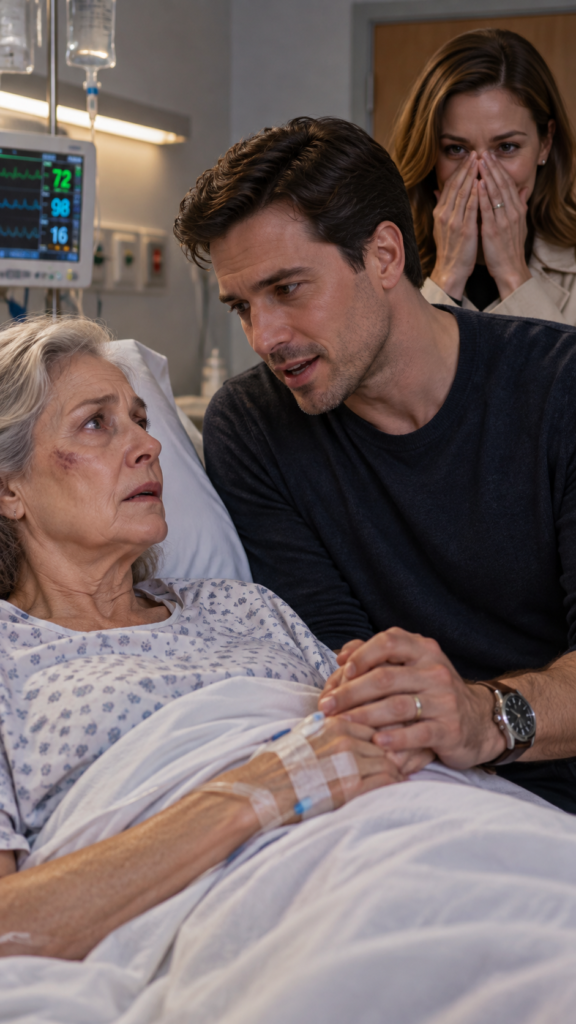
Her eyes were dry. Worse, they were shining with relief.
Dr. Henry stood beside my hospital bed, his clipboard pressed against his chest. “The internal damage from the accident is severe,” he said quietly. “Your vital organs are failing. I’m afraid you have approximately three days.”
Three days.
I turned toward my son, desperate for something familiar—a trembling hand, a broken expression, anything that told me I was still his mother.
Instead, Rachel covered her face and made the sounds of someone crying.
But there were no tears.
When Dr. Henry stepped outside, Mark immediately moved closer. He wrapped his hand around mine with a firmness that almost felt affectionate.
Then he leaned toward my ear.
“It’s finally happening, Mom. All your money will be mine and Rachel’s. It’s about time.”
For a moment, even the machines beside me seemed to disappear.
Rachel lowered her hands.
“Five million dollars, the real estate portfolio, the tech stocks,” she said. “It’s all ours finally. We won’t have to pretend anymore.”
Then they laughed.
I closed my eyes.
For thirty-five years, I had been Mark’s mother. After my husband died when Mark was five, I raised him alone. I worked eighteen-hour days and slowly built a real estate business from nothing so my son could have opportunities I never had.
Now he was standing beside my hospital bed discussing my death like a financial transaction.
“When can we start the paperwork?” Rachel asked.
“The attorney said we can expedite everything,” Mark replied. “We should have access to the accounts within a week.”
“Perfect. I already picked the cruise.”
Rachel sounded almost cheerful.
“A month in the Mediterranean. We deserve it after putting up with so much.”
Putting up with me.
I kept my breathing steady and pretended to sleep while they divided my life between them.
The penthouse furniture. My investments. The properties.
Then Rachel asked something that made my blood run cold.
“Do you think she’ll suffer?”
Mark shrugged.
“The doctor said she’ll probably slip into a coma. Better that way. I don’t want to keep coming here. The hospital smell grosses me out.”
They stayed several more minutes.
When the door finally closed behind them, I opened my eyes.
Tears slid silently toward my temples.
But beneath the grief, something harder had begun to form.
Rage.
An hour later, Dr. Henry returned.
This time, he locked the door.
The grave expression was gone. He pulled a chair beside my bed and looked at me not simply as my physician, but as the man who had known my family for thirty years.
“Helen,” he said softly, “I heard everything.”
I stared at him.
Then he said something I never expected.
“You are not dying in three days.”
My heartbeat jumped.
Henry explained that my injuries were serious—fractures, contusions, internal damage—but my organs were responding far better than he had told Mark and Rachel.
“You could have months,” he said. “Possibly longer.”
“Then why tell them three days?”
His expression hardened.
“Because I needed to see their reaction.”
Henry told me Mark and Rachel had visited the hospital three weeks earlier, asking strangely specific questions about my health, my estate, and what would happen financially if I died.
He had become suspicious.
So he tested them.
And they had shown him exactly who they were.
I thought about the trust documents waiting at home. I had been preparing to make Mark the executor.
Henry reached into his pocket and pulled out his phone.
“There’s something else.”
He told me he had quietly asked a private investigator to examine Mark’s finances.
Then he looked directly into my eyes.
“Helen, your son has more than eight hundred thousand dollars in gambling debt. Rachel’s credit cards are maxed out.”
My fingers tightened around the hospital blanket.
“They’re desperate,” Henry said.
And suddenly, my accident no longer felt like the most frightening thing that had happened to me.
Because now I had to find out exactly how far my own son was willing to go for five million dollars—and Henry had only begun telling me what they had uncovered. 👇
Henry did not unlock his phone.
He simply held it between both hands, watching me as the monitor beside my bed counted out the seconds with soft electronic beeps.
“What else?” I asked.
My voice barely sounded like mine.
Henry looked toward the locked door.
“The investigator found something that worried me enough that I asked her not to contact you directly.”
A cold sensation moved through me.
“Tell me.”
“Mark has been borrowing against anything he can reach. Personal loans. Credit lines. Private lenders. Some of the money appears to have gone directly to gambling accounts. Some of it moved through accounts Rachel controls.”
I swallowed.
“But he cannot borrow against my property.”
“No.”
Henry’s eyes remained on mine.
“Not legally.”
That word settled between us.
Legally.
I turned my head toward the dark hospital window. My reflection floated weakly against the glass: bruised cheek, gray hair pushed away from my forehead, tape over one hand, hospital gown loose around shoulders that suddenly seemed much older than they had three days before.
“What did he do?”
“The investigator found inquiries involving two of your properties. Nothing appears to have closed. But someone has been presenting documents suggesting Mark expects to gain authority over your estate very soon.”
I remembered the papers waiting at home.
The trust amendment.
Mark had brought them to dinner two weeks earlier, smiling as he explained that it was simply responsible planning.
I had almost signed.
My stomach turned.
“Henry, I need my attorney.”
“I thought you might.”
“Not Mark’s attorney. Mine.”
“I know.”
“And nobody tells Mark I’m expected to survive.”
Henry studied me for several seconds.
“You’re sure?”
I looked back at him.
An hour earlier, I would have given my son almost everything I owned.
Now I could still hear him complaining about the smell of the hospital while I supposedly had seventy-two hours left to live.
“Yes.”
Henry nodded once.
Then he made the call.
My attorney, Evelyn Shaw, arrived shortly before midnight.
She came without an assistant and carried only a leather briefcase. Rain darkened the shoulders of her coat. When she entered, she did not greet me with the bright professional smile she normally wore across conference tables.
She came directly to the bed and took my hand.
“I’m sorry.”
Those two words nearly broke me.
Not because of the money.
Because she knew.
Henry had told her enough.
I looked away.
“Don’t be sorry yet.”
Evelyn pulled the chair closer.
“What do you need?”
“I need to know what Mark gets if I die under my current estate plan.”
She hesitated.
“Helen—”
“Everything.”
Evelyn opened her briefcase.
“After charitable distributions and a few smaller bequests, Mark receives the controlling interest in your remaining estate. He is also currently designated successor trustee.”
“And the amendment?”
“The one you were considering would have expanded his authority substantially.”
I shut my eyes.
“How substantially?”
“He could have begun managing certain assets during any period in which you were declared incapacitated.”
The room became very quiet.
I opened my eyes again.
“Declared by whom?”
“Your physicians, subject to the trust provisions.”
Henry shifted beside the window.
I saw the realization move across his face at the same moment it moved through me.
Three weeks earlier, Mark and Rachel had been asking questions about my health.
Then Mark had brought me an amendment concerning incapacity.
Then came the accident.
I could hear my own breathing.
Evelyn noticed.
“Helen, we do not know that those things are connected.”
“No,” I said.
We didn’t.
And I refused to turn suspicion into truth simply because betrayal had made suspicion easy.
“Then we find out.”
By morning, I had signed a new set of instructions.
Not because I wanted revenge.
That surprised even me.
I wanted protection.
Evelyn revoked Mark’s pending authority and arranged safeguards around every account and property I controlled. No transfer could occur without independent verification. Any attempt to use outdated documents would be flagged immediately.
My medical information was restricted.
My room access was changed.
And Mark remained unaware.
At eleven seventeen that morning, he returned with Rachel.
I heard her heels first.
Mark entered carrying flowers.
Yellow roses.
My favorite.
For one terrible second, I remembered him at eight years old, standing in our kitchen with three crushed yellow flowers he had stolen from a neighbor’s garden because he knew I had cried the night before.
“Mom?”
I let my eyelids remain heavy.
Rachel approached the bed.
“How are you feeling?”
Weakly, I whispered, “Tired.”
She squeezed my shoulder.
Her touch was gentle.
That was almost worse.
Mark sat beside me and brushed hair from my forehead.
“You should rest.”
I looked at him.
“Will you stay?”
The question came out before I could stop it.
Something flickered across his face.
Impatience.
Then the smile returned.
“Of course.”
He stayed twelve minutes.
Rachel spent most of them checking her phone.
Before leaving, Mark kissed my forehead.
“I love you, Mom.”
I waited until the door closed.
Then I turned my face toward the pillow and cried so hard that Henry eventually came in and stood beside me without saying anything.
He did not tell me to be strong.
He did not tell me Mark did not deserve my tears.
He simply placed his hand over mine and remained there until I could breathe again.
That afternoon, the private investigator arrived.
Her name was Lena Ortiz.
She was in her late forties, quiet and precise, with a habit of laying each document on the table before explaining it.
Bank records.
Debt notices.
Copies of emails.
Photographs of Mark entering a private gambling club.
Nothing surprised me anymore.
Then Lena placed one final sheet on the table.
“This is why Dr. Henry asked me to keep looking.”
It was a copy of an email Mark had sent to an insurance broker.
The message concerned my accident policy.
My throat tightened.
“That doesn’t prove anything.”
“No,” Lena said. “It doesn’t.”
I appreciated her for saying it.
She slid another page toward me.
“This is more concerning.”
It was a message Rachel had sent Mark two days before my accident.
Most of it concerned debt.
One sentence had been highlighted.
Once she can’t manage things herself, everything gets easier.
I read it three times.
“What does that mean?”
“We don’t know yet.”
Lena gathered the papers.
“And until we do, we don’t accuse anyone.”
I nodded.
Truth mattered now more than anger.
For the next two days, everyone except the people protecting me continued believing I was dying.
Mark called twice.
Rachel called once.
Neither stayed long.
But on what they believed was my final evening, they both appeared shortly after seven.
This time Mark carried a folder.
My pulse changed the moment I saw it.
Rachel closed the door behind them.
Mark sat beside me.
“Mom, there are a few things we should take care of while you’re still able.”
Still able.
He opened the folder.
“I hate doing this now.”
Rachel lowered her eyes with exquisite timing.
“But it’ll prevent legal complications.”
I looked at the first page.
Power of attorney.
The next document concerned trust management.
Another authorized access to financial accounts under specific conditions.
My son had brought paperwork to his dying mother.
“Where’s Evelyn?” I asked.
Mark’s fingers stopped.
“What?”
“My attorney.”
“Oh. You don’t need to bother her with this.”
Rachel moved closer.
“This is just family paperwork.”
I looked at her.
Her expression was soft.
Almost loving.
“What happens if I don’t sign?”
Neither answered immediately.
Mark leaned back.
“Mom, don’t make this difficult.”
There it was.
Not grief.
Not fear.
Pressure.
I let my hand tremble as I reached for the pen.
Rachel exhaled.
Mark’s shoulders loosened.
Then I set the pen down.
“I’m tired.”
His jaw tightened.
“It’ll take thirty seconds.”
“Tomorrow.”
“Mom.”
Rachel touched his arm.
“She may not have tomorrow.”
They thought I was too weak to notice the look they exchanged.
I noticed.
Mark pushed the pen toward me again.
“Sign it.”
I stared at my son.
The little boy with the yellow flowers was gone.
Or perhaps he had not disappeared all at once. Perhaps there had been a thousand small choices between that kitchen and this hospital room, and I had loved him too blindly to see where they were leading.
“No.”
His face changed.
“What?”
“No.”
Rachel stepped forward.
“Helen, you’re confused.”
“I’m not.”
“You’re heavily medicated.”
“I know exactly where I am.”
Mark stood.
His chair scraped sharply across the floor.
“Why are you doing this?”
The question was so astonishing that I almost laughed.
Instead, I looked toward the door.
“Evelyn.”
The door opened.
My attorney entered first.
Henry followed.
Then Lena.
Mark went completely still.
Rachel’s face emptied.
Evelyn walked to the foot of my bed and placed her briefcase on the table.
“The documents you brought will not be signed.”
Mark looked at me.
Then at Henry.
“You said she was dying.”
Henry’s expression did not change.
“I said her condition was critical.”
“You said three days.”
“Yes.”
Mark’s voice rose.
“You lied?”
Henry took one step forward.
“I gave you information intended to expose whether Helen was at immediate risk of financial exploitation.”
Rachel backed toward the wall.
Mark stared at me.
Understanding arrived slowly.
“You set me up.”
“No,” I said.
My voice shook, but I did not look away.
“I gave you three days to believe your mother was dying.”
I glanced at the folder.
“You decided what to do with them.”
Silence.
Mark opened his mouth.
Nothing came out.
Then anger replaced shock.
“You have no idea what I’m dealing with.”
“Eight hundred thousand dollars.”
His face drained.
Rachel turned toward him.
“You told her?”
“I didn’t.”
I looked at Rachel.
“And I know about your cards.”
She folded her arms tightly across herself.
Mark stepped toward my bed.
“You investigated me?”
“I protected myself.”
“I’m your son.”
The words hit exactly where he intended them to.
My eyes burned.
“Yes.”
I nodded.
“You are.”
My voice cracked.
“That is why this hurts.”
For the first time, Mark looked away.
But Lena had not moved.
“There is another matter.”
Mark’s head snapped toward her.
Lena placed a small recorder on the table.
“We obtained lawful records and supporting documentation regarding attempts to use anticipated inheritance as collateral. We also found communications suggesting you expected your mother to become incapacitated.”
Rachel whispered, “Mark.”
He ignored her.
“That proves nothing.”
“By itself, no.”
Lena’s voice remained calm.
“Which is why we kept investigating the accident.”
Every sound in the room seemed to vanish.
I felt Henry move closer to my bed.
Mark’s face became unreadable.
“What about the accident?”
Lena looked at me before answering.
“Helen, the police originally treated the collision as an ordinary road accident. Another driver entered your lane after losing control.”
I remembered headlights.
Rain.
Metal folding around me.
“They found him?”
“They did.”
My fingers tightened.
“He admitted he was distracted.”
I breathed out.
Then Lena continued.
“But that isn’t the hidden truth.”
Mark stared at her.
Lena placed several printed messages on the table.
“The driver had no connection to Mark or Rachel. Your accident was not arranged.”
Something inside me loosened.
For one brief second, relief came so strongly that I nearly sobbed.
My son had wanted my money.
But he had not tried to kill me.
Then Lena turned toward Mark.
“The problem is what you did after the accident.”
Mark’s eyes shifted.
Rachel whispered his name again.
Lena continued.
“Hospital records show that within hours of Helen’s admission, someone attempted to obtain documentation stating that she lacked decision-making capacity.”
Evelyn opened another folder.
“That request was made through an attorney acting on Mark’s instructions.”
I looked at him.
Mark’s shoulders sagged.
“You thought I was going to die anyway,” I said.
He said nothing.
“So you tried to take control before I could recover.”
“It wasn’t like that.”
“Then tell me what it was like.”
His mouth opened.
Closed.
Rachel suddenly stepped away from him.
“He told me you had agreed.”
Mark turned.
“Rachel.”
“You told me she wanted you handling everything.”
“Shut up.”
The words cracked across the room.
Rachel stared at him.
And in that instant, whatever alliance had existed between them began to collapse.
“You said the paperwork was already approved.”
“I said shut up.”
“No.”
Rachel’s voice trembled now.
“You told me your mother had promised you the estate.”
Mark moved toward her.
Henry immediately stepped between them.
“Enough.”
Mark stopped.
Rachel pressed both hands against her face.
This time, when she lowered them, tears were actually there.
It did not erase what she had done.
It did not erase the laughter.
But the performance was over.
“I knew about the debt,” she whispered. “I knew he was gambling. I knew we needed the inheritance.”
She looked at me.
“And I wanted the money. I did. I said horrible things.”
Her chin trembled.
“But I didn’t know he had tried to get you declared incompetent before the doctor said you were dying.”
Mark laughed bitterly.
“Oh, now you’re innocent?”
“I’m not innocent.”
Rachel looked at him.
“But I’m not taking your blame too.”
Mark’s face twisted.
“You spent the money.”
“And you gambled eight hundred thousand dollars.”
“You wanted the cruise.”
“You told me we would be rich!”
Their voices rose over each other until I finally said one word.
“Stop.”
Nobody heard me.
I said it again.
“Stop!”
The monitor accelerated.
Henry turned immediately toward me.
Mark and Rachel fell silent.
I looked at them both.
“I am lying in a hospital bed listening to two people argue over which one was greedier while I was supposed to be dying.”
Neither moved.
“I don’t care who wanted the cruise.”
My eyes found Mark.
“I care that my son sat beside me and celebrated my death.”
His face crumpled slightly.
“You don’t get to explain that away with debt.”
“Mom—”
“No.”
He flinched.
“You thought you had three days left with me.”
My voice became quieter.
“And you spent them trying to inherit me.”
Mark sank into the chair.
For several seconds he stared at the floor.
Then his shoulders began to shake.
I had seen my son cry many times.
At five, when his father died.
At twelve, when he broke his wrist.
At twenty-two, when the woman he loved left him.
This crying was different.
There was no one to rescue him from it.
“I messed up.”
I watched him.
He covered his face.
“I messed everything up.”
“Yes.”
He looked at me as if he had expected comfort.
I had none to give.
Not yet.
“I kept thinking I could win it back,” he whispered. “Every time I lost, I thought the next bet would fix it. Then the debts got bigger.”
His breathing broke.
“I couldn’t tell you.”
“Why?”
“Because you built everything.”
He looked around the room helplessly.
“You never failed at anything.”
I almost interrupted him.
Then I remembered all the nights I had cried over unpaid invoices. All the buildings that almost bankrupted me. All the mistakes Mark had never seen because I had hidden them to make him feel safe.
“You think I never failed?”
He stared at me.
“I failed constantly.”
His brow tightened.
“I just didn’t make you pay for my failures.”
That landed.
Mark lowered his eyes.
Evelyn broke the silence.
“There are legal consequences.”
Mark looked up.
She explained that the attempted financial actions, false representations, and efforts to obtain control of my assets would be turned over for formal review. Accounts connected to questionable transactions had already been frozen where legally appropriate.
Rachel sat down slowly.
“What happens to us?”
Evelyn’s expression remained professional.
“That will depend on what investigators establish.”
Mark looked at me.
“You’re doing this to your own son?”
I felt something inside me tear.
But I answered.
“No, Mark.”
I looked at the unsigned papers.
“You did this.”
The weeks that followed were not dramatic in the way people imagine justice.
There were no triumphant speeches.
There were interviews.
Lawyers.
Records.
Long hospital nights.
Questions repeated until every answer felt scraped raw.
Investigators eventually established that Mark had made false representations while attempting to secure financial authority over assets he did not control. His creditors discovered the extent of his deception. Several arrangements collapsed almost immediately.
Rachel cooperated.
Her cooperation did not erase her behavior, but it mattered.
She admitted what she knew, what she had signed, and what she had ignored because she wanted the life Mark kept promising.
Their marriage did not survive.
Neither did the fantasy built around my death.
Mark faced financial ruin and legal consequences connected to his fraudulent actions. The exact punishment mattered less to me than one fact that became impossible for him to escape:
He would never control my estate.
The money was gone from his future before he ever possessed a dollar of it.
Months passed.
And against everyone’s earliest fears, I kept waking up.
My fractures healed slowly.
The internal injuries stabilized.
Three days became three weeks.
Three weeks became three months.
One morning, Henry walked into my rehabilitation room carrying coffee and wearing a ridiculous grin.
“What?”
He set the cup down.
“I’m tired of being wrong about you.”
I smiled.
“You should be used to it after thirty years.”
He laughed.
It was the first time laughter had sounded safe to me in months.
By spring, I could walk without assistance.
The first place I went was not my penthouse.
It was the small house where Mark and I had lived after my husband died.
I still owned it.
I had never been able to sell it.
The kitchen was smaller than I remembered.
Sunlight fell across the old wooden floor, illuminating scratches I recognized from Mark’s childhood.
Near the back door was the faint mark where he had once measured his height in pencil.
I touched it with one finger.
Eight years old.
The year of the yellow roses.
I cried there.
Not for the businessman he became.
Not for the man who had waited for my death.
I cried for the child who had once believed three stolen flowers could repair his mother’s broken heart.
Evelyn found me sitting at the kitchen table an hour later.
“I thought you might come here.”
She placed a folder in front of me.
I sighed.
“Please tell me that isn’t another legal document.”
“It is.”
I groaned.
“But this one might make you happy.”
I opened it.
My estate plan had been restructured.
A substantial portion would support housing assistance for widowed parents rebuilding financially after losing a spouse. Another portion would fund addiction treatment, including programs for gambling addiction and family counseling.
I stared at Evelyn.
“You included it.”
“You asked me to.”
“I wasn’t sure I meant it.”
She smiled.
“You did.”
I looked through the pages.
The irony was painful.
Mark’s addiction had nearly destroyed us.
Now part of the fortune he had tried to seize would help other families recognize the same danger before desperation became betrayal.
“There’s one more thing,” Evelyn said.
She handed me an envelope.
I recognized the handwriting immediately.
Mark.
I did not open it for nearly ten minutes.
When I finally did, there was no request for money.
No request for intervention.
No demand that I forgive him.
Only four handwritten pages.
He told me he was receiving treatment for gambling addiction.
He admitted that for years he had measured his life against mine and felt smaller each time. Instead of admitting he was drowning, he borrowed. Then lied. Then borrowed again.
He wrote about the hospital.
About the moment he told me my money would finally be his.
He said remembering my face had become unbearable.
Near the end was one sentence I read repeatedly.
I don’t want you to forgive me because I’m your son. If forgiveness ever comes, I want to become someone who could deserve it.
I folded the letter.
Evelyn waited.
“Are you going to answer?”
“Not today.”
She nodded.
That was one of the greatest gifts anyone gave me during that year.
Nobody rushed me.
Nobody told me a mother had to forgive.
Nobody told me blood was stronger than betrayal.
Healing was allowed to take the time it required.
Nearly a year after the accident, I saw Mark again.
We met in the little house.
He looked older.
Thinner.
He stopped inside the doorway as though entering without permission would itself be another theft.
“Hi, Mom.”
“Hello, Mark.”
His eyes filled immediately.
Mine did too.
Neither of us moved.
Then he looked toward the pencil marks by the kitchen door.
“You kept those?”
“I kept the house.”
“I didn’t know.”
“There were many things you didn’t know.”
He nodded.
“I know.”
We sat at opposite sides of the kitchen table.
He told me about treatment.
About debt restructuring.
About working again, this time at a salary that would never make him wealthy quickly.
He told me Rachel had moved away after their divorce and was rebuilding her own life.
Then he placed something on the table.
Three yellow roses.
I stared at them.
His mouth trembled.
“I know they don’t fix anything.”
“No.”
“They didn’t when I was eight either.”
Despite myself, I smiled.
“They helped.”
Mark looked down.
“I’m sorry.”
This time, he did not follow the apology with an explanation.
He did not mention addiction.
He did not mention Rachel.
He did not mention pressure.
He simply sat there.
“I’m sorry I wanted what you had more than I wanted you.”
My breath caught.
That was the truth I had waited a year to hear.
Not that he had made mistakes.
Not that he had been desperate.
That.
I reached across the table.
For a second, my hand stopped halfway.
Then I placed it over his.
Mark began to cry.
“I forgive you,” I said.
His head lifted.
“But forgiveness is not restoration.”
He listened.
“You will not control my money. You will not become executor. You will not inherit the life you thought was waiting for you.”
He nodded through tears.
“I understand.”
“And trust?”
I squeezed his hand once.
“We build that from nothing.”
He closed his eyes.
“Okay.”
It was not the reunion people put in movies.
We did not embrace and erase the past.
We started with coffee.
Then another coffee three weeks later.
Then lunch.
Then a phone call on my birthday.
Small things.
Trust returned in teaspoons.
Rachel wrote once.
Her letter contained no excuses either.
She apologized for smiling when she believed I was dying.
She wrote that there was no version of desperation that made that moment acceptable.
I believed her.
I sent a short reply.
I wished her well.
That was enough.
Two years after the accident, Henry asked me to attend the opening of a new community center funded by my foundation.
The building provided financial counseling, addiction support, temporary housing assistance, and legal guidance for families in crisis.
I stood beneath a simple plaque near the entrance while people moved through the bright lobby.
Henry joined me.
“You never told me why you chose this building.”
I looked at the plaque.
It carried my husband’s name.
Then another name beneath it.
Mark’s father.
“My husband believed people were more than the worst thing they ever did.”
Henry looked at me.
“Did he?”
“Yes.”
I smiled faintly.
“He married me.”
Henry laughed.
Then Evelyn approached carrying an old envelope.
“I found something.”
My smile disappeared.
“What?”
“This was in the original estate archive.”
She handed it to me.
The envelope was addressed in my husband’s handwriting.
To Helen, if she ever doubts Mark.
My hands began trembling.
My husband had been dead thirty years.
I opened it carefully.
Inside was a single sheet of paper.
Helen,
If you are reading this, our boy has probably disappointed you badly.
He will.
So will you.
So did I.
Love him enough to tell him no when yes would destroy him.
And if one day he loses his way, remember that saving someone and rescuing them from consequences are not the same thing.
Make him walk back.
But if he walks back honestly, leave a light on.
I stopped reading.
The lobby blurred.
Henry put a hand beneath my elbow.
Evelyn was crying.
I pressed the letter against my chest.
For thirty years, I had believed I was the parent who stayed.
Suddenly I understood that my husband had never completely left.
Somehow, decades earlier, he had known the hardest thing I would ever have to do for our son would not be giving him everything.
It would be refusing to.
That was the beautiful truth hidden beneath the ugliest year of my life.
Mark had believed my fortune was proof of my love.
I had helped teach him that by solving too many problems with money.
But love had finally demanded something harder from both of us.
Consequences.
Distance.
Truth.
And then, slowly, a road home.
That evening, I returned to the little house.
Mark was already there.
He had been repairing the back porch, and when I arrived he was sitting on the steps with sawdust on his jeans.
“You’re late.”
“I’m seventy-four. I’m allowed.”
He smiled.
I sat beside him.
For a while we watched the sunset without speaking.
Then I handed him his father’s letter.
He read it once.
Then again.
By the third line, his mouth began trembling.
When he finished, he bent forward and covered his face.
I waited.
Finally he whispered, “He knew.”
“He knew people.”
Mark wiped his eyes.
“Do you think he would hate me?”
I looked toward the fading light.
“No.”
Mark stared at me.
“I think he would have made you walk back.”
A broken laugh escaped him.
“And then?”
I leaned my shoulder gently against his.
“He would have left a light on.”
Mark lowered his head against mine.
We sat that way until the sky darkened.
Inside the house, the kitchen lamp was already glowing through the window.
Three yellow roses stood in a glass beside the sink.
Not because they repaired what had happened.
Nothing could.
They were there because something more difficult had happened instead.
We had survived the truth.
We had allowed consequences to remain consequences.
We had stopped confusing money with love, forgiveness with forgetting, and family with permission to cause harm.
And somehow, after all of it, we had found our way back to the smallest house I had ever owned, sitting side by side beneath the same warm light, with nothing left between us that needed to be hidden.
For the first time in years, I did not think about how much time I had left.
I simply reached for my son’s hand.
And when his fingers closed carefully around mine, neither of us needed to hold on too tightly anymore.