My son’s fiancée threw a glass of water in my face in front of thirty-two people at their engagement dinner, then leaned across the table and said, “Question me again, Evelyn, and you’ll never see your son after tonight.”
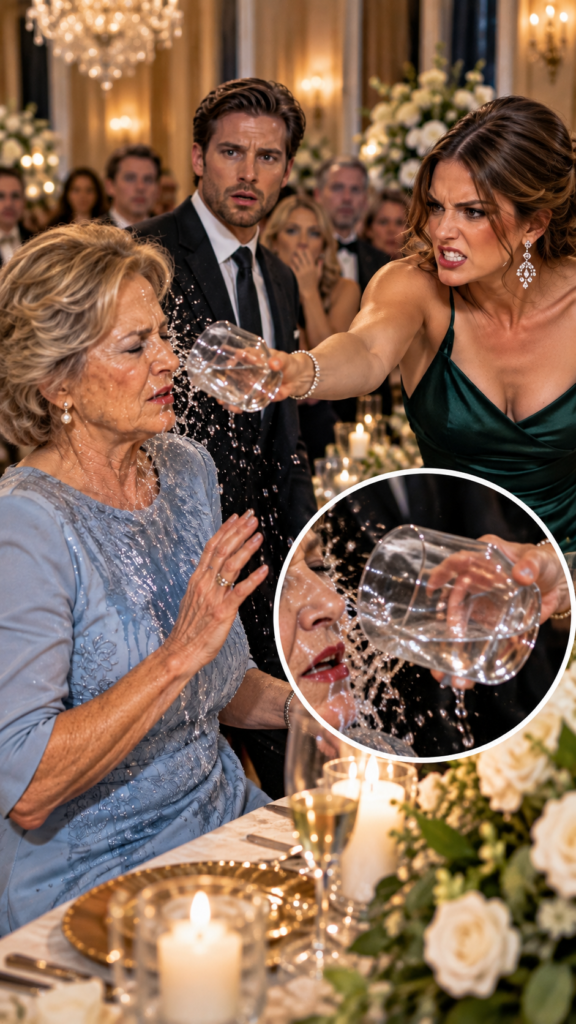
Water ran down my cheeks and soaked the pale blue dress I had bought especially for the celebration, but the humiliation was nothing compared with what happened next. My forty-two-year-old son, Daniel, looked directly at me and said, “Mom, you owe Madison an apology.” In that moment, I realized the woman he planned to marry had not simply turned him against me—she had convinced him that even my humiliation was somehow my fault.
My name is Evelyn Mercer, and I was sixty-eight years old that night at the Brookfield Hotel in Richmond, Virginia. For most of my life, I believed loving your family meant carrying the painful things quietly so they did not have to carry them with you. After my husband Thomas died from pancreatic cancer, Daniel became the closest family I had left, and I tried very hard not to make my grief his responsibility. That was why, when Madison slowly began pushing me out of his life, I told myself it was normal for an adult son to build a future with the woman he loved.
At first, Madison had been charming enough to make me ashamed of ever doubting her. She brought white peonies to my home, asked about Thomas, laughed at stories from Daniel’s childhood, and called me “Evelyn” with such warmth that I thought perhaps I had been given a second daughter. Then phone calls became shorter, holiday invitations became complicated, and Daniel began saying things like, “Madison thinks we need better boundaries.” Soon, he started looking at her before answering even simple questions, as though he needed permission to decide what he thought.
I respected every boundary Daniel asked for because I did not want to become the lonely widow Madison accused me of being. I called less, stopped asking why invitations disappeared, and ignored the way she referred to my home as “the old place.” When Daniel proposed, I hugged him and promised myself I would make the marriage work because his happiness mattered more to me than my pride. But three weeks before their engagement dinner, something happened that made it impossible for me to keep pretending everything was fine.
Thomas’s longtime attorney, Walter Pierce, asked me to come to his office downtown. He placed a folder in front of me containing financial inquiries involving the Mercer Family Trust, which Thomas had created years before his death. Someone had been presenting Daniel as the future controlling beneficiary and trying to establish early access to money that was not yet his. Then Walter showed me a document authorizing an early distribution of eight hundred thousand dollars—and at the bottom was my signature.
Except I had never signed it.
Walter warned me not to confront Daniel or Madison until he understood how much had been compromised. I wanted desperately to believe it was an administrative error, because the alternative meant someone close enough to our family to obtain my financial documents had forged my name. Then the Brookfield Hotel contacted us about an old Mercer Ridge corporate account that should have been inactive. A four-night suite had been charged to that account during February 6 through February 10, the exact dates Daniel had told me he was away at a business conference.
The hotel’s legal department eventually provided the reservation information to Walter because the account had been used without authorization. The reservation had been made by Madison Clarke, and the suite cost $6,842.17. But Madison had not stayed there alone. The second registered guest was Christopher Hale, a man she had once casually introduced as a former business partner.
When Walter handed me the hotel receipt, I stared at Christopher’s name for a long time. I remembered him from a Charleston party, remembered the easy way he and Madison spoke to one another, but I still refused to decide what it meant without speaking to Daniel first. Walter told me to keep the receipt safe, so I folded it carefully and slipped it into the inner pocket of my purse. For three days, I carried it everywhere, hoping there might still be an explanation that did not destroy my son.
Then Daniel came to my house and warned me not to bring up finances around Madison. I quietly asked whether he trusted her with money, and his expression hardened as though I had just confirmed everything she had said about me. “She thinks you can’t stand not being the most important woman in my life,” he told me. I looked at my son and said, “Daniel, I never wanted to be the most important woman in your life. I wanted to be your mother.”
He left without asking why I was suddenly worried about money.
That was the moment I realized Madison had succeeded in something far more dangerous than making Daniel dislike my questions. She had trained him to treat the questions themselves as evidence against me. So I asked Walter to attend the engagement dinner, although I still intended to speak privately with Daniel afterward if anything confirmed my fears. I never imagined Madison would force the confrontation into the middle of a room filled with thirty-two guests.
The Hawthorne Room was covered in ivory roses, candles, crystal glasses, and expensive champagne. Then I noticed the seating chart and felt the first cold warning in my stomach. My assigned seat was six places away from Daniel, while Christopher Hale sat close enough to Madison to speak to her without raising his voice. During dinner, one of Madison’s mother’s friends congratulated her on the luxury event company she planned to launch in Richmond and Charleston, and Madison casually said they had been “fortunate” with financing.
My fork stopped halfway to my plate.
Across the table, Christopher’s eyes lifted for only a second, but it was enough. Madison kept smiling at her mother’s friend, one hand resting beside her champagne glass, while Daniel looked proud in the uncomplicated way people look when they believe good news belongs entirely to them.
“What kind of financing?” I asked.
The question was quiet.
It still changed the room.
Madison’s smile remained in place, but the muscles beside her mouth tightened. “Private financing,” she said. “Nothing you need to worry about.”
Daniel turned toward me at once.
“Mom.”
There was warning in that one word.
I looked at him, then back at Madison. “I’m only asking because Walter mentioned some unusual activity involving the family trust.”
The sound of silverware diminished around us.
Not all at once. One fork stopped. Then another. A champagne glass touched the table without the conversation that had accompanied it. Somewhere behind me, a chair creaked.
Madison’s face changed.
It was not fear.
Not yet.
It was irritation that I had refused to stay in the position she had assigned me.
“This is exactly what I was talking about,” she said to Daniel. “She can’t let us have one night.”
I felt heat move slowly into my face.
“I asked a question.”
“You’re interrogating me at my engagement dinner.”
“No. I’m asking where the financing came from.”
Daniel pushed his chair back an inch.
“Mom, stop.”
I turned toward him.
For a second, I almost did.
That old instinct rose immediately—the instinct that had carried me through Thomas’s illness, the hospital rooms, the paperwork, the funeral, the empty months afterward. Keep the painful thing in your own hands. Do not make the people you love hold it.
Then I saw Christopher look at Madison again.
Not like a former business partner.
Like someone waiting to see how much she was going to say.
I placed my napkin beside my plate.
“Were you at this hotel in February?” I asked.
Madison went still.
Daniel stared at me.
Christopher’s fingers closed around the stem of his wineglass.
“What?” Daniel said.
I kept my eyes on Madison.
“February sixth through the tenth.”
The color left Christopher’s face first.
Madison laughed, but there was no warmth in it.
“This is insane.”
“Was there a suite charged to the Mercer Ridge corporate account?”
Daniel looked from her to me.
“What account?”
Madison stood so quickly that the table trembled. Water shifted inside the crystal glass in front of her.
“You brought financial accusations here?”
“I brought questions here because you left me nowhere else to ask them.”
Her hand closed around the glass.
Walter rose from his chair across the room.
He had barely taken one step when Madison threw the water.
It struck my face cold and hard.
A woman near the far end of the table gasped.
Water ran from my hairline, over my cheeks, down my neck, and into the pale blue fabric across my chest. For one strange second, I could hear individual droplets falling from my sleeve onto the carpet.
Nobody moved.
Madison leaned across the table.
“Question me again, Evelyn, and you’ll never see your son after tonight.”
I looked at Daniel.
I remember thinking that this was the moment.
Surely this was the moment my son would finally see what had been happening directly in front of him.
His face was pale.
His eyes met mine.
“Mom, you owe Madison an apology.”
Something inside me became very quiet.
Not broken.
Quiet.
The difference mattered.
I reached for my purse beside the chair.
Daniel exhaled sharply. “Mom, don’t make this worse.”
I opened the inner pocket and felt the folded receipt beneath my fingers.
Walter stopped beside me.
“No,” he said.
He was not speaking to me.
He was looking at Daniel.
“Your mother has spent three weeks trying to make this less painful for you.”
Daniel frowned.
Madison straightened.
“Walter, this is a family matter.”
Walter’s expression did not change.
“I am here because it stopped being only a family matter when someone forged Evelyn’s signature on a trust distribution request.”
The room became so silent that I heard the candle nearest me crackle.
Daniel stared at him.
“What?”
I pulled the document from my purse, but my hand had begun to tremble. Walter took it gently, unfolded it, and placed it on the table in front of my son.
Daniel looked down.
I watched him recognize my name.
Then the amount.
Eight hundred thousand dollars.
He looked back at me.
“Mom, what is this?”
“A request to release money from the Mercer Family Trust.”
His eyes moved to the signature.
“I didn’t do this.”
“I know.”
Madison spoke too quickly.
“Neither did I.”
Nobody had accused her.
That was the first moment Daniel looked at her differently.
Walter noticed it too.
He opened the slim leather folder he had carried into dinner and removed several pages.
“The trust administrator received supporting inquiries describing Daniel as the future controlling beneficiary,” he said. “Those inquiries were attached to the distribution request.”
Daniel’s voice dropped.
“Who sent them?”
Walter looked toward Madison.
“I spent the last three weeks establishing that.”
Madison’s chair scraped against the floor.
“This is ridiculous. I’m not sitting here while some attorney makes accusations based on paperwork he doesn’t understand.”
Christopher stood.
He did not look at her.
That frightened her more than Walter had.
“Chris,” she said.
He rubbed one hand across his mouth.
Daniel turned toward him.
“What do you know?”
Christopher looked at the table.
For the first time all evening, Madison seemed unable to control where anyone looked.
“Christopher,” Walter said quietly, “the hotel confirmed that the Brookfield suite was reserved in Madison’s name using the dormant Mercer Ridge corporate account.”
Daniel’s face emptied.
He looked toward Madison.
She shook her head immediately.
“It was business.”
I removed the folded hotel receipt from my purse.
My hands were steadier now.
I placed it in front of Daniel.
His eyes found the dates first.
February 6 through February 10.
Then the total.
$6,842.17.
Then Christopher Hale.
Daniel did not breathe for several seconds.
“I was in Denver,” he said.
Madison’s lips parted.
Daniel looked at her.
“You told me you were visiting your mother.”
She glanced toward her mother.
The older woman’s face had gone gray.
Christopher closed his eyes.
Daniel stood.
“Were you here with him?”
Madison reached for his arm.
He stepped back before she could touch him.
“It wasn’t what you’re making it sound like.”
“What am I making it sound like?”
“Daniel—”
“What happened in that room?”
Christopher answered.
“We were together.”
Madison turned on him.
“Shut up.”
He flinched.
The two words landed harder than shouting would have.
Daniel gripped the back of his chair.
I could see the tendons standing out in his hand.
“How long?”
Christopher swallowed.
Madison stared at him with a warning so naked that there was no longer any point pretending their relationship was ordinary.
“Since Charleston,” he said.
Daniel looked as if someone had struck him.
I remembered the Charleston party.
The easy conversation.
The private smiles I had noticed and then scolded myself for noticing.
Daniel’s eyes moved slowly toward me.
There was no accusation in them now.
Only horror.
Madison stepped between us.
“This has nothing to do with the trust.”
Walter’s gaze settled on her.
“Actually, it does.”
She froze.
Christopher sat down again.
He looked exhausted.
Walter placed another page on the table.
“The proposed event company required proof of capital before several financing discussions could proceed. The trust distribution authorization was included in that financial package.”
Daniel stared at Madison.
She said nothing.
Walter continued.
“The signature on Evelyn’s authorization was not genuine. The electronic copy of that authorization originated from documents provided in connection with the event company.”
Madison shook her head.
“No.”
Christopher looked at her.
“You told me Evelyn had agreed.”
Her head snapped toward him.
“You said Daniel had talked to her,” he continued. “You said the trust money was basically his and she was delaying the paperwork.”
Daniel’s voice was almost too quiet to hear.
“You used my mother’s name?”
Madison’s eyes filled, but the tears did not soften her face.
“They were going to give you that money eventually.”
“That isn’t an answer.”
“You were entitled to it.”
“No.”
Daniel looked down at the forged signature again.
“No, I wasn’t.”
Madison’s composure cracked.
“All she has ever done is hold everything over you. The house. Thomas. The trust. Every family memory. Every dollar comes with her standing in the middle of it.”
I stood.
My wet dress clung coldly to my skin.
“Name one time I used that trust to control him.”
Madison looked at me.
Nothing came.
I waited.
“So that’s what you told him?” I asked. “That every question was control?”
Daniel shut his eyes.
Madison turned back to him.
“She wants you dependent on her.”
He opened his eyes again.
“No.”
His voice sounded different.
Not stronger.
Clearer.
“She wanted me to ask why.”
Madison stared at him.
He looked toward me.
“She asked me whether I trusted you with money.”
The shame in his face was almost unbearable to watch.
“And I didn’t ask why.”
I could not rescue him from that moment.
For once, I did not try.
Walter gathered the papers into a neat stack.
“The trust administrator froze the request before any distribution occurred. The relevant institutions have preserved the records. What happens next will be handled properly.”
Madison’s face changed again.
That was the first time I saw fear.
Real fear.
“You reported this?”
Walter answered without raising his voice.
“Evelyn protected Daniel from knowing until we understood the facts. She did not protect anyone from accountability.”
Madison looked at me as though I had betrayed her.
The absurdity of it nearly made me laugh.
Instead, I picked up my damp napkin and pressed it once against my cheek.
Daniel removed the engagement ring from Madison’s finger only because she had reached for his hand and he stopped her.
He did not yank it.
He simply looked at the ring, then at her.
“I can’t marry you.”
She stared at him.
“You’re choosing her.”
He shook his head.
“No. I’m finally choosing what actually happened.”
Madison’s mouth opened.
Nothing came out.
Around us, thirty-two people sat in the wreckage of what had been arranged to look like a perfect evening.
Ivory roses.
Champagne.
Candlelight.
A pale blue dress darkened with water.
And a woman who had spent months teaching my son to distrust me suddenly discovering that control could disappear in a single truthful minute.
Madison’s mother rose first.
She did not go to her daughter.
She picked up her handbag with trembling hands and walked out.
Several guests followed.
Christopher remained seated.
He looked toward Daniel.
“I’m sorry.”
Daniel laughed once.
It was a terrible sound.
“Don’t.”
Christopher lowered his eyes.
Walter placed a hand lightly against my elbow.
“Evelyn.”
Only then did I realize I was shivering.
Daniel stepped toward me.
“Mom.”
I moved back.
He stopped immediately.
That mattered.
“I’m sorry,” he said.
The words were almost inaudible.
I looked at him.
Water was still dripping from the ends of my hair.
“I know you are.”
His face crumpled with relief too soon.
I shook my head.
“That doesn’t mean I’m ready to make you feel better.”
The relief disappeared.
He nodded.
For the first time in months, perhaps years, he accepted something I said without looking at another person to tell him what it meant.
Walter took me home.
Neither of us spoke during most of the drive.
Richmond passed outside the car in blurred amber lights. My dress had begun to dry stiffly against my skin, and every time I moved, I smelled champagne, hotel soap, and the faint floral perfume from the ivory roses.
At my front door, Walter waited while I found my key.
“I should have seen it sooner,” I said.
He frowned.
“You saw enough to ask questions.”
“I kept thinking if I was patient, Daniel would find his way back.”
Walter looked at me for a long moment.
“Patience and silence are not always the same thing.”
I unlocked the door.
The house was dark.
For the first time since Thomas died, I did not turn on every lamp.
I went upstairs, removed the pale blue dress, and hung it over the back of a chair.
There was a faint tide line across the fabric where the water had dried.
I stared at it for several minutes.
Then I left it there.
Daniel came the next morning.
He rang the bell instead of using the key I had once given him.
I saw him through the glass.
He looked as though he had not slept.
I opened the door but did not step aside.
“Can I come in?”
The question was so simple that it hurt.
Months earlier, he would have walked inside while telling me what Madison thought my problem was.
Now he waited.
“Yes.”
He sat on the edge of the sofa.
I remained in the chair opposite him.
For a while neither of us spoke.
Then he said, “Christopher gave Walter access to everything he had.”
I nodded.
“He says Madison told him I knew about the trust.”
I folded my hands in my lap.
Daniel stared at them.
“She told him you had approved the distribution but didn’t want to admit it because you were afraid of looking like you favored me.”
“That sounds like her.”
He flinched.
I had not meant the words cruelly.
They were simply true.
“She told me something different,” he said.
“What?”
“That you were trying to sabotage the company because you didn’t want us moving between Richmond and Charleston.”
I looked at him.
“I didn’t know there was a company until last night.”
He covered his face.
The room filled with his breathing.
When he finally lowered his hands, his eyes were red.
“Why didn’t I ask you?”
I could have softened the answer.
I did not.
“Because she gave you an explanation that made you angry with me, and anger was easier than uncertainty.”
He looked down.
“And because every time I tried to stay close to you, I became afraid of proving her right.”
His forehead tightened.
“About what?”
“That I was too lonely. Too involved. Too dependent on you.”
He shook his head immediately.
“I never thought—”
“You said it.”
He stopped.
I could see him remembering.
“She thinks you can’t stand not being the most important woman in my life.”
The sentence entered the room again.
This time he heard it from where I had been standing.
His shoulders folded.
“I said that to you.”
“Yes.”
He swallowed.
“And then I walked out.”
“Yes.”
His eyes closed.
I let the silence remain.
He needed to feel it.
Not as punishment.
As weight.
Some things cannot be repaired until the person who dropped them finally understands what they were carrying.
“I don’t know how to fix this,” he whispered.
“You don’t.”
He looked at me.
“You live differently.”
That became the beginning.
Not forgiveness.
Not reconciliation.
The beginning.
Daniel gave Walter every financial record Madison had ever asked him to access. He changed passwords, closed shared accounts, and answered investigators’ questions without asking me to protect him from embarrassment.
Christopher turned over emails, drafts, financing proposals, and messages.
The pattern became painfully clear.
Madison had convinced Christopher that Daniel’s future interest in the Mercer Family Trust could be treated as present capital. When lenders wanted documentation, the forged authorization appeared.
When the event company needed early expenses covered, the dormant Mercer Ridge account became convenient.
Convenient.
That word stayed with me.
The stored card was convenient.
The old account was convenient.
My signature was convenient.
My silence had been convenient too.
That was the part I had to take responsibility for.
Not their actions.
Mine.
I had confused keeping peace with preserving love.
Months passed.
Madison’s event company never opened.
The financing collapsed as soon as the supporting documentation was challenged. The forged authorization and the unauthorized Mercer Ridge charges became part of a formal investigation, and Christopher’s records made it impossible to dismiss what had happened as a misunderstanding.
Madison eventually admitted that she had submitted the false authorization and knowingly used the dormant corporate account.
There was no dramatic courtroom speech.
No last-minute confession beneath bright lights.
Just paperwork, hearings, legal consequences, restitution, and the quiet dismantling of the future she had tried to build on other people’s names.
She was ordered to repay what she had taken and faced the sentence the court imposed.
Christopher also faced consequences for his participation.
He cooperated, but cooperation did not erase what he had done.
Daniel never spoke to either of them again after the legal process ended.
I did not ask him to.
One rainy afternoon nearly six months after the engagement dinner, he came to my house carrying the pale blue dress.
I stared at it.
“I thought I threw that away.”
“You did.”
He gave a small, embarrassed nod.
“I took it out of the donation box.”
“Why?”
“I don’t know.”
He looked down at the dress folded across his arms.
“I think because every time I saw it, I remembered telling you to apologize.”
I said nothing.
“I had it cleaned.”
That almost made me angry.
Not because of the dress.
Because there are wounds people try to repair by fixing the nearest object.
He saw it in my face.
“I know,” he said quickly. “I know that doesn’t fix anything.”
I touched the fabric.
The water stain was gone.
The memory was not.
“I don’t want it back.”
Daniel nodded.
“All right.”
He started folding it again.
“Give it to someone who needs a beautiful dress.”
He looked up.
I smiled a little.
“Let something good happen in it.”
His eyes filled.
He nodded.
A week later, he sent me a photograph.
The dress had gone to a Richmond nonprofit that provided formal clothing for women returning to work after financial hardship.
I looked at that photograph for a long time.
Then I saved it.
That was forgiveness beginning.
Not with a declaration.
With a dress no longer belonging to the worst night of my life.
Walter called me several weeks later and asked me to visit his office.
The same office where he had first placed the forged authorization in front of me.
This time, there was no folder waiting on the desk.
There was an envelope.
Old.
Cream-colored.
My name was written across the front in Thomas’s handwriting.
My knees weakened.
“Where did you get this?”
Walter leaned back in his chair.
“Thomas left it with the trust documents.”
I stared at him.
“For what?”
“He gave me very specific instructions.”
Walter’s eyes softened.
“If anyone ever tried to pressure you into an early distribution, or if the trust ever became a source of conflict between you and Daniel, I was supposed to give you this.”
I could barely breathe.
“You knew?”
“I knew the letter existed. I did not know what it said.”
My fingers trembled as I opened it.
Thomas’s handwriting had always leaned slightly to the right.
Even near the end, when the cancer had weakened him, he wrote as though every sentence was hurrying toward someone he loved.
Evie,
If Walter is giving you this, then money has become louder than it was ever supposed to be.
I know you.
You will try to keep everyone comfortable.
You will tell yourself you can carry one more thing because you have always been able to carry one more thing.
Please don’t.
The trust is protected in a way I never explained to you because I knew you would argue with me.
Any early distribution requires your written authorization and Walter’s direct confirmation with you in person.
I did that because you would give Daniel everything if he asked while hurting.
And because someday he may need a mother who loves him enough to say no.
The money was never meant to hold this family together.
You were.
But that does not mean you have to hold us together by yourself.
I stopped reading.
Walter looked away.
I pressed the paper against my mouth.
All those years I had believed Thomas created the trust because he was careful with money.
He had.
But he had also created a wall around me.
A place where my instinct to give could not become someone else’s weapon.
That was why the eight hundred thousand dollars had never moved.
The forged signature had triggered review.
Walter’s confirmation was required.
Without me sitting in front of him, alive and agreeing, the money could not leave.
Thomas had protected me from a version of myself he knew better than I did.
I laughed through tears.
“He knew I’d be furious.”
Walter smiled.
“He said almost exactly that.”
There was one final line beneath Thomas’s signature.
And if Daniel is the reason you are reading this, do not confuse losing his way with losing him.
I closed my eyes.
That sentence broke something open inside me.
Not because it excused Daniel.
It did not.
Thomas had never believed love erased responsibility.
But he had understood both of us.
My instinct to carry.
Daniel’s instinct to avoid what frightened him.
And the long, difficult road between losing your way and choosing to return.
That evening, I called my son.
He answered on the first ring.
“Mom?”
“I found something your father left.”
Daniel did not speak for several seconds.
“Can I come over?”
“Yes.”
When he arrived, I handed him the letter.
He read it standing beside the kitchen counter.
Halfway through, he sat down.
By the last line, he was crying silently.
I had seen Daniel cry at Thomas’s funeral.
This was different.
At the funeral, grief had happened to him.
This was grief mixed with recognition.
He pressed his thumb against the edge of the paper.
“He knew.”
“Yes.”
“He knew I could do something like this?”
“No.”
Daniel looked at me.
“He knew you could lose your way.”
The distinction mattered.
He lowered his head.
“I hate that I became someone he had to protect you from.”
I moved closer.
“You became someone who stopped asking questions.”
He nodded.
“That was enough.”
“Yes.”
He looked at the letter again.
“I don’t want you to forgive me because Dad predicted I might come back.”
“I won’t.”
His head lifted.
“I’ll forgive you because of what you do after you come back.”
For the first time since the engagement dinner, I reached across the table and took his hand.
His fingers closed around mine carefully.
Not possessively.
Not desperately.
Like someone who understood that being allowed to hold on was not the same as being entitled to it.
A year after the dinner at the Brookfield Hotel, Daniel came to my house on a cold February evening.
He brought groceries.
Not flowers.
I was glad.
White peonies had once meant possibility to me, and then manipulation, and I was not interested in forcing them to mean something else.
We cooked Thomas’s favorite dinner.
Daniel burned the onions.
I told him so.
He claimed they were caramelized.
I told him his father had used the same excuse.
For a moment, neither of us moved.
Then Daniel laughed.
So did I.
It was the first time Thomas’s name had entered the room without bringing grief behind it like a shadow.
After dinner, Daniel washed the dishes.
I dried them.
There was no grand conversation.
No final apology.
We had already learned that love did not live in speeches.
It lived in smaller things.
Calling before arriving.
Listening until the other person finished.
Asking instead of assuming.
Leaving room for an answer you might not like.
Daniel had changed jobs after the investigation ended.
He rented a smaller apartment.
He handled his own finances.
He never again asked me about the trust.
Months later, when I mentioned it first, he looked uncomfortable.
“You don’t have to tell me anything about that.”
“I know.”
And I did.
That was the difference.
Walter retired the following spring.
At his small farewell dinner, he raised a glass to Thomas, then to me.
Daniel sat beside me.
When Walter mentioned the trust safeguard, Daniel did not look away.
Shame was still there.
But shame was no longer driving the car.
Responsibility was.
Christopher sent one letter.
I read it once.
He apologized for believing what was convenient.
I did not answer.
Not every apology requires reconciliation.
Sometimes closure is simply the freedom to stop participating.
Madison never contacted me directly.
For that, I was grateful.
The legal process ended.
The restitution arrived.
The trust remained intact.
But none of those things became the part of the story I carried most closely.
What stayed with me was the sound of my son asking permission to enter my house.
The first time he waited at the door.
The first time he heard no without treating it as rejection.
The first time I said something uncomfortable and watched him remain in the room.
Those were the real repairs.
On the second anniversary of Thomas’s death after everything had ended, Daniel and I went to the cemetery together.
We stood beneath a pale Virginia sky while winter wind moved through the bare branches.
Daniel placed one hand on the top of Thomas’s stone.
“I’m trying,” he said.
I slipped my arm through his.
“I know.”
He looked at me.
“Is it enough?”
I thought about that.
Then I shook my head.
“Not yet.”
He smiled faintly.
“Fair.”
I rested my head against his shoulder.
“But it’s real.”
That was enough for that day.
That night, we returned to my house.
Daniel made tea while I sat at the kitchen table with Thomas’s letter folded safely in the drawer beside me.
Outside, rain tapped softly against the windows.
Inside, the lights were warm.
Daniel carried two mugs toward the table, then stopped.
“Mom?”
“Yes?”
“Do you want me to stay for a while?”
Once, I would have said yes before he finished asking.
Not because I wanted company.
Because I was afraid no might send him away forever.
Now I looked at my son.
Really looked at him.
Forty-three years old.
Still imperfect.
Still carrying the consequences of choices he wished he had made differently.
Still my child.
But no longer someone I needed to save from every painful thing.
“Yes,” I said. “I’d like that.”
He sat across from me.
Nothing dramatic happened.
No one raised a voice.
No glass shattered.
No secret waited inside a purse.
There was only the quiet clink of two mugs settling onto the table and the familiar sound of rain moving across the roof.
For most of my life, I had thought loving my family meant carrying the painful things quietly so they would never have to.
Thomas had known better.
Daniel was learning.
And so was I.
I reached across the table.
My son met me halfway.
For the first time in years, home was not the place where I carried everyone else.
It was the place where I was finally allowed to set the weight down.






