She was just a child holding a tablet.
No one in that courtroom expected what was about to happen. Not the judge. Not the lawyers. Not even her own mother, who had spent weeks believing she was the one who had it all wrong.
But children have a way of cutting through the noise. They don’t know how to lie as well as adults do. And sometimes, that honesty arrives like a thunderclap in a room full of people who have been dancing around the truth for far too long.
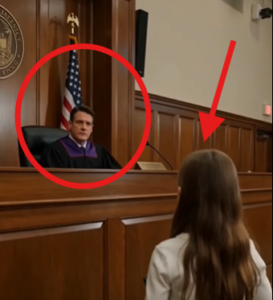
Emma walked in that day looking small — the way children always look when the world they’re standing in is too big, too loud, too complicated for their age. She clutched the tablet to her chest like it was something fragile. Like she already knew what releasing it would cost everyone in that room.
Her mother stood nearby, dressed carefully, the way people dress when they’re trying to hold themselves together on the outside because everything inside is already falling apart. She had fought hard to be believed. She had told her story over and over again, only to be dismissed, doubted, and painted as someone who was confused, emotional, or simply wrong.
The man in the brown suit had been very convincing.
He always was.
That was the thing about men like him — they never looked the part. They looked calm. Reasonable. The kind of person a judge might naturally trust. He had spent months quietly unraveling her mother’s credibility, one careful word at a time. And it was working.
Until Emma raised that tablet.
Until the screen lit up.
And in one silent, devastating moment — every carefully constructed story he had told began to collapse.
His face appeared on that screen in a way he had never intended anyone to see. Not here. Not like this. Not with a judge watching, not with those eyes fixed on him from every corner of the room.
Emma’s mother looked at the screen. Then she looked at him.
“You lied to me,” she whispered.
It wasn’t said with anger. It was said with the hollow ache of someone who had already been through so much — and had just been handed proof that the worst of her fears were real.
The bearded man standing nearby took one slow step back, staring at him with the kind of look you can’t fake and can’t forget. It wasn’t rage. It was something deeper and quieter. Betrayal. The kind that makes a room feel like the walls are closing in.
The judge’s voice came out low and deliberate.
“Do you understand what exactly this means?”
He looked like the floor had shifted beneath him. Like the air had been pulled from the room. His mouth opened, but words — those words he always had ready — were gone.
Emma was crying. She didn’t try to stop. She stood there with tears running freely down her face, and she didn’t look at the man who had caused all of this. She looked at her mother. Just her mother.
“I found it on his tablet,” she said, her voice shaking but steady underneath. “I didn’t want to show you… but he kept saying you were wrong about everything.”
There are moments in life that silence an entire room. Not the quiet of peace — the quiet of reckoning. The kind of silence that comes right before the truth lands so hard that no one knows what to say next.
This was that moment.
And then Emma spoke again.
Her voice was small. The kind of small that breaks your heart precisely because of how much it’s holding.
“Mom…” she said softly, looking at her mother with those wet, wide eyes, “that’s not the worst part.”
No one moved.
Not the judge. Not the attorneys. Not a single person who had been watching this unfold.
Emma’s fingers tightened slightly around the edge of the tablet. Her lips trembled. And she tilted the screen — just a little — toward the judge again.
There was more.
More than what they had already seen.
The judge’s expression shifted in a way that was impossible to miss. It wasn’t just serious anymore. It was alarmed. The kind of alarmed that seasoned judges — people who have seen almost everything — don’t show unless what they’re seeing is genuinely beyond the ordinary.
Emma’s mother saw that change on the judge’s face and for a moment, she stopped breathing.
“What else is on there?” she whispered.
The room seemed to lean in. Every breath held. Every eye on that small girl and the screen she was holding.
Emma looked up at her mother. She cried openly, without pretense, the way children cry when they have been carrying something too heavy for too long and finally have no choice but to set it down.
Then she turned her gaze toward the man in the brown suit.
And in a voice barely louder than a breath, she said the words that would change everything.
“He was talking about me.”
The silence that followed was different from all the others.
Because now, everyone in that courtroom understood.
This was never just about her mother.
It had always been about Emma.
And the man who had spent so long convincing everyone that the adults around him were dramatic, unstable, and untrustworthy — had been exposed, quietly and completely, by the child he had underestimated most.
Sometimes the truth doesn’t arrive with fanfare. It arrives in a small voice, trembling at the edges, held in the hands of someone who simply could not stay silent anymore.
And when it does — no amount of calm, no amount of carefully chosen words, no brown suit or polished appearance can put it back.