The freezing water hit me so hard I forgot how to breathe. One second I was standing on the porch of the mountain cabin my husband and I had built thirty-six years earlier, holding one small overnight bag and trying to leave without making a scene. The next, my own son dumped an entire bucket of melted ice water over my head while relatives watched from behind the windows. Then he pointed toward the gravel road and shouted, “Leave now, or I’ll drag you off this property myself!”
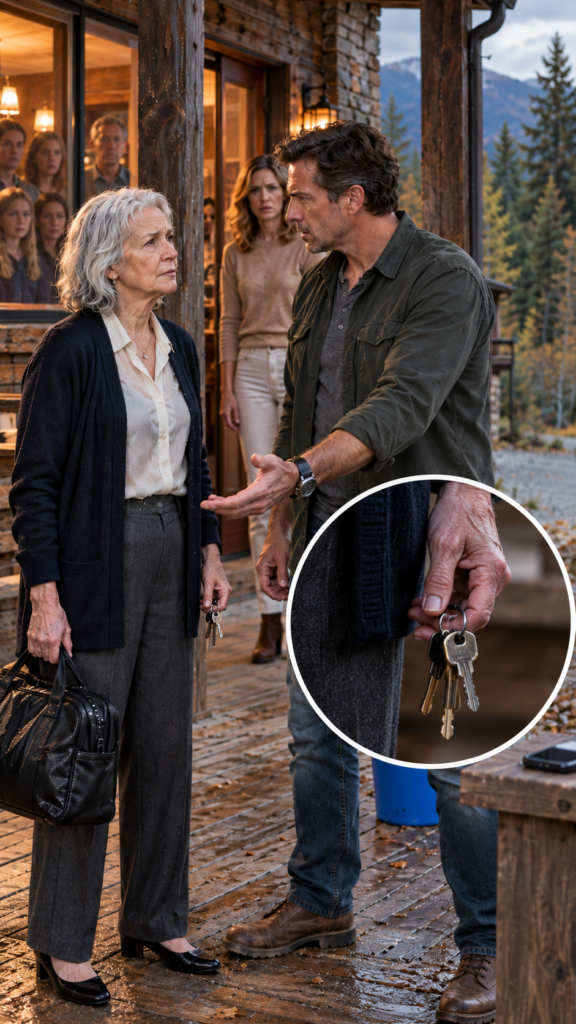
I was sixty-nine years old, soaked through in forty-eight-degree mountain air, and standing outside a house I had helped build with my own hands. Behind my son Daniel, his wife Madison pulled the front door shut and turned the lock. I could see members of my family staring through the glass, but nobody came outside. The sound of that lock hurt worse than the cold water running down my back.
My name is Eleanor Carter, and until that weekend I had spent years convincing myself Daniel was simply grieving, stressed, and struggling financially. His father, William, had died suddenly from a heart attack four years earlier, and losing him seemed to hollow something out inside our son. Daniel’s construction company had fallen on hard times, so I quietly gave him $68,000 from my savings, then another $21,000 when he and Madison needed help refinancing their home. I even paid my grandson Noah’s orthodontic bills because I believed helping family should never become a public scorecard.
But the cabin had always been different. William and I bought twenty-three acres outside Boone, North Carolina, in 1990, when Daniel was only six years old and carried nails around in the pockets of his denim overalls. William worked all week as an electrician and framed walls on weekends, while I sanded floors and stained cabinets after my cafeteria shifts and evening cleaning jobs. We didn’t buy that cabin as an investment; we built it because William had grown up moving through foster homes and wanted one front door his family could always come back to.
After William died, Daniel began speaking about the cabin as though its future had already been decided. He talked about remodeling the kitchen without asking me, changing furniture, adding bathrooms, and “modernizing” the place. Madison removed several photographs of William because she said they made the cabin feel heavy, and one day I found his old green enamel coffee mug in the garbage. When I objected, she shrugged and said, “He doesn’t need it anymore.”
Daniel always told me not to take those things personally. So for far too long, I didn’t. I told myself they were trying to move forward, that younger people saw property differently, and that preserving peace mattered more than fighting over curtains, pictures, or an old chipped mug. What I failed to understand was that Daniel had stopped seeing my generosity as something I chose to give and had started seeing everything connected to me as something he would eventually own.
The weekend everything exploded was supposed to be our annual Carter family fall gathering. I arrived Friday afternoon expecting relatives, coffee, football, and too much food, but instead I found a photographer taking pictures of the bedrooms and a drone circling above the roof. A woman with a laptop was measuring rooms while Madison casually told me they were doing “marketing.” Daniel then explained that he and Madison planned to launch my cabin as a luxury short-term rental.
Neither of them had asked me.
Daniel told me an empty property was wasted money, and Madison accused me of treating the cabin like a museum because I had never gotten over William’s death. I stayed calm and said we could cancel the photographers, enjoy the family weekend, and discuss the property privately later. That was when my son looked at me and said something I will never forget. “Mom, you need to stop calling this your home.”
I stared at him and asked what he meant. Daniel said his father had built the place for the family, then added, “And I’m the family now.” Before I could answer, Madison brought out a folder containing a fifteen-year management agreement naming Daniel’s construction company as the exclusive manager of the cabin. There was also county paperwork requesting approval to convert the property for short-term commercial lodging.
Then I saw my name.
It had already been typed beneath an owner authorization line. I asked Daniel whether he had submitted anything using my name, and for the first time that weekend, he wouldn’t give me a direct answer. He called it “preliminary paperwork” and told me I was making the situation more serious than it was. I closed the folder and said one word: “No.”
That should have ended everything, but Daniel only became more determined. The next afternoon he brought potential business partners to the cabin and placed the agreement in front of me again, apparently hoping I would be too embarrassed to refuse in front of guests and relatives. Madison asked why “a seventy-year-old widow” needed twenty-three acres and a four-bedroom cabin anyway. What hurt most was watching my son stand beside her and say nothing.
I decided to leave before anger made me say something I could never take back. My granddaughter Lily met me by the stairs with tears in her eyes and whispered, “Grandma, Dad is wrong,” but I told her she didn’t have to choose sides. I kissed her forehead, picked up my bag, and headed for my car. Then Madison followed me onto the porch and demanded my cabin keys.
I refused.
Daniel blocked my path and ordered me to hand them over, but I quietly told him that nobody had permission to use my name on county documents. The moment I said that, something changed in his face. He accused me of calling him a criminal, pointed toward the road, and shouted that I was no longer welcome at the cabin. When I calmly picked up my bag again, he grabbed the blue bucket beside the porch.
Then came the freezing water, the locked door, and the humiliation of standing outside while my own family watched. Daniel told me he had already called the county and reported me for refusing to leave private property. I almost laughed at the absurdity of it, but instead I wiped the water from my face and said, “All right. We’ll wait.” Less than ten minutes later, headlights appeared between the pine trees.
A white Watauga County vehicle rolled slowly up the gravel road. Daniel smiled as if help had finally arrived to put me in my place, while a silver-haired man stepped out carrying a folder and introduced himself as Aaron Pike from county property compliance. Aaron looked at my soaked clothes, then at Daniel, and asked whether he was the man who had filed the trespass complaint. Daniel confidently said yes.
Aaron opened his folder.
Then he looked directly at my son and asked one quiet question.
“Who exactly told you this property belonged to you?”
Daniel’s smile stayed on his face for half a second too long.
It was not the smile of someone amused. It was the expression of a man who had been moving so quickly toward an ending he had already written that he had never considered someone might stop him and read the first page.
“My father built it,” he said.
Aaron did not look down.
“I didn’t ask who built it.”
The wind moved through the pines behind us. Water slid from the ends of my hair and tapped softly against the porch boards.
Daniel’s eyes went toward the windows.
Inside, no one moved.
Aaron shifted the folder under one arm and pulled out a page.
“The county parcel record lists Eleanor Carter as the current owner of this property.”
Daniel’s jaw tightened.
“That doesn’t tell the whole story.”
“It tells enough of the story for a trespass complaint.”
Madison unlocked the door behind him.
The deadbolt turned with the same metal click I had heard minutes earlier, only this time nobody stepped through it.
She stood in the doorway with one hand still on the lock.
Aaron glanced at me.
“Mrs. Carter, do you want to be on this property?”
The question was so simple that for a moment I could not answer.
Thirty-six years of weekends lived inside it.
William balancing on rafters with a pencil behind his ear. Daniel at six years old carrying crooked boards twice his height. Christmas mornings. Muddy shoes. Pancakes. William sleeping in a chair after working twelve hours and then driving two more to get here.
I looked at the house.
“Yes.”
Aaron nodded once.
“Then you are not trespassing.”
Something inside my chest loosened.
Not because I had doubted it.
Because my own son had tried to make me doubt whether I still had the right to stand in a place where I had once sanded the floors on my knees.
Daniel stepped forward.
“She’s twisting this. She doesn’t even live here full-time.”
Aaron turned to him.
“Occupancy isn’t ownership.”
“We manage the place.”
“Do you?”
The question landed differently.
Daniel’s mouth closed.
Aaron opened the folder again.
“I was already coming here before you called.”
That stopped everyone.
Even Madison.
Daniel stared at him.
“What?”
Aaron pulled another page free.
“The commercial lodging application triggered a property-record review this morning. The owner authorization attached to the submission raised a question.”
My wet fingers tightened around the handle of my bag.
Daniel’s face changed.
Not dramatically.
That made it worse.
His shoulders lifted slightly. His chin pulled back. His eyes flicked toward Madison, then toward the people still standing inside.
Aaron looked at me.
“Mrs. Carter, did you authorize your son or his company to submit an application on your behalf?”
“No.”
The word left me quietly.
It seemed to travel through the entire house.
Aaron turned back to Daniel.
“Did you represent to the county that you had the owner’s authorization?”
Daniel exhaled through his nose.
“It was preliminary.”
“That isn’t an answer.”
“We were trying to get the process started.”
“With her permission?”
Daniel said nothing.
A chair scraped somewhere inside.
One of the potential business partners stepped away from the dining room doorway.
I recognized him from that afternoon, though we had barely spoken. He looked at Daniel, then at the folder in Aaron’s hands.
“You told us the owner had agreed.”
Daniel turned sharply.
“She was going to.”
My stomach dropped.
Not because I was surprised anymore.
Because I finally understood how far ahead he had traveled without me.
Madison closed her eyes.
Only for a second.
Aaron’s voice remained level.
“Mrs. Carter?”
I looked at him.
“Did you agree in principle?”
“No.”
“Did you authorize marketing?”
“No.”
“Did you authorize photographs for commercial listing?”
“No.”
“Did you authorize a fifteen-year management agreement?”
“No.”
Daniel threw up both hands.
“She knew we had ideas.”
“I knew you wanted to remodel my kitchen.”
“That’s not fair.”
I stared at him.
The water had turned icy beneath my collar.
“No, Daniel. What you did isn’t fair.”
He looked at me then.
Really looked.
Maybe for the first time all weekend.
His expression faltered, but anger rushed in to cover it.
“You let this place sit empty half the year.”
“It is mine to let sit empty.”
“You helped me with the company because you believed in it.”
“I helped my son because he was struggling.”
“We could have made money here.”
“You could have made money here.”
Madison stepped onto the porch.
“Eleanor, nobody was trying to steal anything.”
I turned toward her.
“My name was on paperwork I never approved.”
“It was typed.”
The sentence came out too quickly.
Daniel looked at her.
Madison froze.
Aaron’s attention shifted.
“What do you mean?”
She swallowed.
“I mean there wasn’t a signature.”
Daniel spoke over her.
“Madison.”
But she continued.
“We told them Eleanor was going to sign once she saw the numbers.”
The potential partner inside moved another step backward.
Daniel turned on her.
“Stop talking.”
Madison’s face went pale.
“You told me she’d come around.”
“I said stop.”
“No.”
The word surprised all of us.
Madison looked at me, then at Daniel.
“You said if we got far enough into the process, she wouldn’t want to embarrass you by pulling out.”
Daniel’s face emptied.
There it was.
Not a forged signature.
Not some elaborate hidden conspiracy.
Something sadder.
He had built an entire plan around the belief that I could be pressured into surrendering because I loved him too much to humiliate him.
I thought of the $68,000.
The $21,000.
Noah’s orthodontics.
Every grocery bill I had quietly covered. Every time I had told him not to worry about paying me back. Every moment generosity had taught him the wrong lesson because neither of us had ever forced him to learn the right one.
Aaron closed the folder.
“The lodging application is suspended. Nothing moves forward without verified owner authorization.”
Daniel rubbed both hands over his face.
“What about the complaint?”
Aaron looked toward me.
“There is no basis for removing the recorded property owner from her own property based on what I have here.”
The potential business partner reached for his coat.
Daniel saw him.
“Where are you going?”
The man stopped.
“You told us this was settled.”
“It is.”
“No, it isn’t.”
“We can fix it.”
The man’s eyes moved to me standing soaked beside my overnight bag.
“No.”
Then he left.
The other person who had come with him followed.
Neither looked at Daniel on the way out.
The silence afterward was enormous.
I could hear the engine of their vehicle start below the porch.
Daniel’s breathing changed.
It became shallow and quick, the way it had when he was a boy trying not to cry after getting hurt in front of other children.
For one dangerous second, my body remembered being his mother before my mind remembered what he had just done.
I almost stepped toward him.
Then Lily appeared behind Madison.
Her eyes landed on my wet clothes.
She covered her mouth.
“Grandma.”
Daniel turned.
“Go inside.”
She did not move.
“Lily.”
“No.”
Her voice trembled.
He stared at her.
She walked past her mother and came onto the porch.
Then she took off the oversized cardigan she was wearing and tried to put it around my shoulders.
It was too small.
That nearly broke me.
I caught her hands.
“Sweetheart, keep it on.”
“You’re freezing.”
“I’m all right.”
“You’re shaking.”
I was.
I had not noticed.
Lily looked at her father.
“What did you do?”
Daniel’s eyes hardened from shame.
“This is between adults.”
“You dumped water on Grandma.”
“Lily.”
“You locked her out.”
“Enough.”
“No.”
She moved closer to me.
I had told her she did not have to choose sides.
Standing there, I understood something I should have told her instead.
There are moments when refusing to choose is not peace.
It is permission.
Aaron asked whether I wanted medical attention.
I told him no.
What I wanted was dry clothes.
What I wanted was William.
What I wanted was to wake up three days earlier and still be a woman who believed her son had simply become careless with her feelings.
Aaron handed me his card.
“There will be follow-up on the application. They may need a statement confirming you did not authorize it.”
“I’ll give one.”
Daniel stared at me.
“Mom.”
I looked at him.
That single word had rescued him from consequences for most of his life.
Mom.
It had meant lend me money.
Forgive me.
Understand me.
Don’t embarrass me.
Don’t make me pay for what I did because I am yours.
Not this time.
“Yes?”
He looked around at everyone watching.
His voice dropped.
“Can we talk privately?”
“No.”
His eyes widened.
I had never refused him that way.
Not angrily.
Not loudly.
Just completely.
“You wanted witnesses when you put the agreement in front of me,” I said. “You wanted witnesses when you demanded my keys. You were comfortable humiliating me in front of this family. So whatever you need to say now, you can say here.”
Madison looked away.
Daniel’s lips parted.
Nothing came out.
That was when I knew the moment had passed.
Not the moment to punish him.
The moment to save him from himself.
I walked toward the door.
Madison stepped aside.
I stopped at the threshold.
“That lock gets changed tonight.”
Daniel laughed once in disbelief.
“You’re kicking us out?”
“I’m removing your access to my property.”
“Dad would never have done this.”
The words hit exactly where he meant them to.
For years, invoking William had been the easiest way to make me question myself.
This time I did not.
“Your father would never have poured freezing water over his mother.”
Daniel flinched.
Nobody spoke.
I walked inside.
The warmth of the cabin hurt my skin.
My relatives scattered instinctively to give me space, and that hurt too. They had watched through the glass. Some had looked frightened. Some ashamed. Some simply frozen.
My sister-in-law Ruth came toward me with two towels.
“I’m sorry.”
I took them.
“For what?”
Her eyes filled.
“For not opening the door.”
That answer mattered.
Not because it fixed anything.
Because it was true.
One by one, people began finding their voices.
My nephew admitted he had assumed Daniel must know something about the ownership that they did not. A cousin said she had been afraid of escalating things. Someone else whispered that when Daniel said he had called the county, they thought authorities were coming to remove me.
I listened.
Then I said, “Being confused explains silence for a minute. It doesn’t explain watching someone you love be humiliated and doing nothing.”
No one defended themselves after that.
Lily led me upstairs.
In the bedroom William and I had shared, she found dry clothes while I stood near the old dresser shivering so hard I could barely undo the buttons of my blouse.
She helped me without speaking.
When I finally sat on the edge of the bed, wrapped in a blanket, she knelt in front of me.
“Grandma?”
“Yes?”
“Are you going to forgive Dad?”
I stared at the floorboards William and I had sanded thirty-six years earlier.
“I don’t know.”
She nodded.
“I think that’s okay.”
I looked at her.
She was crying silently.
I reached down and wiped one tear from her cheek.
“You are not responsible for what happens between your father and me.”
“But I knew they were planning something.”
My hand stopped.
“What did you know?”
“Not everything.”
She looked terrified.
“I heard Mom and Dad arguing about the cabin before this weekend. Dad said once you saw how much money it could make, you’d stop being emotional.”
I closed my eyes.
Lily rushed on.
“I should’ve told you.”
“No.”
“I should have.”
“You are his daughter. You should never have been put in the middle.”
“But if I’d told you—”
“He would still have made the choices he made.”
That silenced her.
I held out my arms.
She came into them.
For a while, neither of us said anything.
Downstairs, Daniel left before I came back down.
Madison went with him.
He did not take the cabin keys because they had never left my hand.
The locksmith arrived before sunset.
Aaron had given me the number of a local company used by property owners dealing with access disputes, and by seven o’clock every exterior lock had been changed.
I stood beside the front door while the locksmith handed me three new keys.
Three.
I stared at them in my palm.
For years I had given Daniel one without thinking.
That night I gave one to Lily.
She looked at me in surprise.
“Why me?”
“Because a key isn’t a reward.”
I folded her fingers around it.
“It’s trust.”
Her face crumpled.
She hugged me carefully.
The next morning I drove into Boone and met an attorney.
By Monday, the county had my written statement confirming that I had never authorized commercial use, never approved Daniel’s company as manager, and never granted anyone permission to submit an application in my name.
The application was withdrawn from consideration.
Daniel’s plan ended before a single guest ever booked a night.
But that was not the consequence that changed him.
Two weeks later, I asked him to meet me at my attorney’s office.
He arrived looking exhausted.
No Madison.
No folder.
No confident voice.
He sat across from me and stared at the table.
My attorney placed several documents between us.
I had updated my estate plan.
Daniel looked at me.
“What is this?”
“The cabin is going into a family trust.”
His face tightened.
“For who?”
“For the grandchildren.”
He went still.
“The property cannot be sold for commercial development by any beneficiary. It cannot be pledged as security for anyone’s company. No beneficiary can appoint themselves manager or force another beneficiary to sell.”
His eyes moved slowly over the documents.
“You’re cutting me out.”
“I am protecting something you tried to take control of.”
“I’m your son.”
“Yes.”
“That means nothing?”
“It means I love you.”
He looked up.
“Then why are you doing this?”
“Because loving you and trusting you with this property are no longer the same thing.”
He stared at me for a long time.
Then came the anger.
It was quieter now.
More frightened.
“Dad wanted this cabin to stay in the family.”
“It will.”
“He meant me.”
“No.”
“You don’t know that.”
“I knew your father for forty-three years.”
Daniel pushed his chair back.
“He built it for us.”
“We built it together.”
“He did the framing.”
“I worked two jobs and paid for half the materials.”
Daniel looked away.
I leaned forward.
“You have erased me from the story of this cabin little by little because it made what you wanted easier to justify.”
He said nothing.
“You talked about your father building it. You talked about what he would have wanted. You talked about family as though I was already gone.”
His face reddened.
“That wasn’t what I meant.”
“It became what you did.”
His hands flattened on his knees.
“I was trying to save my company.”
There it was.
The first honest sentence.
I waited.
He swallowed.
“We’re worse off than I told you.”
I felt the old instinct rise immediately.
How much?
What do you need?
How can I help?
I let the questions die before they reached my mouth.
Daniel saw it.
Maybe that hurt him more than anything.
“I thought if the cabin produced income, I could stabilize things.”
“You could have asked me.”
“You would’ve said no.”
“Yes.”
He laughed bitterly.
“Exactly.”
I shook my head.
“No, Daniel. That is not permission.”
His eyes filled.
He looked furious about it.
“I’ve spent four years watching everything fall apart.”
“Your father died.”
“My father died, my company started failing, and every time I looked at you, you were still standing.”
I went quiet.
He rubbed his face.
“You still had the cabin. You still had savings. You still had everything you and Dad built. I felt like I was losing every piece of him and you were just… holding all of it.”
The sentence wounded me in a new place.
Not because it excused him.
Because finally I could see the grief underneath the entitlement.
“You thought I wasn’t losing him because I still had the house?”
Daniel’s shoulders dropped.
“I don’t know what I thought.”
“I woke up beside your father for forty-three years.”
My voice broke.
“I reached for him in my sleep for months after he died.”
Daniel looked at me.
“I couldn’t walk into the garage without expecting to hear him whistle. I stopped making pancakes for almost a year because he always stole the first one from the plate. I came up to that cabin alone and sat on the porch until dark because the chair beside me stayed empty.”
His mouth trembled.
“Do not mistake the fact that I survived your father for proof that I lost less than you.”
He covered his face.
For the first time since William died, my son cried in front of me.
Not loudly.
No dramatic apology.
His shoulders folded inward, and he sat there with both hands pressed over his eyes.
I did not go around the table.
That mattered.
He needed to feel grief without my rescuing him from the consequences attached to it.
When he finally lowered his hands, he whispered, “I’m sorry.”
I looked at him.
“For which part?”
His face crumpled again.
“The water.”
I waited.
“The paperwork.”
I waited.
“The money.”
My eyebrows lifted.
He shook his head.
“Not the money you gave me. The way I started thinking every time I needed something, you’d fix it.”
He took a breath.
“The way I talked about the cabin like you were already dead.”
That was the one.
I looked down because my eyes filled too quickly.
Daniel continued.
“And the way I used Dad because I knew you would listen if I made it sound like something he wanted.”
Silence filled the office.
My attorney quietly left the room.
Daniel looked at the closed door.
“I don’t expect you to forgive me.”
“Good.”
He nodded.
That surprised him less than it would have a month earlier.
“I can love you,” I said, “and still require you to live with what you did.”
“I know.”
“No more money.”
He closed his eyes briefly.
“I know.”
“No access to the cabin unless I invite you.”
“I know.”
“No involvement in the property.”
He nodded.
“And you will never again use my name, my finances, my property, or my relationship to you to open a door I have not opened myself.”
He met my eyes.
“I won’t.”
I watched him for a long time.
“Those are not punishments.”
His brow furrowed.
“They are boundaries. If you treat them like punishment, then you still don’t understand.”
He looked down.
“I’m trying to.”
That was the most I could ask for.
Not transformation.
Not redemption delivered neatly in one conversation.
Trying.
Madison took longer.
For nearly two months, she did not call me.
Then a handwritten envelope arrived.
I almost threw it away.
Instead, I opened it at my kitchen table.
There was no excuse inside.
No explanation about stress or money or Daniel.
She wrote that throwing away William’s photographs and his mug had been cruel. She admitted she had resented entering a family where every room seemed to carry a memory she could never compete with, and instead of admitting that insecurity, she had tried to erase the memories.
She wrote that she had confused being uncomfortable with being entitled to change things that were not hers.
The last line said, I understand if being sorry does not earn me access to you.
I read it twice.
Then I put it in a drawer.
I did not call.
Not yet.
Healing is not the same thing as reopening every door.
Winter came early that year.
The first snow settled on the mountain in November.
I drove to the cabin alone.
For the first time since the confrontation, I stayed overnight by myself.
I made coffee before sunrise and carried it onto the porch wrapped in William’s old wool coat.
The new locks turned smoothly.
No drone circled above the roof.
No photographer measured bedrooms.
No folder waited on the table.
The silence had returned.
But it no longer sounded like abandonment.
It sounded like mine.
Near Christmas, Noah came to see me.
He was taller than I remembered.
He stood awkwardly inside my kitchen and thanked me again for paying for his orthodontic work years earlier.
“You don’t owe me gratitude forever for braces.”
He smiled.
“I know.”
Then he became serious.
“I also don’t owe Dad agreement just because he’s my father.”
I looked at him.
“Did Lily send you?”
“No.”
A pause.
“Okay. She might’ve threatened me.”
I laughed for the first time in days.
Noah sat across from me.
“I’m sorry I wasn’t at the cabin that weekend.”
“I’m glad you weren’t.”
“I heard what happened.”
“I assumed.”
He looked down.
“Dad told me his version first.”
“And?”
“It kept changing.”
That made me smile sadly.
“He’s getting help.”
I did not ask what kind.
That was Daniel’s work.
Noah reached across the table.
“I don’t want the cabin if getting it means waiting for you to be gone.”
My throat tightened.
“That is exactly why I want you and Lily to have it someday.”
He looked startled.
I squeezed his hand.
“But someday is not today.”
He nodded.
“Good.”
The following fall, I held the family gathering again.
Not because tradition demanded it.
Because I chose to.
The guest list was smaller.
Some relatives never received another invitation after I realized their silence that afternoon had not been confusion but convenience.
Others had apologized without asking me to make them feel better about it.
Those people came back.
Lily arrived first.
She carried groceries in both arms and complained that I had bought enough butter to feed the entire county.
Noah arrived an hour later with firewood.
Daniel came last.
He parked at the bottom of the drive.
He did not have a key.
That was intentional.
He walked to the front door and knocked.
I stood inside with my hand on the knob.
For a moment I saw him at six years old again, denim overalls dusty at the knees, nails in his pockets, waiting for William to tell him where the next board went.
Then I saw the man on the porch with the blue bucket.
Both were my son.
Neither erased the other.
I opened the door.
“Hi, Mom.”
“Hi, Daniel.”
He did not step inside.
“May I come in?”
That question changed more than any apology could have.
I moved aside.
“Yes.”
He entered as a guest.
Not an owner.
Not a manager.
Not a man waiting for me to disappear so his life could begin.
A guest.
And strangely, that made room for him to become my son again.
Madison did not come that year.
She and Daniel were still together, but they were working through things I did not need to supervise.
I had spoken with her twice.
Carefully.
Briefly.
There had been no grand reconciliation.
Only truth.
Sometimes truth is enough to begin.
Dinner was loud.
Noah burned the rolls.
Lily accused him of doing it deliberately because he hated being asked to cook.
Ruth brought too many pies.
Daniel washed dishes without anyone asking.
At one point I found him standing near the wall where William’s photographs had been rehung.
Every one of them.
He stared at a picture of himself at seven years old sitting on William’s shoulders beside the unfinished cabin frame.
I came to stand beside him.
“I remember that day,” he said.
“So do I.”
“I thought Dad was the strongest person in the world.”
“He thought the same thing about you.”
Daniel’s eyes closed.
I let that sit between us.
Then he looked at me.
“Mom?”
“Yes?”
“I know the trust is final.”
“It is.”
“I’m not asking you to change it.”
I waited.
He swallowed.
“I’m glad.”
That surprised me.
He looked toward the dining room where Lily and Noah were arguing over pie.
“I don’t think I should ever get to decide what happens to this place.”
I studied his face.
For once, there was nothing behind the words.
No angle.
No request.
Just understanding.
I touched his arm.
“Then maybe you finally understand what your father wanted.”
Daniel’s eyes moved back to William’s photograph.
“A place the family could come back to.”
“Yes.”
“Not a place somebody gets to own everyone else through.”
My throat tightened.
“No.”
He nodded.
Then Lily called from the kitchen.
“Grandma, come here.”
Something in her voice made me turn.
She stood beside the old china cabinet holding a small cardboard box.
“What are you doing?”
“Just open it.”
Daniel looked confused.
Noah was smiling.
Apparently I was the only person who did not know.
I lifted the lid.
For one second, I could not understand what I was seeing.
Then my knees nearly gave way.
Inside the box was a green enamel coffee mug.
Chipped along the rim.
Scratched near the handle.
William’s.
My hand flew to my mouth.
“No.”
Lily started crying before I did.
I lifted the mug with both hands.
“Where did you get this?”
She wiped her cheek.
“The garbage.”
I stared at her.
“Four years ago?”
She nodded.
“I saw Mom throw it away.”
Daniel went completely still.
Lily looked at me.
“You were upstairs. I took it out before the trash went outside.”
My fingers moved across the chipped enamel.
It was cold.
Solid.
Real.
“I washed it,” she said. “Then I hid it because Mom was angry whenever Grandpa’s things were around.”
“Why didn’t you tell me?”
Lily’s face crumpled.
“I was a kid. I thought if I told anybody, they’d throw it away again.”
I pulled her into me with one arm while still holding the mug in the other.
She laughed through tears.
“I kept moving it.”
“Where?”
“My closet. Then my dorm stuff. Then Noah’s apartment for a while.”
Noah lifted both hands.
“I was sworn to secrecy.”
I laughed and cried at the same time.
Daniel had not moved.
His eyes were fixed on the mug.
Finally he whispered, “I didn’t know.”
Lily looked at him.
“I know.”
There was no accusation in her voice.
That made it heavier.
Daniel sat down at the table.
He pressed his thumb and forefinger against his eyes.
“I let her do that.”
I knew he meant Madison.
The photographs.
The mug.
The slow removal of William from rooms where Daniel had been too afraid to face his own grief.
I sat across from him.
“You did.”
He lowered his hand.
“I’m sorry.”
This time I did not ask for which part.
He already knew.
I turned the mug over.
William’s initials were still scratched into the bottom.
W.C.
He had done that because at construction sites people stole each other’s coffee mugs.
I suddenly remembered teasing him about it.
Who is going to steal that ugly thing?
Somebody with excellent taste, he had answered.
I laughed aloud.
Everyone looked at me.
“What?”
I shook my head.
“Nothing.”
But it was not nothing.
For four years I had believed one small piece of William had been thrown away because someone decided a dead man no longer needed it.
The truth was different.
A fourteen-year-old girl had quietly reached into the garbage and rescued it.
While the adults were fighting over grief, inheritance, ownership, and whose memories mattered, Lily had understood something none of us did.
Love was not preserving every object.
It was recognizing the ones that carried a person home.
Later that evening, the others drifted toward the fireplace.
I washed William’s mug carefully.
The enamel had dulled.
The chip had grown slightly darker.
It was imperfect.
So was everything else worth keeping.
I poured coffee into it.
Daniel watched from the doorway.
“You’re actually going to use it?”
“Of course.”
“What if it breaks?”
I wrapped both hands around the warmth.
“Then it breaks after being loved.”
He smiled.
A small smile.
Nothing like the one he had worn when the county vehicle arrived a year earlier.
Lily opened the front door to let in the cold evening air.
Outside, the pines moved beneath a darkening blue sky.
Lights glowed from the cabin windows and spread across the porch William and I had built before any of us knew how much life would happen there.
Noah carried another log to the fire.
Ruth called everyone for pie.
Daniel stood at the door and waited for me instead of walking ahead.
I took William’s green mug with me.
Before stepping into the dining room, I glanced toward the hook beside the entrance.
Three keys hung there.
Mine.
Lily’s.
Noah’s.
Daniel looked at them too.
Then he looked away without asking.
I reached for his hand.
His fingers closed around mine carefully.
Not possession.
Not entitlement.
Just a son holding his mother’s hand.
We walked back toward the voices together.
Behind us, the front door remained open for another few seconds, letting the mountain air move through the house.
Then Lily crossed the room and closed it softly.
Not to keep anyone out.
Because everyone who belonged there was finally home.






