The plate struck my forehead so hard that I never heard it break. For several seconds, all I heard was ringing inside my skull while something warm slid down the bridge of my nose. When I touched my face, my fingers came away covered in blood. My daughter-in-law, Marissa, was still standing in front of me with her arm raised.
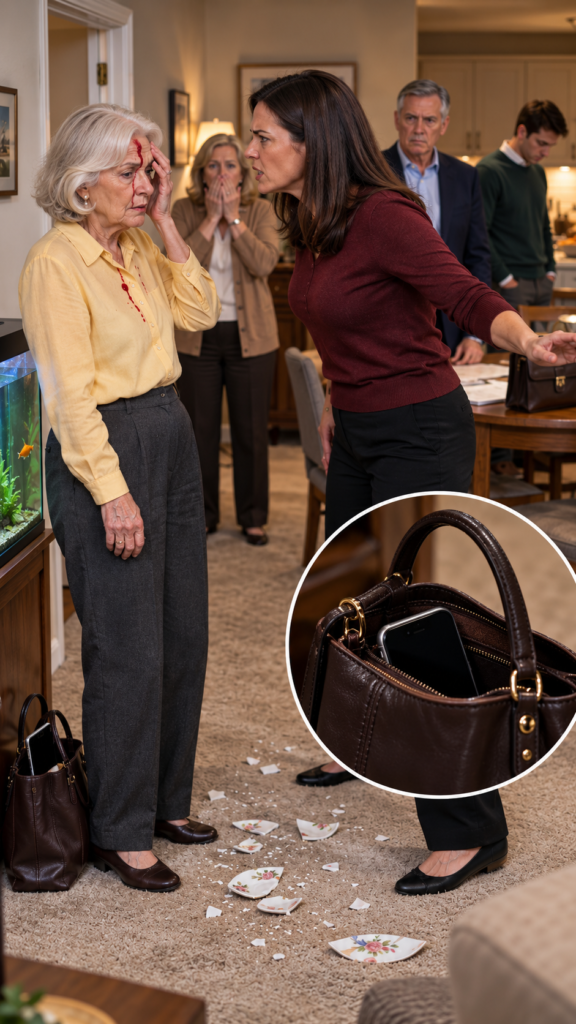
“How dare you refuse my mother?” she screamed. Her face was bright red, and her whole body shook with rage. “You selfish old woman! You have two houses, and my mother has nowhere to live!” No one in the room moved.
White pieces of the plate lay scattered across my grandson’s carpet. One piece had even fallen into the fish tank, frightening the little orange fish into hiding. Diane, Marissa’s mother, held both hands over her mouth as if she were shocked. But I knew that look was not horror—it was fear that their plan had gone too far.
Marcus, Marissa’s father, stood near the dining table with a leather briefcase beside him. He was a lawyer who handled wills, property transfers, and powers of attorney. He had come to dinner carrying documents that would place my rental house in Marissa’s name. Other papers would have given my grandson Tyler control over my money, property, and medical decisions.
Tyler stood by the kitchen counter, pale and silent. This was the boy I had raised since he was three years old, after his mother disappeared from our lives. I had worked night shifts at a button factory, bought his clothes at yard sales, and skipped meals when money was tight. Now he could not even look at me.
The gathering had been presented as a celebration for Tyler’s new job. I had worn a yellow blouse I found at a thrift store and baked his favorite apple cake. For half an hour, everyone had acted warm and cheerful. Then Marcus opened his briefcase and placed a pen in front of me.
They called the papers “routine family planning.” The property transfer would give my rental home to Marissa and Diane. The monthly support agreement would require me to pay Diane fifteen hundred dollars every month. The power of attorney would give Tyler control over almost every part of my life.
I refused to sign.
Marissa’s smile disappeared the moment I said no. Diane began crying loudly and accused me of wanting her to live on the street. Marcus warned me that resisting family planning could create “future complications.” Tyler kept staring at the table.
When I stood to leave, Marissa blocked the door. She told me I was not going anywhere until the matter was settled. I ordered her to move, but she pointed at the papers and demanded that I sign them. When I refused again, she grabbed the flowered plate from the table.
Now blood dripped from my chin onto the blouse I had bought for Tyler’s celebration. Marissa demanded the house again, her voice shaking with fury. She said that if I refused to transfer it, I had to pay her mother’s rent for the rest of her life. The entire room waited for me to surrender.
Instead, I smiled.
It was not because I felt no pain. My head was pounding, my grandson had betrayed me, and the family I thought I had was collapsing in front of me. But as I looked at each frightened face, I realized they still believed they had control. They had no idea how carefully I had been watching them.
“You don’t know what I already did,” I said.
Marissa’s face changed instantly. The red drained from her cheeks until she looked almost gray. Diane lowered her hands from her mouth, and Marcus stopped moving toward the door. Even Tyler finally looked at me.
“What are you talking about?” Marissa asked. Her voice was much smaller now. Marcus stepped forward and asked which people I had contacted. I did not answer him immediately.
I let them wonder.
Four months earlier, Marissa and Diane had cornered me in Tyler’s kitchen while I washed dishes after Sunday lunch. Marissa told me that Diane needed a place to stay because her latest housing arrangement had ended. She suggested that Diane move into my spare bedroom or take over my rental house across town. She spoke as though the decision had already been made.
That rental house was not an extra toy. I had bought it in 1989 after years of double shifts, packed lunches, and cheap dinners. It was now my safety net, producing income that helped cover taxes, repairs, insurance, and my future care. A young family with twin babies lived there and paid their rent on time.
When I told Marissa the house was occupied, Diane said leases could be ended for family reasons. She smiled as if removing two parents and their babies from their home would be a small inconvenience. I dried my hands, turned to both women, and gave them one answer. No.
From that moment, every family gathering became a punishment. Marissa made loud comments about selfish people who owned two houses. Diane complained constantly about the cost of rent. At Christmas, they gave me a book about seniors clearing out their belongings and preparing for the next stage of life.
Tyler slowly stopped meeting my eyes. At first, he only looked away when Marissa insulted me. Then he avoided looking at me when he said hello, when he left, and whenever I asked him a question. It felt as though my grandson was disappearing while sitting only a few feet away.
Nine weeks after I first refused them, Marissa appeared at my house carrying a blue folder. She walked inside without waiting for an invitation and spread papers across my coffee table. They were articles about scams, memory loss, dementia, and financial guardianship. Several sections had been highlighted.
She told me elderly people often failed to recognize their own confusion. Then she produced a power-of-attorney form that would give Tyler access to my accounts. When I refused, she smiled and told me not to blame the family when something eventually happened to me. That sentence stayed with me.
A few days later, Tyler called and accused me of being rude to his wife. I asked whether he believed I was losing my mind. He said no, but he still insisted that giving him control would make things easier. When I asked easier for whom, he ended the call.
Then a letter arrived from my bank.
Someone had tried to add Tyler as an authorized user on one of my accounts. The request had been rejected because the signature did not match mine. I read the notice three times before driving to the bank. The manager confirmed that someone had submitted an application using a forged version of my signature.
That was the moment I stopped believing this was merely a family disagreement. Someone was trying to create access to my money without my permission. Someone had already copied my personal information. And someone seemed certain that an old woman would be too confused or frightened to fight back.
I left the bank and made my first call.
Then I made another.
Then several more.
Now, standing in Tyler’s living room with blood on my face, I reached into my purse. Marissa stepped backward, and Marcus stared at my hand as though I might pull out a document that could destroy them. Tyler whispered my name, but I did not look at him.
I pulled out my phone.
“I called an attorney,” I said. “I called my bank. I called a doctor. I called the county recorder’s office.” Then I pressed the emergency-call button and looked directly at Marissa. “And now I’m calling the police.”
The color vanished from every face in the room.
But the police were not the only reason they should have been afraid.
The dispatcher answered before Marissa found her voice.
I gave my name, Tyler’s address, and told her I had been struck in the head with a ceramic plate after refusing to sign documents transferring my property and finances. My voice sounded strange to me—too calm, almost ordinary—while blood continued slipping past my eyebrow.
Marissa lunged one step toward me.
Marcus caught her wrist.
“Don’t,” he said.
It was the first sensible thing anyone in that room had done all evening.
Marissa jerked free and stared at him. “You’re just going to let her say that?”
Marcus did not answer.
His eyes were fixed on my phone.
The dispatcher asked whether the person who hit me was still present.
“Yes.”
Marissa opened her mouth.
Marcus snapped, “Be quiet.”
That silenced everyone.
Even Diane.
I could hear the aquarium filter humming behind me. The little orange fish had emerged from the plastic castle and hovered near the opposite corner of the tank, as far from the broken piece of china as it could get.
I understood the feeling.
The dispatcher told me officers were on the way and asked whether I felt dizzy.
“A little.”
“Sit down if you can.”
I looked at the chair Marissa had ordered me into twenty minutes earlier, when she still believed I would sign whatever Marcus placed in front of me.
“No,” I said. “I’m all right standing.”
Tyler finally moved.
He came away from the kitchen counter slowly, both hands visible at his sides.
“Grandma.”
I looked at him then.
His face crumpled in a way I had not seen since he was a child.
“Don’t call me that right now.”
He stopped.
The words hurt me almost as much as they hurt him, but I did not take them back.
Marcus glanced toward the dining table.
The papers were still there.
The deed.
The monthly payment agreement.
The power of attorney.
A pen lay across the top sheet.
“Those documents stay exactly where they are,” I said.
Marcus’s expression changed.
Just slightly.
But I saw it.
“Those are drafts,” he said.
“Good. Then you won’t mind the police seeing them.”
His jaw tightened.
Marissa turned on him. “Do something.”
He looked at her with a coldness I had never seen before.
“I told you not to touch her.”
Diane gave a sharp breath.
Marissa stared at her father.
“You said she’d fold.”
Nobody spoke.
Marcus closed his eyes for half a second.
That half second told me more than any confession could have.
I lowered the phone from my ear when the dispatcher said officers had arrived outside.
Blue light flashed against the living-room window.
Marissa backed away from me.
The same woman who had blocked the door ten minutes earlier now moved toward it as though she wanted to disappear through the wall.
Tyler reached for the lock.
“Leave it,” I said.
He obeyed.
Three knocks sounded.
Firm.
Measured.
Tyler opened the door.
Two officers stepped inside.
Everything changed the moment strangers entered the room.
Marissa’s shoulders dropped. Diane began crying. Marcus straightened his jacket. Tyler moved aside.
And I suddenly felt very tired.
One officer looked at my forehead, then at the shattered plate.
“Ma’am, who did this?”
Marissa answered before I could.
“It was an accident.”
I looked at her.
She looked back.
For the first time that night, there was no anger in her face.
Only calculation.
“She threw the plate at me,” I said.
“I did not throw it at you.”
The other officer turned toward Marissa.
“Please don’t speak over her.”
“It slipped.”
I almost laughed.
Instead, I touched the edge of the dining chair to steady myself.
“She was holding it in her hand,” I said. “She demanded that I sign those documents. I refused. She struck me with it.”
Diane’s crying became louder.
Marcus stared at the floor.
The officer looked toward Tyler.
“Were you here?”
Tyler swallowed.
“Yes.”
“Did you see what happened?”
Marissa turned so fast I heard the fabric of her blouse pull across her shoulder.
“Tyler.”
He flinched.
The officer waited.
Tyler looked at his wife.
Then at me.
Then at the blood on my yellow blouse.
His mouth opened, but nothing came out.
For a few terrible seconds, I was back in that button factory thirty years earlier, standing under fluorescent lights at two in the morning while my feet throbbed inside cheap shoes, calculating whether I had enough money left after rent to buy Tyler a winter coat.
I remembered carrying him asleep from the car.
Teaching him to tie his shoes.
Sitting beside his hospital bed when he had pneumonia at seven.
Clapping so hard at his high school graduation that my hands hurt.
All of it seemed to gather between us.
Tyler looked at the officer.
“She threw it.”
Marissa stopped breathing.
“She picked up the plate,” he continued, his voice shaking, “and she threw it at Grandma.”
The room became utterly still.
Marissa stared at him.
“You coward.”
He did not answer her.
The officer stepped between them.
What happened next moved quickly.
Marissa was separated from the rest of us. Marcus was told not to touch the papers. Diane was taken into the kitchen to give her account. An ambulance crew arrived and cleaned the cut above my eyebrow while an officer photographed the broken plate and the blood on my blouse.
Nobody touched the apple cake.
It sat in the center of the table with one slice missing.
I had cut that slice for Tyler before Marcus opened his briefcase.
The sight of it nearly broke me.
One of the paramedics asked if I wanted to go to the hospital.
I said yes.
Not because I was frightened of the cut.
Because I wanted to leave that house with someone who was not asking me for anything.
As they walked me toward the door, Tyler followed.
“Grandma, please.”
I stopped without turning around.
“I told them the truth.”
“Yes.”
“I should have done it sooner.”
“Yes.”
“I’m sorry.”
My hand tightened around the strap of my purse.
I wanted to turn around.
I wanted to touch his face and tell him everything could be repaired because that was what I had always done for him.
Fixed things.
Paid things.
Forgiven things.
Made room.
Instead, I said, “Sorry is what you say after you break a cup, Tyler. I don’t know what this is yet.”
Then I walked outside.
The cold air hit my face and made the cut sting.
I was grateful for the pain.
It kept me from looking back.
At the hospital, the doctor told me the wound was superficial but needed stitches.
While he worked, I stared at the ceiling tiles and listened to the soft click of metal instruments on a tray.
“Any nausea?”
“No.”
“Confusion?”
“No.”
“Memory problems?”
I looked at him.
He immediately understood why I had gone quiet.
“No,” I said again. “And that question has become very important lately.”
The doctor paused.
Then he lowered his voice.
“Do you feel safe going home?”
For the first time that evening, someone asked me a question that had nothing to do with what I owned.
“Yes,” I said.
And I meant it.
My house was mine.
My accounts were mine.
My decisions were mine.
Four months earlier, after that first conversation about the rental property, I had ignored the tightness in my stomach because I did not want to believe my family could be planning around me instead of with me.
After the forged bank request, I stopped ignoring it.
My attorney had helped me put written instructions in place making clear that no one had authority over my property or medical decisions.
The bank had added heightened verification requirements to every account in my name and preserved the rejected authorization request for investigation.
My doctor had completed a full cognitive evaluation at my request and documented that I was competent, independent, and fully capable of managing my affairs.
And the county recorder’s office had placed a fraud alert on both properties so that any attempt to transfer ownership would trigger additional verification.
Marissa’s favorite weapon had been the suggestion that I was confused.
I had quietly taken that weapon away from her.
Marcus had not known.
None of them had.
That was why his face had changed when I told them whom I had called.
The next morning, my attorney sat across from me at my kitchen table.
Sunlight came through the curtains and landed on the stack of documents between us.
I had not slept.
Neither, judging by his face, had he.
He placed a copy of the police report beside the bank letter.
“We need to talk about Tyler.”
I looked toward the window.
“What about him?”
“He called me.”
My chest tightened.
“He wants to give a statement.”
“He already gave one to the police.”
“This is different.”
I turned back.
My attorney slid a yellow legal pad toward me.
“He says he knows who submitted the bank form.”
I did not touch the pad.
“Marissa.”
“Yes.”
The answer did not surprise me.
The next one did.
“He says he gave her the account information.”
For a moment, the kitchen disappeared.
I heard nothing.
Not the refrigerator.
Not the traffic outside.
Not even my own breathing.
My attorney continued carefully.
“Tyler says he did not know she intended to forge your signature when he gave her the information. But he knew afterward.”
I looked down at my hands.
They were steady.
That frightened me more than shaking would have.
“He knew.”
“Yes.”
“And he said nothing.”
“Yes.”
A sound came out of me.
Not quite a laugh.
Not quite a sob.
I pressed my palm against my mouth.
My attorney waited.
“He wants to come here and tell you himself.”
“No.”
“He understands if you—”
“No.”
The word came harder the second time.
I stood and walked to the sink.
Outside, a sparrow landed on the fence and shook rain from its wings.
“I raised him,” I said.
“I know.”
“I taught him how to write his name.”
My voice broke on the last word.
I closed my eyes.
“And he watched someone write mine.”
My attorney said nothing.
There was nothing useful to say.
Tyler came three days later.
I made him wait on the porch.
Not because I wanted to punish him.
Because I needed the door between us.
He looked older than he had at dinner.
He had not shaved. His eyes were red. His wedding ring was gone.
“I moved out,” he said.
I kept my hand on the doorframe.
“That’s your marriage.”
“I know.”
“This is about me.”
“I know.”
He looked down.
Then he forced himself to look back up.
“Marissa asked me for your bank information. She said it was for the power-of-attorney paperwork. I gave it to her.”
My throat tightened.
“She tried adding me to the account.”
“Yes.”
“When did you find out?”
“The day the request was rejected.”
I stared at him.
Weeks.
He had known for weeks.
“Marcus knew too,” Tyler said.
Something cold moved through me.
“What did Marcus know?”
“He knew she submitted it.”
“Before or after?”
“After.”
Tyler swallowed.
“He told her the bank would probably keep a record. He said we needed to stop pushing that way and get you to sign everything voluntarily.”
My hand slipped from the doorframe.
I stepped back.
Tyler did not move forward.
For once, he understood that space belonged to me.
“He knew someone forged my signature,” I said.
“Yes.”
“And then he came to dinner with documents.”
Tyler’s face twisted.
“Yes.”
“To get me to sign away my property.”
“Yes.”
The word barely came out.
I looked at the man I had raised.
“Why?”
He shook his head.
“I kept telling myself it wasn’t as bad as it looked.”
“That’s not an answer.”
“I was afraid of losing my marriage.”
“And losing me seemed cheaper.”
He closed his eyes.
That landed.
When he opened them again, tears had gathered there.
“Yes.”
I had expected excuses.
Instead, he gave me the truth.
It did not make the truth hurt less.
“I’m giving everything to the police,” he said. “Emails. Messages. The files Marissa sent me. Everything.”
“You should.”
“Even if it hurts Marcus.”
“You should.”
“Even if it hurts me.”
I held his gaze.
“You should.”
He nodded.
“I will.”
Then he reached into his coat.
My body stiffened.
He stopped immediately and raised his empty hand.
“It’s just an envelope.”
“Put it down.”
He placed it on the porch.
Inside were printed copies of messages.
I did not read them that day.
My attorney did.
The messages did not contain a dramatic confession.
They were worse than that.
They were ordinary.
Marissa asking Tyler for account numbers.
Diane complaining that I was “sitting on property other people need.”
Marcus advising them that any transfer had to appear voluntary.
Marissa replying that I would “come around once she understands everyone is united.”
One message, sent after the rejected bank application, simply read:
Dad says stop doing anything electronically. She needs to sign in person.
That sentence ended Marcus’s career long before any disciplinary board made it official.
The criminal investigation widened.
Marissa had already been arrested for the assault that night.
The financial evidence brought additional scrutiny.
Marcus hired his own attorney.
Diane stopped calling me.
Tyler kept cooperating.
I did not ask for updates every day.
I discovered that justice moved more quietly than rage.
There were interviews.
Subpoenas.
Bank records.
Statements.
Hearings.
Weeks when nothing seemed to happen.
Then suddenly everything did.
Marcus was suspended from practicing law while the professional investigation continued.
Months later, after the messages, documents, and his own involvement were reviewed, he surrendered his license rather than fight the disciplinary case to the end.
The man who had sat at Tyler’s table warning me about “future complications” lost the profession he had used to give those words weight.
Marissa eventually accepted responsibility in court for the assault and the forged banking request.
I did not attend every hearing.
I attended the one where she had to stand and listen while the prosecutor described what she had done.
She looked smaller than I remembered.
Not weak.
Just ordinary.
That mattered to me.
For months, I had allowed her anger to become enormous in my mind.
In that courtroom, she was simply a woman who had made deliberate choices and finally reached the place where those choices had consequences.
Diane sent me a letter.
Eight pages.
The first three explained her housing problems.
I almost stopped reading.
Then the tone changed.
She wrote that she had spent years believing need gave her permission to resent anyone who had more stability than she did. She admitted she had known the pressure on me was wrong. She admitted she had wanted my rental house badly enough to look away while Marissa became cruel.
At the end she wrote:
You said no, and I treated your no like an injury to me instead of a boundary belonging to you.
I folded the letter.
I did not forgive her that day.
But I kept it.
That surprised me.
Tyler’s consequences were quieter.
He lost his marriage.
He lost the home he had shared with Marissa.
And for a long time, he lost me.
He never complained.
Every Sunday afternoon, he sent one text.
I hope you’re okay.
I did not answer the first twelve.
On the thirteenth Sunday, I wrote:
I am.
He replied:
Thank you for telling me.
Nothing else.
That was the first thing he did right without being told.
Spring arrived.
The cut above my eyebrow faded into a thin pale line.
My yellow blouse did not survive.
I threw it away one morning after finding it at the back of my closet.
I stood over the trash can longer than I expected.
Then I let go.
The rental house stayed exactly where it was.
The young couple with the twin babies renewed their lease.
When I went over for the annual inspection, the babies were toddlers now, racing through the hallway in mismatched socks while their exhausted mother apologized for toys covering the floor.
“Don’t apologize,” I said.
One little boy crashed gently into my leg and wrapped both arms around my knee.
His father laughed.
“He thinks everyone is a climbing structure.”
I looked around the small house.
Crayon pictures on the refrigerator.
A tiny pair of boots by the door.
Laundry folded badly on the sofa.
Life everywhere.
I thought about Diane saying leases could be ended for family reasons.
For the first time, I understood how close these people had come to losing their home because someone else had decided their safety mattered less.
I drove home angry all over again.
But beneath the anger was something else.
Gratitude.
My no had protected more than me.
Two months later, the young couple asked if I would ever consider selling them the house.
I laughed because I thought they were joking.
They were not.
They had been saving for years.
They had enough for a down payment.
They loved the neighborhood.
Their children knew every crack in the sidewalk.
I asked for a week to think.
That night, I sat alone at my kitchen table with the old notebook where I tracked rent, taxes, repairs, and insurance.
I had always called the property my safety net.
But safety could change shape.
My attorney helped arrange an independent appraisal and a sale that protected my retirement while giving the young family a fair chance to buy the place they already called home.
At the closing, their hands shook more than mine.
The mother cried when she signed.
Her husband kissed the top of her head.
Their twin boys drew circles on scrap paper while the adults finished documents that actually meant what everyone said they meant.
When the last page was signed, I slid the keys across the table.
The mother stared at them.
“These are ours?”
“They are.”
She covered her mouth.
For one sharp second, she reminded me of Diane standing in Tyler’s living room.
Then the similarity disappeared.
These were tears without calculation.
I smiled.
“Take care of it.”
“We will.”
I believed her.
The money from the sale went where I decided it would go.
Some into long-term care savings.
Some into repairs on my own house.
Some into an account that required only one signature.
Mine.
By summer, Tyler and I had progressed from weekly texts to coffee once a month.
The first time he came inside my house again, he stopped in the entryway.
“Shoes off?”
I almost smiled.
“You lived here for fifteen years.”
“I know.”
“Then why are you asking?”
“Because I don’t want to assume anything anymore.”
That answer opened the door farther than any apology had.
He started seeing a counselor.
He did not tell me what they discussed unless I asked.
I rarely did.
One afternoon, while replacing a loose hinge on my garden gate, he said, “I thought being afraid was the same as being trapped.”
I watched him tighten the screw.
“It isn’t.”
“I know that now.”
“You could have walked away.”
“Yes.”
“You could have warned me.”
“Yes.”
“You could have told Marissa no.”
He put the screwdriver down.
“Yes.”
No excuses.
No explanation about pressure.
No attempt to turn cowardice into victimhood.
Just yes.
I realized then that forgiveness, if it came, would not be one grand moment.
It would be this.
A thousand small opportunities to lie, defend, manipulate, or demand—and choosing not to.
Autumn came.
One Saturday morning, I found a thick envelope in my mailbox.
There was no return address.
Inside was a photograph.
The young family stood in front of the rental house that was no longer my rental house.
The twins held a crooked sign between them.
We’re Home.
Behind the photograph was a note.
We thought you should know something.
I sat down at my kitchen table.
The note continued.
For the last few months before closing, Tyler had been coming by on Saturdays to help fix things around the house.
A leaking gutter.
A broken cabinet hinge.
A sticking bedroom window.
He had never mentioned it to me.
The father wrote that when they offered to pay him, Tyler refused.
When they asked why he kept helping, he told them:
I nearly helped people take this house away from you. I can’t undo that. I can at least stop pretending it had nothing to do with me.
I read the sentence twice.
Then a third time.
My vision blurred.
Tyler had not told me because he was not doing it to impress me.
He was not collecting proof that he had changed.
He was changing where nobody important was watching.
That was the beautiful part.
And it hurt.
Because suddenly I could see the little boy I had raised inside the man who had disappointed me.
Not erased.
Not innocent.
Still there.
I called him.
He answered on the first ring.
“Grandma?”
I had not let him call me that since the night of the plate.
He caught himself.
“I’m sorry. I mean—”
“No.”
Silence.
“No what?”
“Say it again.”
He did not breathe for a moment.
“Grandma?”
I closed my eyes.
“Yes.”
I heard him break on the other end.
Not loudly.
Just one breath that refused to stay steady.
I pressed my fingers to my lips.
“I got the picture,” I said.
“Oh.”
“You fixed their window.”
“It barely closed.”
“And the gutter.”
“It was going to damage the siding.”
“And the cabinet.”
“That thing was hanging by one screw.”
I laughed.
The sound surprised both of us.
Tyler laughed too.
Then we were quiet.
“I’m not telling you this means everything is fine,” I said.
“I know.”
“It isn’t.”
“I know.”
“I still get angry.”
“You should.”
“I still remember you standing by that counter.”
His voice dropped.
“I do too.”
“I may always remember it.”
“I know.”
I rubbed my thumb over the edge of the photograph.
“But I remember other things too.”
Tyler said nothing.
This time his silence did not feel like abandonment.
It felt like listening.
“Come over Sunday,” I said.
“For coffee?”
“For apple cake.”
He began crying then.
So did I.
Neither of us pretended otherwise.
On Sunday, I baked the same recipe I had baked for his new-job celebration.
For a while, I wondered whether that would make me sad.
It did.
But sadness was not the only thing in the kitchen anymore.
Butter softened on the counter.
Apples simmered with cinnamon.
Late-afternoon sunlight warmed the floorboards.
When Tyler arrived, he stood on the porch holding nothing.
No folder.
No papers.
No flowers purchased to force forgiveness.
Just himself.
“That’s new,” I said.
“What?”
“You came empty-handed.”
He looked worried.
“Was I supposed to bring something?”
“No.”
I opened the door wider.
“That’s why I like it.”
We ate at my kitchen table.
He took one bite of cake and closed his eyes.
“Same recipe.”
“Of course.”
“I haven’t had this since…”
“I know.”
He put down his fork.
“I don’t deserve this.”
I looked at him.
“It’s cake, Tyler. Not absolution.”
A surprised laugh escaped him.
I smiled.
Then I cut him another piece.
We talked for nearly three hours.
Not about Marissa.
Not about court.
Not about property.
We talked about his new apartment, the terrible curtains he had bought, the plant he had already killed, and whether he should learn to cook something that did not come from a box.
Before he left, he washed his plate.
I stood in the doorway and watched him at the sink.
Years earlier, I had taught him to stand on a chair so he could reach that faucet.
He used to flood the counter.
Now gray had begun to appear near his temples.
Time had carried us farther than either of us understood.
Tyler dried the plate and put it away.
Then he looked at me.
“Do you need anything before I go?”
There had been a time when that question would have frightened me.
What do you need?
What can you give?
What do you own?
What can we take?
Now it sounded different.
I shook my head.
“No. I have everything I need.”
He nodded.
At the door, he hesitated.
Then he opened his arms slightly.
A question.
Not an assumption.
I stepped forward.
His arms closed around me carefully.
I felt his face press against my silver hair.
For a moment, neither of us moved.
Then I patted his back the way I had when he was three years old and frightened by thunderstorms.
“You’re not getting the house,” I whispered.
He laughed against my shoulder.
“Good.”
“And you are never getting power of attorney.”
“Excellent.”
“And if you ever bring me a book about downsizing—”
“I’m leaving.”
I laughed so hard I had to hold onto him.
When we finally separated, both of us were crying.
He wiped his face.
I did not wipe mine.
The evening light had turned gold beyond the windows.
Tyler stepped outside, then looked back.
“Next Sunday?”
I pretended to think about it.
“Bring apples.”
He smiled.
“Yes, ma’am.”
I closed the door after him.
The house settled into silence.
For years after my husband died, silence had frightened me because it made grief louder.
Then my family had taught me another kind of silence—the silence of people watching something wrong and choosing not to speak.
But this silence was neither.
It was peaceful.
It belonged to me.
On the kitchen counter sat the photograph of two little boys holding their crooked sign in front of a house that was finally theirs.
Beside it was the empty cake plate Tyler had washed and returned to its place.
I switched off the kitchen light.
For the first time in a very long while, every door in my life felt closed against the people who wanted to take something from me—and open to the ones who had finally learned how to knock.






