My daughter-in-law threw me out of a house she thought belonged to her, ten minutes after eating the apple pie I had baked for Sunday dinner. She did not scream, and she did not lose control. Jessica simply stood in the guest-room doorway, folded her arms, and said, “This house doesn’t need you here anymore.” What she did not know was that every wall around her belonged to me.
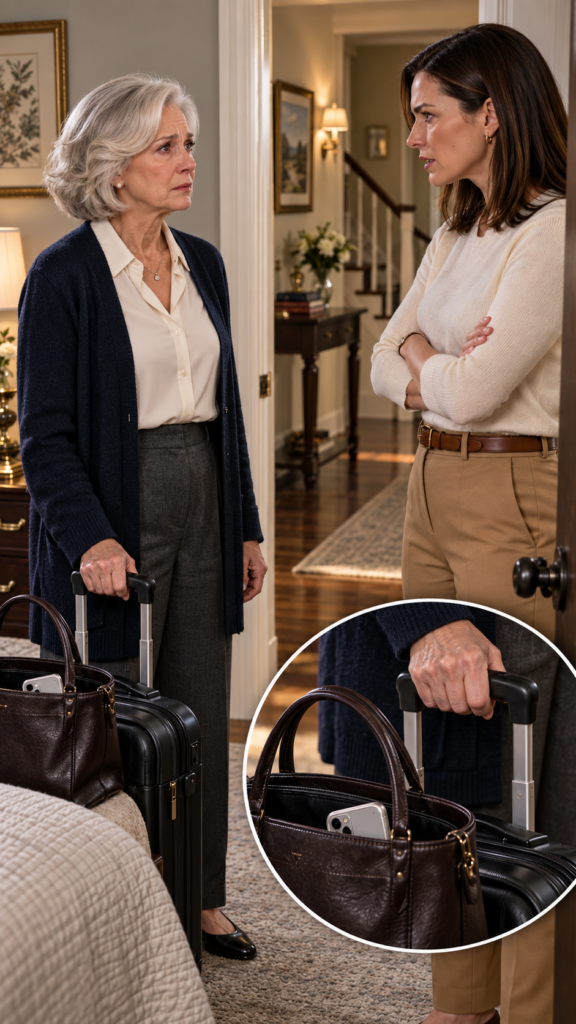
For a moment, I thought I had misunderstood. Downstairs, my son Daniel was watching football, completely unaware that his wife had already packed my clothes into a small black suitcase. Jessica told me I came too often, stayed too long, and acted as though I had a right to be there. Then she said Daniel agreed with her.
That was the part that hurt most. Daniel was my only child, and I had spent my life helping him without making him feel indebted to me. When he and Jessica could not qualify for the home they wanted, I quietly stepped in. I paid the down payment, secured the mortgage, and placed the deed under my legal name.
But I never used that fact against them. I never walked into the house without permission, never demanded gratitude, and never reminded Jessica who paid for the kitchen she proudly showed off to her friends. I came with pies, folded laundry, and listened to their stories. She looked at my modest clothes and ordinary car and decided I was an aging widow who depended on them.
Jessica pointed toward the suitcase beside the door. She had gone through my belongings, packed my pajamas and toothbrush, and decided my place in the family without speaking to Daniel. When I asked whether he had truly told her to remove me, she avoided the question. She only said he would understand.
I could have marched downstairs and exposed her lie immediately. I could have told Daniel that his wife had packed my things while he sat twenty feet away, believing we had enjoyed a peaceful family afternoon. But I knew how the scene would unfold. Jessica would cry, Daniel would beg us both to calm down, and I would once again be expected to make the pain disappear.
So I did something she never expected. I picked up my purse, lifted the suitcase, and walked downstairs without arguing. Daniel looked up in surprise and asked why I was leaving when I had planned to stay overnight. Before I could answer, Jessica quickly said I had decided to go home.
Daniel frowned because her explanation did not make sense. He asked whether my knee was hurting, whether I felt sick, and whether something had happened. Jessica stood behind me, silent and tense, waiting to see whether I would expose her. I looked directly at my son and said, “Yes, something happened.”
Then I walked toward the front door. Jessica followed me and whispered that I needed to leave my key on the entry table. I reached into my purse, placed the brass key beside their bowl of loose change, and watched relief cross her face. That relief told me she believed she had won.
I walked down the steps, past the flower beds I had paid to landscape and the maple tree I had planted three years earlier. Behind me stood five bedrooms, a stone fireplace, a renovated kitchen, and a mortgage paid from my account every month. Jessica believed she had removed a burden from her home. In reality, she had just ordered the legal owner off the property.
Daniel called three times that evening. I did not answer because I knew he still had not heard the truth. Then Jessica sent me a message saying she hoped we could “move forward respectfully,” as though packing my belongings and lying to my son had been a polite disagreement. I stared at the message until my anger became something colder and much more useful.
The next morning, I called my attorney, Charles Bennett. Charlie had known me for twenty-five years and had warned me more than once that my informal arrangement with Daniel and Jessica was dangerous. When I told him what Jessica had done, he listened without interrupting. Then he asked me one simple question: “What do you want?”
I looked out his office window and thought about every time I had quietly solved a problem for my family. For years, I had believed love meant helping without keeping score. But my silence had allowed Jessica to rewrite the truth until she saw herself as the owner and me as an unwanted guest. I told Charlie I wanted the arrangement formalized.
He reminded me that legal paperwork could change my family forever. I told him the family had already changed when Jessica decided my dignity depended on what she thought I owned. I did not ask him to evict them immediately. I asked him to prepare documents proving ownership and requiring a formal agreement for their continued occupancy.
A week later, the papers arrived at Hawthorne Lane. By Saturday afternoon, Daniel’s messages began flooding my phone. “Mom, what is happening?” he wrote, followed by, “Why is your name on our deed?” Then came the sentence that showed how deeply the illusion had settled into him: “That has to be some kind of mistake.”
I finally answered when he called. Daniel sounded frightened and confused as he explained that legal documents claimed I owned the house. I told him there was no mistake and that he and Jessica had never paid the mortgage. His silence lasted so long that I could hear Jessica arguing in the background.
Then I asked whether he knew she had thrown me out. He admitted she had told him I wanted more independence and had chosen to leave on my own. The truth hit him all at once, but before he could say more, the call ended. Ten minutes later, someone began pounding on my apartment door.
I looked through the peephole and saw Jessica standing in the hallway with Daniel behind her. Her face was furious, but one hand gripped his sleeve as though doubt had finally entered their marriage. I opened the door only a few inches and left the chain locked. Jessica demanded to know why I was trying to steal their house.
I told her calmly, “I own it. I always have.” She released a sharp, disbelieving laugh and insisted that was impossible because they had been paying every month. Then Daniel lowered his eyes toward the floor and whispered the words that made her turn pale.
“Jess,” he said, “not exactly.”
Her fingers loosened around his sleeve.
For several seconds, nobody moved.
Jessica stared at Daniel as though he had switched languages in the middle of the sentence. The hallway light made her face look strangely flat, all the color draining from the places where anger had been moments earlier.
“What does that mean?”
Daniel rubbed one hand across his mouth.
“I checked everything after Mom called.”
“What everything?”
“Our statements. The mortgage documents. The closing records Charlie sent.”
Jessica looked at me through the narrow opening in the door.
Then back at him.
“We make a payment every month.”
“We make deposits into our household account every month,” Daniel said quietly. “Utilities come out of it. Insurance. Repairs. Groceries. The contractor for the kitchen came out of it.”
Jessica shook her head once.
“The mortgage.”
Daniel swallowed.
“Mom pays the mortgage.”
Her hand fell completely away from his arm.
“No.”
“I saw the transfers.”
“You told me—”
“I told you we were covering the house.”
“You said the house payment.”
“I was wrong.”
His voice cracked slightly on the last word.
Jessica backed away from my door as if distance could rearrange the facts.
I had imagined this moment several times during the week. In some versions, I was fierce. In others, I was eloquent. I had imagined telling her exactly how much the down payment had been, exactly how many years of payments had left my account, exactly how many times I had swallowed irritation so Daniel would not have to choose between his mother and his wife.
But standing there, watching her look at my son as though he had betrayed her by discovering the truth, I felt no triumph.
Only exhaustion.
“Go home,” I said.
Jessica turned toward me.
“You can’t just—”
“I can close my own door.”
Her mouth opened.
Daniel touched her elbow.
“Jess.”
She jerked away from him.
“You knew?”
“I found out this week.”
“You knew before we came here.”
“Yes.”
“And you let me stand here and accuse her of stealing it?”
Daniel looked at her for a long moment.
“You packed my mother’s things while I was downstairs.”
The silence that followed was different.
Jessica’s face hardened again, but this time the anger had nowhere clean to land.
“She was taking over our lives.”
“No,” he said.
“She was always there.”
“No.”
“She treated that house like it was hers.”
My hand tightened around the inside edge of the door.
Daniel’s eyes lifted to mine.
“It is hers.”
Jessica gave a short, breathless laugh.
“You’re choosing her.”
Daniel flinched.
“I’m choosing what’s true.”
I had never heard my son say anything like that before.
Jessica must have heard it too, because for the first time since I had known her, she seemed unable to find the next sentence.
I closed the door gently.
The chain rattled against the brass plate.
On the other side, I heard Jessica say Daniel’s name.
Then footsteps.
Then the elevator bell.
Then nothing.
I stayed with my hand on the door for nearly a minute.
My apartment felt too quiet after they left.
The lamp beside the sofa was still on. My tea had gone cold on the table. The little black suitcase Jessica had packed sat near the bedroom wall where I had left it a week earlier, still unopened except for the toothbrush I had taken out the first night.
I crossed the room and knelt beside it.
Folded on top was my navy nightgown.
Underneath were two blouses, my slippers, a book I had been halfway through, and a small framed photograph of Daniel at eight years old standing between his father and me at Lake Michigan.
Jessica had packed that too.
I touched the glass.
Daniel was missing both front teeth in the picture.
His father’s hand rested on his shoulder.
Mine rested on the other.
I sat on the floor.
For the first time since Sunday dinner, I cried.
Not because of the house.
Not because of Jessica.
I cried because I could suddenly see how much of my life had been spent making myself easy to need.
I had solved problems before anyone asked.
Paid bills before anyone felt the fear of them.
Smoothed arguments before Daniel had to sit inside discomfort.
Made generosity so quiet that eventually nobody could see it at all.
The next morning, Daniel called.
This time I answered.
“I’m sorry,” he said.
There was no greeting before it.
I sat at my kitchen table and looked at the gray light beyond the window.
“For which part?”
He went silent.
It was not a cruel question.
But it was an important one.
“For believing her when she said you wanted to leave.”
I waited.
“For not asking why you were carrying a suitcase.”
Another pause.
“For never asking enough questions about the house.”
His breathing sounded uneven.
“And for letting you make my life easy enough that I stopped noticing what it cost you.”
I closed my eyes.
That one hurt because it was true.
“Where is Jessica?”
“At Hawthorne Lane.”
“And you?”
“My car.”
I opened my eyes.
“You slept in your car?”
“No. I got a hotel. I just left.”
He sounded tired.
“She thinks the papers are some kind of punishment.”
“They aren’t.”
“I know.”
“They are boundaries.”
“I know that too.”
He hesitated.
“Charlie wants us in his office tomorrow.”
“Yes.”
“Are you going?”
“Yes.”
“Okay.”
I expected him to ask what I intended to do.
Instead, he said, “Mom?”
“Yes?”
“I should have come downstairs.”
The words caught me off guard.
“What?”
“Sunday. When you said something happened. I should have gotten up and followed you. I knew something was wrong.”
My fingers tightened around the mug in front of me.
“But I didn’t.”
“No,” I said.
“You didn’t.”
The next afternoon, Charlie’s conference room smelled faintly of coffee and old leather.
He had placed three copies of the occupancy agreement on the polished table.
Jessica arrived first.
She wore a charcoal coat and carried a folder pressed tightly against her chest. Daniel entered two minutes later from a different elevator.
They did not sit together.
That told me more than either of them could have.
Charlie explained the documents carefully.
The house belonged to me.
That was not negotiable.
If Daniel and Jessica wished to remain there, there would be a written occupancy agreement. They would contribute a fixed monthly amount toward ordinary household costs. Major alterations would require my written permission. They could not represent themselves as owners, borrow against the property, sell it, transfer it, or make legal commitments involving it.
Jessica’s jaw tightened with every sentence.
When Charlie finished, she looked at me.
“So now we’re tenants.”
“You were never owners,” I said.
“We built a life there.”
“Yes.”
“We renovated it.”
“Part of it.”
“We maintained it.”
“Yes.”
“And none of that matters?”
“It matters,” I said. “It just does not change ownership.”
She looked toward Daniel.
“Say something.”
He studied the agreement.
“What do you want me to say?”
“That this is insane.”
He lifted his eyes.
“It isn’t.”
Jessica pushed her chair back.
The legs scraped loudly against the floor.
“So that’s it? Your mother humiliates us with legal papers and you sit there?”
Daniel’s face changed.
Not dramatically.
Just enough.
“My mother didn’t pack your clothes.”
Jessica stopped.
Charlie looked down at his notes.
I stayed still.
Daniel continued.
“She didn’t lie to me about why you left.”
Jessica stared at him.
“She didn’t tell you that I wanted her gone.”
“I was protecting our marriage.”
“No.”
His voice was quiet now.
“You were protecting yourself from having to ask me.”
Jessica’s nostrils flared.
“You always let her interfere.”
Daniel nodded once.
“I let everyone decide things for me.”
That answer seemed to confuse her.
Then he placed the agreement on the table.
“And I’m done doing that.”
My heart beat harder.
Jessica folded her arms.
“So what are you saying?”
Daniel looked at her for several seconds.
“I’m saying I’m not signing anything today.”
She gave me a small, victorious glance.
Then he finished.
“And I’m not going back to Hawthorne Lane tonight.”
The victory vanished.
“Daniel.”
“I need space.”
Her face changed.
This time the fear was real.
“You’re leaving me over a house?”
“No.”
He looked almost unbearably tired.
“I’m stepping away because you threw my mother out and lied to me about it.”
Jessica’s eyes filled, but the tears did not fall.
“You’re destroying our marriage.”
Daniel’s jaw tightened.
“I think we both did damage to it.”
She looked at me.
There it was again.
That instinct to locate the person responsible outside herself.
I refused to take it.
“This is between you and Daniel.”
For once, I meant it.
Jessica left Charlie’s office without signing.
The door shut behind her.
Daniel stayed seated.
He stared at the empty chair beside him.
Charlie quietly gathered the unused papers.
“What happens now?” Daniel asked.
“That depends on what the two of you decide,” Charlie said.
Daniel looked at me.
“No. I mean the house.”
I had spent the previous night thinking about that question.
“I’m selling it.”
His face went still.
Charlie looked at me, though he already knew.
Daniel leaned back.
“Hawthorne Lane?”
“Yes.”
“Why?”
“Because I don’t want a house to become the third person in this family.”
He looked down.
“I thought maybe you’d let me stay.”
“I would.”
That surprised him.
“But I don’t think staying would help you.”
His eyes lifted.
“Every room would turn into an argument about who deserved what. Jessica would see it as something taken from her. You would see it as something you owed me for. I would wonder whether every invitation was sincere.”
My voice softened.
“I bought that house to help you build a life. If it is now helping destroy one, I can let it go.”
Daniel pressed his lips together.
His eyes turned red.
“That maple tree.”
I smiled despite myself.
“I know.”
“Dad would have liked that tree.”
“Yes.”
Neither of us spoke for a while.
Two weeks later, Jessica moved out.
She did not disappear dramatically.
There were no police cars.
No screaming neighbors.
No boxes thrown onto lawns.
Her downfall was quieter than that.
It was the slow collapse of certainty.
The house she had introduced as hers was listed for sale.
The kitchen she had shown proudly to friends became a photograph on a real-estate website.
The entry table where she had ordered me to leave my key was cleared for showings.
The guest room where she had packed my suitcase was emptied.
And Daniel did not follow her when she moved into her sister’s condominium across town.
He rented a small one-bedroom apartment near his office.
For the first time in his adult life, he signed a lease with no help from me.
When he told me, I nearly offered to cover the security deposit.
The words rose automatically.
Then I stopped myself.
Daniel saw it happen.
A tired smile crossed his face.
“I’ve got it, Mom.”
I nodded.
“I know.”
That became our new language.
Not absence.
Not punishment.
Room.
He handled his own bills.
I stopped asking whether he had eaten every time we spoke.
He stopped calling only when something was broken.
Some weeks we had dinner.
Some weeks we did not.
At first, that frightened me.
Then I learned something I should have learned years earlier.
Distance is not always rejection.
Sometimes it is where respect grows back.
Jessica called me once before the house sold.
I almost did not answer.
But I did.
Her voice sounded smaller than I remembered.
“I’m not calling about Daniel.”
“All right.”
“I’m calling about Sunday.”
I waited.
She breathed in slowly.
“I was cruel.”
I looked out my kitchen window.
Below, a woman in a red coat was walking a terrier through wet leaves.
“Yes.”
Jessica inhaled again.
“I thought you were judging me.”
“I wasn’t.”
“I know that now.”
Another silence.
“I thought every time you came over, you were checking whether I was taking care of things properly.”
“I came because Daniel invited me.”
“I know.”
Her voice broke slightly.
“And I hated how easy everything seemed for you.”
That surprised me.
“Easy?”
“You never seemed worried about money. You never asked for anything. You just showed up with food and fixed things and acted like none of it mattered.”
“It mattered.”
“I know.”
She swallowed.
“I mistook quiet for weakness.”
I thought about the suitcase.
The key.
Her relief when I put it on the table.
“Yes,” I said.
“You did.”
“I’m sorry.”
I did not tell her I forgave her.
Not then.
Forgiveness offered too quickly can become another way of making somebody else comfortable.
So I said the truest thing I had.
“I hope you understand why sorry isn’t enough yet.”
“I do.”
For once, she did not argue.
The house sold in early spring.
The morning before closing, Daniel asked whether I wanted to see it one last time.
We met at Hawthorne Lane just after nine.
The rooms echoed.
Without furniture, the house looked larger and strangely younger.
Sunlight lay across the hardwood floors.
The stone fireplace was cold.
In the kitchen, I could still see a faint mark on the counter where the pie dish had rested that final Sunday.
Daniel noticed me looking.
“I keep thinking about that pie.”
I laughed softly.
“Of all things.”
“You baked it for us.”
“Yes.”
“And ten minutes later…”
He stopped.
I touched the counter.
“Some moments do not improve by finishing the sentence.”
He nodded.
We walked outside.
The maple tree was beginning to bud.
Daniel stood beneath it and looked up.
“Are you sure?”
“Yes.”
He shoved his hands into his coat pockets.
“I found something.”
My stomach tightened.
“What?”
“Not something bad.”
He reached into his inside pocket and pulled out a folded envelope.
Charlie’s return address was printed in the corner.
I recognized it immediately.
“What is that?”
“You tell me.”
Inside was a photocopy of a letter I had signed almost eleven months earlier.
My knees nearly weakened.
I had forgotten Charlie still had it.
Daniel watched my face.
“What was this?”
I did not answer immediately.
Eleven months earlier, I had gone to Charlie’s office for an entirely different reason.
Daniel had just received a promotion.
He and Jessica seemed settled.
For the first time, I had thought perhaps they were ready.
So I had asked Charlie to prepare the preliminary paperwork for transferring Hawthorne Lane to Daniel as a future gift once a few financial conditions were satisfied.
I had never told them.
I wanted it to be a surprise.
Daniel had found the copy among the closing documents Charlie gave him permission to review.
His eyes were wet now.
“You were going to give me the house.”
“Eventually.”
He stared at the page.
“Before any of this.”
“Yes.”
His mouth opened, then closed.
Jessica had thrown me out of a house I had been quietly preparing to give away.
The cruelty of it should have made me angry again.
Instead, standing beneath the maple tree, I felt something loosen.
Maybe because the secret proved something I had been struggling to explain even to myself.
I had never kept the house to control Daniel.
I had kept it because I was still protecting him.
Even my mistake had come from love.
Daniel looked toward the empty windows.
“Does Jessica know?”
“No.”
“Should she?”
“That is your decision.”
He folded the letter carefully.
“I think she should.”
Not to punish her.
I could hear that in his voice.
He simply wanted the truth complete.
Later that week, he showed her.
He told me about it afterward.
Jessica read the letter twice.
Then she sat down.
She did not accuse anyone.
She did not say it was unfair.
She simply covered her face with both hands and cried.
For the first time, Daniel said, she understood that the thing she had fought to possess had almost been given freely.
And that she had lost it not because I was vindictive, but because she had treated kindness as something she was entitled to control.
Their marriage did not repair itself overnight.
It did not collapse overnight either.
They began counseling separately.
Months later, together.
Daniel never asked me whether I thought he should stay married.
I never offered an answer.
That choice belonged to him.
Jessica sent me a handwritten note in June.
There were no excuses in it.
Only three sentences.
I hurt you.
I lied because I wanted control.
I am learning why.
I kept the note.
Not because it erased anything.
Because it was the first apology she had ever given me that did not ask for immediate forgiveness in return.
By autumn, Daniel told me they were trying again.
Slowly.
In separate apartments.
With rules.
With honesty.
With no house large enough to hide inside.
I was surprised by my own relief.
I did not need Jessica punished forever.
I needed what happened to matter.
There is a difference.
Charlie called one afternoon and asked what I intended to do with the proceeds from Hawthorne Lane.
“Please don’t tell me you’ve already bought Daniel another house,” he said.
I laughed so loudly that the woman at the next café table turned around.
“No.”
“Good.”
“I did something worse.”
He groaned.
“What?”
“I booked a trip.”
Silence.
Then Charlie laughed.
“Finally.”
I went to Maine for ten days.
Alone.
I ate lobster by the water.
I read two entire novels.
I bought a blue sweater I did not need.
One morning, I sat on a rocky beach with coffee in my hands and realized nobody knew where I was for almost three hours.
Nobody needed me.
Nobody was waiting for me to solve anything.
And instead of feeling useless, I felt light.
That may have been the greatest surprise of all.
When I came home, Daniel picked me up from the airport.
He did not ask whether I needed help with money.
I did not ask whether he had been eating properly.
He took my suitcase.
I let him.
On the drive back, he said, “Jessica wants to see you.”
I watched the highway lights slide across the windshield.
“Do you?”
“Yes.”
That answer mattered more than hers.
So two Sundays later, they came to my apartment.
Jessica stood outside the door holding a bakery box.
For a moment, none of us spoke.
Then she lifted it slightly.
“Apple pie.”
I almost laughed.
She looked terrified.
“I did not bake it.”
That did make me laugh.
Daniel smiled.
Some of the tension left the hallway.
I opened the door wider.
Jessica stepped inside.
She stopped near the entry table.
There was no brass key waiting there.
No suitcase.
No deed.
Nothing to win.
Nothing to take.
We ate pie at my small kitchen table.
Jessica asked permission before helping with the plates.
Daniel noticed.
So did I.
The conversation was awkward.
Then less awkward.
Then, for a few minutes at a time, ordinary.
When they stood to leave, Jessica hesitated.
“I know I can’t undo it.”
“No.”
“I know you may never trust me the way you did before.”
“That is probably true.”
She nodded.
“But I’m going to try to become someone you can trust differently.”
I looked at her.
That was not a perfect sentence.
It was better.
It was honest.
I reached for the empty pie plate.
“So bring better pie next time.”
Jessica blinked.
Then she laughed through tears.
Daniel covered his eyes with one hand.
“Mom.”
“What?”
“That pie was terrible.”
“It was.”
Jessica laughed harder.
And somehow that was the moment I finally forgave her.
Not because the past disappeared.
Because for the first time, none of us was pretending it had.
A year after the night she ordered me out, Daniel came over carrying a small paper bag.
He placed it on my kitchen counter.
Inside was a brass key.
Not the old Hawthorne Lane key.
A new one.
I looked at him.
“What is this?”
“My place.”
He had moved into a two-bedroom apartment with Jessica three months earlier.
They were rebuilding.
Carefully.
Their names were both on the lease.
Their bills came from their account.
Their decisions were theirs.
I turned the key in my fingers.
Daniel leaned against the counter.
“You don’t have to use it.”
I looked up.
“Then why give it to me?”
His eyes softened.
“Because I want you to have it.”
For a moment, neither of us spoke.
A year earlier, a key had been demanded from me as proof that I did not belong.
Now my son was placing one in my hand without conditions.
Jessica appeared in the doorway behind him carrying a pie dish wrapped in a towel.
She looked at the key.
Then at me.
“I agreed,” she said.
I smiled.
“That seems important.”
“It is.”
She set the pie on the counter.
“I made this one myself.”
Daniel groaned.
“We may need an emergency bakery backup.”
Jessica elbowed him.
I looked down at the brass key resting in my palm.
Then I closed my fingers around it.
Not because I needed access to their home.
Not because I owned anything inside it.
Not because they owed me a place in their lives.
I kept it because this time the key meant exactly what a key should have meant all along.
Trust.
Jessica cut the pie.
Daniel poured coffee.
Late-afternoon sunlight warmed the small kitchen, catching along the brass edge of the key beside my cup.
Nobody asked me to leave.
Nobody asked me to stay.
I was there because we had all chosen to be.
And for the first time in years, that was enough.






