The filthy cloth looked almost as large as the child’s hands.
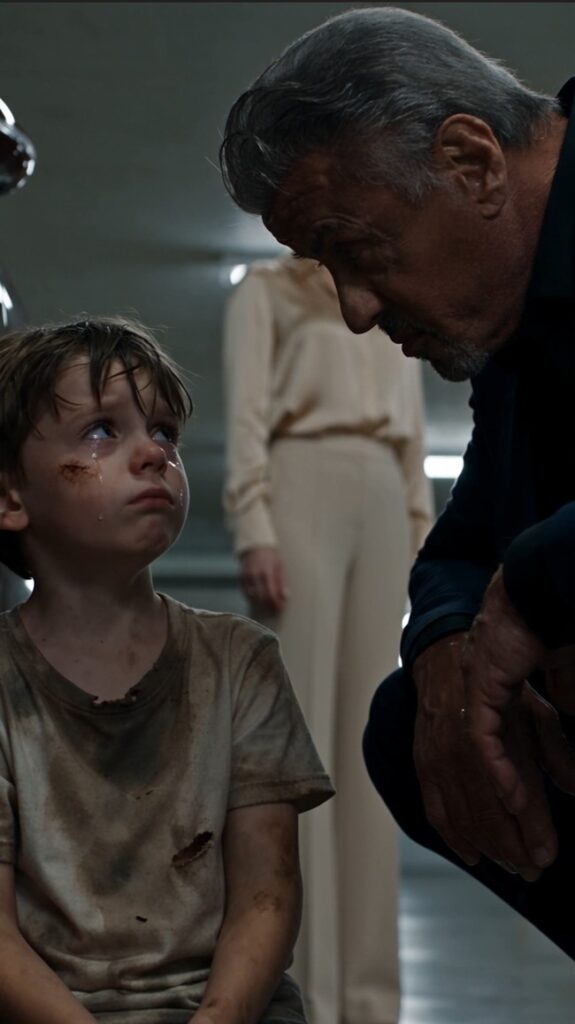
At three years old, Leo should never have been kneeling on the cold garage floor beside a luxury car, his clothes torn, his knees dirty, and an overturned bucket dripping soapy water across the concrete. But Helena Bellucci stood over him as if none of that mattered.
“Pick it up.”
Leo stared at the cloth near his shoes.
His lower lip trembled.
“I’m hungry.”
Helena’s expression barely changed.
“You scratched my car,” she said. “You don’t eat until you’ve worked off what you damaged.”
She nudged the bucket aside with her shoe, sending water sliding beneath the polished black vehicle.
Then she pushed the dirty cloth back into his tiny hands.
“Keep cleaning.”
Leo swallowed hard and turned toward the car.
He was too young to understand what a debt was. Too young to understand why food had suddenly become something he needed to earn.
All he understood was that Helena was angry, and that if he stopped wiping the car, she might not let him eat.
He dragged the cloth weakly across the lower door.
Behind them, the garage remained silent.
Helena never heard the man who had entered.
Carmine Bellucci had come home early.
At fifty-two, Carmine was a man accustomed to rooms changing the moment he walked into them. People watched their words around him. Decisions waited for his approval. Even silence seemed heavier when he was present.
But none of that prepared him for the sight in front of him.
His son was on his knees.
For several seconds, Carmine simply stood there.
Leo’s small shoulders were hunched beneath torn clothing. His fingers were wrapped around a stained rag. Water darkened the concrete beneath him while Helena’s immaculate luxury car gleamed inches from his face.
Something shifted behind Carmine’s eyes.
Not rage.
Something colder.
Leo looked up first.
His face changed the instant he recognized his father.
“Daddy.”
Helena froze.
The color slowly drained from her face as she turned.
Carmine’s gaze moved from her to Leo, then back to the cloth in his son’s hands.
“What is he doing?”
Helena recovered quickly enough to lift her chin.
“He scratched the car.”
Carmine said nothing.
“He needed to learn that actions have consequences,” she continued. “I told him he was going to work off his debt.”
Leo glanced between them, confused by the sudden quiet.
Carmine crouched beside him.
He gently removed the filthy cloth from his fingers and placed it on the floor.
“Did you eat?”
Leo hesitated.
Then shook his head.
That tiny movement was enough.
Carmine rose.
Helena stepped backward.
“You’re making this into something it isn’t,” she said. “I was teaching him responsibility.”
“He’s three.”
“He damaged something expensive.”
Carmine stared at her.
For the first time, Helena seemed to understand that every explanation was making the silence worse.
She tightened her grip around the car’s key fob.
“He has to learn,” she insisted.
Carmine moved between her and Leo.
When Helena tried to step toward the boy again, Carmine slapped her away from him in one sharp motion.
She stumbled back, stunned.
No one spoke.
Carmine’s attention dropped to the key fob still clenched in her hand.
He took it from her.
Helena stared at him.
“What are you doing?”
Carmine looked at the luxury car, then at his frightened son standing behind him.
When he turned back, his voice was almost unnervingly calm.
“You said Leo had a debt.”
Helena’s breathing changed.
“Carmine…”
He held up the key fob.
“Now it’s not your car anymore.”
For the first time that afternoon, Helena looked genuinely terrified—not because of what Carmine had already done, but because she suddenly understood that he had not finished deciding what came next.
And that was the moment everything inside that house began to unravel. 👇
The key fob remained motionless in Carmine’s hand.
Helena watched it as though something far larger than a car had just been taken from her, but Carmine was no longer looking at her. A small hand had closed around the side of his trousers.
“Daddy?”
He looked down.
Leo’s eyes were fixed on him.
“Can I eat now?”
The question entered the garage more quietly than any threat ever could have.
Carmine’s face did not change, but his fingers closed around the key fob until the plastic pressed into his palm.
“Yes,” he said.
Leo waited.
Carmine realized the child was still waiting for permission to move.
He crouched again.
“You don’t have to ask me twice for food.”
Leo studied his face as though trying to decide whether that was a rule he could trust.
Then, slowly, he reached up.
Carmine lifted him.
Leo weighed almost nothing against his chest.
Helena moved toward them.
“Carmine, listen to me.”
He stopped without turning.
“No.”
“One minute.”
“No.”
“You’re letting a three-year-old decide what happened.”
That made him turn.
Leo immediately tucked his face against Carmine’s shoulder.
Carmine noticed.
So did Helena.
Whatever she had meant to say next disappeared.
“He isn’t deciding anything,” Carmine said. “I am.”
He carried Leo into the house.
Helena followed as far as the kitchen doorway.
Carmine set Leo on a chair and opened the refrigerator. For once, the ordinary sounds of the room seemed unbearably loud—the refrigerator seal pulling open, a plate touching the counter, a cabinet door closing.
Leo watched every movement.
Carmine warmed soup, cut bread into small pieces, poured milk into a child-sized cup.
When he placed the plate in front of Leo, the boy did not touch it.
“What is it?” Carmine asked.
Leo looked toward the doorway.
Helena stood there.
“Can I have the bread?”
Carmine stared at him.
“It’s yours.”
“All of it?”
A pause.
“All of it.”
Leo reached for one piece.
He took two bites.
Then he slipped the remainder into the pocket of his torn pants.
Carmine saw it.
His chest tightened.
“Leo.”
The child froze.
Carmine forced his voice to remain gentle.
“Why did you put that in your pocket?”
Leo looked down.
“For later.”
“There will be more later.”
Another silence.
Leo’s fingers remained inside his pocket.
“When she’s not mad?”
Carmine did not look toward the doorway immediately.
He was afraid of what his face might reveal if he did.
Instead, he pulled out the chair beside Leo and sat.
“There will be food when anyone is mad,” he said. “There will be food when nobody is mad. Breakfast. Lunch. Dinner. Snacks. You never have to earn food.”
Leo blinked.
Children were supposed to accept reassurance easily.
Leo did not.
That frightened Carmine more than anything Helena had said.
“How many times has this happened?”
Helena’s voice cut in.
“Oh, come on.”
Carmine raised one hand without looking at her.
She stopped speaking.
Leo stared at the soup.
Carmine changed the question.
“Has Helena told you before that you couldn’t eat?”
Leo nodded once.
Helena stepped into the kitchen.
“He refuses meals and asks for snacks. You know how children are.”
Carmine finally looked at her.
“Stay where you are.”
She stopped.
“You’re twisting this.”
“I’m asking my son a question.”
“He is three. He barely understands what you’re asking.”
Carmine looked back at Leo.
That argument might have worked if the child had not already learned to hide bread in his pocket.
Leo reached for the soup.
His hand trembled slightly around the spoon.
Carmine let him eat.
No more questions.
Not yet.
He sat beside him until the bowl was empty.
When Leo finished, he glanced at the bread still on the plate.
“You can leave it,” Carmine said.
Leo frowned.
“I won’t be bad?”
Carmine closed his eyes for one second.
When he opened them, Helena was no longer merely nervous.
She looked afraid.
Not of what Carmine might do to her.
Of what Leo might say.
That distinction mattered.
Carmine lifted Leo from the chair.
“You’re going upstairs.”
“With you?”
“Yes.”
That answer relaxed something in the boy’s shoulders.
Carmine carried him to his room.
He helped him change out of the torn clothes, washed the dirt from his hands, and found clean pajamas. Leo spoke very little.
But when Carmine reached for the bedroom door, Leo sat upright.
“Daddy?”
Carmine stopped.
“Stay until I sleep?”
He returned to the bed without answering.
Leo lay down.
Carmine remained in the chair beside him.
Within minutes, the child’s breathing slowed.
One hand remained tucked beneath the pillow.
Carmine noticed the shape underneath.
Carefully, without waking him, he lifted the edge.
Two crackers.
Half a cookie.
A small piece of bread wrapped in a napkin.
Carmine lowered the pillow again.
For a long time, he did not move.
Downstairs, Helena was waiting.
She had poured herself water but had not touched it. The glass sat between both hands on the kitchen island.
Carmine entered without Leo.
Her eyes flicked behind him.
“Is he asleep?”
“Yes.”
“Good. Then we can finally talk like adults.”
Carmine walked past her.
He did not sit.
Instead, he crossed the hall and returned toward the garage.
“Where are you going?”
He opened the door.
Helena followed.
The bucket still lay on its side.
The filthy cloth remained where Carmine had dropped it.
For the first time, Helena seemed embarrassed by the scene.
She stepped around the water.
“Carmine, I know it looked bad.”
He looked up at the corner of the garage.
A small security camera faced the car.
Helena followed his eyes.
Her face changed.
Only slightly.
But enough.
Carmine noticed.
He went to the wall panel near the interior door.
“Don’t,” Helena said.
He stopped.
It was the first honest thing she had said since he came home.
Carmine turned.
“Why not?”
Helena stared at him.
Her mouth opened.
Nothing came out.
He accessed the recording.
The screen showed the garage earlier that afternoon.
Helena entered first.
She was carrying a handbag with a metal clasp.
As she squeezed between the wall and the car, the clasp dragged against the rear door.
Even through the camera’s tiny speaker, they could hear the faint scrape.
Helena stopped.
She looked down.
She touched the mark.
Then she looked toward the house.
Carmine did not move.
Neither did Helena beside him.
On the recording, several minutes passed.
Then Leo appeared.
He walked into the garage carrying a toy in one hand.
He did not go near the damaged area.
He did not touch it.
Helena called him closer.
The boy approached.
She pointed at the scratch.
The audio was imperfect, but her words were clear enough.
“Look what you did.”
Present-day Helena closed her eyes.
Carmine kept watching.
Leo shook his head.
Helena pointed again.
Then came the bucket.
The rag.
The order to clean.
The demand that he continue.
The refusal of food.
The moment she kicked the bucket aside.
The moment she forced the cloth back into his hands.
Carmine watched until his own figure appeared in the garage entrance.
Then he stopped the recording.
The silence afterward felt larger than the room.
Helena spoke first.
“I panicked.”
Carmine looked at her.
“I didn’t want you angry about the car.”
“So you blamed him.”
“I wasn’t thinking.”
“You had time to get a bucket.”
She looked away.
“You had time to get a cloth.”
“Carmine—”
“You had time to tell a three-year-old he owed you a debt.”
Her voice cracked.
“I made a mistake.”
“No.”
The word was quiet.
“That was not one mistake.”
Helena wrapped her arms around herself.
“I said I was sorry.”
“You said you panicked.”
“I am sorry.”
“You’re sorry there’s a camera.”
That landed.
Her eyes hardened for the first time.
“Fine.”
Carmine waited.
Helena’s fear sharpened into anger.
“Fine. You want honesty? You are never here.”
Carmine’s expression changed almost imperceptibly.
She continued.
“I deal with everything. His tantrums. His food. His mess. His noise. And then you walk in for five minutes and suddenly I’m some kind of monster.”
“He hid bread under his pillow.”
Helena stopped.
Carmine took one step toward her.
Not threatening.
Just closer.
“He hides food.”
“I didn’t tell him to do that.”
“You taught him he might need to.”
Her face went pale.
“That is not fair.”
“No,” Carmine said. “It isn’t.”
The words were so controlled that Helena almost missed their meaning.
Then she understood.
He was not talking about her.
He was talking about Leo.
Helena looked toward the house.
“I can fix this.”
Carmine shook his head.
“You will not be alone with him again.”
Her head snapped back toward him.
“You don’t mean that.”
“I do.”
“You can’t make a decision like that in one night.”
“I made it the moment my son asked whether he was allowed to eat.”
Helena stared at him.
For perhaps the first time since Carmine had known her, she had no argument ready.
Then her eyes went to the key fob still in his hand.
“And the car?”
Carmine placed it on the garage shelf behind him.
“That stays here.”
Her face tightened.
“You gave me that car.”
“I let you use it.”
“It’s mine.”
“The transfer was never completed.”
Helena went still.
Carmine had bought the vehicle and intended to put it fully into her name. The paperwork had remained unfinished because of a scheduling delay neither of them had thought important.
Until now.
Her gaze moved slowly from the key fob to him.
“You’re taking everything because of this?”
“No.”
His answer came immediately.
“I am removing my son from someone who used food to control him and blamed him for something she knew he didn’t do.”
“You think one recording tells you everything about me?”
“No.”
Carmine’s jaw tightened.
“Leo hiding food told me the rest.”
That was the moment her power finally broke.
Not when he took the key.
Not when he saw the video.
Not even when he said she would never be alone with Leo again.
It broke when Helena realized there was nothing left to argue about.
Leo’s behavior had spoken for him.
Carmine picked up her phone from the workbench where she had left it earlier and held it out.
“You’re leaving tonight.”
Helena did not take it.
“And where am I supposed to go?”
“That is yours to decide.”
“You’re throwing me out?”
“I am asking you to leave this house tonight and stay away from Leo while everything else is handled properly.”
“You expect me to walk out with nothing?”
“Take what is yours.”
She stared at him.
No raised voice.
No threat.
No spectacle.
Perhaps that frightened her most.
Helena had expected anger.
She had prepared herself for anger.
She knew how to fight anger.
She did not know what to do with certainty.
Her hand finally closed around the phone.
“You’ll regret this.”
Carmine looked toward the doorway leading back into the house.
Upstairs, his son was sleeping with food hidden under his pillow.
“No,” he said. “I regret what I didn’t see.”
Helena left before midnight.
Carmine did not watch her go.
He was sitting on the floor beside Leo’s bed when the front door closed downstairs.
The sound was faint.
Leo stirred.
His eyes opened halfway.
“Daddy?”
“I’m here.”
“Is Helena mad?”
Carmine leaned forward.
“Helena isn’t staying here tonight.”
Leo absorbed that.
“Tomorrow?”
“No.”
The child’s eyes opened a little wider.
“Why?”
Carmine chose his words carefully.
“Because grown-ups have rules too.”
Leo was quiet.
“What rule?”
“You don’t make children afraid to eat.”
Leo looked toward the pillow.
He knew Carmine had seen the hidden food.
His face crumpled with embarrassment.
“I was saving it.”
“I know.”
“I’m sorry.”
Carmine moved before he could stop himself.
He gathered Leo into his arms.
“No.”
Leo went still against his chest.
“You do not apologize for being hungry.”
Carmine felt the child’s small fist close in the fabric of his shirt.
For several minutes, neither of them spoke.
The next morning, the garage had been cleaned.
Not by Leo.
The bucket was gone.
The dirty cloth was gone.
The black car remained exactly where Helena had left it, gleaming beneath the overhead lights.
Leo stopped when he saw it.
His hand slipped into Carmine’s.
Carmine felt the grip tighten.
“We don’t have to come in here,” he said.
Leo stared at the car.
“Do I still owe?”
Carmine crouched.
“No.”
“For the scratch?”
“You didn’t make the scratch.”
Leo frowned.
“Helena said.”
“Helena was wrong.”
The boy looked genuinely confused by the idea that an adult could say something certain and still be wrong.
Carmine wished that were a lesson he could have delayed for years.
He pointed toward the clean floor.
“You never owed anything.”
Leo studied him.
“Not food?”
“Especially not food.”
The car was removed later that day.
Leo watched from an upstairs window.
Carmine stood behind him but said nothing.
When the garage door finally closed on the empty space, Leo turned away first.
Life did not become normal immediately.
Carmine learned that quickly.
For the first week, Leo asked permission before opening the refrigerator.
The second week, he stopped asking but still looked over his shoulder.
At night, food continued to appear beneath his pillow.
A cracker.
Half a banana wrapped badly in tissue.
A piece of toast.
Carmine never scolded him.
Every morning, he quietly replaced anything spoiled with something fresh and left the kitchen stocked where Leo could see it.
Then he created a low drawer.
Leo’s drawer.
Fruit pouches.
Crackers.
Small boxes of cereal.
Nothing locked.
Nothing counted.
Nothing dependent on mood or behavior.
The first time Carmine showed it to him, Leo stared for almost a full minute.
“All mine?”
“Whenever you’re hungry.”
Leo looked suspicious.
“What if I’m bad?”
Carmine knelt beside him.
“The drawer stays.”
“What if you’re mad?”
“The drawer stays.”
“What if I break something?”
“The drawer stays.”
Leo touched the handle.
“What if I make a really big mess?”
Despite everything, Carmine almost smiled.
“The drawer stays.”
Leo opened it.
Then closed it.
Then opened it again.
As though testing whether the promise would disappear between one movement and the next.
It didn’t.
Carmine changed too.
He had spent years believing protection meant keeping danger far from his home.
He had thought walls, locks, cameras, and people watching doors were enough.
He had been wrong.
Danger had been standing inside his garage holding a cleaning cloth.
And the camera had seen it before he did.
That knowledge followed him everywhere.
He began coming home earlier.
He rearranged what could be rearranged.
He ate breakfast with Leo.
He learned which spoon Leo preferred, which pajamas he refused to wear, and that a three-year-old could ask the same question eleven times without any reduction in urgency.
He learned that Leo hated peas but would eat them if they were mixed into rice.
He learned that Leo liked the hallway light left on exactly halfway.
He learned that silence from a small child did not always mean contentment.
Sometimes it meant calculation.
Sometimes it meant fear.
Sometimes it meant a child had learned not to ask.
That lesson hurt the most.
There were conversations Carmine could not handle alone.
He accepted that.
A child specialist began working with Leo, slowly and gently, without forcing him to tell a story before he was ready.
Carmine attended every meeting he was allowed to attend.
He listened more than he spoke.
Weeks passed.
Then months.
Helena did not return.
There were formal conversations, arrangements, signatures, and boundaries handled away from Leo. Carmine refused to turn any of it into theater.
The facts from the garage recording were preserved.
So were the recordings of Helena blaming Leo for damage she had caused herself.
The adults handled what adults were supposed to handle.
Leo was never made responsible for Helena’s consequences.
That distinction became one of Carmine’s rules.
The child did not owe an explanation.
He did not owe forgiveness.
He did not owe testimony over the dinner table.
He did not owe anyone comfort for what had happened to him.
Helena’s access to Leo ended.
The car never returned.
And the version of her life in which she could stand over a frightened three-year-old and assume nobody would question her ended with it.
One evening, nearly four months later, Carmine was alone in his study reviewing copies of the garage footage.
He had already seen the important part.
Too many times.
He almost closed the file.
Then he noticed something in the first few minutes.
Leo entered the garage before Helena.
Carmine leaned closer.
The boy was carrying the small toy Carmine remembered seeing on the floor that day.
Leo wandered toward the car.
He did not touch the painted surface near the scratch.
Instead, he stopped beside the lower passenger door where a thin layer of dust had gathered from the previous day.
He lifted one finger.
Slowly, carefully, he drew something.
Carmine enlarged the image.
It was uneven.
Crooked.
Barely recognizable.
A small heart.
Leo stepped back to inspect it.
Then he added a second shape beside it.
A taller stick figure.
A smaller one.
The garage microphone caught his tiny voice.
“Daddy.”
Carmine stopped breathing.
On the recording, Leo pointed at the taller figure.
Then at the smaller one.
“Me.”
He smiled at his own work.
A few minutes later, Helena entered carrying the handbag.
She brushed against the opposite side of the car.
The metal clasp made the actual scratch.
Carmine had seen that part.
What he had never noticed was Leo looking back at his dusty drawing just before Helena called him over.
He had not gone into the garage to damage anything.
He had gone there to make something for his father.
Carmine sat alone in the study long after the recording ended.
The next morning, he found Leo on the kitchen floor building a tower from plastic blocks.
Carmine sat beside him.
Leo looked up.
“You working?”
“Not right now.”
Leo added another block.
The tower leaned dangerously.
Carmine took out his phone and showed him a still image from the garage video.
The dusty heart.
The two figures.
Leo stared.
Then his face brightened.
“My picture.”
“You remember it?”
“For you.”
Carmine swallowed.
“I know.”
Leo pointed at the smaller figure.
“That’s me.”
“And the big one?”
“You.”
Carmine nodded.
Leo looked at the image for another moment.
Then he leaned against Carmine’s arm as casually as if he had not just broken something open inside his father.
“I made your car pretty.”
Carmine laughed.
It surprised both of them.
Not a large laugh.
Not loud.
But real.
Leo smiled because Carmine was smiling.
“The car wasn’t mine,” Carmine said.
Leo thought about that.
“Good.”
Carmine raised an eyebrow.
“Why good?”
Leo added another block to his tower.
“I like you better.”
Carmine looked away for a second.
He had spent much of his life surrounded by expensive things people treated as symbols of power.
Cars.
Houses.
Clothes.
Keys.
Objects people fought to possess because possession made them feel untouchable.
A three-year-old had reduced all of it to one sentence.
I like you better.
Carmine printed the image of the dusty heart.
Not the scratch.
Not Helena.
Not the bucket.
Only the frame showing the two uneven figures beside the heart.
He put it in a simple frame in the kitchen.
Leo saw it that afternoon.
“My picture!”
“Your picture.”
“Forever?”
Carmine looked at him.
“Forever.”
By winter, Leo no longer stored bread under his pillow.
Carmine discovered this accidentally.
He was changing the sheets when he lifted the pillow and found nothing beneath it.
He stood there longer than necessary.
An empty space should not have felt like a victory.
But it did.
That evening, he made grilled cheese and tomato soup.
Leo ate half the sandwich.
Then he pushed the plate away.
“I’m full.”
Carmine glanced at the untouched half.
Months earlier, Leo would have hidden it.
Now he climbed down from the chair.
“Can I play?”
“Yes.”
Leo ran toward the living room.
Three steps later, he stopped.
He looked back at the sandwich.
Carmine understood the question before Leo asked it.
“Will it still be there?”
“Yes.”
“When I come back?”
“Yes.”
Leo stared at him.
Then he ran away.
He came back twelve minutes later.
The sandwich was still on the plate.
Nobody had thrown it away.
Nobody had told him he had lost it.
Nobody had demanded payment.
He climbed back onto the chair, took one bite, decided he was still full, and left it again.
Carmine said nothing.
Some healing needed celebration.
Other healing needed to feel ordinary.
That night, rain tapped softly against the windows.
Leo came downstairs after bedtime carrying his blanket.
Carmine was in the kitchen.
The framed picture from the garage sat on the shelf behind him.
“Can’t sleep?”
Leo shook his head.
Carmine opened his arms.
Leo climbed onto his lap.
For a while, they listened to the rain.
Then Leo pointed toward his food drawer.
“Can I have crackers?”
“Yes.”
Leo climbed down.
He opened the drawer.
He took one packet.
Then he stopped.
His small hand rested on a second packet.
Months earlier, he would have taken both.
Maybe three.
Anything he could hide.
Now he closed the drawer.
One was enough.
He returned to Carmine.
They shared the crackers at the kitchen table while the rain traced silver lines down the windows.
Leo became sleepy halfway through.
His head dropped against Carmine’s arm.
Carmine lifted him carefully.
As he carried him toward the stairs, Leo murmured something.
Carmine looked down.
“What did you say?”
Leo’s eyes barely opened.
“Home.”
Carmine stopped at the bottom of the staircase.
For years, he had believed a home was something a man defended from the outside.
Now he understood better.
Home was the place where a child never had to hide bread.
Where anger did not empty a plate.
Where mistakes did not cost love.
Where a closed door still opened again.
Where the refrigerator remained full whether someone was pleased with you or not.
Where a small heart drawn in dust was seen for what it had always been.
A gift.
Carmine carried Leo upstairs and tucked him beneath the blankets.
Before leaving, he opened the bedroom door halfway, exactly as Leo liked it.
A stripe of warm hallway light crossed the carpet.
Leo stirred.
“Daddy?”
“I’m here.”
“You staying home tomorrow?”
Carmine looked at him.
“Yes.”
Leo smiled without opening his eyes.
“Good.”
Carmine stood in the doorway until the child’s breathing became slow and even.
Then he went downstairs.
The house was quiet.
The garage beyond the kitchen wall was empty now.
No black luxury car.
No bucket.
No filthy cloth.
Nothing remained from that afternoon except the recording Carmine had kept for the truth and the small framed picture he had kept for himself.
He crossed the kitchen and touched the edge of the frame.
Two crooked figures.
One little heart.
In the morning, sunlight filled the room before Leo came running downstairs in mismatched socks.
He opened his food drawer without asking.
He chose a cereal bar.
Then he climbed onto his chair and reached for the toast Carmine had already made.
Carmine poured milk.
Leo talked about a dream involving a dinosaur, a red balloon, and something Carmine could not quite understand about a boat.
Carmine listened as though every detail mattered.
Because it did.
Halfway through breakfast, Leo abandoned the toast.
He jumped down from his chair and ran toward the living room when he remembered a toy he wanted.
The half-eaten toast remained on the plate.
Carmine looked at it.
Then at the framed dusty heart.
Then toward the doorway where Leo had disappeared.
A moment later, the child’s laughter traveled back through the house.
Carmine smiled.
For the first time, Leo had left food unfinished without hiding it, saving it, or asking whether it would still belong to him when he returned.
It was only half a piece of toast on a kitchen plate.
But Carmine understood exactly what it meant.
Leo knew there would be more.
He knew the food would stay.
He knew his father would stay.
And in the warm morning light, with his crooked little heart framed on the shelf and his laughter filling every room, Leo finally behaved like a child who no longer had to prepare for love to disappear.






