The laughter died the moment I saw Vivienne’s face. A three-year-old girl had just pointed at my fiancée’s hand and said the ring belonged to her dead mother, and for half a second, I almost smiled with everyone else—until Vivienne looked less offended than exposed.
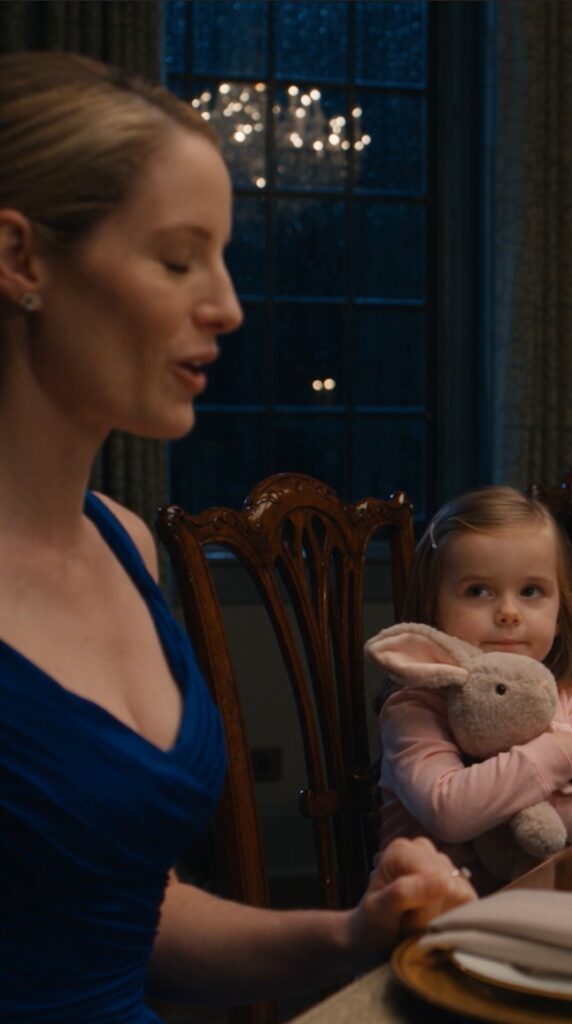
Nineteen days earlier, Sofia had been buried.
Now her daughter Rosie stood in the middle of my formal dining room, clutching a stuffed rabbit dressed in pink pajamas. Around her, thirty-two guests sat beneath a crystal chandelier while November rain streaked the windows of my Long Island estate. Lawyers. Relatives. Business partners. Men accustomed to noticing everything and discussing nothing.
Beside me, Vivienne looked immaculate in a sapphire gown. She always did.
Earlier that evening, I had noticed the narrow platinum band on her finger. Something about it had tugged at my memory.
“New?” I had asked.
Vivienne glanced down casually. “Vintage. From an estate dealer.”
I believed her.
That was my first mistake.
Sofia had worked in my home for years. She moved quietly through my mornings, brought coffee before meetings, remembered schedules I forgot, and somehow made herself nearly invisible while holding the entire household together. Three weeks earlier, she had died suddenly from what doctors called a stroke.
I paid for her funeral. Helped with expenses. Told myself I had done what a decent man should do.
Then Rosie wandered in through the service doorway.
She stopped several feet from the table and stared at Vivienne’s hand.
“That ring belongs to my mommy.”
A few guests laughed softly. Not because it was funny, but because adults often laugh when a child says something that makes a room uncomfortable.
Vivienne gave her a practiced smile. “Oh, sweetheart, I’m sure—”
“That’s Mommy’s,” Rosie said again.
Then Vivienne covered the ring with her other hand.
The movement was tiny.
Almost nothing.
But I saw it.
Something cold tightened in my chest. People did not usually hide something before they had even been accused.
“Show me,” I said.
Vivienne turned toward me, irritation sharpening her features. “Damian, don’t be ridiculous.”
The room quieted.
I kept my voice level. “Your hand.”
Her smile vanished.
Slowly, she placed her hand on the table.
I took it and turned the platinum band beneath the chandelier light. For years, Sofia had served my coffee wearing a ring almost exactly like this one. Once, by accident, I had noticed the mark scratched inside it.
A tiny star.
Uneven.
Hand-carved.
I turned Vivienne’s ring farther.
There it was.
The same star.
For a moment, I heard nothing. Not the rain. Not the shifting chairs. Not even the breath of the people around me.
I looked at Rosie.
“Where did your mommy keep this ring?”
She squeezed the stuffed rabbit against her chest. “In the wood box by her bed.”
Vivienne shoved her chair backward.
“You’re interrogating a child at our engagement dinner?”
That was when I really looked at her.
Not at the gown. Not at the perfect makeup or the polished expression she wore for other people.
At her eyes.
She wasn’t frightened.
She was calculating.
And that frightened me more than panic would have.
Behind the doorway, my security chief, Marco, had already appeared. I lifted two fingers.
He stepped into the room.
Thirty-two guests fell completely silent.
“Escort everyone to the drawing room,” I said.
Vivienne stared at me. “Damian, what are you doing?”
I stood slowly.
Nobody moved.
I looked around the table, then back at the woman I was supposed to marry.
“Making sure,” I said, “that nobody leaves until I find out how a dead woman’s ring ended up on my future wife’s hand.”
Vivienne’s face changed again.
And this time, nobody laughed.
What happened in that house after that moment began to unravel everything we thought we knew. 👇
The first sound was Rosie’s rabbit slipping against the front of her coat as she hugged it tighter.
Not a voice. Not a chair.
Just soft fabric brushing soft fabric in a room full of people who suddenly seemed afraid to move.
Vivienne looked around the table as though she expected someone to rescue her from the absurdity of the moment. A sympathetic laugh. A relative telling me I was overreacting. One of my business partners reminding everyone that children confused things all the time.
No one did.
“Damian,” she said carefully, “look at what you’re doing.”
I had spent years negotiating with people who believed calmness was weakness until they realized it was the last warning they were going to get.
I looked at her hand.
“Take off the ring.”
Her fingers curled.
“No.”
One word.
Too quick.
Too certain.
Marco stopped several feet away. He knew me well enough not to mistake my anger for an instruction.
The doors remained open.
Nobody was being physically prevented from leaving. Yet strangely, no one moved toward them.
They wanted to know too.
Vivienne saw that.
Her eyes traveled from face to face, and I watched the realization settle over her: the same room that had admired her twenty minutes earlier was now studying every movement she made.
Finally, she pulled the ring free.
She did not hand it to me.
She placed it on the white tablecloth between us.
The tiny sound of platinum touching the table seemed louder than the rain.
Rosie leaned forward.
“That’s Mommy’s star.”
Vivienne closed her eyes for half a second.
There it was again.
Not surprise.
Recognition.
I picked up the ring.
“Tell me the estate dealer’s name.”
Her eyes opened.
“What?”
“The dealer you bought this from.”
“This is insane.”
“The name.”
“I don’t remember.”
“You bought an engagement-dinner ring recently enough that I noticed it tonight, and you don’t remember where you bought it?”
“I buy things all the time.”
“You told me it was vintage.”
“It is.”
“From an estate dealer.”
“Yes.”
“Which one?”
Her jaw tightened.
Behind her, someone set down a wineglass.
Vivienne flinched at the sound.
Then she looked at Rosie.
That was the moment I knew.
Not because Rosie was proof of anything.
Because Vivienne looked at a grieving three-year-old child with resentment.
As though Rosie had done something to her.
“Don’t look at her,” I said.
Vivienne turned back sharply. “Excuse me?”
“She didn’t create this problem.”
“Neither did I.”
“Then explain the ring.”
“I already did.”
“No. You gave me a sentence.”
I placed the platinum band on the table.
“Now give me the truth.”
For several seconds, she said nothing.
The rain pressed harder against the windows.
Rosie shifted from one foot to the other. I suddenly became aware of how small she was, standing in the middle of a dinner built for adults who had spent an extraordinary amount of money making themselves look important.
I stepped away from the table and crouched so I was closer to her height.
“Rosie.”
Her eyes moved to mine.
“Did somebody bring you here tonight?”
She nodded.
“One of Mommy’s friends brought me to the kitchen.”
That answered enough for now.
I held out my hand, not touching her.
“Would you like to sit down?”
Rosie looked at the chair beside me, then at Vivienne.
“No.”
“All right.”
She stayed where she was.
I stood again.
Vivienne gave a brittle laugh.
“This is exactly what I mean. You are turning a child’s confusion into some kind of trial.”
Rosie’s face crumpled slightly.
Not crying.
Just hurt.
“My mommy didn’t get confused.”
The words landed harder than anything I could have said.
Vivienne stared at her.
I saw the answer forming before she spoke, saw the impatience rise in her throat.
“Rosie is three.”
“That doesn’t make her blind,” I said.
Vivienne’s gaze snapped toward me.
For the first time that evening, something beneath her polish broke completely.
“You want the truth?” she said.
I did not answer.
Her breathing changed.
She looked around the room again, realizing there was no graceful exit left.
“It was sitting in a box.”
Nobody moved.
I felt the back of my neck go cold.
“What box?”
Vivienne swallowed.
Rosie whispered before she could answer.
“Mommy’s wood box.”
Vivienne shut her eyes.
The room disappeared around me.
All I could see was Sofia carrying my coffee into the library on mornings when I barely looked up. Sofia remembering which meetings I hated, which guests took tea instead of coffee, which documents I had left on the wrong desk.
Sofia thanking me too many times for things that had cost me almost nothing.
Sofia dead at forty-two.
Rosie without a mother.
And the woman I had planned to marry wearing something taken from beside that woman’s bed.
“When?” I asked.
Vivienne’s voice was lower now.
“The day after the funeral.”
A murmur moved through the room.
I looked at Marco.
He did not react, but his shoulders became perfectly still.
Vivienne rushed on.
“I went to the apartment because people were sorting things. Everyone was distracted. There were boxes everywhere.”
“You went there alone?”
“No.”
“Who was with you?”
“It doesn’t matter.”
“It matters to me.”
“No one helped me take anything.”
The room went silent again.
She realized what she had said.
So did everyone else.
Vivienne’s face drained.
I stared at her.
“Take anything.”
She shook her head immediately. “That’s not what I meant.”
“It is exactly what you meant.”
“Damian—”
“You took it.”
Her lips parted.
For one strange second, she looked almost young. Not innocent. Just caught in the sudden collapse of a future she had assumed was guaranteed.
Then the defensiveness came back.
“It was one ring.”
Rosie made a tiny sound.
Vivienne heard it.
So did I.
“One ring,” I repeated.
“I thought it was costume jewelry.”
“You told me it came from an estate dealer.”
“I panicked tonight.”
“You had nineteen days to panic.”
“I didn’t know anyone would recognize it.”
That sentence changed the temperature of the room.
Not I thought it was mine.
Not Sofia gave it to me.
Not there has been a misunderstanding.
I didn’t know anyone would recognize it.
My fingers closed around the back of my chair.
Rosie looked down at her rabbit.
“Mommy knew it.”
Vivienne’s face tightened.
I saw her preparing another explanation, another rearrangement of language designed to make the ugliest fact in the room sound smaller.
I did not let her.
“Why?”
She stared at me.
“Why did you take it?”
Her shoulders lifted with a breath.
Then lowered.
“I liked it.”
Thirty-two people heard her.
No one spoke.
She looked down at the ring.
“I saw it before. Sofia wore it all the time. I thought it was beautiful.”
“So you waited until she was dead?”
“That’s not fair.”
I almost laughed.
Not because anything was funny.
Because there are moments when a sentence reveals so much about a person that every previous conversation with them becomes evidence.
“Not fair?”
“She was gone, Damian.”
Rosie looked up.
Vivienne noticed too late.
The damage had already been done.
“She didn’t need it anymore,” Vivienne said more quietly.
Rosie’s lower lip trembled.
“But I do.”
I turned away from Vivienne.
Rosie had both arms around the rabbit now, her cheek pressed into one floppy ear.
I took the ring from the table.
Then I crouched again.
“This belongs to your family.”
Rosie stared at my palm.
“Mommy’s?”
“Yes.”
She looked uncertainly toward the ring.
Then back at me.
“Can you keep it safe?”
The question nearly undid me.
I had spent most of my adult life being trusted with companies, contracts, money, houses, secrets.
Nothing had ever felt heavier than that tiny platinum band.
“Yes,” I said.
Rosie studied my face.
“Promise?”
“I promise.”
She nodded once.
I stood.
Vivienne was crying now.
Quietly.
Beautifully, even then.
Tears that left her makeup mostly intact.
Once, that would have moved me.
Now I understood that some people learned early how to cry without surrendering anything.
“Damian,” she whispered. “Please.”
I looked at the woman I had planned to marry.
Our engagement photographs were displayed in silver frames three rooms away.
Her overnight things were upstairs.
There were wedding invitations waiting for final approval in my study.
There had been conversations about flowers, music, travel, where we would spend Christmas.
A whole future had existed an hour earlier.
Now all I could see was Sofia’s hand placing coffee beside mine, that uneven star flashing beneath the library lamps.
“You stole from a dead woman,” I said.
Vivienne shook her head.
“I made a mistake.”
“You stole from her child.”
Her face collapsed.
“I didn’t know Rosie cared about the ring.”
“That sentence is the problem.”
She stared at me.
I removed the engagement ring she had given me to keep resized after dinner from my jacket pocket. The jeweler had returned it that afternoon, and I had planned to surprise her with it after dessert.
I placed the small box on the table between us.
Her eyes went to it.
“No.”
“The engagement is over.”
“Damian.”
“No.”
She stepped toward me.
Marco shifted one step closer but did not touch her.
Vivienne stopped.
“You’re throwing away our entire life over a ring?”
“No.”
I looked at Rosie.
“I’m ending it because I finally understand what you think other people are worth.”
Vivienne opened her mouth.
Nothing came out.
Around us, chairs began to move.
Not loudly.
One by one.
People were standing.
No one applauded.
No one made a speech.
That would have made the moment easier for Vivienne because anger can be fought.
Silence cannot.
My uncle was the first person to walk past her without looking at her.
Then one of my oldest business partners.
Then a woman Vivienne had spent months trying to impress.
They moved toward the drawing room exactly as I had requested earlier, but the purpose had changed. They were no longer waiting to watch a scandal.
They were giving Rosie space.
Vivienne watched them go.
Every departing footstep seemed to take part of her certainty with it.
Within two minutes, only Marco, Rosie, Vivienne, and I remained in the dining room.
Thirty-two abandoned place settings stretched beneath the chandelier.
Vivienne pressed her palms against the table.
“What happens now?”
It was the first honest question she had asked all night.
“You go upstairs with Marco nearby. You pack what is yours. Tomorrow, anything remaining will be sent to you.”
“You’re really doing this.”
“Yes.”
“Where am I supposed to go?”
I held her gaze.
“That is no longer a decision I make for you.”
Her face twisted.
“After everything I gave you?”
I thought of Sofia.
Of nineteen days.
Of a wooden box beside a bed.
“You should leave before you say something else you cannot take back.”
Vivienne looked at Rosie once more.
This time there was no resentment in her face.
Only the terrible recognition that the smallest person in the room had told the simplest truth, and Vivienne had destroyed herself trying to make it disappear.
She turned and walked out.
Marco followed at a respectful distance.
I heard their footsteps move toward the staircase.
Then they faded.
Rosie and I were alone.
The dining room suddenly looked ridiculous.
Thirty-two crystal glasses.
Imported flowers.
Candles burning low in silver holders.
A cake no one had touched.
Rosie looked at the chandelier.
“Is she mad?”
“Yes.”
“At me?”
I put the ring carefully into the empty engagement-ring box.
“No.”
Rosie waited.
I chose my next words slowly.
“She is upset because she did something wrong and people found out.”
Rosie considered this with the gravity only very young children can bring to simple facts.
Then she nodded.
“Mommy said lying makes your tummy hurt.”
A laugh escaped me before I could stop it.
It broke halfway through.
I covered my mouth.
Rosie watched me.
“Your tummy hurt?”
I lowered my hand.
“A little.”
She walked closer.
Then she held out the stuffed rabbit.
“You can hold Bunny.”
I stared at it.
Pink pajamas. One ear bent permanently forward.
I accepted the rabbit with both hands.
“Thank you.”
Rosie climbed into the chair beside mine.
For ten minutes, neither of us said much.
The rain softened.
The candles burned shorter.
Eventually Marco returned.
He paused in the doorway.
“She’s gone.”
I looked at him.
“All of her things?”
“Enough for tonight. I’ll arrange the rest tomorrow.”
He glanced at Rosie.
Then at the little box beside my hand.
“Do you want me to document what happened?”
“Yes.”
He nodded.
“Do you want the police contacted?”
The question hung there.
I looked at Rosie.
This was no longer only my decision.
The ring belonged to Sofia’s family.
“We’ll speak to the person caring for Rosie first,” I said. “They decide what they want to do about the ring being taken.”
Marco nodded once.
No threats.
No revenge.
No dramatic order.
For the first time that night, making the right decision felt quieter than making the powerful one.
Before Rosie left, she asked for Bunny back.
I handed him over solemnly.
She tucked him beneath her chin.
Then she pointed toward the little box.
“You promised.”
“I remember.”
“Don’t lose Mommy’s star.”
“I won’t.”
I kept that promise.
Two mornings later, I stood outside the small apartment where Sofia had lived with Rosie.
The rain had finally stopped.
A woman from Sofia’s family let me in and showed me to the bedroom while Rosie sat on the living-room floor nearby, feeding imaginary soup to Bunny.
The room was painfully ordinary.
A narrow bed.
A lamp with a crooked shade.
Three framed photographs.
A child’s sweater folded over a chair.
And beside the bed, exactly where Rosie had said it would be, sat a small wooden box.
The lid was open.
There was an empty indentation in the velvet lining where the ring had rested.
I placed the ring inside.
It fit perfectly.
No one needed an expert.
No one needed a dramatic revelation.
The truth had a shape.
And it had just gone home.
The woman beside me exhaled shakily.
“That was Sofia’s mother’s ring.”
I looked at her.
She touched the edge of the box.
“Her mother gave it to her when Rosie was born. The star was already inside.”
For a moment, neither of us spoke.
“Why a star?”
She smiled through tears.
“Sofia’s mother used to tell her that if she ever felt lost, she should remember that people found their way home by looking up.”
I stared at the uneven mark.
All this time, I had remembered the star because it was imperfect.
Now I understood why Sofia had never replaced the ring.
It was not jewelry.
It was direction.
The woman lifted a folded envelope from beneath the velvet lining.
My name was written across the front.
I stopped breathing.
“When did she write this?”
“We found it while sorting through things. I wasn’t sure whether to give it to you.”
I took it carefully.
Inside was a single sheet.
Sofia’s handwriting was exactly as I remembered from the small notes she left beside my coffee.
Mr. Damian,
If you are reading this, then someone finally convinced you to sit still long enough to open an envelope.
Despite everything, I smiled.
The next lines erased it.
I don’t know how much time any of us gets. I only know I was luckier than I looked. Work is work, but some places become part of your life anyway. Rosie always believed your house was enormous because everyone important lived there. I never corrected her.
My vision blurred.
There was more.
Thank you for always asking about her, even when you forgot you had asked. Thank you for the rabbit when she was born. You probably don’t remember sending it. I do.
I looked through the doorway.
Rosie was holding Bunny by both paws, making him dance across the rug.
The pink pajamas were faded at the knees.
I read the final paragraph twice.
One day Rosie will be old enough to understand that her mother worked in a beautiful house where she entered through the back because that was my job. Please make sure she grows up knowing that where a person enters a building has nothing to do with where they belong in the world.
I lowered the letter.
For the first time since Sofia died, I cried.
Not elegantly.
Not quietly.
I sat on the edge of her bed with the paper shaking in my hands and cried because I had spent years believing generosity could be measured in checks.
I had paid for Sofia’s funeral.
I had helped with expenses.
I had told myself I had done enough.
Yet Sofia had understood something about me that I had never understood about myself.
I noticed details.
Rings.
Schedules.
Coffee.
Numbers.
Contracts.
But I had often failed to notice the invisible architecture that told people where they were allowed to stand.
The service entrance.
The staff staircase.
The quiet assumptions.
The invisible lines between belonging and being useful.
Rosie appeared in the bedroom doorway.
Bunny hung from one hand.
“Why are you crying?”
I wiped my face.
“Your mommy wrote me something.”
“What?”
I looked at the letter.
“She reminded me of something important.”
Rosie climbed onto the bed beside me.
“Mommy knows lots.”
“Yes,” I whispered.
“She did.”
Vivienne never returned to my house.
Her belongings were sent to her the following week.
The engagement announcement was withdrawn without explanation beyond what was necessary. When people asked, I said the truth in one sentence.
We were no longer getting married.
I refused to turn Sofia into gossip.
The people who had been in the dining room knew enough.
No one needed more.
Vivienne sent me three messages during the first week.
The first blamed panic.
The second blamed grief.
The third apologized.
I answered only once.
You did not lose this life because Rosie spoke. You lost it because you believed Sofia’s death made what belonged to her available to you.
There was no reply.
Rosie’s family chose not to make a spectacle of what had happened. The ring had been recovered. Vivienne had admitted taking it in front of witnesses. What consequences followed outside my house were theirs to decide, not mine to orchestrate.
For me, the punishment was already complete.
Vivienne had wanted a future built around status, beauty, and proximity to power.
She lost it because she looked at a grieving child and assumed the child’s memory did not matter.
Winter passed.
The house became quieter.
At first, I hated the dining room.
I avoided it for weeks.
Then one February morning, I went inside before anyone else arrived.
The long table was bare.
No flowers.
No crystal.
Just pale winter light.
I stood near the service doorway where Rosie had appeared that night.
For years, Sofia had walked through that door without anyone thinking about it.
I had not thought about it.
That was the part I could no longer forgive in myself.
Not because having a service entrance was cruelty.
Because I had allowed myself to confuse familiarity with seeing someone.
Sofia had been essential to my life, and somehow I had still thought of her gratitude more often than her dignity.
So I changed what I could.
Not with a plaque.
Not with some dramatic announcement bearing Sofia’s name.
Those things would have made me feel better without necessarily helping anyone else.
I changed the small rules.
Staff ate in the same dining spaces when schedules allowed.
Family members visiting employees came through whichever entrance was closest, including the front.
No child coming to see a parent working in my home would ever be redirected to a back hallway because someone thought the main rooms looked too important.
Marco listened while I explained it.
Then he nodded.
“Sofia would have liked that.”
“I hope so.”
He looked toward the service doorway.
“She used to complain about one thing.”
I turned.
“What?”
A faint smile appeared.
“That you never finished your coffee while it was hot.”
I laughed.
For the first time, remembering Sofia did not feel like being cut open.
It felt like missing someone.
There is a difference.
By spring, Rosie had stopped asking every time she saw me whether the ring was safe.
She knew it was.
The wooden box remained with her family, placed high enough that curious three-year-old fingers could not reach it without help.
Sometimes Rosie asked to see the star.
Someone would open the box.
She would stare at the ring solemnly.
Then she would say, “That’s Mommy’s.”
No one corrected her.
Years would pass before anyone needed to explain that one day it would be hers.
On the first warm Sunday in April, I invited Rosie and her family to lunch.
Nothing formal.
No lawyers.
No business partners.
No crystal chandelier blazing in the middle of the afternoon.
Just food, open windows, sunlight, and a smaller table near the garden.
I was arranging plates when the doorbell rang.
One of the staff started toward the service corridor out of habit.
I stopped.
“I’ve got it.”
I walked to the front hall.
When I opened the main door, Rosie stood on the step.
Bunny was tucked beneath one arm.
His pink pajamas were freshly washed.
For a second, neither of us said anything.
Then Rosie looked past me into the enormous house.
Something about her expression brought Sofia’s letter back so clearly that I could almost hear the paper unfolding.
Rosie pointed toward the side of the house.
“Mommy went in that door.”
I swallowed.
“Yes.”
“Do I?”
I crouched.
“No.”
She frowned.
“Why?”
Because where a person enters a building has nothing to do with where they belong in the world.
The sentence rose in my mind exactly as Sofia had written it.
I smiled.
“Because you’re coming in with me.”
Rosie considered that.
Then she held out her free hand.
I took it.
She stepped across the front threshold with Bunny beneath her arm and sunlight behind her.
No one applauded.
No music played.
Nothing dramatic happened.
A little girl simply entered a house through the front door.
But as we walked toward the sound of voices and dishes and people waiting for her, I finally understood that this was the ending Sofia had been asking for long before any of us knew we needed one.
Not the recovered ring.
Not the broken engagement.
Not even the truth.
Home.
And this time, Rosie did not have to come through the back.






