The crying was so quiet that at first it barely sounded like crying at all. Just a small, broken breath beneath the running water—and a four-year-old girl standing at the kitchen sink as though she were trying desperately not to be heard.
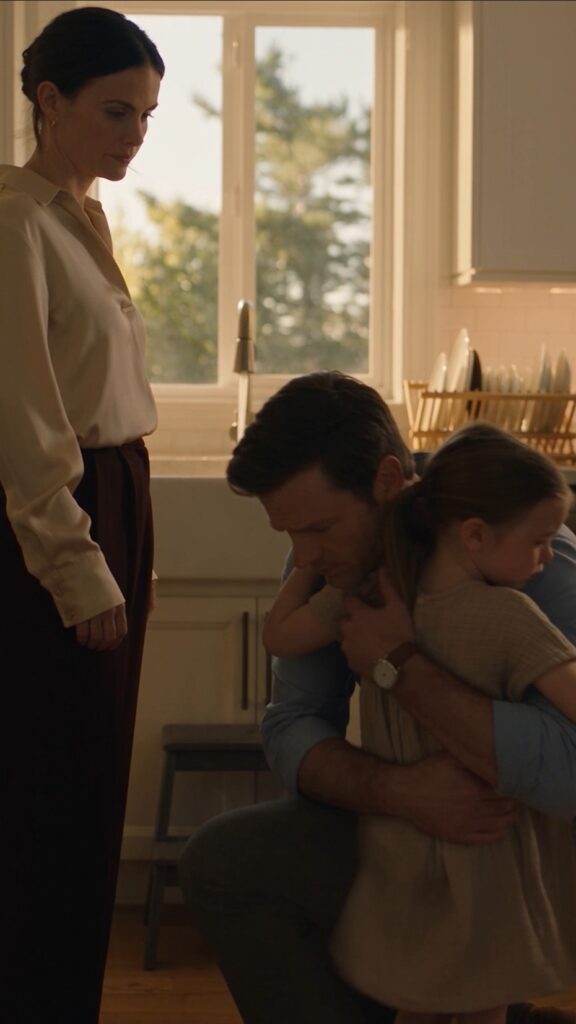
Her father wasn’t supposed to be home yet.
But that afternoon, he came through the door early.
He heard the faucet before he saw Sophie. Water rushed into the basin while she stood on a small step in front of the sink, shoulders trembling, her little hands held beneath the stream.
Something about the scene stopped him cold.
Sophie didn’t notice him immediately. She was staring down at her hands, tears slipping silently over her cheeks, her breathing uneven from trying to keep herself from sobbing.
Then Vanessa appeared.
Sophie’s stepmother moved toward the sink, and the instant Sophie realized she was there, her entire body changed. Her shoulders tightened. Her head lowered. The crying disappeared into frightened silence.
Her father stayed where he was.
He watched.
He didn’t interrupt. Didn’t announce that he had come home. For a few terrible seconds, he simply stood there taking in the look on his daughter’s face.
And whatever he witnessed was enough.
“Sophie?”
The little girl spun around.
For one second, she seemed frozen between fear and relief.
Then she ran.
“Daddy!”
She threw herself against him so hard that he had to catch his balance. Her arms locked around his neck, and suddenly all the crying she had been holding back came out at once.
Her father crouched, holding her against his chest.
“What happened?”
Sophie buried her face against him.
Vanessa stepped closer immediately.
“She’s upset because she was misbehaving.”
But Sophie shook her head.
Once.
Then harder.
Her father felt her tiny fingers tighten around his shirt.
“Sophie,” he said gently. “Tell me.”
She lifted her face.
Her cheeks were wet. Her chin trembled so badly that the first words almost disappeared beneath another sob.
“Daddy…”
Vanessa’s expression sharpened.
“Sophie, stop.”
The little girl flinched.
Her father noticed.
That tiny reaction seemed to change something inside him.
He drew Sophie closer.
“What is it?”
She looked at Vanessa.
Then back at him.
“Daddy… she hurts me every day!”
The room went completely still.
Vanessa stared at her.
Then she laughed once, but there was no warmth in it.
“That is a lie.”
Sophie pressed herself against her father.
“She lies when she doesn’t get what she wants,” Vanessa continued quickly. “You know how children are.”
But her father wasn’t looking at Vanessa anymore.
He was looking at Sophie.
At the fear in her eyes.
At the way she refused to let go of him.
And at the sink behind her, where the water was still running as if the afternoon had somehow continued while everything else had stopped.
He reached over and turned the faucet off.
The sudden silence felt enormous.
Vanessa folded her arms.
“You’re seriously going to believe a four-year-old over me?”
Her father slowly stood, lifting Sophie with him.
He had seen enough before either of them knew he was home.
Enough to know that this conversation was no longer about whether Sophie was telling the truth.
Vanessa seemed to realize it too.
Her confidence began to slip.
“Whatever you think you saw—”
“I saw enough.”
Her face tightened.
Sophie rested her head against her father’s shoulder, exhausted from crying.
Vanessa opened her mouth again, but he stopped her with a look.
Then something changed in his expression.
Not anger.
Recognition.
As if the scene at the sink had finally connected to something he had already been carrying in the back of his mind.
He looked Vanessa directly in the eyes.
“There’s something else.”
Vanessa didn’t move.
His voice became quieter.
“I know about your first husband.”
The color drained from her face.
For the first time since he had walked into the kitchen, Vanessa had absolutely nothing to say.
And whatever he knew, nobody in that room was prepared for him to say it aloud. 👇
Vanessa’s left hand dropped from her folded arms.
It was such a small movement that Sophie’s father might have missed it if he had not already spent the last several minutes noticing everything. Vanessa’s eyes flicked toward the kitchen counter, then toward the hallway, as though the shape of the room had suddenly changed around her.
“What did he tell you?” she asked.
That question was the first crack.
Not Who?
Not What are you talking about?
What did he tell you?
Sophie’s father felt the last piece fall into place.
He adjusted Sophie carefully against his shoulder. Her breathing had softened, but she was still holding a fistful of his shirt in one hand.
“His name is David,” he said.
Vanessa closed her eyes for half a second.
When she opened them again, the familiar certainty had returned to her face, but now it looked constructed.
“David is bitter.”
“I didn’t ask if he was bitter.”
“He spent years blaming me for everything wrong in his life.”
“I didn’t ask that either.”
Vanessa’s jaw tightened.
Sophie stirred against her father’s shoulder.
He felt it immediately and lowered his voice.
“David called me at work this afternoon.”
Vanessa went still again.
Outside, a car passed along the street. Its tires whispered over wet pavement, then faded. Somewhere upstairs, the heating system clicked on.
“He asked me one question,” Sophie’s father continued.
Vanessa said nothing.
“He asked if you ever made Sophie stand at the sink.”
Sophie’s fingers tightened.
Her father stopped breathing for a beat.
Vanessa saw it.
“That proves nothing.”
He looked down at Sophie.
Her face had disappeared against his shoulder.
Very gently, he rubbed one hand over her back.
“What happens at the sink, sweetheart?”
Vanessa stepped forward.
“Don’t interrogate her.”
He raised his eyes.
One look stopped Vanessa where she was.
Then Sophie whispered, “I have to wash.”
Her father’s throat tightened.
“When?”
“When I’m bad.”
“What does bad mean?”
Sophie hesitated.
Vanessa shook her head slowly, warning without words.
Sophie saw it.
Her father shifted sideways until his body completely blocked Vanessa from Sophie’s view.
“You can look at me,” he said.
Sophie did.
Her lashes were wet.
“When I spill,” she whispered. “Or talk too much. Or don’t eat fast.”
Her father stayed very still.
“What happens if you want to stop washing?”
Sophie stared at his collar.
“She says I’m not sorry yet.”
The kitchen seemed to contract.
Vanessa exhaled sharply.
“Oh, for God’s sake. She gets soap on her hands. That’s what she means. You’re turning a routine into something sinister.”
Sophie’s father looked at the sink.
At the small step.
At the bottle beside the faucet.
Objects he had walked past a hundred times without ever understanding that, to his daughter, they could mean something entirely different.
“How long?” he asked.
Sophie held up both hands, uncertain.
“I don’t know.”
Vanessa spoke faster now.
“She has no sense of time. She’s four.”
Sophie flinched again.
This time, her father did not look away from Vanessa.
David’s voice came back to him from three hours earlier, tense and careful through the phone.
I don’t know what your house looks like. I don’t know what she’s like now. But if there’s a child in that house, please listen to me before you decide I’m just an angry ex-husband.
At first he had nearly ended the call.
Then David had said one sentence that made him stand up from his desk.
Ask her about the sink.
He had driven home without calling Vanessa.
Now he understood why.
Vanessa seemed to read the memory on his face.
“You talked to him for what, ten minutes?” she said. “And suddenly you know me better than the woman you married?”
“No.”
His voice was almost gentle.
“I know Sophie better than I knew her ten minutes ago.”
Vanessa’s expression changed.
Not much.
But enough.
He carried Sophie into the living room and sat her on the couch without letting go until she loosened her arms herself. Then he crouched in front of her.
“I need you to stay right here for one minute.”
Her eyes widened.
“No.”
The word came so quickly that it hurt him.
He took her hands.
“I’m not leaving the house.”
She searched his face.
“I’m going to stand where you can see me the whole time.”
Only then did she nod.
He returned to the kitchen doorway.
Vanessa had not moved.
“I want you to pack a bag.”
She gave a short laugh.
“You cannot be serious.”
“I am.”
“This is my home too.”
“And Sophie is my daughter.”
Vanessa stared at him.
“I never hit her.”
The sentence landed strangely because he had not accused her of hitting Sophie.
He heard himself ask, “Why did you say that?”
Vanessa’s mouth opened.
Nothing came out.
Behind him, Sophie shifted on the couch.
He turned just enough to see her.
She was watching Vanessa.
Not him.
Vanessa followed his gaze.
For the first time, shame crossed her face.
It vanished almost immediately.
“You are letting a four-year-old destroy our marriage.”
“No,” he said. “I’m letting my four-year-old tell me what her life has been like when I wasn’t here.”
Vanessa’s eyes filled, but her voice stayed hard.
“You think David’s daughter didn’t lie too?”
Silence.
Vanessa realized what she had said.
Her face changed.
Sophie’s father did not move.
“Rachel,” he said quietly.
Vanessa looked toward the floor.
David had told him the name.
Rachel had been six when David married Vanessa. Seven when the marriage ended.
According to David, his daughter had begun becoming strangely quiet whenever Vanessa entered a room. She had started apologizing for ordinary mistakes. She had stopped asking for snacks because Vanessa accused her of being manipulative when she cried.
And there had been a sink.
David had not understood it at first either.
Rachel would come to him with red, dry hands and say she had been washing because Vanessa told her she was dirty after touching things she was not supposed to touch. Vanessa called it discipline. Structure. Teaching responsibility.
David called it a misunderstanding until the day he came home unexpectedly.
Not because he did not love his daughter.
Because he had trusted the adult explanation over the child’s fear.
He had carried that failure for fifteen years.
“I have copies of the messages you sent David,” Sophie’s father said.
Vanessa stared at him.
“No, you don’t.”
“He kept them.”
“That was private.”
“So you remember them.”
Her breathing changed.
He continued before she could recover.
“One of them says Rachel was ‘dramatic’ and that children learn to lie when adults reward tears.”
Vanessa looked toward Sophie.
Sophie’s father stepped into her line of sight.
“You said almost the same thing five minutes ago.”
Vanessa’s composure finally broke.
“Because it’s true!”
The words came out louder than anything else she had said.
Sophie jerked on the couch.
Her father turned immediately.
“It’s okay,” he said.
Vanessa pressed both hands against the counter.
“No. You don’t get to do this. You don’t get to take things from a marriage that ended fifteen years ago and twist them into some pattern because Sophie is having a tantrum.”
Sophie’s father looked at her.
“She was crying before she knew I was home.”
Vanessa went silent.
“I watched her stop crying when you walked toward her.”
Still nothing.
“I watched her lower her head.”
Vanessa’s eyes moved away.
“I watched her flinch when you told her to stop.”
The refrigerator hummed behind them.
Vanessa’s face crumpled for one second.
Then hardened again.
“I was trying to raise her.”
“No.”
His voice stayed quiet.
“You were trying to make her easier for you to control.”
Vanessa recoiled as if he had shouted.
He had not.
That seemed to make it worse.
A few minutes later, she walked upstairs.
Sophie’s father stayed at the bottom of the staircase where Sophie could see him.
He called his sister and asked her to come over.
He did not explain everything.
He only said, “I need you here with Sophie.”
His sister heard his voice and did not ask questions.
Vanessa came down with a suitcase twenty minutes later.
She had changed clothes.
Her face was freshly washed.
She looked composed enough that, from across a room, no one would have guessed what had just happened.
Sophie pressed closer to her aunt.
Vanessa noticed.
Her mouth tightened.
Then she looked at Sophie’s father.
“You’ll regret this.”
He did not answer.
She waited.
Perhaps she expected him to soften.
Perhaps that had happened before.
When he remained silent, she picked up her suitcase.
At the front door, she turned.
“I loved you.”
He believed that she believed it.
That was the saddest part.
But love that required a frightened child to stay silent was not something he could protect.
He opened the door.
Vanessa left.
The lock clicked behind her.
For several seconds, nobody moved.
Then Sophie asked, “Is she coming back?”
Her father crossed the room so quickly he almost stumbled.
He knelt in front of her.
“No.”
Sophie studied him with the frightening seriousness children sometimes have when they are deciding whether an adult promise can be trusted.
“Tonight?”
“No.”
“Tomorrow?”
“No.”
She swallowed.
“Ever?”
His eyes burned.
“Not unless you are safe and people whose job is to protect children say it is safe. And right now, you will not be alone with her again.”
Sophie looked at her aunt.
Then at him.
“Are you mad?”
The question broke something in him.
He took her face gently between his hands.
“At you?”
She nodded.
“No.”
“Because I told?”
“No.”
“Because I was bad?”
His breath caught.
“You were never bad.”
Her eyes filled.
He pulled her into him.
This time, when she cried, she did not try to make it quiet.
That night, Sophie slept in his bed with one hand curled around the fabric of his sleeve.
He barely slept at all.
Every few hours she stirred, checked that he was still there, and settled again.
At 2:13 in the morning, his phone lit up with a message from Vanessa.
Then another.
Then eleven more.
He did not answer.
Some accused David of poisoning him against her. Some said Sophie had misunderstood. Some said Vanessa had only been trying to teach discipline.
One message said, I did the same thing with Rachel and David made it sound horrible too.
He stared at that line for a long time.
Then he saved every message.
In the morning, he called Sophie’s pediatrician.
He called a child therapist.
He called an attorney.
And then, because fear had already taken enough choices away from his daughter, he sat beside her at the kitchen table and asked what she wanted for breakfast.
Not what was healthy.
Not what was fastest.
What she wanted.
Sophie thought about it.
“Pancakes.”
So he burned the first batch because his hands would not stop shaking.
She ate the second batch with strawberries.
When syrup dripped onto the table, Sophie froze.
Her father saw it.
He took a napkin.
“It’s okay.”
She watched him wipe the syrup.
“That’s it?”
“That’s it.”
She looked down at her plate.
Then, cautiously, she spilled one tiny drop from the edge of her fork.
He pretended not to notice the test.
He wiped that one too.
Sophie’s shoulders lowered.
Over the next several weeks, the truth came out slowly.
Not in one dramatic confession.
Not in perfect sentences.
Children rarely hand adults neat explanations.
Sophie remembered pieces.
Being told to stand at the sink after spilling food.
Being required to keep washing after she said she was finished.
Being told that crying proved she was trying to manipulate people.
Being sent to sit alone when she asked for her father.
Having her arm gripped too tightly once when she tried to walk away.
Being told afterward that she was “too sensitive.”
None of it came all at once.
The therapist never pushed.
Neither did her father.
They waited.
They listened.
And each time Sophie told something difficult, her father made sure the next thing she experienced was ordinary.
A snack.
A cartoon.
A walk.
A bedtime story.
Proof, repeated quietly, that telling the truth did not make the world end.
David agreed to speak with the attorney.
Rachel did too.
She was twenty-two now.
Her voice over the phone was calm in the careful way of someone who had spent years learning how to say painful things without being swallowed by them.
“I’m sorry Sophie knows that feeling,” she said.
Sophie’s father sat alone in his parked car while they spoke.
“I’m sorry nobody listened to you soon enough.”
Rachel was quiet.
“My dad did eventually.”
“He told me he still hates himself for not seeing it sooner.”
“He shouldn’t.”
Sophie’s father looked through the windshield.
Neither should I, he thought.
But guilt was not logical.
It had teeth.
Rachel seemed to understand the silence.
“You came home,” she said.
He closed his eyes.
“I almost didn’t.”
“What do you mean?”
He told her David’s call had arrived during a meeting.
He had looked at the unknown number.
He had almost sent it to voicemail.
For reasons he could not explain, he answered.
Rachel took a slow breath.
“That wasn’t my dad’s idea.”
He opened his eyes.
“What?”
“He called because I asked him to.”
Sophie’s father sat completely still.
Rachel continued.
“I found Vanessa online three days ago.”
Her voice trembled for the first time.
“She was in a picture with you and Sophie.”
He remembered the photograph.
A summer barbecue.
Sophie sitting on his shoulders.
Vanessa smiling beside them.
“I recognized her,” Rachel said. “Then I saw Sophie.”
He could hear Rachel trying to control her breathing.
“I told my dad we had to say something.”
The world inside the car seemed to narrow.
“So David called because of you.”
“Yes.”
“Why that day?”
Rachel hesitated.
“Because I kept thinking about how long I waited for someone to notice.”
He covered his eyes with one hand.
Rachel’s next words came softly.
“I didn’t want Sophie to wait as long as I did.”
That was the moment the entire afternoon changed shape in his memory.
He had thought coming home early was instinct.
Then luck.
Then fear.
It had been none of those things.
A young woman his daughter had never met had seen a photograph, recognized a danger from her own childhood, and refused to stay silent.
Rachel had reached backward through fifteen years of pain and changed the course of another little girl’s life.
Sophie’s father could not speak for several seconds.
Finally he said, “You got me home.”
Rachel cried then.
Quietly.
So did he.
The legal process took months.
Vanessa denied much of what Sophie said.
Then she minimized it.
Then she argued that everyone had misunderstood her intentions.
The saved messages made that harder.
So did David’s records.
So did Rachel’s account.
And most damaging of all were Vanessa’s own late-night texts after she left the house, where she repeatedly insisted that she had treated Sophie no differently than Rachel and that both children had been “overly emotional.”
No one needed to invent a monster.
Vanessa had documented her own refusal to understand what she had done.
A temporary order kept her from contacting Sophie while the allegations were reviewed.
Later, after the evidence was heard and the marriage formally ended, that separation became permanent.
Vanessa had no parental rights to Sophie.
She lost access to the house.
She lost the relationship she had assumed would survive because it had survived every smaller warning before.
There was no dramatic arrest.
No courtroom screaming.
No crowd celebrating her defeat.
Her downfall was quieter.
A judge read the record.
An attorney closed a folder.
A door shut.
And for the first time, Vanessa could no longer define reality simply by speaking more confidently than a frightened child.
When the final order was signed, Sophie’s father sat in his car outside the courthouse and stared at the paper.
He expected relief to arrive like a wave.
Instead, he felt tired.
Deeply, physically tired.
His sister sat in the passenger seat.
“It’s over,” she said.
He nodded.
But he knew the paper could only end Vanessa’s access.
It could not erase what Sophie had learned about fear.
That part would take longer.
And it did.
For months, Sophie asked permission for things no four-year-old should have needed permission to do.
Can I get water?
Can I sit here?
Can I stop eating?
Can I leave my toy there?
Can I cry?
That last one nearly destroyed him.
He crouched beside her.
“You never have to ask me if you’re allowed to cry.”
She thought about that.
“What if it’s loud?”
“Then it’s loud.”
“What if you’re working?”
“I’ll still hear you.”
“What if I’m crying for no reason?”
He smiled sadly.
“Then we’ll find the reason together. Or we won’t. You’re still allowed.”
She leaned against him.
That evening, she cried because a crayon broke.
It lasted twenty seconds.
He had never been so grateful for a broken crayon in his life.
Spring arrived.
The house changed with it.
Not dramatically.
The curtains were opened more often.
Music played in the kitchen.
Sophie began leaving toys in places without immediately rushing back to put them away.
She started singing badly and joyfully while getting dressed.
Her father learned that healing was often noisy.
It sounded like laughter from the bathtub.
Like cabinet doors closing too hard.
Like a child calling his name from another room without fear that she was interrupting something important.
One Saturday morning, a package arrived.
There was no return name Sophie recognized.
Inside was a small wooden box painted pale blue.
Her father opened the note first.
It was from Rachel.
For Sophie, it said. This was mine when I was little. My dad made it for me after we moved into our own apartment. I kept treasures in it. Maybe Sophie can keep something happy in it.
Sophie looked up.
“Who’s Rachel?”
Her father sat beside her on the floor.
He had wondered when to explain.
The therapist had helped him find language that was truthful without giving Sophie someone else’s burden.
“Rachel knew Vanessa a long time ago.”
Sophie’s smile disappeared.
He touched her hand.
“She was little too.”
Sophie stared at the box.
“Did Vanessa make her wash?”
Her father hesitated.
“Yes.”
Sophie absorbed that.
Then she asked, “Did Rachel’s daddy believe her?”
“Not fast enough.”
Sophie looked troubled.
“But he did?”
“Yes.”
“And you believe me?”
“Always.”
Sophie traced one finger along the painted lid.
Then she went upstairs.
She returned carrying a smooth white stone she had collected at the park.
She placed it inside the box.
“What’s that for?” her father asked.
She shrugged.
“It’s pretty.”
That was enough.
Weeks later, Rachel came to visit.
Sophie hid behind her father at first.
Rachel did not approach.
She sat on the floor across the room and admired the wooden box from a distance.
“You found something good to put in it,” she said.
Sophie nodded.
After several minutes, Sophie brought Rachel the white stone.
Rachel held it like it was precious.
“It’s beautiful.”
Sophie studied her.
“Were you scared too?”
The room became very still.
Rachel looked at Sophie’s father.
He let Rachel decide.
“Yes,” she said.
Sophie moved closer.
“Did you stop being scared?”
Rachel’s eyes filled.
“Mostly.”
Sophie considered this with great seriousness.
Then she climbed onto the couch beside her.
“I’m mostly not scared too.”
Rachel smiled through tears.
“Mostly is pretty good.”
There was no grand speech.
No dramatic embrace.
Sophie simply leaned against Rachel for a moment while showing her a picture book.
It was enough.
David arrived later that afternoon.
He stood awkwardly in the doorway until Sophie’s father reached out and shook his hand.
Neither man knew what to say.
Finally David whispered, “I’m sorry.”
“For what?”
“For waiting fifteen years to warn somebody.”
Sophie’s father shook his head.
“You warned me exactly when I needed it.”
David’s eyes moved toward Rachel.
“No,” he said.
“She did.”
Across the room, Rachel was helping Sophie build a crooked tower of wooden blocks.
The tower fell.
Sophie laughed.
No one told her to be quieter.
David looked away, wiping his face.
Summer returned.
By then, Sophie no longer asked whether Vanessa was coming back.
She had stopped watching the front door when cars slowed outside.
The skin on her hands had healed.
So had habits that could not be seen.
Her father had learned to recognize the tiny pauses that meant she was checking his reaction.
He answered them with patience.
Sometimes with words.
Sometimes by doing nothing at all.
Because sometimes a child needed to knock over a glass and discover that the only consequence was a wet table.
One evening, Sophie knocked over an entire cup of milk.
It spread across the kitchen table and dripped onto the floor.
She froze.
Her father froze too.
Not because he was angry.
Because he knew exactly what this moment was.
Sophie’s eyes rose to his.
He picked up a towel.
“Want to help?”
She stared.
Then she slid down from her chair.
They cleaned it together.
Halfway through, Sophie started giggling because the towel made a squeaking noise against the floor.
Her father laughed too.
It was ridiculous.
Ordinary.
Perfect.
By autumn, Sophie had started preschool.
Her teacher told her father that she was kind to children who cried.
If someone fell down, Sophie was usually the first one beside them.
If someone spilled paint, she said, “It’s okay. We can clean it.”
Her father sat in his car after that meeting and cried harder than he had outside the courthouse.
Not because Sophie had forgotten.
Because she had remembered differently.
She had taken what frightened her and turned it into gentleness.
A few days before Thanksgiving, Rachel sent another letter.
This one was for Sophie to open when she was older.
Her father put it in the blue box beneath the white stone.
He did not read it.
Some truths belonged to the person they were written for.
On Thanksgiving morning, Sophie dragged her small step back to the kitchen sink.
Her father stopped in the doorway.
For one second, the sight hit him with such force that he could not move.
Same sink.
Same step.
Same little girl.
But everything else was different.
Sunlight filled the kitchen.
Music played softly from the living room.
Sophie wore pajamas covered in tiny stars, and her hair stuck out on one side because she had refused to let him brush it before breakfast.
She climbed onto the step.
Then she turned.
“Daddy?”
His chest tightened.
“Yes?”
“Can I wash the strawberries?”
He looked at the bowl beside her.
“Absolutely.”
Sophie turned on the faucet.
Water rushed into the sink.
For a fraction of a second, he heard that first afternoon again.
The broken breaths.
The silence.
The fear.
Then Sophie began humming.
Completely off-key.
She washed one strawberry.
Then another.
Her father moved beside her.
She handed him the green tops after pulling them off, one by one.
Halfway through, she splashed water onto his shirt by accident.
She froze.
Old reflex.
Old fear.
He looked down at the wet spot.
Then at her.
Sophie waited.
Her father dipped two fingers under the faucet and flicked three drops of water at her sleeve.
Her mouth fell open.
“You splashed me!”
“You splashed me first.”
“That was an accident!”
“So was mine.”
“No, it wasn’t!”
She laughed.
He laughed.
She splashed him again.
He held up both hands.
“Okay, okay. Truce.”
Sophie considered whether to accept.
Then she nodded solemnly.
“Truce.”
She finished washing the strawberries.
When the bowl was full, Sophie reached for the faucet handle.
Her father watched.
She turned it off herself.
The water stopped.
Silence filled the kitchen.
But this time, the silence held nothing frightening.
Sophie looked at the strawberries.
Then at her father.
Then she slipped her damp little hand into his.
“Come on,” she said. “Everybody’s waiting.”
He looked toward the dining room.
His sister was setting plates on the table.
David was arguing with Rachel about whether the rolls were burning.
Rachel was laughing.
The blue wooden box sat safely on a shelf near the window, the white stone still inside, holding a letter for another day.
Sophie tugged his hand.
He followed.
Behind them, the sink was quiet.
The small step remained beneath it.
Nothing had been removed.
Nothing needed to be.
The room itself had not changed.
What it meant had.
And as Sophie carried the strawberries toward the people who had learned, finally, how to listen to one another, her father looked at her wet hands curled safely around the bowl and understood something he would remember for the rest of his life.
She had not become brave because she stopped being afraid.
She had become brave because, when she finally spoke, someone came home and stayed.






