My daughter-in-law told me to leave the house I had spent fifty years paying for.
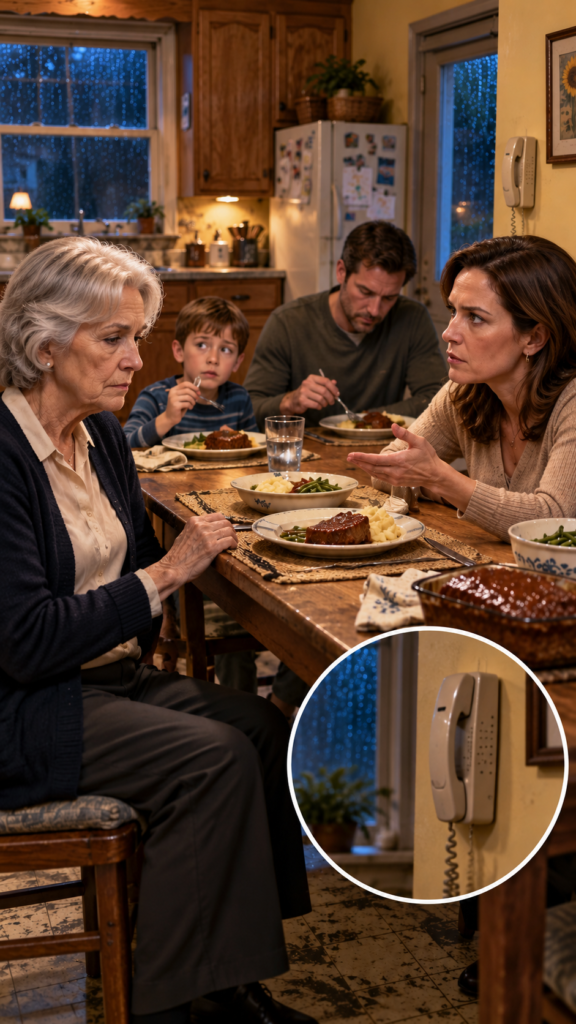
She said it over meatloaf.
“You eat here, but you don’t help.”
Samantha’s voice was calm.
That was what made it cruel.
She sat across from me at the kitchen table, her untouched dinner in front of her, her expression polished and certain—as though she’d rehearsed the words until they sounded perfectly reasonable.
Then she leaned back.
“She eats like a pig and does nothing. I’m not her babysitter.”
Her eyes settled on me.
“Maybe she should take the hint and leave before I have to throw her out.”
The refrigerator hummed near the back door.
Rain tapped softly against the windows.
My eight-year-old grandson, Oliver, froze with his fork halfway to his mouth.
And my son kept eating.
Jason didn’t defend me.
He didn’t ask his wife to stop.
He didn’t even look at me.
His fork scraped slowly across his plate.
That tiny sound cut deeper than anything Samantha had said.
Because I remembered another Jason.
A little boy with scraped knees who used to run through this same kitchen calling for his mother.
The boy I’d held through fevers.
The boy I’d worked extra shifts for so he could have new shoes.
The boy I’d stayed awake waiting for when he came home late, praying every pair of headlights belonged to him.
Now, at seventy-six, I watched my only child chew his dinner while his wife explained why I was a burden.
I swallowed the food already in my mouth.
Then I placed my fork beside my plate.
My hands were steady.
No tears.
No argument.
No desperate speech about everything I’d sacrificed.
Age teaches a woman something pride cannot.
Sometimes words lose their value long before you stop having things to say.
I reached for the serving bowl and began clearing the table.
“Grandma?”
Oliver’s small voice broke the silence.
I turned toward him and softened my face.
“It’s all right, sweetheart.”
It wasn’t.
But children shouldn’t have to carry the cruelty of adults.
The house stood outside Lancaster, Pennsylvania, on a quiet street lined with maple trees and brightly painted mailboxes.
To anyone passing by, it looked like an ordinary family home.
Tulips bloomed beside the porch every spring.
White lights framed the windows every Christmas.
The oak cabinets had been built by my late husband, Frank, and his brother during the summer of 1988.
The kitchen floor dipped slightly beside the sink.
I knew exactly where.
I’d stood there for decades washing bottles, packing lunches, preparing holiday meals, and stretching every dollar until it covered one more week.
Samantha called the yellow walls outdated.
She called the cabinets ugly.
But she had never paid for a single one of them.
After dinner, she walked away.
I washed the plates.
Jason took Oliver upstairs for his bath.
A few minutes later, laughter drifted down from the living room.
Their laughter.
Inside my house.
I stood at the sink until the water turned cold.
Arthritis burned through my fingers as I dried the last plate.
Samantha always noticed when my hands moved slowly.
She noticed a pan left soaking.
A towel folded unevenly.
A crumb left on the counter.
But she never noticed when I packed Oliver’s school snacks.
She never noticed when I mended his jacket.
She never noticed the mornings I walked him to the bus stop.
She never noticed the groceries I bought.
Or the utility bills I’d quietly covered.
To her, I wasn’t the woman keeping their household running.
I was simply the old woman taking up space.
When the kitchen was finally clean, I climbed the stairs to the room they called mine.
It had once been a storage room.
There was barely enough space for a narrow bed, a small dresser, and a lamp with a crooked shade.
The window sat too high for me to see anything except a strip of dark sky.
The ceiling fan clicked as it turned.
Click.
Click.
Click.
Downstairs, Samantha laughed again.
I lay on the bed without changing my clothes.
And for the first time that night, I thought about Frank.
Not the Frank cancer had slowly weakened.
Not the man surrounded by medicine bottles and the soft hiss of an oxygen machine.
I remembered him young.
Sleeves rolled up.
A pencil tucked behind his ear.
Bills spread across the kitchen table.
That familiar smile on his face.
“We’ll manage, Ruth,” he’d say.
“We always do.”
We bought that house in 1974.
Back then, it wasn’t much.
But it was ours.
We sacrificed for every brick.
Frank worked thirty-one years at a packaging plant.
I took every job that allowed me to stay close to Jason.
Cafeteria cashier.
Church secretary.
Fabric-store clerk.
Whatever paid.
Whatever fit around school pickups and sick days.
We repaired what broke.
Saved what we could.
Paid every bill.
And slowly, year after year, that little house became the center of our lives.
When cancer came for Frank, everything changed.
He became quieter.
At night, when the pain kept him awake, he’d reach for my hand beneath the blankets.
“You’ll be all right, Ruth,” he’d whisper.
I always told him not to talk nonsense.
But lying in that cramped upstairs room decades later, listening to my son laugh downstairs while his wife told me I didn’t belong in the home I’d spent my life building, I finally understood what Frank had been trying to tell me.
He hadn’t been comforting me.
He had been preparing me.
The next morning, I woke before sunrise.
I dressed quietly.
Walked downstairs.
And stood in the kitchen Frank and I had built our life around.
The same oak cabinets.
The same worn floor.
The same window where we’d once watched Jason ride his bicycle for the first time.
I ran my fingers along the countertop.
Then I noticed something I’d somehow stopped seeing.
The house wasn’t Samantha’s.
It wasn’t Jason’s.
It had never belonged to the loudest person in the room.
It belonged to the person whose name was on the deed.
I walked to the telephone.
My hand didn’t shake.
When my lawyer answered, I held the receiver tightly.
“Mr. Hall,” I said, “pull the deed to my house.”
There was a brief silence.
Then his voice changed.
“Ruth… are you sure you want me to do that?”
“Yes.”
“Why?”
I looked toward the staircase.
At the room they’d given me.
At the kitchen they’d treated me like a servant in.
At the home Frank and I had spent half a century paying for.
Then I said quietly,
“Because my daughter-in-law just told me to leave.”
Another pause.
“And I think it’s time my son learned exactly whose house he’s been living in.”
I heard papers moving on the other end.
Then Mr. Hall said something that made me sit down.
“Ruth… there’s more here than the deed.”
I tightened my grip on the phone.
“What do you mean?”
“The ownership records were updated years ago.”
My heart began to pound.
“Updated how?”
He took a breath.
“Your husband left instructions that were never meant for Jason to see unless you decided to activate them.”
I stared at the kitchen table.
Frank had left me many things.
Photographs.
His wedding ring.
A toolbox.
A thousand ordinary memories.
But apparently…
he had left me something else.
Something my son and his wife had never known existed.
And after the way they had treated me the night before, I had a feeling Frank’s final protection was about to change everything.
The receiver suddenly felt heavier against my ear.
Outside, rainwater still clung to the dark glass, catching the first weak blue of morning. Somewhere upstairs, a floorboard creaked.
I lowered my voice.
“What instructions?”
Mr. Hall was silent for several seconds.
When he finally answered, the careful professionalism had left his voice.
“Frank came to see me about six months after his diagnosis.”
My fingers tightened around the telephone cord.
“He never told me.”
“He asked me not to tell you unless it became necessary.”
A chair scraped faintly above me.
I glanced toward the ceiling.
“What did he do?”
“First, he made certain the house was recorded entirely in your name. No ambiguity. No expectation. No future claim belonging to anyone else.”
My throat went dry.
“And the rest?”
Mr. Hall exhaled.
“He left a sealed letter with written instructions for me. He said that if you ever called because someone was pressuring you to leave your own home, I was to open it with you and help you protect your right to remain there.”
For a moment, I heard nothing but the old refrigerator cycling on.
Frank had known me too well.
He had known I would excuse things.
Endure things.
Tell myself that family meant compromise until compromise became surrender.
I pressed my fingertips against my lips.
“Is the letter still there?”
“Yes.”
“Bring it.”
Another pause.
“Today?”
“Today.”
I surprised myself with the certainty in my voice.
Mr. Hall must have heard it too.
“I’ll be there at nine.”
The line went quiet after we hung up, but I remained seated with my hand resting on the receiver.
At seven, footsteps came down the stairs.
Samantha entered first, tying the belt of her robe.
She stopped when she saw me already dressed at the table.
For half a second, uncertainty crossed her face.
Then it disappeared.
“You’re up early.”
“I had a telephone call to make.”
She opened the refrigerator.
“That so?”
“Yes.”
Jason came in behind her, rubbing sleep from his face.
His eyes met mine briefly before dropping away.
That hurt less than it had the night before.
Something had shifted.
Not in him.
In me.
Oliver appeared a few minutes later carrying his backpack, his hair still mussed from sleep.
The moment he saw me, he came over and wrapped both arms around my shoulders.
Children know when a room has changed even if no one explains why.
“Are you coming to the bus stop?”
I looked at his small hand on my sleeve.
“Of course.”
Samantha turned from the counter.
“You don’t have to. Jason can take him.”
“I know.”
I stood slowly.
“But Oliver asked me.”
No one argued.
We walked beneath a gray sky, the pavement shining from the rain.
Oliver kicked a wet maple leaf along the sidewalk.
Halfway to the corner, he looked up at me.
“Are you leaving?”
I stopped.
His face tightened before I answered.
“No, sweetheart.”
“Mom said—”
“I know what your mother said.”
He stared down at his shoes.
I crouched carefully, ignoring the ache in my knees.
“Listen to me. Nothing that happened at dinner was because of you.”
His mouth trembled.
“I didn’t say anything.”
“You’re eight.”
I brushed damp hair from his forehead.
“It isn’t your job to protect grown-ups.”
The bus appeared at the end of the street.
Oliver looked at me one more time.
“You’ll be here when I get back?”
I took his hand.
“Yes.”
For the first time in months, the promise did not feel fragile.
“I’ll be here.”
At nine exactly, a dark sedan stopped at the curb.
Mr. Hall climbed out carrying a leather portfolio.
He had represented Frank and me for more than thirty years, but that morning he looked older than I remembered. Maybe grief does that. Maybe certain envelopes age everyone who has to carry them.
Samantha was in the living room when he entered.
Her smile was automatic.
Then she saw the portfolio.
“Who’s this?”
“Daniel Hall,” he said.
“My lawyer,” I added.
The smile vanished.
Jason came in from the hallway.
“Mom?”
“Sit down.”
Samantha folded her arms.
“What is this?”
I looked at her.
It would have been easy to repeat her cruelty.
To tell her to take the hint.
To make her feel small because she had tried so hard to make me feel small.
But revenge and dignity are not the same thing.
“I want Oliver at school before we discuss this,” I said. “He is. So now we can talk.”
Jason lowered himself onto the sofa.
Samantha stayed standing.
Mr. Hall opened his portfolio at the dining table.
The table where Frank had once balanced our checkbook.
The table where Jason had done homework.
The table where, less than fourteen hours earlier, I had been told I ate too much and contributed nothing.
Mr. Hall laid down a copy of the property record.
He did not slide it toward Samantha.
He placed it in front of me.
“Ruth is the sole owner of this property.”
Samantha gave a small laugh.
Not amusement.
Defense.
“We all live here.”
“That isn’t the same thing,” Mr. Hall said.
Jason stared at the paper.
“You mean Dad left it to Mom?”
“No.”
Mr. Hall looked at him.
“Your father made sure your mother held full ownership before his death.”
Jason’s face changed.
“Why?”
Mr. Hall reached into the portfolio.
“Because he knew his wife.”
He removed a cream envelope.
My name was written across the front.
Frank’s handwriting.
The sight of it nearly undid me.
The R leaned slightly forward, just as it had on birthday cards, grocery lists, notes left beside the coffeepot.
My hands stopped being steady.
Mr. Hall noticed.
He waited.
Samantha did not.
“So what?” she said. “Ruth lives here. We live here. Nobody is stealing anything.”
I looked at her.
“You told me to leave.”
Her eyes flicked toward Jason.
“I was angry.”
“No.”
My voice stayed quiet.
“You were calm.”
Silence filled the room.
“That was the part I remembered.”
Jason leaned forward.
“Mom, Sam shouldn’t have said it.”
I turned to him.
“You were there.”
His face tightened.
“I know.”
“You heard every word.”
“I know.”
“And you kept eating.”
He closed his eyes.
For the first time since the night before, he looked like my son instead of a stranger wearing his face.
But pain does not disappear merely because the person who caused it finally recognizes its shape.
Mr. Hall pushed the envelope toward me.
“Frank instructed me to give you this if you ever reached the point where you needed to reclaim your home.”
My thumb slipped beneath the flap.
Inside was one sheet of paper.
I unfolded it.
Ruth,
If Hall is giving you this, then somebody has made you feel like you need permission to stay in the life we built.
You don’t.
I know you. You’ll give Jason your last dollar and call it love. You’ll sleep in the smallest room and say you’re comfortable. You’ll make yourself useful until people forget you are allowed to simply belong.
So I’m doing one last stubborn thing.
The house is yours.
Not because you outlived me.
Because you earned it beside me.
Every payment. Every repair. Every meal. Every night you sat awake with our boy. Every year you made a home out of what we could afford.
If anyone ever tries to push you out, don’t leave to keep the peace.
Stay.
Let them be uncomfortable.
You have spent your whole life making room for everyone else.
Keep some room for yourself.
I love you.
Frank
By the time I reached his name, the paper was trembling.
No one spoke.
Even Samantha had gone still.
I pressed the letter against the table with both palms.
Jason’s breathing became uneven.
“He knew I’d do this,” he whispered.
I looked at him.
“Not this exactly.”
Jason wiped his mouth with the back of his hand.
“No. He knew you’d keep giving.”
His voice broke on the last word.
Samantha turned sharply toward him.
“Jason.”
He didn’t look at her.
I folded Frank’s letter along the old crease.
Then I looked at my son.
“Did you know I paid the electric bill last month?”
He stared at me.
“Yes.”
“Did you know I bought the groceries?”
A long pause.
“Yes.”
“Did you know I packed Oliver’s lunches when Samantha worked late?”
“Yes.”
Samantha’s head snapped toward him.
“You told me she barely contributed.”
Jason’s face went pale.
“I said she wasn’t paying rent.”
“That wasn’t what I asked.”
He said nothing.
And there it was.
Not a legal secret.
Not a hidden fortune.
Something uglier because it was ordinary.
My son had known the truth.
He had known I was helping.
He simply had not found it worth defending.
Samantha looked from him to me.
Her certainty began to collapse.
“You could have said something.”
I almost laughed.
“I was sitting three feet from you.”
She opened her mouth.
Closed it.
Mr. Hall removed another document from his portfolio.
“This is not an eviction notice,” he said evenly. “It is Ruth’s written request that you make arrangements to leave the property. If necessary, I will handle whatever formal process Pennsylvania law requires.”
Jason looked up.
“Leave?”
“Yes,” I said.
His eyes widened.
“Mom.”
“I want my house back.”
Samantha stepped forward.
“This is Oliver’s home.”
“I know.”
“You’d throw your grandson out?”
The cruelty in the question landed differently now.
It no longer controlled me.
“No.”
I folded my hands.
“You and Jason will find your son another place to sleep. Oliver will always be welcome here.”
Samantha’s jaw tightened.
“You can’t separate us from him with money and property.”
“I am not separating anyone.”
I looked directly at her.
“I am ending an arrangement in which you live in my home while telling me I don’t belong in it.”
Jason stood.
“Give us time.”
“I will.”
“How much?”
“Thirty days, if that is workable under the process Mr. Hall advises. If more time is legally required, you’ll have it. I will not put you on the street.”
Samantha’s eyes flashed.
“How generous.”
I felt something inside me become very still.
“You mistook my kindness for surrender once already.”
She looked away first.
That was the moment her power broke.
Not when Mr. Hall produced the property record.
Not when Frank’s letter was read.
It broke when she realized I no longer needed her to understand me.
For the next three weeks, the house changed.
Boxes appeared in the hallway.
Closet doors opened and stayed open.
Tape ripped loudly across cardboard.
Samantha stopped criticizing the counters.
Stopped mentioning the cabinets.
Stopped noticing crumbs.
She barely spoke to me at all.
Jason spoke too much.
At first, apologies came in fragments.
“Mom, I should’ve—”
“I didn’t realize—”
“I never thought—”
Each one ended when he saw my face.
Eventually he understood that an apology shaped to reduce his guilt was not the same as one shaped to acknowledge my pain.
One evening, I found him sitting alone at the kitchen table.
No television.
No phone.
Just the soft ticking of the clock.
He looked at the chair across from him.
“Can you sit?”
I did.
He rubbed his palms together.
“When Sam first complained about you, I thought it would pass.”
I waited.
“Then it was easier to agree with her than fight.”
His eyes stayed on his hands.
“And every time I didn’t say anything, the next time got easier.”
There was no excuse in his voice.
That mattered.
“I knew you bought groceries,” he continued. “I knew you paid bills. I knew you were helping with Oliver.”
His throat moved.
“I let her call you useless because correcting her meant admitting I’d been letting my mother carry part of my life.”
I looked toward the sink.
The familiar dip in the floor caught the light.
“What hurt most,” I said, “wasn’t what she said.”
Jason nodded before I finished.
“It was me.”
“Yes.”
His face folded.
Not dramatically.
Quietly.
Like something inside him had finally given way.
“I don’t know how to fix that.”
“You don’t.”
He looked at me.
“You live differently.”
Tears filled his eyes.
I did not reach across the table.
Not yet.
Some distances should not be crossed before the truth has had time to stand between two people.
On moving day, Oliver carried a cardboard box filled with books to the car.
Then he ran back inside.
He found me beside the staircase.
“Grandma.”
I opened my arms.
He collided with me hard enough to make me laugh.
His face pressed against my cardigan.
“Can I still come here?”
“As often as your parents allow.”
“Can I sleep over?”
“Yes.”
“In my room?”
I hesitated.
The room he called his had once been Jason’s.
I touched the back of his head.
“Yes.”
His shoulders relaxed.
Then he whispered, “I’m sorry Mom was mean to you.”
I closed my eyes.
There are sentences children should never feel responsible for carrying.
I pulled back and held his face gently.
“You never apologize for the choices grown-ups make.”
He nodded.
Outside, Samantha stood beside the loaded car.
She did not come inside to say goodbye.
I watched her through the window.
For months, I had imagined what justice might feel like.
I thought perhaps it would feel triumphant.
It didn’t.
It felt quiet.
A door closing.
A room becoming still.
A threat ending without applause.
Jason came in last.
He placed his key on the kitchen table.
The metal clicked against the wood.
“I’ll call you.”
“I know.”
He hesitated.
Then he looked toward the narrow staircase leading to the room they had given me.
His face tightened.
“Why did you let us put you up there?”
The question startled me.
I thought about it.
“Because you said Oliver needed more space.”
He looked sick.
“And you just agreed.”
“Yes.”
He stared at the floor.
“Dad was right about you.”
I almost smiled.
“Your father was often annoyingly right.”
Jason laughed once through his tears.
Then he hugged me.
I allowed it.
But when he left, I did not tell him everything was forgiven.
Love can survive before forgiveness is complete.
Sometimes that is the more honest form of love.
The front door closed.
The car pulled away.
And for the first time in years, the house was silent without feeling lonely.
I climbed the stairs slowly.
Past Jason’s old room.
Past Oliver’s room.
Past the linen closet.
I stopped at the cramped storage room where my narrow bed still stood.
The ceiling fan clicked.
Click.
Click.
Click.
I stared at it for a long time.
Then I laughed.
A real laugh.
I unplugged the crooked lamp.
Carried it downstairs.
And never slept in that room again.
The first night back in the bedroom Frank and I had shared, I left his side of the bed untouched.
Moonlight crossed the quilt.
I lay awake expecting grief.
Instead, I felt space.
Not emptiness.
Space.
There is a difference.
Over the following months, Jason did what I had asked.
He lived differently.
He found an apartment across town.
He stopped asking me to solve problems he could solve himself.
When Oliver needed school supplies, Jason bought them.
When a utility bill came due, I never heard about it.
When he visited, he knocked.
The first time he did, I almost cried.
Samantha came with him twice.
Both times she was polite.
Neither time did I invite her to stay for dinner.
That boundary did not make me cruel.
It made me safe.
She never apologized in any meaningful way.
I stopped waiting for one.
Peace became easier when I realized closure did not require the person who hurt me to become someone better.
It only required me to stop handing them the key to my self-respect.
Jason’s apologies changed too.
They became smaller.
More specific.
More useful.
He replaced the loose handrail without being asked.
He drove me to an arthritis appointment and sat quietly in the waiting room.
He never again told me what I should do with the house.
One Sunday, while Oliver colored at the kitchen table, Jason stood beside the sink drying dishes.
He looked at me.
“I remember you doing this when I was his age.”
“Doing what?”
“Everything.”
I shook my head.
“Not everything.”
“It felt like everything.”
He dried another plate.
“I think that’s why I stopped noticing.”
I understood what he meant.
People can become invisible inside the consistency of their love.
But understanding was not absolution.
So I only said, “Notice now.”
He nodded.
“I do.”
Spring came.
Tulips pushed through the soil beside the porch.
The maple trees filled with green.
I repainted the storage room a pale blue and turned it into a sewing room.
I kept the narrow bed, but only for guests.
My bedroom remained mine.
My name remained on the deed.
And Frank’s letter stayed in the top drawer of my dresser beside his wedding ring.
Then, one Saturday morning, a cabinet door came loose.
One of Frank’s cabinets.
The ugly ones, according to Samantha.
Jason offered to replace the whole set.
I told him absolutely not.
Instead, he removed the loose door and carried it to the table.
Oliver watched from a stool while I made coffee.
“Grandpa built these?” he asked.
“He did.”
“With Dad?”
“No. With your great-uncle.”
Oliver ran his fingers over the wood.
“They’re old.”
“So am I.”
He grinned.
Jason loosened one hinge.
Then he stopped.
“Mom.”
Something in his voice made me turn.
He was staring at the inside edge of the cabinet frame.
“What?”
He moved closer to the window.
“There’s writing here.”
My coffee cup paused halfway to my mouth.
“What writing?”
Jason rubbed decades of dust from a narrow strip of wood hidden behind the hinge.
Pencil marks appeared.
Faded.
Crooked.
unmistakably familiar.
My breath caught before I could read them.
Jason looked at me.
His eyes were already wet.
I crossed the kitchen.
There, on a piece of wood that had been hidden since the summer of 1988, Frank had written:
Ruth’s kitchen.
Built to last.
F.
For several seconds, no one moved.
Oliver read it twice.
Then he looked up.
“Grandpa wrote that?”
I touched the pencil marks with one finger.
Thirty-eight years disappeared.
I could almost hear the saw in the driveway.
Frank calling for another screw.
His brother laughing.
Jason running through the house.
My younger self standing barefoot on the unfinished floor, complaining about sawdust while secretly loving every minute of it.
All those years, Samantha had called the cabinets ugly.
I had looked at them and seen age.
Wear.
Work that needed refinishing.
But Frank had marked them before the first plate was ever placed inside.
Ruth’s kitchen.
Not his.
Not ours.
Mine.
Jason covered his mouth.
“He knew.”
I shook my head as tears finally slipped down my face.
“No.”
I smiled.
“He loved.”
Oliver leaned against me.
Jason stood on my other side.
And in the middle of the kitchen where our family had broken open, the three of us stayed that way for a while.
No speeches.
No promises.
Just breathing.
Just standing.
Just allowing the room to hold something gentler than what it had held before.
We left the pencil writing exactly where it was.
Jason tightened the hinge around it.
Oliver made me promise no one would ever paint over it.
“I promise.”
That evening, I cooked meatloaf.
Not because I wanted to reclaim the memory.
Because I refused to let one cruel dinner own a meal I’d been making for forty years.
Oliver mashed the potatoes badly.
Jason burned the green beans.
I laughed so hard I had to sit down.
When we finally ate, nobody hurried.
Nobody watched my plate.
Nobody measured what I contributed.
The window above the sink reflected the three of us beneath the warm kitchen light.
Outside, the last of the spring rain moved through the maple trees.
After dinner, Jason reached for the plates.
“I’ve got them.”
I let him.
Oliver dried.
I stood in the familiar dip beside the sink, one hand resting on the old oak cabinet Frank had built.
For most of my life, I had believed home was something you preserved by making yourself useful enough to deserve your place inside it.
Frank had understood before I did.
Home was never supposed to require that bargain.
I looked at the faint pencil words hidden behind the cabinet hinge.
Ruth’s kitchen.
Built to last.
And as my son washed the dishes and my grandson hummed beside him, I finally understood that Frank’s last protection had never really been the deed.
It was the reminder that love could build a room for someone without asking them to disappear inside it.
The rain softened.
The dishes clinked.
Oliver laughed when Jason splashed water onto his sleeve.
And for the first time in a very long while, I stood in the house I had spent fifty years paying for without wondering whether I was taking up too much space.
I was home.






