My daughter-in-law volunteered my house for Christmas without asking me.
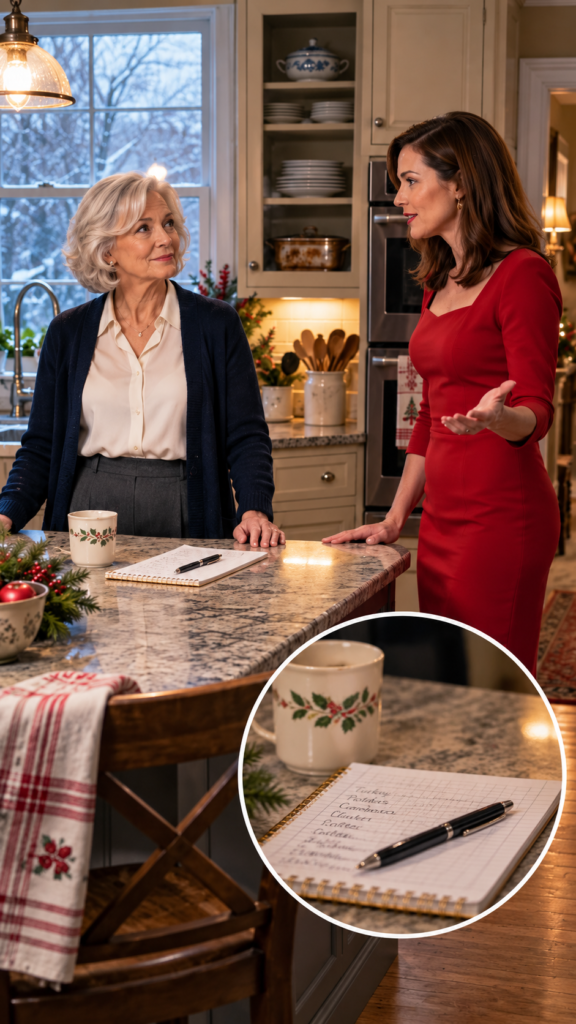
She stood in my kitchen wearing a red dress and high heels, looked around as though she were inspecting a banquet hall, and smiled.
“My whole family is coming here for Christmas,” she announced. “It’s only twenty-five people.”
Only twenty-five.
My kitchen.
My groceries.
My oven.
My aching knees.
So I smiled back and quietly said,
“Perfect. I’ll be away this year. You can cook, clean, and host it yourselves.”
The color drained from her face.
She thought I was canceling dinner.
She had no idea I had already signed something three days earlier that would change far more than Christmas.
My name is Carolyn Beck.
I am sixty-eight years old.
For most of my adult life, Christmas happened because I made it happen.
The same home outside Louisville.
The same kitchen island.
The same battered roasting pan that had cooked more holiday dinners than I could count.
The same serving dishes carefully lifted from the highest cabinet every December, as though family traditions were stored inside porcelain.
Women from my generation learned to make exhaustion look effortless.
You write every shopping list.
You thaw the turkey.
You wash the guest sheets.
You borrow folding chairs.
You remember who hates pecans.
Who drinks decaffeinated coffee.
Who needs the downstairs bathroom.
Which grandchildren touch everything they see.
Then, when everyone says,
“What a beautiful Christmas.”
You smile…
even though your feet ache…
your back burns…
and you haven’t sat down in ten hours.
Nobody notices the woman who built the holiday.
They notice the lights.
The decorated tree.
The perfectly set table.
They watch my son, Trevor, carve the turkey while everyone compliments Whitney as though she personally carried Christmas through the front door.
For five years…
Whitney had treated my home like a free event venue that happened to include a grandmother.
Easter brunch?
My kitchen.
Fourth of July?
My grill.
Thanksgiving?
My grocery bill.
My oven.
Her family posing beside my fireplace as though it came with their marriage certificate.
I stayed quiet because Trevor always gave me the same answer.
“Mom… you know how Whitney is.”
Yes.
I knew exactly how Whitney was.
Warm whenever guests were watching.
Sharp whenever they weren’t.
She loved introducing me as “such a lifesaver” while handing me another tray to refill.
She told everyone I “loved keeping busy,” as though being overworked had become my favorite hobby.
Then came one gray December afternoon.
The sky had already turned white before dinner.
I stood alone at the kitchen island holding a mug of coffee, writing the first half of another Christmas grocery list.
Without knocking…
Whitney walked in.
Bright red dress.
Black heels.
Perfume far too expensive for someone planning to cook absolutely nothing.
She didn’t ask a question.
She made an announcement.
“Your whole family is spending Christmas here this year.”
“It’s only twenty-five people.”
Not…
“Would that be okay?”
Not…
“How can we help?”
Just another twenty-five guests quietly dropped onto my shoulders.
For one long second…
I saw every Christmas I had sacrificed.
Every greasy roasting pan.
Every cold meal I ate after everyone else finished.
Every towel washed.
Every floor scrubbed.
Every compliment Whitney accepted while I stood alone in the kitchen scraping leftovers into the trash.
Then…
Something inside me became completely calm.
Because by then…
I already knew something Whitney didn’t know I knew.
So I smiled.
Not a bitter smile.
Not an angry smile.
Just enough to let her believe she still controlled the conversation.
“Perfect,” I said.
“I’ll be away this Christmas.”
“You and Trevor can cook, clean, and host everyone yourselves.”
Whitney blinked.
Her confident smile disappeared almost instantly.
She opened her mouth.
Nothing came out.
A few minutes later…
Trevor came home from work.
Still wearing his overcoat.
Already wearing the careful expression adult children use when they think they’re about to explain why their parents should simply understand.
“Mom,” he began gently,
“It’s Christmas.”
“People have already made plans.”
I nodded.
He talked about tradition.
I nodded again.
He talked about family.
I kept nodding.
Neither of them realized…
three days earlier…
I had been sitting across from my attorney and a notary.
For thirty years…
my estate plan had been simple.
Everything would eventually go to Trevor.
The house.
My savings.
The small parcel of land my parents left me decades ago.
Trevor’s hand stopped halfway toward the buttons of his overcoat.
The kitchen went so quiet I could hear the refrigerator humming behind him.
Whitney looked from his face to mine, waiting for somebody to laugh, to soften the moment, to restore the familiar order in which I eventually sighed and agreed.
Nobody did.
Trevor lowered his hand.
“What did you sign?”
His voice had changed.
The gentle persuasion was gone.
Not replaced by anger.
By fear.
I placed my coffee mug on the island carefully enough that the ceramic barely made a sound.
“A new estate plan.”
Whitney’s eyes sharpened.
Trevor stared at me.
I could see him trying to decide whether the sentence meant what he thought it meant.
“Because of Christmas?” he asked.
“No.”
That answer seemed to disturb him more.
I folded the unfinished grocery list once, then opened it again. My fingers were steady.
“Christmas was simply the first time I decided not to pretend everything was fine.”
Whitney gave a short laugh.
There was no humor in it.
“You changed your will because I invited my family for dinner?”
“I changed my estate plan because you have spent five years behaving as though my home, my money, my time, and eventually my death were household resources you were entitled to manage.”
The last word seemed to strike the air between us.
Trevor flinched.
Whitney’s face hardened.
“That is an awful thing to say.”
“So was telling twenty-five people they could spend Christmas in my house before asking me.”
“They’re family.”
“They’re your family.”
Her mouth opened.
I lifted one hand.
“And they would have been welcome if I had been asked.”
That stopped her.
Because that was the part she could not argue with.
I had never resented the people.
I resented becoming invisible while serving them.
Trevor pulled out one of the kitchen stools and sat down slowly, his overcoat still on. For once, he looked less like the son preparing to smooth over a disagreement and more like a man realizing the disagreement had existed for years without his permission to end it.
“What exactly changed?” he asked.
I looked at him.
“You are no longer inheriting everything outright.”
Whitney’s hand moved to the edge of the island.
“Excuse me?”
I did not look at her.
“My attorney restructured it. The house and land will not pass directly into anyone else’s name when I die. They’ll be sold unless I make another decision while I’m alive. My savings will remain protected in a trust for Trevor’s benefit.”
Trevor frowned.
“For my benefit?”
“Yes.”
Whitney leaned forward.
“What does that mean?”
It was the first question she had asked all afternoon.
And it was not about me.
I turned toward her.
“It means whatever Trevor eventually receives remains his. It does not become a house you can remodel, a property you can promise to relatives, or an account you can plan around.”
The color left her face again.
Trevor saw it.
So did I.
For several seconds, nobody moved.
Then Whitney said, much too quickly, “I have never planned around your money.”
Trevor’s eyes remained on her.
Something in the speed of her answer bothered him.
“Whitney.”
She crossed her arms.
“What?”
“What does Mom mean by property you can promise to relatives?”
Her gaze flicked toward me.
There it was.
Not guilt exactly.
Calculation.
She was searching for the smallest version of the truth.
“I don’t know. She’s upset.”
Trevor did not look away.
“Did you tell your family this house was going to be ours someday?”
Whitney’s face tightened.
“No.”
A pause.
Then she added, “Not like that.”
My son went very still.
I watched the words register.
Not like that.
Three words can sometimes carry more truth than a confession.
Trevor leaned back slightly.
“How, then?”
Whitney looked toward the window.
Outside, the afternoon had darkened until the bare branches were reflected faintly in the glass.
“It came up.”
“What came up?”
“This house.”
“How?”
“Trevor, this is ridiculous.”
“No. Tell me.”
She exhaled sharply.
“My mother asked what we would do with it someday.”
I saw Trevor’s jaw tighten.
“And what did you say?”
Whitney’s impatience finally cracked through the polished surface.
“I said we’d probably update it.”
The kitchen seemed to shrink.
Trevor stared at her.
“You discussed renovating my mother’s house after she dies?”
Whitney’s expression changed immediately.
“That is not what I said.”
“It is exactly what you just said.”
“I meant eventually.”
My son closed his eyes.
Only for a second.
But I saw something break there.
Not his marriage.
Not yet.
Something older.
His ability to tell himself he had misunderstood.
Whitney’s voice rose.
“Everyone talks about the future. That doesn’t make me some monster.”
“No,” I said quietly. “But you were living in my future before I was finished with my present.”
She turned toward me.
“You’re twisting everything.”
“Am I?”
“Yes.”
“Then tell Trevor why your family believed they were spending Christmas here before I had been told.”
Her lips pressed together.
“That has nothing to do with an estate plan.”
“You’re right.”
I folded the grocery list again.
“It has to do with respect.”
Trevor rubbed a hand over his mouth.
The movement looked tired.
Older than I had ever seen him.
“Mom,” he said, “why didn’t you tell me any of this before?”
For the first time that afternoon, something inside me hurt.
Not anger.
Grief.
“Trevor, I did.”
His hand dropped.
“You told me she was taking advantage.”
“I told you I was tired.”
He looked down.
“I told you Thanksgiving was becoming too much.”
His eyes stayed on the counter.
“I told you I couldn’t keep paying for every meal.”
His shoulders shifted.
“I told you I didn’t want strangers in my bedroom looking for coats. I told you my knees hurt after Easter. I told you I wanted one Fourth of July where I wasn’t standing over a grill.”
Every sentence seemed to make him smaller.
“And every time,” I said, “you told me I knew how Whitney was.”
He swallowed.
I felt my voice tremble then.
Only once.
“So yes, Trevor. I told you.”
Whitney uncrossed her arms.
“Are we really doing this? Are we going to pretend Carolyn never enjoyed hosting?”
I looked at her.
“I enjoyed hosting when I was the host.”
She stared back.
“I did not enjoy being staff in my own home.”
Trevor’s head lifted.
Whitney gave a disbelieving shake of her head.
“This is insane. We have one disagreement and suddenly I’m some gold digger?”
“No one called you that,” Trevor said.
His voice was low.
Whitney stopped.
He looked at her differently now.
Not angrily.
Carefully.
As though he had finally discovered that some truths could not survive being rushed past.
“You called yourself that.”
Her face changed.
“What?”
“You heard Mom say she changed her estate plan, and your first concern was what it meant.”
“That’s because she was clearly threatening us.”
“She wasn’t threatening us.”
His eyes shifted toward me.
“She was protecting herself.”
Whitney laughed again.
“You cannot seriously be taking her side.”
There it was.
The phrase I had heard in softer forms for years.
Side.
As though dignity were a contest.
As though a son could only respect his mother by betraying his wife.
Trevor stood.
He removed his overcoat slowly and draped it across the stool.
“I should have taken her side a long time ago.”
Whitney’s face emptied.
“Trevor.”
“I don’t mean against you.”
He pressed his palms flat against the island.
“I mean when something was wrong.”
She stared at him.
“You’re humiliating me.”
He gave a small, exhausted shake of his head.
“No. I’m finally not covering for you.”
Her expression tightened so suddenly I almost looked away.
Then she said something none of us could take back.
“Do you have any idea how much I have put up with because someday this was supposed to be yours?”
Trevor stopped breathing.
So did I.
Whitney heard herself too late.
Her eyes widened.
She stepped backward.
“That came out wrong.”
Trevor’s voice was barely audible.
“What have you put up with?”
“Nothing. I just meant—”
“My mother?”
“No.”
“You meant my mother.”
“I meant the expectations. Holidays. Family obligations.”
I watched my son’s face.
He did not look furious.
That would have been easier.
He looked devastated.
Whitney reached toward him.
He stepped back.
The distance between them was less than two feet.
It felt enormous.
“You married me knowing my mother was part of my life,” he said.
“She is part of our life.”
“No. You just said you were tolerating her because of what I might inherit.”
“I did not say that.”
“You did.”
His voice broke on the last word.
Whitney’s eyes filled.
For one instant, I saw panic behind the anger.
Real panic.
And I understood something I had not understood before.
She was not afraid of losing Christmas.
She was afraid of losing the future she had privately arranged.
My house.
My land.
My savings.
Perhaps even the version of Trevor who would never force her to look too closely at how she treated me.
I touched the edge of the grocery list.
“I think you should go home now, Whitney.”
Her head snapped toward me.
“This is my husband.”
“Yes.”
I met her eyes.
“And this is my house.”
The words were not loud.
They did not need to be.
She looked at Trevor.
“Are you coming?”
He did not answer immediately.
Whitney picked up her purse from the chair where she had dropped it when she entered.
Her fingers missed the strap the first time.
“Trevor.”
He stared at the floor.
When he finally looked at her, his face was pale.
“I’ll come later.”
Her chin trembled.
“You’re choosing her.”
He closed his eyes.
“No.”
He opened them again.
“I’m choosing not to pretend I didn’t hear what you just said.”
Whitney stood motionless.
Then her expression hardened.
“Fine.”
One word.
Sharp enough to cut.
She turned and walked toward the door, her heels striking the wood with the same confidence she had carried into my kitchen.
But the rhythm was faster now.
Uneven.
At the doorway, she stopped without looking back.
“You’re both going to regret turning one Christmas dinner into this.”
Trevor’s face changed.
Not much.
Enough.
“No,” he said.
Whitney turned.
He looked directly at her.
“You turned five years into one sentence.”
She left.
The door closed.
No slam.
That somehow made the silence afterward worse.
Trevor stood staring at it.
I could see his chest rising and falling beneath his shirt.
Neither of us spoke.
The refrigerator hummed.
A car passed outside on the wet road.
Somewhere in the house, the old heating system clicked on.
Then my son sat down again.
He put his elbows on the island and covered his face with both hands.
I had imagined this moment differently.
In the quiet part of my mind where I had rehearsed standing up for myself, I had expected satisfaction.
I felt none.
Only sorrow.
I walked around the island.
For a second, I nearly placed my hand on his shoulder.
Then I stopped.
He needed to feel what he had avoided.
Not as punishment.
As truth.
His hands dropped.
“I’m sorry.”
I looked at him.
He shook his head.
“No. That’s too small.”
His eyes were wet.
“I let you carry all of it because it was easier for me.”
The honesty hurt more than an excuse would have.
I pulled out the stool beside him and sat.
Trevor stared at the grocery list.
“I knew she could be demanding.”
I waited.
“I knew you were tired.”
His mouth twisted.
“And I kept thinking if you really wanted us to stop, you’d say no.”
“I did say no.”
He nodded immediately.
“I know.”
His voice cracked.
“I just only heard you when you finally stopped asking me to hear you.”
We sat there without fixing it.
That was new for us too.
Eventually Trevor looked toward the hallway.
“Are you really leaving for Christmas?”
“Yes.”
“Where?”
“I rented a small cabin about an hour away.”
His eyebrows rose.
“You rented a cabin?”
“I am sixty-eight, Trevor. I am capable of making reservations.”
A laugh escaped him.
It surprised both of us.
Then the laugh broke into something else.
He covered his eyes again.
This time, I touched his shoulder.
Just once.
“I don’t want you coming with me,” I said.
He looked up.
I saw the hurt before he hid it.
“I understand.”
“You need to go home and decide what kind of marriage you are in.”
He stared at me.
“And I need one Christmas that does not become another job.”
His eyes lowered.
“Okay.”
I stood.
He did too.
At the door, he stopped.
“Mom?”
“Yes?”
“Did you cut me out completely?”
I studied his face.
There was shame in the question.
Not greed.
Fear.
Maybe fear that the paperwork represented more than money.
That I had removed him from my life too.
“No.”
His shoulders shifted.
I did not explain further.
“Go home, Trevor.”
He nodded.
Then he left.
Christmas Eve arrived with snow.
Not the decorative kind that floats politely through Christmas-card windows.
Heavy Kentucky snow.
Wet flakes gathering on the cabin railing, bending the bare branches and swallowing the road in white.
I woke without an alarm.
For several seconds, I did not know where I was.
Then I remembered.
No turkey thawing downstairs.
No folding chairs.
No serving dishes.
No twenty-five people.
No Whitney.
No Trevor.
The silence should have felt lonely.
Instead, it felt unfamiliar.
And then, slowly, luxurious.
I made coffee.
I sat beside the window in my robe while it was still hot.
That detail alone almost made me cry.
I ate toast.
I read half a novel.
At noon I took a walk through the snow in boots I had owned for eleven years and rarely worn because Christmas Day had always trapped me inside my own kitchen.
My phone buzzed several times.
Messages from Trevor.
Nothing dramatic.
Merry Christmas, Mom.
Hope the cabin is peaceful.
The roads are bad. Please don’t drive tonight.
I answered the last one.
I won’t.
Then another message appeared.
I cooked.
I stared at it.
A photograph followed.
A turkey.
Or what I assumed had begun life intending to become a turkey.
The skin was too dark on one side and suspiciously pale on the other. Something that might have been gravy had escaped across the counter.
Against my will, I laughed aloud.
Another message arrived.
I understand the roasting pan now.
I sat there with the phone in my hand, laughing until tears came.
Not because it was funny.
Not entirely.
Because somewhere in Louisville, my son had spent hours doing one small piece of what I had done for decades.
And nobody had rescued him from it.
I typed back.
Let it rest before carving.
Three dots appeared.
Then:
Thank you.
He did not ask me to come home.
That mattered.
The week after Christmas, Trevor came to see me.
Whitney had moved temporarily into her sister’s house.
He looked exhausted.
He had started seeing a counselor alone.
“I don’t know what happens next,” he told me.
I poured coffee.
“You don’t have to know yet.”
He wrapped both hands around the mug.
“She says I betrayed her.”
I sat across from him.
“Do you think you did?”
His eyes lifted.
“No.”
There was no triumph in the answer.
Only grief.
“She keeps saying what she said about the house came out wrong.”
“Do you believe her?”
He stared into the coffee.
“I believe it came out exactly right.”
Months passed.
Winter softened.
Then disappeared.
Trevor did not move back home with Whitney.
He did not rush toward divorce either.
For the first time in his adult life, he allowed discomfort to remain unresolved long enough to understand it.
They tried counseling together.
He told me very little.
That was another change.
Their marriage was theirs.
My life was mine.
By early summer, he came to the house one evening and stood beside the kitchen island where everything had begun.
“She filed.”
I looked at him.
“For divorce?”
He nodded.
“After I refused to ask you to change the estate plan back.”
There it was.
The final fracture.
Not caused by my paperwork.
Revealed by it.
Trevor sat down.
“She told the counselor she couldn’t stay married to someone who put his mother ahead of his wife.”
I waited.
He gave a tired smile.
“I told her protecting my mother from being treated like an asset wasn’t putting you ahead of her.”
The divorce became final in October.
There was no dramatic courtroom scene.
No shouting on courthouse steps.
No victory.
Just signatures.
Separate addresses.
A marriage ending because one person had finally stopped translating disrespect into personality.
Whitney’s family stopped coming to my house.
Of course they did.
For a while I worried they would blame me.
Then I realized I had spent too many years managing the opinions of people who had never once washed one of my roasting pans.
I let them think whatever they needed to think.
Trevor came by more often.
Not constantly.
That would have become another kind of dependence.
Sometimes he changed a lightbulb.
Sometimes I helped him figure out why his gravy turned to paste.
Once he came over and said nothing about Whitney for three entire hours.
That was the first time I knew he was healing.
The following December, my attorney called.
There were a few routine papers to review.
Trevor happened to be with me when I returned from the appointment.
He was standing at the stove attempting soup.
I placed my folder on the counter.
He glanced at it.
Then immediately looked away.
That small movement touched me more than I expected.
A year earlier, the folder would have represented his future.
Now he treated it as mine.
“Trevor.”
He turned.
“Yes?”
“Sit down.”
His face tightened.
“Is everything okay?”
“Everything is fine.”
He sat.
I opened the folder.
“I want to tell you what I actually changed last year.”
He blinked.
“You don’t have to.”
“I know.”
I smiled.
“That is why I’m telling you.”
I slid one page toward myself, not him.
“The house and land still won’t pass directly to you.”
He nodded.
“I know.”
“My savings still go into trust.”
Another nod.
He looked almost embarrassed that we were discussing it.
Then I said, “You are still the primary beneficiary.”
Trevor went completely still.
“What?”
“You heard me.”
His eyes moved to the folder.
Then back to me.
“I thought…”
“I know what you thought.”
His mouth opened.
Nothing came out.
I reached across the island.
“For a year, you believed I had mostly disinherited you.”
He looked down.
“I figured you had every right.”
“And you never once asked me to reconsider.”
His face changed.
He understood before I finished.
I felt my throat tighten.
“That was the part I needed to know.”
His eyes filled immediately.
“Mom.”
“The trust was never punishment.”
I squeezed his hand.
“It was protection.”
He shook his head.
“Protection from Whitney?”
“Partly.”
I paused.
“Mostly protection from the part of you that had forgotten inheritance is a gift, not a plan.”
He looked away.
A tear slipped down his cheek.
He wiped it quickly.
I pretended not to notice.
Then he laughed softly.
“You tested me.”
“No.”
I shook my head.
“Life did.”
He looked at me for a long moment.
“What happens to the house?”
“I haven’t decided.”
“The land?”
“Also undecided.”
He nodded.
No disappointment.
No calculation.
Just acceptance.
And that was when I knew the documents had already done what I needed them to do.
Not legally.
Emotionally.
Christmas that year was smaller.
Trevor asked if I would come to his apartment.
I said yes under one condition.
“What?”
“I am bringing nothing but myself.”
He smiled.
“Deal.”
I arrived at four in the afternoon carrying my purse.
No casserole.
No pie.
No emergency gravy.
Nothing wrapped in foil.
Trevor opened the door wearing an apron.
I almost laughed.
“You look terrified.”
“I am terrified.”
The apartment smelled like rosemary, onions, and something slightly overcooked.
Music played quietly.
The table was set for two.
Two.
I stood in the doorway longer than I meant to.
Trevor noticed.
“Too small?”
I looked at the table.
“No.”
My voice caught.
“It’s perfect.”
He took my coat.
I sat down.
Actually sat down.
While somebody else worked.
Trevor moved back and forth between the stove and the table.
He forgot the butter.
He burned the first batch of rolls.
He dropped a spoon.
He apologized to the turkey.
And every time I started to stand, he pointed at the chair.
“No.”
I raised my eyebrows.
“Excuse me?”
“You said you were bringing nothing but yourself.”
“I can still help.”
“No.”
He smiled.
“Apparently you love keeping busy.”
For one second, I stared at him.
Then we both started laughing.
The sentence that had once made me feel invisible had finally become ours to laugh at.
When dinner was ready, Trevor carried out the turkey.
My battered roasting pan sat underneath it.
I stared.
“You took my pan.”
“Borrowed.”
“When?”
“Last week.”
I ran my fingers over the darkened edge.
The same scratched handles.
The same shallow dent near one corner.
The same pan I had cursed, scrubbed, stored, and carried through more Christmases than I could remember.
Trevor placed it carefully between us.
“I almost bought a new one,” he said.
“Why didn’t you?”
He looked down at it.
“Because this one knows what it’s doing.”
I smiled.
“So do I.”
“I know.”
He looked at me.
“That’s why you’re sitting.”
We ate.
The turkey was a little dry.
The potatoes were excellent.
The gravy was technically liquid.
I told him so.
He looked proud enough to have won an award.
After dinner, he disappeared into the bedroom.
When he returned, he carried a small flat package wrapped in brown paper.
“I know we said no big gifts.”
“This isn’t big.”
He handed it to me.
I opened it.
Inside was a simple wooden frame.
Behind the glass was my old Christmas grocery list from the previous year.
The one I had been writing when Whitney walked into my kitchen.
The fold lines were still visible.
At the top, in my handwriting:
Turkey.
Potatoes.
Butter.
Cranberries.
Coffee.
Then the list simply stopped.
I stared at it.
“You kept this?”
Trevor nodded.
“I found it on the island after you left for the cabin.”
I looked closer.
Beneath the original list was a small brass plaque.
Not expensive.
Not fancy.
Just six words.
THE CHRISTMAS MOM FINALLY SAT DOWN.
I covered my mouth.
Trevor’s eyes filled.
“I used to think Christmas happened because we all came home.”
His voice shook.
He looked at the roasting pan.
The table.
Then me.
“It happened because you never got to sit down.”
I could not speak.
He pulled out the chair beside mine and sat.
“I’m sorry it took me forty years to notice.”
I reached for his hand.
“It took me sixty-eight years to notice too.”
He frowned.
“What?”
“That I was allowed to stop.”
We sat there quietly.
Snow had begun falling outside the apartment window.
Not much.
Just a few flakes drifting through the streetlight.
Trevor leaned back.
“So what are you going to do with the land?”
I smiled.
“I have an idea.”
His eyebrows lifted.
I had visited the parcel in November.
For years, it had existed only on tax forms and estate documents.
A few acres my parents had left me outside the city.
Nothing dramatic.
Trees.
Grass.
A narrow rise overlooking a creek.
I had always assumed Trevor would inherit it.
Because that was what families did.
We passed things forward whether or not anyone had asked what the living person still wanted to do with them.
“I’m building something.”
Trevor stared.
“A house?”
“A small one.”
“For you?”
“Yes.”
His face slowly broke into a smile.
I laughed.
“Don’t look so shocked.”
“I’m not shocked.”
“You are.”
“I just thought you loved your house.”
“I do.”
I looked at the framed grocery list.
“But I think I’d like one Christmas where the highest cabinet is low enough that I don’t need a ladder.”
He laughed.
The plan was simple.
A smaller home.
One bedroom downstairs.
A wide kitchen.
A porch facing the creek.
Enough room for dinner.
Not twenty-five.
Unless I invited them.
I sold the Louisville house the following spring.
Trevor offered to help me pack.
This time, he waited until I asked.
We wrapped the porcelain serving dishes together.
When he reached for the battered roasting pan, I stopped him.
“That comes with me.”
He nodded solemnly.
“Obviously.”
On moving day, I stood in the empty kitchen one last time.
The island was bare.
The walls echoed.
Sunlight fell across the floor where extra tables had once stood at Thanksgiving.
I expected grief.
There was some.
Homes hold versions of us.
Young mothers.
Tired wives.
Widows learning silence.
Grandmothers carrying trays.
Women standing at sinks long after everyone else has gone home.
I touched the countertop.
Then I left.
My new house was finished before winter.
The kitchen was smaller.
The windows were larger.
The cabinets were lower.
Trevor helped me hang one thing on the wall beside the dining table.
The framed grocery list.
The Christmas I stopped.
The Christmas everything changed.
That December, Trevor called.
“How many people are coming for Christmas?”
I smiled into the phone.
“Two.”
A pause.
“Can I bring dessert?”
“You may.”
“I’m buying it.”
“Even better.”
Christmas morning arrived bright and cold.
The creek behind the house had frozen along the edges.
I made coffee.
I sat on the porch wrapped in a blanket while the sun climbed through the bare trees.
At noon, Trevor arrived carrying one bakery box and nothing else.
No assumptions.
No extra guests.
No plans made on my behalf.
He stopped at the door.
“Merry Christmas, Mom.”
“Merry Christmas.”
He lifted the box.
“I brought pie.”
“I see that.”
He hesitated.
“Can I come in?”
Such a small question.
Such an ordinary question.
I felt something inside me loosen completely.
Not because he needed permission.
Because he remembered to ask.
I stepped aside.
“Yes.”
Trevor came in.
Later, we ate at the little table by the window.
The old roasting pan sat between us.
The framed grocery list hung nearby.
Snow began to fall over the creek.
My son carved the turkey.
I drank my coffee while it was still hot.
And for the first Christmas in my entire adult life, when someone said, “What a beautiful Christmas,” I did not look toward the kitchen to see what still needed to be done.
I stayed in my chair.
Trevor reached across the table and covered my hand with his.
Outside, snow settled quietly over the land my parents had left me.
Inside, nothing needed carrying.
Nothing needed proving.
Nothing needed saving for someday.
For once, the house was warm, the work was finished, and I was already home.






