The Thanksgiving dinner shattered in a single heartbeat.
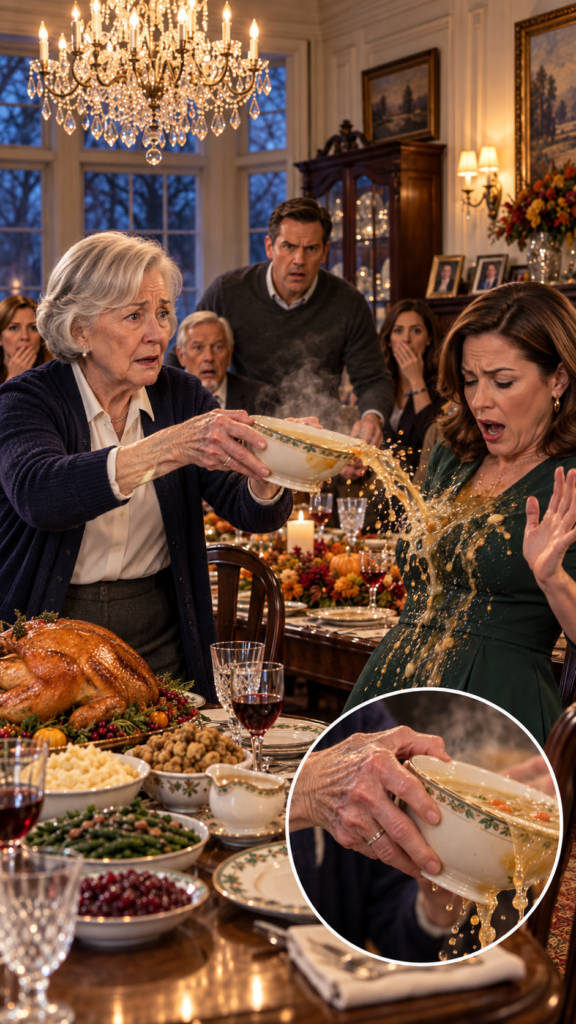
Margaret Whitmore, a frail 72-year-old mother with trembling hands, slowly lifted a steaming bowl of soup toward her daughter-in-law, Olivia. Before anyone could react, the bowl slipped. Scalding soup splashed across Olivia’s dress.
“”What is WRONG with you?”” Olivia screamed.
In a burst of rage, she swept the entire dinner table onto the floor. Plates exploded into pieces. Glasses shattered. Turkey, vegetables, and gravy scattered across the dining room as terrified family members gasped.
Daniel Whitmore jumped to his feet, his face burning with anger. Instead of helping his frightened mother, he slammed his fist onto the table and shouted, “”Mom! You ruined Thanksgiving!””
Margaret froze. Her lips trembled as she whispered, “”I… I’m sorry…””
But Daniel wasn’t finished.
He grabbed his mother’s small suitcase from beside the hallway, threw it toward the front door, and yelled, “”If you can’t stop causing problems, then leave this house!””
The elderly woman silently bent down to pick up the broken pieces of a family photograph lying among the shattered dishes. Her hands shook uncontrollably… yet no one noticed why.
No one knew this Thanksgiving dinner was about to expose a heartbreaking secret that would change the Whitmore family forever.
The latch on Margaret’s suitcase snapped open when it struck the floor.
The sound was small compared with the shattered dishes still settling beneath the table, but somehow everyone heard it. A neatly folded blouse slid halfway out, followed by a clear plastic bag of medication and a cream-colored medical folder that skidded across the hardwood until it stopped beside Daniel’s shoe.
Margaret looked up.
For the first time that evening, fear replaced embarrassment on her face.
“”Daniel, don’t.””
Her son stared down at the folder.
The anger did not vanish immediately. It simply lost its shape.
He bent and picked it up.
Margaret rose too quickly, one hand gripping the broken photograph while the other reached toward him. Her fingers shook so violently that a thin shard of glass slipped from her palm and clicked onto the floor.
“”Please,”” she whispered.
Daniel’s eyes moved across the first page.
He stopped breathing.
Olivia, still standing beside the wrecked dining table with soup staining the front of her dress, glanced from Daniel to Margaret.
“”What is it?””
Daniel did not answer.
His mouth opened, then closed again.
Around them, the family remained unnaturally still. A candle hissed where gravy had splashed near its base. Somewhere in the kitchen, a timer continued beeping because no one had remembered to turn it off.
Daniel finally raised his eyes.
“”Movement Disorders Clinic?””
Margaret shut her eyes.
Those three words changed the room more completely than the broken plates had.
Daniel looked back at the page.
His voice dropped.
“”Parkinson’s?””
No one moved.
Margaret’s shoulders lowered by barely an inch.
“”Six weeks ago.””
Daniel stared at her.
“”Six weeks?””
She nodded.
The photograph trembled against her chest.
“”The neurologist confirmed it six weeks ago.””
Daniel looked at her hands as if he were seeing them for the first time.
Not as clumsy hands.
Not as careless hands.
Not as the hands that had ruined dinner.
His mother’s hands.
The hands that had buttoned his winter coats when he was six. The hands that had packed lunches, checked fevers, signed birthday cards, wrapped Christmas presents, steadied his bicycle seat, and once sat beside a hospital bed all night with his father’s fingers folded between them.
Now they would not stop shaking.
Daniel’s face went pale.
“”Why didn’t you tell me?””
Margaret swallowed.
Her eyes moved briefly toward Olivia, then back to her son.
“”I came here to tell you.””
The words were quiet enough that everyone leaned toward them without realizing it.
“”Tonight?””
“”After dinner.””
Daniel’s fingers tightened around the medical folder.
Margaret looked down at the ruined floor.
“”I thought if we had one normal meal first, I might find the courage.””
A terrible silence followed.
Olivia’s expression shifted, but not into remorse.
She looked at the soup on her dress.
Then at Margaret.
“”If your hands are that bad, why were you carrying something boiling?””
Several people around the room turned toward her.
Daniel’s head moved slowly.
“”Olivia.””
“”What?”” she said. “”I’m asking a reasonable question.””
Margaret flinched.
Olivia gestured toward the wreckage.
“”She could have seriously burned me.””
Daniel stared at his wife.
A few minutes earlier, he had been furious for the same reason.
Now the words sounded different.
Crueler.
Smaller.
One of the older relatives near the far end of the room pushed her chair back.
“”She just told you she has Parkinson’s.””
Olivia folded her arms.
“”And that changes what happened?””
Margaret lowered her eyes.
That was the moment Daniel’s anger finally broke.
Not loudly.
Not dramatically.
It simply drained out of him and left something far worse behind.
Shame.
He looked at the suitcase he had thrown.
Then at the folder in his hand.
Then at his mother kneeling among broken plates because no one had helped her stand.
Daniel crouched.
“”Mom.””
Margaret stepped backward.
Only one step.
But Daniel felt it.
He had never seen his mother move away from him before.
Not once.
“”Don’t,”” she said.
His hand froze in the air.
Margaret took a breath that trembled almost as much as her fingers.
“”I can pick up my own things.””
“”You shouldn’t have to.””
Her eyes lifted.
“”No. I shouldn’t.””
Daniel’s face crumpled.
Behind him, Olivia made an impatient sound.
“”Can we not turn this into something it isn’t?””
Daniel turned.
“”Something it isn’t?””
“”I didn’t know she was sick.””
“”Neither did I.””
“”Exactly.””
Daniel stared at her.
Olivia spread her hands.
“”She didn’t tell us. How were we supposed to know?””
Margaret’s voice came from behind him.
“”You weren’t.””
Everyone looked at her.
She had managed to stand.
The broken photograph was held carefully against her cardigan. A thin line of blood crossed one fingertip where the glass had cut her, but she seemed not to notice.
“”You weren’t supposed to know,”” she repeated. “”You were only supposed to be kind.””
No one had an answer.
Margaret bent toward her open suitcase.
Daniel immediately moved to help, then stopped himself.
He waited.
After several seconds, Margaret nodded once.
Only then did he kneel beside her.
Together they gathered the medication, the folded blouse, and the papers from the floor.
Daniel’s hands shook now too.
When he placed the folder back into the suitcase, he noticed another envelope beneath it.
His name was written across the front.
Daniel.
The handwriting was Margaret’s.
He looked at her.
“”What’s this?””
She took it gently from him.
“”Something I wrote after the diagnosis.””
His throat tightened.
“”For me?””
“”In case I lost the nerve to say everything aloud.””
Daniel looked as though someone had struck him.
Margaret slid the envelope back beneath her clothes.
“”You don’t get it tonight.””
He closed his eyes.
“”I understand.””
“”No,”” Margaret said quietly. “”You don’t yet.””
She stood and closed the suitcase.
Olivia stared at them.
“”You’re seriously leaving?””
Margaret looked toward her.
There was no anger in her expression.
That made it worse.
“”Your husband threw my suitcase at the door.””
Daniel dropped his gaze.
Olivia’s jaw tightened.
“”He was upset.””
Margaret looked at Daniel.
“”So was I.””
Then she reached for the suitcase handle.
Daniel stood.
“”Let me drive you home.””
“”No.””
“”Mom, please.””
“”Not tonight.””
The words were gentle.
Final.
One of the relatives quietly offered to call a car.
Margaret nodded.
No one tried to stop her after that.
The family watched while she crossed the foyer slowly, carrying the damaged photograph beneath one arm and pulling the little suitcase behind her.
Daniel followed as far as the front door.
Outside, cold November air rushed into the house.
Margaret stepped onto the porch.
“”Mom.””
She turned.
Daniel stood beneath the warm light of the entryway, surrounded by the wreckage he could no longer pretend had been caused by spilled soup.
His eyes were wet.
“”I’m sorry.””
Margaret looked at him for a long time.
“”I know you are.””
Hope flickered across his face.
Then she added, “”But I need you to understand what you’re sorry for before I can hear it.””
The car arrived five minutes later.
Daniel watched from the porch until its red taillights disappeared beyond the end of the street.
When he went back inside, nobody had resumed Thanksgiving.
The food remained on the floor.
The chairs stood crooked.
The turkey lay on its side beside broken porcelain.
Olivia was upstairs changing her dress.
No one spoke to Daniel.
One by one, relatives put on their coats.
A cousin squeezed his shoulder before leaving but said nothing.
An aunt stopped at the doorway and looked toward the stairs.
“”Take care of your mother,”” she said.
Daniel nodded.
She looked at him.
“”I mean it this time.””
Then she left.
By midnight, only Daniel and Olivia remained.
Daniel sat alone at the ruined dining table.
He had cleaned nothing.
Olivia came down wearing sweatpants and a gray sweater, her hair damp from the shower.
She stopped when she saw him.
“”You’re still sitting there?””
Daniel looked at the empty chair where his mother had been.
“”She was shaking when she walked in.””
Olivia leaned against the doorway.
“”Daniel.””
“”I noticed.””
He rubbed both hands over his face.
“”I noticed and didn’t ask.””
“”Neither did anyone else.””
“”I’m not anyone else.””
Olivia’s expression hardened.
“”So now this is my fault?””
Daniel looked at her.
“”I didn’t say that.””
“”You don’t have to.””
He stared at the shards still glittering beneath the chandelier.
“”You swept an entire table onto the floor.””
“”She burned me.””
“”My mother has Parkinson’s.””
“”And I didn’t know that.””
Daniel’s voice remained low.
“”You shouldn’t need a diagnosis before you decide not to humiliate someone.””
Olivia went very still.
“”Excuse me?””
“”She apologized before she even understood what was happening. You screamed at her. I screamed at her. Then I threw her belongings out of the house.””
“”You did that, Daniel.””
“”I know.””
He looked at her.
“”That’s the difference between us right now.””
Olivia’s face changed.
“”What is that supposed to mean?””
“”It means I know what I did was wrong.””
“”And I don’t?””
Daniel waited.
Olivia said nothing.
That silence answered him.
The next morning, Daniel drove to Margaret’s house.
Her curtains were open.
Her car sat in the driveway.
He remained behind the wheel for nearly twenty minutes.
Finally, he walked to the front door and knocked.
Margaret opened it wearing a pale blue sweater and dark trousers.
She looked tired.
Not fragile.
Just tired.
Daniel held the broken photograph frame in both hands.
He had spent half the night gathering every piece from the dining room floor.
“”I thought you might want this.””
Margaret looked down.
A crack ran through the wooden corner, but the photograph itself had survived.
Daniel had placed it inside a temporary frame.
Margaret took it.
“”Thank you.””
He waited.
She did not invite him inside.
“”Can I see you again?””
Margaret looked at him.
“”You’re seeing me now.””
He nodded, absorbing it.
“”Can I come with you to your next appointment?””
Her expression tightened slightly.
“”Why?””
“”Because I want to understand.””
“”Or because you’re frightened?””
Daniel looked down.
“”Both.””
Margaret studied him.
“”My appointment is Tuesday at ten.””
He looked up.
“”I’ll be there.””
“”Nine fifty-five.””
A faint ghost of the mother he remembered passed through her eyes.
“”You were always late.””
Daniel almost smiled.
He didn’t.
“”Not Tuesday.””
He arrived at nine thirty-eight.
Margaret said nothing about it.
During the appointment, Daniel sat beside her while the neurologist discussed medication adjustments, stiffness, tremor, sleep, exercise, and the uncertainty of progression.
He took notes until his handwriting became unreadable.
Margaret finally touched his wrist.
“”Daniel.””
He looked at her.
“”You don’t have to memorize my disease.””
His mouth tightened.
“”I missed it.””
“”That doesn’t mean you can defeat it by paying attention harder.””
He stared at his notebook.
“”I want to do something.””
Margaret’s hand trembled against his sleeve.
“”Then learn how to stay when you can’t fix something.””
He stopped writing.
That became the beginning.
Not forgiveness.
Not yet.
But a beginning.
For several weeks, Daniel visited without expecting to be welcomed for long.
He brought groceries once. Margaret made him take half of them home because she had already shopped.
He offered to reorganize her kitchen. She told him absolutely not.
He installed a better handrail by the back steps only after asking three separate times and receiving an irritated yes.
Some afternoons she let him stay for coffee.
Other days she said she was tired.
Daniel learned not to make her boundaries about his guilt.
Olivia never came with him.
At first, Daniel explained that she needed time.
Then he stopped explaining.
Two months after Thanksgiving, he and Olivia began marriage counseling.
The first session lasted fifty minutes.
The second felt like five hours.
By the fourth, Daniel finally said what he had been afraid to admit.
“”I don’t think the problem was one dinner.””
Olivia stared at him from the other end of the couch.
“”Then what was it?””
Daniel thought of Margaret stepping backward when he reached for her.
“”I think the dinner showed me who I become when cruelty feels easier than patience.””
Olivia looked away.
“”So you’re calling me cruel.””
“”I’m talking about both of us.””
“”Don’t include me in your guilt.””
The counselor remained silent.
Daniel’s chest tightened.
“”Do you regret what you said to her?””
Olivia crossed her legs.
“”I regret that things got out of control.””
“”That isn’t what I asked.””
Her eyes flashed.
“”I am not going to spend the rest of my life apologizing because your mother hid an illness and then had an accident.””
Daniel sat motionless.
“”She didn’t ask you to.””
“”Good.””
“”She hasn’t asked you for anything.””
Olivia leaned back.
“”Then why are we still talking about it?””
Daniel looked at her for a long time.
And something inside him became terribly quiet.
Their marriage did not end that afternoon.
Real endings rarely happen in one clean moment.
They tried for another three months.
Daniel apologized for the things that were his.
Olivia defended the things that were hers.
He asked her twice to visit Margaret.
She refused.
He asked whether she would write a letter.
She said she had nothing to say that would not make things worse.
When spring arrived, Daniel moved into a small apartment fifteen minutes from his mother.
By summer, he and Olivia had filed for divorce.
There was no dramatic courtroom confrontation.
No final screaming match.
No revenge.
Just signatures.
Boxes.
Keys placed on a counter.
And the irreversible knowledge that one terrible evening had not destroyed their marriage by itself.
It had simply made the truth impossible to ignore.
Margaret never celebrated the divorce.
When Daniel told her, she sat quietly at her kitchen table.
“”I’m sorry,”” she said.
Daniel looked surprised.
“”For what?””
“”For the life you thought you were going to have.””
His eyes filled.
“”You don’t hate her?””
Margaret considered the question.
“”No.””
“”How?””
She folded her hands together to steady them.
“”Hatred would keep her in the room.””
Daniel looked down.
“”I’m still angry.””
“”You should be careful with that.””
“”Why?””
Margaret’s eyes softened.
“”Because anger likes to wear the clothes of justice.””
He gave a broken laugh.
“”You always talk like that?””
“”Only when you’re finally listening.””
That made them both smile.
It was the first easy smile they had shared since Thanksgiving.
The envelope remained unopened for nearly eight months.
Daniel never asked for it.
Margaret never offered.
Then one rainy September afternoon, Daniel arrived carrying the repaired family photograph.
Not the temporary frame.
The original.
He had found a craftsman who restored the cracked wooden corner and replaced the shattered glass.
Margaret ran one finger along the edge.
“”You fixed it.””
“”Mostly.””
“”Mostly?””
Daniel sat across from her.
“”There was something behind the backing.””
Margaret’s hand stopped.
Daniel reached into his coat pocket.
He pulled out a folded piece of yellowed paper.
The edges were soft with age.
Margaret stared at it.
Then she laughed.
A small, astonished sound.
“”You found that?””
Daniel unfolded it carefully.
The handwriting belonged to a child.
Large uneven letters leaned across the page.
Mommy,
When I get big you can live with me and I will make you soup and you never have to be scared because I will take care of you forever.
Love,
Danny
Daniel could barely read the final line aloud.
His voice broke.
Margaret covered her mouth.
For several seconds, neither of them spoke.
Rain tapped softly against the windows.
Daniel looked at her.
“”I wrote this?””
“”You were eight.””
“”Why was it behind the photograph?””
Margaret’s eyes moved toward the restored frame.
The picture showed Daniel as a boy standing between his parents at Thanksgiving, his two front teeth slightly too large for his face, his arms wrapped around both of them.
“”You gave it to me the year your father was in the hospital,”” she said.
Daniel closed his eyes.
A memory returned in fragments.
Hospital corridors.
His father’s gray face.
Margaret pretending not to be frightened.
A bowl of soup warming on the stove when they finally came home.
“”I kept it because you were so serious,”” Margaret said.
Daniel’s eyes filled.
“”And then I threw you out over soup.””
Margaret reached across the table.
Her hand trembled.
Daniel took it carefully.
“”Danny.””
He looked up.
She had not called him that in decades.
“”I did not keep that note because I expected you to take care of me forever.””
“”Then why?””
Margaret smiled through tears.
“”Because for one afternoon, an eight-year-old boy saw that his mother was scared and decided the answer was kindness.””
Daniel lowered his head.
A tear struck the yellowed page.
Margaret squeezed his fingers.
“”I needed to remember that boy existed.””
Daniel could not speak.
She waited.
“”Do you still think he does?”” he finally whispered.
Margaret looked at him for a long time.
“”I think he’s sitting in my kitchen.””
Daniel broke.
Not loudly.
He bent forward with both hands covering his face, shoulders shaking, every apology he had tried to perfect collapsing into something rawer and more honest.
Margaret came around the table slowly.
She placed one hand on the back of his neck.
He leaned against her.
“”I’m sorry,”” he said.
This time there was no explanation attached.
No request.
No defense.
Just the words.
Margaret held him until he stopped shaking.
A week later, she gave him the envelope.
Daniel opened it alone in his apartment.
The letter inside had been written six weeks before Thanksgiving.
Daniel,
If I lose the courage to tell you, I want you to know that I am frightened, but I am not disappearing. I am still your mother. I will still argue about how much salt you use. I will still remember every embarrassing thing you did in middle school. I will still call you when my television decides to become smarter than I am.
I don’t need you to rescue me.
I need you to see me.
If this illness changes my hands, my walk, my voice, or the speed at which I do things, please do not mistake slowness for absence.
And if I become afraid, sit with me.
You were very good at that when you were eight.
Love,
Mom
Daniel read the letter three times.
Then he folded it along its original creases and placed it beside the childhood note.
By the following Thanksgiving, Margaret’s tremor had not disappeared.
Some days were easier.
Some were not.
Her movements had become more deliberate, and she had learned which cups were easier to hold and when pride was useful and when it was merely exhausting.
She also learned how many people loved her once she stopped protecting them from the truth.
Relatives who had stayed silent during the previous Thanksgiving came to her one by one.
Some brought flowers.
Some brought food.
One simply sat across from her and said, “”I should have stood up.””
Margaret did not tell any of them that their silence had been acceptable.
But she let sincere apologies become beginnings.
The next Thanksgiving was held at Margaret’s house.
Smaller.
Quieter.
No enormous guest list.
No performance of perfection.
Daniel arrived before noon carrying a turkey and a grocery bag containing three different kinds of potatoes because he had forgotten which ones she preferred.
Margaret inspected the bag.
“”You bought all three?””
“”I panicked.””
“”Clearly.””
He kissed her cheek.
She smiled.
Later, when dinner was almost ready, Daniel reached for the soup pot.
Margaret reached for it at the same time.
They both stopped.
For one second, the previous Thanksgiving stood between them.
The shouting.
The broken plates.
The suitcase striking the floor.
Daniel slowly removed his hand.
“”Do you want help?””
Margaret looked at him.
Not Do you need help.
Do you want help.
The difference mattered.
She nodded toward the ladle.
“”You carry the soup.””
Daniel smiled.
“”I can do that.””
“”Carefully.””
“”I was eight when I made the promise. My technique has improved.””
Margaret laughed.
The sound filled the kitchen.
Daniel carried the soup into the dining room while Margaret followed with the bread.
No one stared at her hands.
No one pretended not to see them either.
When she needed a moment to steady a glass, conversation simply continued around her.
When she asked for help, someone helped.
When she did not, nobody rushed in to make her smaller than she was.
After dinner, Daniel brought out the restored photograph.
It had been placed in a new frame with two layers of glass.
Behind the family picture, visible only if you turned it over, was the childhood note.
Margaret touched the edge.
“”You put it back.””
Daniel nodded.
“”It belongs there.””
She looked at him.
“”Why?””
Daniel glanced around the room.
At the family clearing plates.
At the half-eaten pie.
At the warm lights reflected in the windows.
At his mother standing beside him.
“”Because I finally understand what the picture was of.””
Margaret raised an eyebrow.
“”Us?””
Daniel shook his head.
“”A promise I forgot I knew how to keep.””
Margaret’s eyes filled.
She did not answer.
She only slipped her hand into his.
It trembled against his palm.
Daniel did not tighten his grip to stop it.
He did not look away.
He simply held on.
Outside, November wind moved through the bare trees.
Inside, candlelight flickered across the repaired frame, the old photograph, and the childish note tucked safely behind it.
Margaret’s hand was still trembling when Daniel led her back toward the table.
This time, no one mistook it for weakness.
And this time, she was home.






