“Get out of my kitchen,” Ellie said, and her hand struck my shoulder before I understood she meant it.
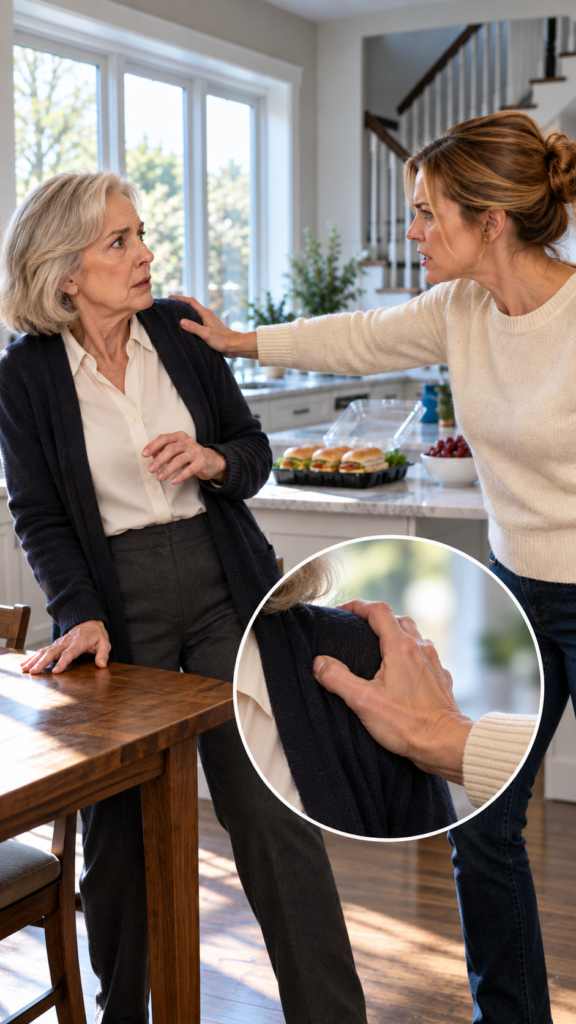
I stumbled backward, hit the table, and felt my wrist bend against the corner with a sickening burst of pain.
The room went silent.
Ellie stood three feet away, breathing hard through her nose.
Her cream sweater looked spotless.
Her hair was pinned neatly at the back of her head.
My hand shook against my chest.
For one strange second, I noticed the Costco tray on the island.
Half the sandwiches were gone.
A plastic lid hung open beside a bowl of grapes.
Sunlight poured through the tall windows of their new rental in Naperville, Illinois.
Everything looked too bright for what had just happened.
I looked toward the stairs.
“Jacob?” I called.
Nothing answered me.
Ellie’s mouth tightened.
“Don’t do that,” she said.
“Do what?”
“Make this dramatic.”
I stared at her.
My wrist throbbed so hard I felt it in my teeth.
“You put your hands on me,” I said.
Ellie folded her arms.
“You were crowding me.”
“I was standing by the table.”
“You always have a way of making yourself the victim.”
Her voice had changed.
It was calm now.
That frightened me more than the shove.
A moment earlier, she had been yelling.
Now she sounded almost rehearsed.
I tried to stand straighter.
The movement sent another white-hot pulse through my wrist, and I caught my breath before I could stop myself.
Ellie saw it.
For half a second, something uncertain passed across her face.
Then it disappeared.
“You came in here already upset,” she said.
I stared at her.
“No, I didn’t.”
“You wouldn’t let it go.”
“Let what go?”
Her eyes flicked toward the stairs.
It was quick.
Almost nothing.
But I saw it.
And suddenly I understood why her voice had become so careful.
She was no longer speaking to me.
She was preparing the version she intended to give Jacob.
“You kept getting closer,” she said. “I asked you to back up.”
“That never happened.”
“You were angry.”
“I wasn’t.”
“You raised your voice.”
“Ellie.”
“You did.”
The certainty in her tone made my stomach turn.
Not because I believed her.
Because she believed certainty could become truth if she delivered it calmly enough.
I lowered my injured hand as far as I could and reached for the back of the nearest chair.
The wood felt solid under my fingers.
I needed something solid.
“You shoved me.”
“I moved you away from me.”
“You shoved me into that table.”
“You lost your balance.”
I looked at her for several seconds.
Then I heard a floorboard above us creak.
Ellie heard it too.
Her shoulders changed.
Only slightly.
But I watched the tension leave them as though someone had just handed her a script she knew by heart.
Footsteps moved toward the stairs.
Jacob appeared at the top landing.
He stopped when he saw us.
His face went pale.
“Mom?”
The word broke something open inside me.
Not relief.
Not yet.
I had called for him twice.
He had not answered.
Now he was standing there looking from my face to Ellie’s folded arms, then down toward the hand I was holding against my chest.
“What happened?”
Ellie spoke first.
“Your mother got upset.”
I closed my eyes for one second.
There it was.
Not she shoved me.
Not I fell.
Not my wrist was hurt.
Your mother got upset.
Jacob came down two steps.
“Mom, what happened to your hand?”
“She backed into the table,” Ellie said.
My eyes opened.
Jacob stopped.
I looked directly at my son.
“She shoved me.”
The kitchen seemed to shrink around those three words.
Jacob’s gaze moved to Ellie.
Ellie gave a short, disbelieving laugh.
“Oh my God.”
“She hit my shoulder hard enough that I fell backward.”
“I did not hit you.”
“You put your hand on me.”
“I was creating space.”
“You told me I was crowding you.”
“You were.”
“I was standing beside the table.”
Jacob came down another step.
“Stop.”
Neither of us spoke.
He rubbed one hand across his mouth.
The silence that followed felt worse than the argument.
I watched his eyes.
I had known those eyes since the first morning they opened.
I knew what Jacob looked like when he was confused, embarrassed, frightened, guilty.
What I saw now was all four.
“Did you see what happened?” I asked.
He looked at me.
Then at Ellie.
“No.”
The answer came too quickly.
Something in me went still.
Ellie exhaled.
It was barely audible.
But I heard that too.
I picked up my handbag from the chair beside me with my good hand.
Jacob came off the final stair.
“Mom, wait.”
“I need to have this looked at.”
“I’ll drive you.”
“No.”
His face tightened.
“Mom.”
“I called you.”
He stopped moving.
I held his eyes.
“Twice.”
Ellie shifted behind him.
“You don’t have to make him feel guilty because we had an argument.”
I turned toward her.
“We did not have an argument.”
Her jaw set.
“You came into my house—”
“And you put your hands on me.”
Jacob flinched.
Ellie looked at him immediately.
“Jacob, you know how she gets.”
There are sentences that hurt because they are cruel.
And there are sentences that hurt because they reveal they have been spoken before.
I looked at my son.
He did not meet my eyes.
That was the moment I knew this had not begun in the kitchen.
Ellie had been building a story about me long before I arrived.
I walked toward the front door.
Jacob followed me into the hall.
“Mom, please.”
I kept going.
“Let me take you somewhere.”
“I can drive.”
“With your wrist?”
“I’ll manage.”
He stepped in front of the door but did not block it.
His eyes were wet now.
“I don’t know what happened.”
I stared at him.
“That is exactly the problem.”
Then I opened the door and left.
Outside, the afternoon had turned painfully beautiful.
A row of maples along the street moved in the breeze.
Somewhere nearby, a dog barked twice.
A delivery truck rolled past as if nothing in the world had changed.
I sat in my car for several minutes because I could not get the key into the ignition without shaking.
My wrist had begun to swell.
But it was not the pain that kept me there.
It was Jacob’s face when Ellie said, You know how she gets.
He had recognized the sentence.
Worse, he had accepted it.
At least once.
Maybe many times.
I drove to urgent care with one hand steadying the wheel and the other pressed against my coat.
The waiting room smelled faintly of disinfectant and coffee.
A television mounted in the corner played a cooking program with the sound turned low.
People came and went.
A child cried because he did not want his temperature taken.
An elderly man slept with his chin against his chest.
Everything around me was so normal that I almost began doubting the size of what had happened.
Then a nurse asked how I had injured my wrist.
I opened my mouth.
Nothing came out.
She waited.
Her expression did not change.
“My daughter-in-law shoved me,” I finally said.
Hearing it aloud in a room where nobody knew us made the sentence feel brutally simple.
No family history.
No competing version.
No explanation.
Just an action and its consequence.
The examination showed no broken bone, but the wrist was badly sprained. They wrapped it, fitted me with a brace, and told me to rest it.
When I stepped back into the parking lot, Jacob had called seven times.
There were three texts.
Mom please call me.
I’m sorry.
Please tell me where you are.
I read them all.
I answered only the last one.
I’m safe. I need tonight.
He responded almost immediately.
Okay.
Then, a minute later:
I love you.
I put the phone facedown.
Love was not the question.
The question was what love did when truth became inconvenient.
That evening, I sat at my kitchen table with a bag of frozen peas wrapped in a towel over my wrist.
At 8:17, someone knocked.
I knew who it was before I opened the door.
Jacob stood on the porch alone.
His hair was damp from the mist that had started after dark.
He looked younger than he had that afternoon.
And older.
“Can I come in?”
I stepped aside.
He entered but did not remove his coat.
For a while, neither of us sat down.
His eyes dropped to the brace.
His throat moved.
“Is it broken?”
“No.”
He nodded.
“That’s good.”
“Yes.”
Another silence.
Then he whispered, “I’m sorry.”
I leaned against the counter.
“For what?”
His face crumpled slightly.
Not dramatically.
Just enough that I saw how hard the question had landed.
“For not coming down.”
My breathing stopped.
Jacob stared at the floor.
“I heard you call me.”
The room seemed to tilt.
“You heard me?”
“Yes.”
“Both times?”
His eyes closed.
“Yes.”
I had imagined many possible answers.
None of them prepared me for that one.
“Why didn’t you answer?”
He pressed both palms against the edge of the table.
“I was standing on the landing.”
I waited.
He looked at me.
“I came out when I heard the table hit.”
A cold feeling moved through me.
Jacob’s voice dropped.
“I saw Ellie standing there. I saw you holding your wrist. I heard you say she put her hands on you.”
My eyes burned.
“And you stayed upstairs.”
“I froze.”
I laughed once.
There was no humor in it.
“You froze.”
“I know how that sounds.”
“No, Jacob. I don’t think you do.”
He swallowed hard.
“Ellie has been telling me for months that things between you two were getting worse.”
I said nothing.
“She said you criticized her. That you ignored boundaries. That you made little comments and then acted confused when she reacted.”
“Did you believe her?”
He looked away.
“Sometimes.”
The honesty hurt more than a lie would have.
“Did you ever ask me?”
“No.”
“Why?”
“Because I thought I was protecting my marriage.”
I stared at my son.
“From me?”
His mouth trembled.
“I don’t know anymore.”
“That is not an answer.”
“I know.”
He pulled out a chair but remained standing behind it.
“She would tell me something happened, and when I said it didn’t sound like you, she’d say that was because you never acted that way around me.”
I felt my good hand curl against the counter.
“And every time I tried harder not to offend her, it became proof that I had offended her before.”
He nodded slowly.
“Yes.”
I looked toward the dark window above my sink.
For months, I had felt something changing.
Calls ending sooner.
Invitations becoming vague.
Jacob saying Ellie was tired.
Ellie saying they were busy.
Small distances that never seemed large enough to confront.
Now I could see the shape they had formed.
“You let her explain me to you,” I said.
Jacob’s eyes filled.
“Yes.”
That answer, at least, was clean.
I turned back toward him.
“What happened today?”
He took a breath.
“After you left?”
“No. Before I left. Tell me what you saw.”
His face tightened.
“I saw the end.”
“What does that mean?”
“I saw you against the table. I saw Ellie in front of you. I heard what you both said.”
“Did you see her shove me?”
He hesitated.
Then shook his head.
“No.”
My heart sank.
“But I saw something else.”
I waited.
“When you said she put her hands on you, Ellie didn’t say she never touched you.”
I remembered every word.
I moved you away from me.
You lost your balance.
Jacob continued.
“She said you were crowding her. She said she was creating space. Then when I came downstairs, she told me you backed into the table.”
He looked at me.
“She changed it.”
I felt the frozen peas slipping in my lap and adjusted them without speaking.
Jacob’s eyes were red.
“And after you left, she changed it again.”
“How?”
“She said you tripped.”
The room went quiet.
I could hear the refrigerator humming.
“She told me she never touched you at all.”
I closed my eyes.
Jacob whispered, “That’s when I knew.”
I opened them.
“Knew what?”
“That I had been waiting for a version that would let me avoid choosing.”
He sat down at last.
His shoulders folded forward.
“I kept telling myself there had to be some misunderstanding because if there wasn’t, then I had to admit I had listened to her talk about you for months without once coming to you.”
I did not rescue him from the sentence.
He needed to finish it.
“And I had to admit that when you called my name today, I stayed on those stairs because I was afraid of what answering would force me to do.”
His voice broke.
“I left you alone in that room.”
“Yes.”
He nodded.
A tear hit the back of his hand.
“Yes.”
The next morning, Jacob asked me to come back to the rental.
I almost refused.
Every part of me resisted the idea of stepping into that kitchen again.
Then I realized refusal would leave the last image exactly where Ellie had put it.
Me backing away.
Me leaving.
Me becoming the person who disappeared while she supplied the explanation.
So I went.
I did not go for Ellie.
I went for myself.
The Costco tray was gone.
The bowl of grapes remained on the island.
The plastic lid had been thrown away.
Sunlight came through the same tall windows, but the room felt different now.
Jacob stood near the table.
Ellie stood across from him in the same cream sweater.
She looked exhausted.
When she saw the brace on my wrist, her expression hardened.
“This is unnecessary,” she said.
Jacob did not look at her.
“Sit down.”
“I’m not sitting through some interrogation.”
“Then stand.”
She stared at him.
Something had changed between them overnight.
I could feel it before either of them said another word.
Ellie turned to me.
“I’m sorry you hurt your wrist.”
It was almost elegant.
Carefully shaped.
An apology with the person who caused the injury removed from the sentence.
I said nothing.
Jacob did.
“How did she hurt it?”
Ellie looked at him.
“We already talked about this.”
“Tell me again.”
“She stepped backward.”
“Why?”
“Because we were arguing.”
“You told me she tripped.”
Ellie’s eyes narrowed.
“She did.”
“You also told Mom you moved her away from you.”
“I barely touched her.”
The sentence landed like glass breaking.
Ellie realized it instantly.
Her face changed.
Jacob did not move.
“Yesterday you told me you never touched her.”
“She was in my space.”
“So you did touch her.”
“She would not back up.”
“She says she was standing beside the table.”
“She’s lying.”
Jacob’s jaw tightened.
“How hard did you push her?”
“I didn’t push her.”
“You just said you touched her.”
“To move her.”
“Hard enough that she hit the table?”
Ellie’s composure cracked.
“Oh, for God’s sake, Jacob. Are you seriously doing this?”
“Yes.”
“After everything I’ve told you?”
“That’s why I’m doing it.”
She went silent.
He looked at her with a sadness I had never seen on his face before.
“You told me my mother made things up.”
Ellie’s lips parted.
“You told me she exaggerated. You told me she twisted things. You told me she created scenes and then pretended she didn’t understand why people were upset.”
“She does.”
Jacob glanced at my wrist.
“No.”
Ellie laughed sharply.
“One brace and suddenly I’m a monster?”
“No. One brace made me stop pretending I wasn’t seeing a pattern.”
Her expression changed.
Fear entered it.
Not fear of me.
Fear of losing control of him.
She stepped closer.
“Jacob.”
He backed away.
It was the smallest movement in the room.
It was also the end.
“I heard her call me yesterday,” he said.
Ellie froze.
“I was on the landing.”
The color left her face.
Jacob’s voice shook, but he kept going.
“I heard you tell her she was crowding you. I heard you say you moved her. I heard you tell her she always makes herself the victim.”
Ellie looked at me.
Then back at him.
“You were listening?”
“I was hiding.”
The shame in his voice made me look away.
He did not.
“I hid because you had spent months convincing me that every conflict with my mother was proof that she was the problem. And when I finally heard one happening with my own ears, I still stood there trying to find a reason not to believe it.”
Ellie’s face twisted.
“So now this is all my fault?”
“No.”
Jacob took a breath.
“My silence is mine.”
The room became utterly still.
He looked at me.
“I own that.”
Then he looked at his wife.
“But what you did is yours.”
Ellie stared at him.
For once, she had no prepared sentence.
Jacob walked to the counter where a set of keys rested beside his wallet.
He picked them up.
“I’m leaving.”
Her eyes widened.
“For how long?”
“I don’t know.”
“You’re leaving me because your mother fell into a table?”
Jacob’s face went cold.
“No.”
He opened his hand.
The keys lay across his palm.
“I’m leaving because you shoved my mother, lied about it three different ways, and expected me to help you make her doubt what happened.”
Ellie looked toward me.
“You wanted this.”
I shook my head.
“No.”
“Of course you did.”
“No, Ellie. I wanted my son to answer when I called his name.”
Her face went blank.
Nothing I could have said would have hurt her more because nothing else was as true.
Jacob closed his hand around the keys.
“I’ll contact you about the rest.”
“Jacob, don’t walk out that door.”
He looked at her.
“Yesterday, my mother called me twice.”
His voice was barely above a whisper.
“I didn’t answer.”
Then he opened the front door.
“I’m answering now.”
He left.
I followed several seconds later.
Ellie did not try to stop me.
The last thing I saw was her standing alone in the center of that spotless kitchen, arms hanging at her sides, surrounded by all the calm she had worked so hard to manufacture.
It no longer protected her.
Jacob did not come home with me.
I would not let him.
That surprised him.
“You need somewhere to stay,” I said.
“I’ll get a hotel.”
“You can stay with me.”
“No.”
His face fell.
I touched his arm with my good hand.
“You need to learn that doing the right thing doesn’t erase what happened before it.”
He nodded slowly.
“And I need time.”
Another nod.
“I understand.”
“I hope you do.”
He stayed at a hotel for three weeks.
He and Ellie separated.
The separation did not become a dramatic war.
That would almost have been easier.
Instead, it became paperwork, boxes, difficult phone calls, divided furniture, canceled plans, and the quiet dismantling of a marriage that had already been damaged long before either of them admitted it.
Ellie sent me one message.
I read it once.
You have always wanted him to choose you.
I did not answer.
I showed it to Jacob when he asked whether she had contacted me.
He stared at the screen for a long time.
Then he said, “She still thinks that’s what this is.”
“What do you think it is?”
He handed the phone back.
“I think she needed every relationship to have a winner.”
He looked toward the brace still wrapped around my wrist.
“And I helped her believe silence meant she was winning.”
Jacob started therapy.
I did not ask him what he discussed there.
I did not need reports of his progress.
I needed evidence of it in the way he lived.
And slowly, I saw some.
He stopped explaining himself before apologizing.
He stopped saying, “I didn’t mean to,” as though intention could erase consequence.
When he said he would call, he called.
When he did not know what to say, he admitted it.
Once, over coffee, he looked at me and said, “I spent years thinking keeping the peace was the same thing as being kind.”
I waited.
He rubbed his thumb against the rim of his cup.
“It isn’t.”
“No.”
“It’s sometimes just choosing who gets hurt quietly.”
That was the first time I believed he truly understood.
The divorce became final the following spring.
Jacob did not celebrate.
Neither did I.
There was nothing joyful about the collapse of something he had once believed would last.
But there was relief in the finality.
Ellie’s power over the story ended when Jacob stopped participating in it.
She could call me dramatic.
She could call him disloyal.
She could describe the marriage however she wanted.
But she could no longer require either of us to live inside her version.
My wrist healed long before the rest of us did.
For weeks after the brace came off, I still caught myself protecting that hand.
Reaching with the other one.
Turning my body slightly when someone stepped too close.
The body remembers things the mind has already named.
Jacob noticed once when he moved quickly past me in my kitchen.
He stopped immediately.
“I’m sorry.”
“You didn’t touch me.”
“I know.”
We looked at each other.
Then he stepped back anyway.
Not because I asked.
Because he understood.
That mattered.
Summer came.
Then the first cool evenings of September.
Jacob rented a small apartment of his own.
It had terrible cabinets, uneven floors, and one window in the living room that stuck halfway open.
I loved it immediately.
Not because it was beautiful.
Because every object in it belonged to a life he was building without asking anyone else what version of himself would be easiest to live with.
One Sunday afternoon, months after the divorce, he called and asked if he could come over for lunch.
“Of course.”
“I’m bringing food.”
“You don’t have to.”
“I know.”
He arrived at twelve-thirty carrying a large paper shopping bag.
I opened the door and smelled bread.
Then I saw the black plastic tray in his hands.
For one second, I could not breathe.
Costco sandwiches.
Beside them, tucked into the bag, was a clear container of green grapes.
Jacob saw my face.
His confidence disappeared.
“I can take this back.”
I looked at the tray.
Half a year vanished.
I saw sunlight through tall windows.
A cream sweater.
My hand shaking against my chest.
A plastic lid hanging open.
“Why did you bring those?”
He set the bag carefully on my counter.
His eyes were uncertain.
“Because I’ve hated sandwiches for six months.”
I stared at him.
A tiny, embarrassed smile touched his mouth.
“I know that sounds ridiculous.”
“It does.”
He laughed softly.
Then his eyes filled.
“I thought maybe we shouldn’t let her keep those too.”
The words went through me slowly.
The tray.
The grapes.
The ordinary lunch that had become fused to the worst moment between us.
Jacob lifted the clear lid.
“I figured we could give the day a different ending.”
For a moment, neither of us moved.
Then I reached into the bag with the same hand I had once held trembling against my chest.
My healed hand.
I picked up a grape.
Jacob watched me.
I ate it.
He laughed.
I did too.
Not loudly.
Not because anything was especially funny.
Because something inside me had finally loosened.
We carried the food to my table.
The afternoon sun came through my own windows, softer than it had been that day in Naperville.
Jacob sat across from me.
No stairs between us.
No closed door.
No person translating one of us to the other.
Just my son.
Just me.
Halfway through lunch, Jacob put down his sandwich.
“There’s one more thing I never told you.”
I looked up.
For an instant, I felt the old tightening in my chest.
He saw it.
“It’s not bad.”
I waited.
“The first time you called my name that day, I took one step toward the stairs.”
His eyes lowered.
“Then I stopped.”
I said nothing.
“The second time, I was already standing there.”
He swallowed.
“I’ve replayed that moment more times than I can count.”
I reached across the table.
Not to comfort him.
Not exactly.
I placed my hand between us, palm down.
The same wrist.
The same hand.
Whole again.
Jacob looked at it.
“I used to think the worst part was that I didn’t come down soon enough,” he said.
“What do you think now?”
He placed his hand beside mine.
Not over it.
Beside it.
“I think the worst part would have been staying that person.”
The room was quiet.
Outside, a breeze moved through the leaves.
Somewhere down the block, children were riding bicycles, their voices rising and fading.
I looked at our two hands resting on the table.
Separate.
Close.
Neither holding the other in place.
I smiled.
“You didn’t.”
Jacob breathed out.
“No.”
Then he reached for another sandwich.
I slid the bowl of grapes toward him.
And in the warm afternoon light, with the clear plastic lid folded harmlessly beside us and nothing left unsaid between mother and son, we finished the lunch that had once seemed ruined forever.
This time, when Jacob said my name, I did not have to wonder whether he would answer.
He was already home.






