At my own lake house, my daughter-in-law pointed toward a cramped room beside the utility area and said calmly, “That’s your room for the week.”
I stared at her, then toward the hallway.
My real bedroom—the corner room overlooking the lake—was already filled with Daniel and Marissa’s luggage.
For twenty-nine summers, that room had been mine. My late husband and I had carried furniture upstairs piece by piece. I had paid for the roof, deck, repairs, and renovations.
Now Marissa stood inside my house, holding a glass of wine, acting as though she had reassigned my place in it.
“You’ll be more comfortable downstairs,” she said. “The bathroom is closer.”
That was when I understood.
This was not kindness.
It was control disguised as concern.
“I’ll be taking the corner room,” I said.
Marissa’s smile disappeared.
“We already unpacked.”
“Yes,” I replied. “I noticed.”
My son Daniel tried to calm things down. He said it was only one week and asked whether the bedroom really mattered.
I refused to argue.
Instead, I walked down to the dock, opened the house-control app on my phone, and changed the entry code.
Then I called Daniel.
“I’ve updated the code,” I told him. “You’ll get the new one after we talk.”
Eight minutes later, he appeared on the dock, rubbing the back of his neck.
He had done that since childhood whenever he knew something was wrong.
“Mom, Marissa was only trying to be practical.”
I looked across the water.
“The bedroom is only the part you can see.”
His hand stopped moving.
“What does that mean?”
I finally turned toward him.
“The lake house account. The insurance paperwork. Your father’s trust.”
Daniel’s face changed.
Then I gave him the detail that silenced him.
“The messages Marissa sent to my broker pretending I authorized a change in access.”
“What?”
His shock looked genuine.
Before I could continue, the screen door slammed behind us.
Marissa stood on the deck.
“Daniel!” she called. “Are we locked out now?”
Then she looked toward me.
“Your mother is being dramatic.”
“No,” I said quietly. “For once, I’m being precise.”
That night, after my granddaughter fell asleep, Daniel came downstairs.
Marissa was already pacing through the house.
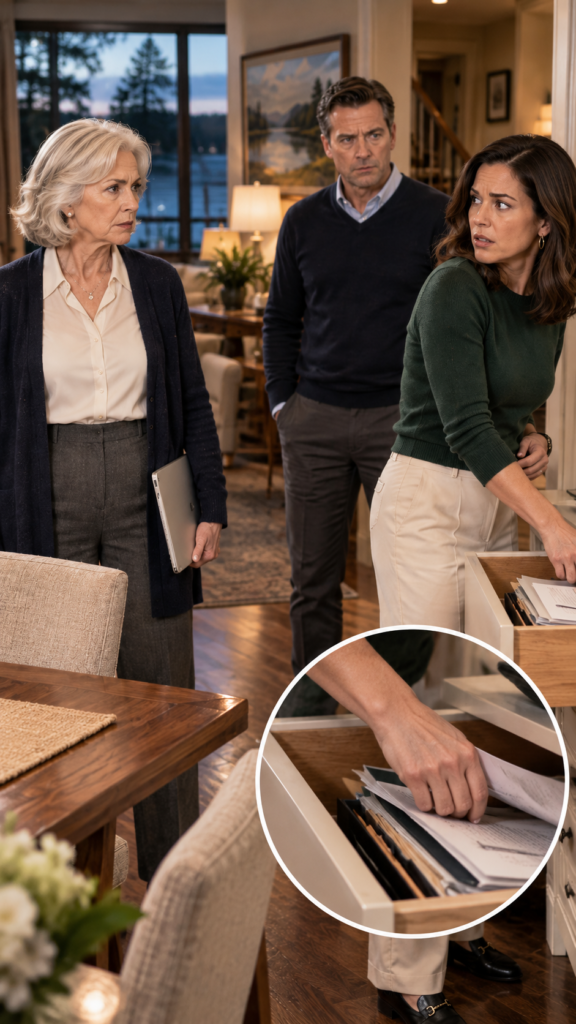
She opened drawers.
Closed cabinets.
Searched places she had no reason to search.
Then I caught her beside the drawer where I kept important paperwork.
“I was looking for a charger,” she claimed.
Daniel stared at her.
“You knew where the chargers were.”
For the first time, he wasn’t defending his wife.
I placed my laptop on the dining table.
“Sit down.”
Marissa refused.
Then I said one sentence that stopped her.
“This concerns your name.”
I opened the laptop.
First came the attempted lake house account access.
Then the insurance inquiry.
Then messages to my financial broker requesting authorization Marissa never had.
And finally, the contact involving my late husband’s trust.
Daniel slowly turned toward his wife.
“You sent these?”
Marissa’s confidence finally cracked.
“I was trying to protect our future.”
Daniel stared at her.
“By pretending Mom gave you permission?”
And suddenly, that tiny downstairs bedroom meant something completely different.
It had never been just about where I slept.
It was the first boundary Marissa had become confident enough to cross right in front of Daniel.
But when I revealed what she had been quietly preparing behind our backs—and why she already seemed to think my lake house belonged to them—Daniel finally stopped defending her.
What happened next changed who controlled that house, their marriage, and our family forever.
Marissa’s fingers tightened around the back of the dining chair.
For several seconds, nobody moved. The refrigerator hummed in the kitchen. Somewhere upstairs, the old floorboards settled with a soft creak, and the lake pressed black against the windows behind us.
I turned the laptop slightly toward Daniel.
There was one more message on the screen.
It had been sent to the administrator connected to my husband’s trust three weeks earlier.
Marissa had written that I was becoming “overwhelmed by financial details” and had asked the family to begin helping me manage property-related decisions.
I read the sentence twice the first time I found it.
Not because it was complicated.
Because it sounded so reasonable.
That was what frightened me.
Daniel leaned closer to the screen.
His face drained of color.
“Mom never said this.”
Marissa’s jaw tightened.
“I didn’t say she was incompetent.”
“No,” I said. “You were more careful than that.”
Her eyes snapped toward me.
I clicked open the next exchange.
She had asked whether future notices concerning the lake house, insurance, and trust administration could be copied to her directly. She had asked whether Daniel could be listed as the primary family contact. She had asked what documents would be required if I later wanted someone else to handle property matters for me.
Every question had been phrased hypothetically.
Every question had moved in the same direction.
Toward me having less control.
Toward them having more.
Daniel backed away from the table.
“You told them she asked for this?”
“I was preparing,” Marissa said.
“For what?”
She looked at him as though the answer should have been obvious.
“For reality.”
The word landed harder than if she had shouted.
I watched Daniel’s expression change.
Not anger yet.
Something quieter.
Something breaking.
“What reality?”
Marissa exhaled through her nose and folded her arms.
“Your mother is getting older.”
I felt the sting, but I kept my hands flat against the table.
Daniel stared at her.
“She drives herself here.”
“That isn’t the point.”
“She manages the house.”
“I know.”
“She manages her finances.”
“I know, Daniel.”
“Then what exactly were you preparing for?”
Marissa looked from him to me.
For the first time that evening, she seemed to understand that neither of us was going to rescue her from the silence.
Her voice dropped.
“You both keep acting like this house is just a house.”
I said nothing.
She continued.
“It’s the center of the family. It’s where everyone comes. It’s where holidays happen. It’s where summers happen. One day it’s going to have to belong to someone.”
Daniel’s shoulders went rigid.
“One day?”
Marissa looked at him.
“You know what I mean.”
“No,” he said. “I don’t think I do.”
Her composure slipped.
“Eventually, Daniel.”
The room seemed to grow colder.
I looked toward the dark windows.
For years I had thought grief had taught me what absence felt like.
I had been wrong.
There was another kind of absence that could happen while you were still standing in the room—when someone began arranging the future as though you were already gone.
Daniel covered his mouth with one hand.
Marissa softened her voice.
“I was thinking about our daughter.”
That almost worked.
I saw it in Daniel’s face.
A reflex.
A familiar instinct to meet her halfway.
Then he glanced at the laptop again.
“You used Mom’s name.”
Marissa looked away.
“You told people she authorized you.”
No answer.
“You searched her drawer.”
“I told you, I needed—”
“Stop.”
Daniel had never spoken to her that way in front of me.
Not loudly.
Not cruelly.
Just finally.
Marissa froze.
He pointed toward the laptop.
“This isn’t about our daughter.”
She blinked.
“This is about you deciding Mom was in the way.”
Her face hardened instantly.
“That is not fair.”
Daniel laughed once, but there was no humor in it.
“Fair?”
He looked toward the hallway.
“The first thing you did when we arrived was put Mom in the downstairs room.”
Marissa’s eyes flashed.
“That room is perfectly fine.”
“In her house.”
“It was practical.”
“In her house.”
The repetition stripped the excuse down to what it was.
Marissa grabbed the back of the chair again.
“I am tired of being made into some monster because I plan ahead.”
I closed the laptop halfway.
“No one called you a monster.”
She looked at me.
“I’m describing what you did.”
That seemed to unsettle her more.
Anger she could fight.
Precision was harder.
I stood.
“Tomorrow morning, I’m forwarding every message to my broker, my insurance representative, and the trust administrator. I’m also asking each of them to confirm in writing that no one has authority to make changes for me unless I personally authorize it through the procedures they already have.”
Marissa’s face shifted.
“You’re going to embarrass us.”
“No.”
My voice stayed quiet.
“I’m going to protect myself.”
Daniel lowered his gaze.
Marissa turned toward him.
“Say something.”
He did.
“Pack.”
Her mouth opened.
“What?”
“Pack our things.”
She stared at him.
“Daniel.”
“We’re leaving in the morning.”
A bitter laugh escaped her.
“You’re choosing her.”
His face twisted.
It was the most painful thing she could have said, and she knew it.
But this time it failed.
Daniel looked at me, then back at his wife.
“I should never have had to choose between respecting my mother and keeping my marriage peaceful.”
Marissa went completely still.
He continued.
“And the fact that you think those things are opposites is the problem.”
For a long moment, only the lake moved.
Soft waves touched the dock outside.
Upstairs, my granddaughter turned in her sleep, and the faint sound of her footsteps crossed the ceiling before becoming quiet again.
Marissa looked upward.
Her face changed.
Not enough to erase what she had done.
Enough to remind all of us that there was a child sleeping above a room full of adult consequences.
“I’m not waking her,” Marissa said.
“No one asked you to.”
“We leave tomorrow.”
Daniel nodded.
“Yes.”
She looked at me.
“You’ve wanted this.”
I shook my head.
“No.”
She waited.
I finished.
“I wanted you to stop.”
That was all.
Something in her expression collapsed—not remorse exactly, but the realization that I was no longer participating in the argument she had expected.
She went upstairs without another word.
Daniel remained beside the dining table.
When her footsteps disappeared, he sank into the chair she had refused to use.
For almost a minute, he stared at his hands.
Then he whispered, “How long have you known?”
“About the messages?”
He nodded.
“Eleven days.”
His head lifted sharply.
“Why didn’t you call me?”
I looked at him.
“Because I needed to know whether you already knew.”
The pain that moved across his face was immediate.
“Mom.”
“I’m sorry.”
He swallowed.
“No. Don’t apologize.”
He rubbed the back of his neck again, just as he had on the dock.
Only now the gesture made him look like the boy who had once stood in my kitchen after breaking a neighbor’s window, terrified less of punishment than of disappointing us.
“I didn’t know.”
“I believe you.”
He shut his eyes.
I had expected relief when I finally said those words.
Instead, his shoulders shook once.
He pressed both palms against his face.
“I defended her.”
I walked around the table, but I did not touch him immediately.
“You defended your wife.”
“I defended her against you.”
“You didn’t know the whole truth.”
“I knew enough to know it was your bedroom.”
That silenced me.
He lowered his hands.
His eyes were wet.
“I stood there and asked if the bedroom mattered.”
“It did.”
“I know.”
The apology came quietly.
“I’m sorry.”
I put my hand over his.
Not because everything was repaired.
Because he had finally stopped pretending nothing was broken.
We sat there until after midnight.
He asked to see every message.
I showed him.
He never interrupted me again.
The next morning, rain covered the lake in silver.
Marissa came downstairs dressed and fully composed, two suitcases standing near the front door.
My granddaughter followed behind her carrying a small backpack, confused by the sudden change in plans.
“Are we going home?”
Daniel crouched beside her.
“Yeah, sweetheart.”
“Did Grandma do something?”
The question hit me before I could prepare for it.
Daniel looked toward me.
Then he answered.
“No.”
He took his daughter’s hand.
“Grandma didn’t do anything wrong.”
Marissa turned her face toward the window.
It was a small sentence.
But it mattered.
Children build their understanding from sentences like that.
Before they left, Daniel carried their luggage downstairs from my bedroom.
My bedroom.
He paused in the doorway after placing the final suitcase in the hall.
“Your things are still downstairs.”
“I’ll move them later.”
“No.”
He picked up my bag.
“I will.”
He carried every one of my belongings upstairs himself.
Marissa watched from the foyer.
Neither of us said anything.
When Daniel came down again, he placed the corner-room key on the table beside me.
Then he hugged me.
It was awkward at first.
There was too much shame inside him.
I held on anyway.
Marissa stood by the open door.
For one second, I thought she might say something.
An apology.
An accusation.
Anything.
Instead, she walked outside.
The car disappeared through the wet trees ten minutes later.
I closed the door.
Then I changed the entry code again.
This time, my hands did not shake.
By noon, every professional involved had responded.
My broker confirmed that Marissa had no authority over my accounts.
The insurance representative documented that no future inquiry about the lake house would be acted upon without direct verification from me.
The trust administrator called personally.
His voice was careful.
“We received questions,” he said. “Nothing was changed.”
I closed my eyes.
“Thank you.”
“There is something else.”
My fingers tightened around the phone.
“A document your husband placed in the trust file several years before he died.”
I opened my eyes.
“What document?”
“Not a legal amendment.”
He paused.
“A letter.”
I leaned against the kitchen counter.
“He asked that it be given to Daniel if there was ever disagreement involving the lake property.”
For a moment, I couldn’t speak.
My husband had been dead for six years.
There were still mornings when I reached toward his side of the bed before remembering.
“What disagreement?”
“He didn’t specify.”
The administrator hesitated.
“He simply wrote that if the house ever became a source of pressure between you and your son, Daniel should read it.”
I looked toward the staircase.
The house suddenly felt full of old footsteps.
“Send it to me.”
“I can send a copy today.”
“No.”
My voice surprised me.
“Send it to Daniel.”
That evening, he called.
I knew he had read it before he spoke.
His breathing told me.
“Mom.”
I sat on the dock wrapped in my cardigan, watching the sun disappear behind the far shore.
“Yes?”
He was crying.
Not loudly.
The way his father had cried only twice in all our years together—like a man trying to keep grief from disturbing anyone else.
“Did you know about this?”
“No.”
He inhaled shakily.
Then he read me one line.
“Don’t ever let inheritance make you treat your mother like she’s borrowing her own life.”
I closed my eyes.
The lake blurred.
My husband’s voice wasn’t in the words exactly.
But his character was.
His bluntness.
His stubborn tenderness.
Daniel continued reading.
The letter wasn’t about ownership.
It wasn’t even really about the house.
His father had written that buildings became dangerous inside families when people started confusing future inheritance with present entitlement.
He reminded Daniel that I had spent decades building the place beside him.
He reminded him that I had stayed during hard years, paid bills during lean ones, repaired what broke, hosted everyone, remembered birthdays, changed sheets, cooked meals, and kept the doors open.
Then came the last paragraph.
Daniel’s voice broke halfway through it.
“If I’m gone when you read this, your mother is not the caretaker of what you might someday receive. She is the owner of her own days. Protect that.”
I covered my mouth.
The sunset disappeared.
For a while neither of us spoke.
Finally Daniel whispered, “I failed him.”
“No.”
He breathed.
“I did.”
“You failed one moment.”
“It was more than one.”
“Yes.”
I let the truth sit there.
Then I said, “That doesn’t mean you have to fail the next one.”
Three days passed before I heard from Marissa.
She did not call.
She sent a message.
I’m sorry you felt threatened.
I stared at the sentence.
Then deleted it.
An apology that preserved the excuse was not an apology.
Daniel understood that before I said it.
Their marriage did not end that week.
Real endings rarely happen that neatly.
For two months they lived in the same house and spoke carefully around their daughter.
They went to counseling.
Daniel asked questions he had avoided for years.
Why had Marissa spoken about my property as though it were already part of their plans?
Why had she told friends they would “take over the lake place eventually”?
Why had she contacted professionals without telling him?
Why, whenever I established a boundary, had she described it as instability, stubbornness, or drama?
Each question led to the same place.
Marissa believed planning for the future gave her permission to occupy it early.
She apologized for the messages.
Then defended the motive.
She admitted she should not have searched my drawer.
Then insisted I had overreacted.
She admitted the bedroom choice had been deliberate.
Then said she had only wanted Daniel to feel the house was “theirs too.”
That was the sentence Daniel could not move past.
Not because it was the worst thing she said.
Because it was the most honest.
Their separation began quietly.
Daniel moved into a small apartment near his daughter’s school.
They shared parenting time.
There were no dramatic scenes at my house.
No screaming phone calls.
No triumphant victory.
Just consequences.
Marissa lost the thing she had tried hardest to create: automatic access to a future that did not belong to her.
My broker blocked her from making further inquiries on my behalf.
The trust administrator documented the unauthorized communications.
My insurance file was secured.
My house access remained mine alone to grant.
And Daniel, for the first time in years, stopped asking me to make myself smaller to keep someone else comfortable.
The following spring, he returned to the lake house by himself.
He stood on the porch holding a toolbox.
I raised an eyebrow.
“What’s that?”
“The upstairs window sticks.”
“I know.”
“You’ve complained about it for four years.”
“I prefer consistency.”
He laughed.
It was the first easy sound between us in months.
He fixed the window.
Then the loose board on the dock.
Then the cabinet hinge his father had once promised to repair and never did.
We didn’t talk about Marissa until late afternoon.
Daniel sat beside me on the steps overlooking the water.
“The divorce will be final next month.”
I nodded.
“How are you?”
He thought about it.
“Embarrassed.”
“That isn’t the same as broken.”
“No.”
He looked across the lake.
“Lonely, though.”
I waited.
“I loved her.”
“I know.”
“Part of me still does.”
“I know that too.”
His eyes filled.
“I hate that both things can be true.”
I touched his shoulder.
“That’s usually when grief is real.”
He looked at me.
“You’re not glad.”
“That your marriage ended?”
He nodded.
“No.”
He seemed surprised.
“I’m glad you stopped lying to yourself. Those are different things.”
He stared at the water for a long time.
Then he leaned his head against my shoulder.
He hadn’t done that since he was twelve.
I stayed still.
Sometimes healing announces itself with speeches.
Sometimes it is simply an adult son forgetting, for one exhausted minute, that he is too old to lean against his mother.
Summer returned.
So did my granddaughter.
The first weekend she came to the lake house without Marissa, she stood in the hallway holding her bag.
“Which room is mine?”
I smiled.
“Whichever guest room you want.”
She pointed upstairs.
“Can I have the one with the yellow quilt?”
“Yes.”
Then she glanced toward the corner bedroom.
“That’s yours, right?”
Something tightened in my throat.
“Yes.”
She nodded as if the answer were obvious.
Because to her, it was.
That night we made popcorn and watched an old movie.
Daniel burned half of it.
My granddaughter laughed so hard she nearly dropped the bowl.
Later, after she went upstairs, Daniel handed me an envelope.
“What’s this?”
“Dad’s letter.”
I looked at him.
“I thought you should have the original.”
I opened the envelope carefully.
My husband’s handwriting leaned slightly to the right, just as it always had.
Daniel watched me read.
When I reached the final paragraph, I found something he had not mentioned.
A postscript.
One sentence.
And suddenly I understood why the trust administrator had sounded almost amused when I later asked how long the letter had been sitting there.
My husband had written:
If this argument is about the corner bedroom, tell your mother I still maintain she stole the better lake view in 1997.
I laughed.
I laughed so suddenly and so hard that tears came before I could stop them.
Daniel stared.
“What?”
I handed him the page.
He read the postscript.
Then he laughed too.
For six years, I had imagined every undiscovered thing my husband left behind would hurt.
I was wrong.
Some grief waits quietly until it can give something back.
That autumn, I met with my attorney.
Not because I was frightened.
Because I wanted clarity.
I kept full ownership and control of the lake house for the rest of my life.
No one would become an authorized decision-maker merely because they were family.
No one would gain access without my explicit consent.
And when I was gone, the house would be held for the next generation in a way that protected it from becoming anyone’s shortcut to power.
Daniel read the plan.
He looked up.
“You don’t have to leave me anything.”
“I know.”
“I mean it.”
“I know.”
He touched the papers.
“Then why?”
“Because your father and I built this place for family.”
He looked uneasy.
I smiled.
“Family is not the same thing as entitlement.”
His expression softened.
“No.”
“It took us a while to learn that.”
He reached across the table.
“Yes.”
A year after the night everything changed, we returned to the lake for the first full week of summer.
Daniel arrived carrying groceries.
My granddaughter came behind him with three books, two swimsuits, and more enthusiasm than luggage discipline.
She ran upstairs.
A moment later, her voice floated down.
“Grandma!”
I looked toward the ceiling.
“Yes?”
“Your room has the best view!”
Daniel stopped beside me.
I smiled.
“I know.”
He laughed.
Outside, sunlight scattered across the lake in long white ribbons.
The old dock creaked beneath the afternoon heat.
Somewhere upstairs, a suitcase thumped onto the floor of the yellow-quilt guest room.
Daniel carried the groceries into the kitchen without asking where anything belonged.
He knew now.
Not just where the plates went.
Where the boundaries were.
Where love ended and ownership began.
Where respect had to stand even when comfort wanted it to move.
That evening, the three of us ate dinner on the deck.
No one discussed accounts.
No one discussed trusts.
No one discussed who would someday own anything.
My granddaughter told us a ridiculous story from school.
Daniel nearly choked laughing.
I watched them both as the sky turned pale gold over the water.
For the first time in a long time, the future did not feel like something approaching to take my place.
It felt like something unfolding beside me.
When the air cooled, I went upstairs.
The corner bedroom smelled faintly of cedar and lake wind.
I opened the window Daniel had repaired and listened to the water below.
On the dresser sat the framed photograph of my husband that had always been there.
I placed his letter beside it.
Then I noticed something Daniel had added beneath the frame.
The old brass key to the bedroom.
A small paper tag was tied around it.
Two words were written in his handwriting.
Mom’s room.
I stood there for a long time.
Then I opened the drawer, placed the key inside, and smiled at the photograph.
Downstairs, my granddaughter called for me to come see the moon over the lake.
“I’m coming,” I said.
I switched off the light, left the bedroom door open, and followed their voices downstairs, where the house no longer felt like something I had to defend.
It was simply home.






