My fiancée called my injured mother a “clumsy old bat” inside a luxury bridal boutique—without realizing I had witnessed every second from behind the velvet curtains.
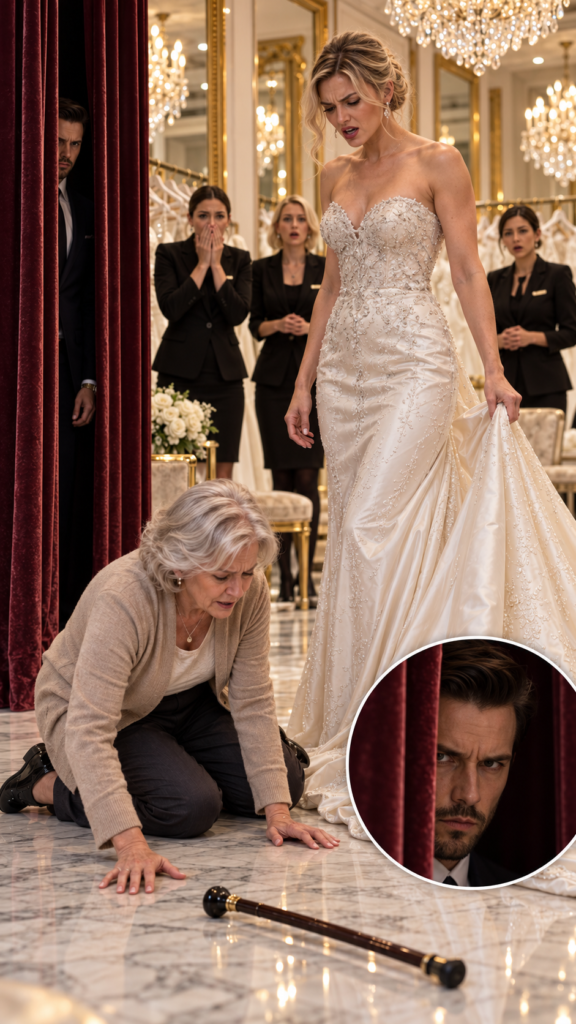
The scream wasn’t what made me stop.
It was the sound immediately before it.
A sharp scrape tore through the bridal suite as wood slid violently across polished marble. For half a heartbeat, I thought someone had dropped a chair.
Then I looked through the narrow opening between the velvet curtains.
My mother’s cane spun across the floor.
Everything inside me went cold.
My mother, Elena, was falling.
Not stumbling.
Not simply losing her balance.
Falling.
Her frail body pitched forward, her hands reaching desperately for something that was no longer there. Her knees struck the marble with a sickening crack, and the sound echoed beneath the crystal chandeliers.
The bridal consultants gasped.
One woman covered her mouth.
Another stood frozen beside a rack of designer gowns.
But the person closest to my mother did not move at all.
Vanessa.
My fiancée.
The woman I was supposed to marry in six weeks.
She stood beneath the boutique’s golden lights wearing a custom wedding gown that cost more than my mother’s first house. Ivory silk hugged her waist, hand-sewn crystals shimmered across the bodice, and a long train spread behind her like something designed for royalty.
She looked beautiful.
Until she opened her mouth.
“Pick up my train, you clumsy old bat.”
The words cut through the room more sharply than my mother’s cane striking the floor.
Nobody breathed.
My mother lowered her eyes.
Not because she had done anything wrong.
Because she was embarrassed.
Embarrassed for falling.
Embarrassed for being old.
Embarrassed that her body had become unreliable.
Embarrassed for becoming what cruel people called an inconvenience.
That was the part that nearly broke me.
Elena was the woman who had worked double shifts while fighting an illness she barely spoke about. She had come home exhausted, hidden her medication in the kitchen cabinet, and smiled as though nothing hurt.
She had spent countless nights pretending she wasn’t in pain because she didn’t want me to be afraid.
When we had almost nothing, she gave me everything.
When doctors told her to rest, she kept working.
When I told her I would quit school and find a job, she took my face between her trembling hands and said, “You are going to have a future, Adrian. That is not negotiable.”
Now that same woman was kneeling on the floor of an exclusive bridal boutique while the woman I planned to marry stared down at her as if she were dirt.
One of the consultants stepped forward.
Vanessa lifted a hand.
“Careful,” she snapped.
The consultant stopped instantly.
Vanessa glanced at the delicate fabric pooled around her feet, checking for wrinkles before she looked at my mother again.
“Do you know how long they spent tailoring this train?”
My mother pressed one palm against the marble, trying to rise without assistance.
Vanessa sighed dramatically.
“As if I could have one day without drama.”
That was when I stepped through the curtains.
The room did not merely become quiet.
Silence exploded through it.
Vanessa turned.
For one brief second, I saw the truth on her face.
Annoyance.
Disgust.
Cruelty.
Then it vanished.
Her expression transformed so quickly it would have impressed a professional actress. Her eyes widened. Her lips parted. Concern softened every feature.
“Adrian!”
She gathered the front of her gown and hurried toward me.
“Thank God you’re here.”
Her voice became sweet.
Gentle.
Perfect.
“Your mother slipped.”
She placed one hand on my arm, as though we were already husband and wife and she needed my strength to survive the terrible accident she had just witnessed.
“I was trying to help her.”
The lie was flawless.
If I had entered ten seconds later, I might have believed it.
Everyone else in the room knew the truth, but no one spoke. The consultants stared at the floor, the mirrors, the dresses—anywhere except at me.
My mother looked up.
There was fear in her eyes.
Not fear of Vanessa.
Fear of what I might do.
She knew me too well.
I crossed the room without saying a word.
My shoes clicked against the marble as I bent down, picked up the cane, and placed it within her reach. Then I slid one arm carefully around her waist and helped her stand.
Her hands trembled against mine.
“Are you hurt?” I asked quietly.
“I’m fine,” she whispered.
She wasn’t.
Pain tightened the corners of her mouth. Her knees shook beneath her. But Elena would have denied a broken bone if admitting it might ruin someone else’s afternoon.
Vanessa gave a nervous laugh.
“See? She’s fine.”
I looked at her.
She rolled her eyes as though my concern were another inconvenience.
“You know how dramatic older people can be.”
The consultant nearest the mirror visibly flinched.
My mother’s fingers tightened around the handle of her cane.
I turned fully toward Vanessa.
For eight months, I had watched her perform the role of the perfect woman.
Perfect smile.
Perfect manners.
Perfect photographs.
She brought flowers to hospital visits. She called my mother “Mama Elena” whenever other people were listening. She organized charity fundraisers, posed beside oversized donation checks, and filled her social media pages with inspirational quotes about kindness.
I had mistaken performance for character.
Standing before me in that magnificent wedding dress, she looked uglier than I had ever seen her.
“You owe her an apology,” I said.
Vanessa blinked.
Then she laughed.
“You can’t be serious.”
“Apologize.”
Her smile disappeared.
Her jaw tightened, and the softness drained from her voice.
“Adrian, don’t do this.”
“Do what?”
“Embarrass me in front of everyone.”
There it was.
Not remorse.
Not guilt.
Not shame.
Only irritation.
Only concern for herself.
My mother had fallen because of her, yet Vanessa believed she was the victim because people had witnessed it.
In that moment, everything became painfully clear.
The charitable woman in photographs had never existed.
The loving future daughter-in-law was a costume.
And the wedding dress was simply the most expensive costume she had ever worn.
The funny thing about people like Vanessa was that they mistook calm for weakness.
She saw my tailored suit, the expensive watch on my wrist, and the luxury car waiting outside. She saw the technology company, the magazine covers, and the life money had built around me.
She forgot who I had been before all of it.
Before I became a CEO, I was a desperate kid fighting grown men in illegal underground rings to pay for chemotherapy treatments.
I had entered cages with blood on the floor and fear in my throat because my mother needed medicine we could not afford.
Men twice my size had laughed when they saw me.
They laughed at my thin arms.
They laughed at my age.
They laughed because they believed desperation made a person weak.
Every scar on my body carried the memory of someone who had made that mistake.
Vanessa had made it too.
She thought the most dangerous version of me would shout.
She expected anger.
A scene.
Perhaps a threat she could later twist into another story.
But the most dangerous men were rarely the loud ones.
They were the quiet ones.
The ones who stopped arguing because the decision had already been made.
So I smiled.
Slowly.
My mother’s fingers tightened around my wrist.
She recognized that smile immediately.
Years earlier, she had seen it before I stepped into fighting cages where men twice my size laughed from the opposite corner.
They always laughed first.
They never laughed last.
Vanessa stared at me, and for the first time, uncertainty flickered across her face.
“Adrian?” she whispered.
I looked at the wedding gown.
At the consultants.
At my injured mother.
Then I reached into my jacket and pulled out my phone.
Vanessa still had no idea that her dream wedding was about to become the first casualty of the biggest mistake of her life.
Nobody in that room was prepared for what came next.
My thumb moved once.
The wedding planner answered on the second ring.
“Adrian? Perfect timing. I was just about to send over the revised—”
“Cancel everything.”
The words were quiet enough that I could hear the tiny hum of the boutique’s air-conditioning after I said them.
There was a pause on the other end.
“I’m sorry?”
“The venue. Catering. Flowers. Music. Transportation. Everything connected to the wedding. Cancel it.”
Vanessa’s face lost color so quickly it was almost frightening.
“Adrian.”
I lifted one finger without looking at her.
Not now.
The planner inhaled carefully. “Do you want me to contact Vanessa before I—”
“No.”
That was the first time Vanessa moved.
She came toward me in a rush of ivory silk and crystal, one hand gripping the front of the gown.
“Give me the phone.”
I stepped back.
Her hand stopped in the air.
The consultants had gone perfectly still.
Even my mother seemed to forget the pain in her knees for a moment.
“Send every cancellation confirmation directly to me,” I told the planner. “Do not charge anything new. Do not authorize substitutions. Do not reschedule.”
“Adrian, what are you doing?” Vanessa demanded.
I ended the call.
The screen went black in my hand.
Only then did I look at her.
“Ending the wedding.”
Her lips parted.
No sound came out.
For eight months, Vanessa had always known what expression to wear. Concern. Warmth. Surprise. Grace. She could summon them like costumes from a closet.
Now, for the first time, she seemed unable to find the right one.
“You’re joking.”
“No.”
“You’re canceling our wedding because your mother fell?”
My mother flinched.
That small movement angered me more than anything Vanessa had said.
I put the phone back into my jacket.
“No,” I said. “I’m canceling our wedding because of what you did after she fell.”
Vanessa stared at me.
“I didn’t do anything.”
One of the consultants near the mirror looked up.
Her eyes met mine.
Then she looked at Vanessa.
“You stopped me from helping her.”
Vanessa turned so sharply that the train of her gown swept across the marble.
The consultant swallowed, but she didn’t look away this time.
“I stepped forward,” she said, quieter now. “You told me to be careful because of the dress.”
Another consultant spoke from beside the gown rack.
“We all heard what you called her.”
Vanessa’s cheeks flushed.
“Oh, wonderful. Now the sales staff gets a vote in my marriage?”
Nobody answered.
That silence did what shouting never could.
It exposed her.
My mother’s grip on the cane tightened.
“Adrian,” she murmured.
I turned.
Her face had gone pale beneath the boutique lights.
“Let’s just go.”
Not forgive her.
Not continue the wedding.
Just go.
Elena wanted distance because that was how she had survived most of her life—by absorbing pain quietly and moving forward before anyone could make a fuss.
I knew that pattern.
I had inherited part of it.
But this time I couldn’t leave the truth lying on the floor beside us.
I looked at my mother.
“Has she spoken to you like this before?”
Elena’s eyes shifted toward Vanessa.
That hesitation answered before she did.
My stomach tightened.
“Mom.”
Vanessa’s posture changed.
Barely.
But I saw it.
Her shoulders rose. Her chin pulled back.
Fear.
Not of me.
Of my mother speaking.
“Elena,” Vanessa said softly, suddenly returning to the gentle voice she used when other people were listening. “You’re upset. Maybe this isn’t the time.”
My mother looked at her.
Something in Elena’s face settled.
She had spent years hiding pain to protect me.
I watched her decide, in real time, that she was tired of protecting someone who had humiliated her.
“There was a hospital visit,” she said.
Vanessa went still.
My mother’s voice remained quiet.
“You brought flowers.”
I remembered them.
White roses in a glass vase.
Vanessa had carried them through the hospital corridor with both hands while a nurse complimented her on how thoughtful she was.
She had taken a photograph beside my mother’s bed.
She posted it that evening.
Family means showing up, the caption had said.
I felt cold again.
“What happened?” I asked.
Elena looked at the floor.
“In the parking garage afterward, she told me that once you were married, I needed to stop expecting you to rearrange your life around me.”
Vanessa exhaled sharply.
“That is not what I said.”
My mother lifted her eyes.
“You said you weren’t marrying a man who would always come running whenever his mother needed him.”
The boutique seemed smaller.
The chandeliers too bright.
The mirrors too revealing.
Vanessa turned toward me.
“It was a conversation about boundaries.”
“You told a woman receiving treatment that her son needed to stop coming when she needed him?”
“She was getting better.”
My mother’s mouth tightened.
Vanessa heard herself too late.
I could see it.
She tried to recover.
“I was under pressure. We were planning a wedding. Your mother was calling you constantly—”
“I called him twice,” Elena said.
Vanessa snapped her head toward her.
My mother’s voice trembled, but she continued.
“Once because my medication made me dizzy and I needed a ride home. Once because the clinic changed an appointment and I knew he wanted to know.”
The cane shook in her hand.
I covered her fingers with mine.
She stopped trembling.
Vanessa stared at us.
Then something ugly and exhausted broke through her carefully maintained composure.
“This is exactly what I mean.”
Nobody moved.
She laughed once.
There was no humor in it.
“Every time something happens, he looks at you like the entire world is ending.”
My mother recoiled slightly.
I stepped between them.
Vanessa kept going.
“You want honesty? Fine. I was tired of feeling like I would always come second.”
There it was.
Not a misunderstanding.
Not one terrible afternoon.
A belief.
A resentment she had dressed in charity photographs and hospital flowers.
I studied the woman I had planned to build a life with.
“My mother never asked you to come second.”
“She didn’t have to.”
“And she never asked me to choose.”
Vanessa looked at Elena.
Then back at me.
“But you are choosing.”
“Yes.”
Her eyes filled.
For half a second, I almost saw the woman I thought I knew.
Then she whispered, “Her.”
I shook my head.
“No.”
Vanessa’s brow tightened.
“I’m choosing the kind of person I can live with becoming.”
That landed harder than anger would have.
Her face changed.
The fight went out of her eyes.
I looked at the gown again.
Six weeks from now, I would have stood in front of everyone we knew while she walked toward me wearing that dress.
I would have believed I was watching my future arrive.
Now all I could see was my mother on the floor.
Vanessa reached for my hand.
I moved it away.
“Don’t.”
Her fingers curled inward.
“Adrian, eight months cannot disappear because of ten bad seconds.”
“It wasn’t ten seconds.”
She went silent.
“It was the parking garage. It was today. It was every time you called her Mama Elena in front of me and treated her differently when you thought I wasn’t there.”
Her eyes narrowed.
“You don’t know that.”
“No,” I said. “I didn’t.”
I looked at my mother.
“And that may be the part I’ll have the hardest time forgiving myself for.”
Elena’s face crumpled for one heartbeat.
Then she straightened.
“Don’t carry what she did.”
Vanessa laughed bitterly.
“Of course. Saint Elena.”
The consultant nearest us closed her eyes.
I felt my mother’s fingers tighten beneath mine.
That was the final moment.
Not the insult.
Not the lie.
Not even the confession.
That.
Given one last chance to stop, Vanessa chose cruelty again.
I pointed toward the private dressing room.
“Change out of the gown.”
She stared at me.
“What?”
“The wedding is canceled. The fitting is over.”
She looked around the room as though someone might intervene.
Nobody did.
The consultants stood silently.
My mother leaned on her cane.
I stood beside her.
Vanessa’s eyes moved from face to face until she understood what had changed.
She no longer controlled the room.
Her power had depended on everyone else being too uncomfortable to challenge her.
Now the discomfort belonged to her.
She grabbed the skirt of the gown with both hands and disappeared behind the fitting-room curtains.
A few seconds later, I heard something strike the padded bench inside.
Then nothing.
The silence lasted a long time.
One of the consultants finally approached my mother.
“I’m sorry.”
Elena gave her a tired look.
“You tried.”
“I should have tried harder.”
My mother studied her.
Then she said, “Next time someone is on the floor, don’t wait for permission.”
The young woman’s eyes filled.
She nodded.
I never forgot that.
Neither did she.
By the time Vanessa emerged in the clothes she had arrived in, my mother was sitting in a chair with an ice pack wrapped in a soft towel against one knee.
Vanessa had wiped her face.
Her makeup was perfect again.
Almost.
She stopped several feet from us.
Her engagement ring caught the chandelier light.
For a moment, she looked at it.
Then at me.
Her fingers twisted the ring once.
Twice.
She pulled it free.
I expected anger.
I expected her to throw it.
She didn’t.
She walked to a small velvet ottoman and placed it carefully on the cushion.
That restraint somehow made the moment heavier.
“So that’s it?”
“Yes.”
She nodded slowly.
Then she looked at my mother.
Elena met her eyes.
Vanessa opened her mouth.
Maybe an apology had finally reached her.
Maybe not.
Whatever it was, she could not make herself say it.
She turned and walked out.
The boutique door closed behind her with a soft click.
No dramatic slam.
No final scream.
Just a small mechanical sound.
The sound of a future ending.
My mother released a breath beside me.
Her whole body sagged.
I crouched in front of her.
“We’re getting your knees checked.”
“Adrian—”
“That part is not negotiable.”
For the first time that afternoon, she smiled.
It was weak.
But real.
At urgent care, the fluorescent lighting made everything feel stripped of drama.
There were no chandeliers.
No mirrors.
No silk.
Just plastic chairs, the squeak of nurses’ shoes, and a vending machine humming in the hallway.
The X-rays showed no fracture.
Severe bruising.
Swelling.
A strained wrist from catching herself.
The doctor told her to rest, elevate her knees, and use the cane even when she felt she didn’t need it.
My mother promised.
The doctor looked at me.
I raised an eyebrow.
Elena sighed.
“Fine. I actually promise.”
When we were alone again, she sat on the examination table with a paper sheet beneath her and stared at her hands.
I sat beside her.
Neither of us spoke for a while.
The adrenaline had left.
What remained was worse.
Clarity.
“I should have told you,” she said.
I looked at her.
“About the hospital?”
She nodded.
“Why didn’t you?”
Her thumb moved slowly over one knuckle.
“Because you loved her.”
“That wasn’t a reason to hide it.”
“It was to me.”
I waited.
She looked up.
“You spent your whole life believing you had to protect me. When you were young, I couldn’t stop you from putting yourself in those terrible places because you thought my medicine mattered more than your body.”
My throat tightened.
She knew how much I hated talking about the fights.
Not because I was ashamed.
Because remembering them returned me instantly to the smell of sweat and metal, the fluorescent lights, the roar of men gambling on whether I would stay conscious.
“I didn’t want to become another thing you had to fight.”
“You weren’t.”
“I know that now.”
Her eyes shone.
“But I was afraid if I told you what she said, you would feel forced to choose. And I thought maybe I could absorb it.”
I stared at her.
There it was again.
The habit that had shaped both of us.
She absorbed pain.
I attacked it.
Neither of us knew how to simply admit that something hurt.
I took her hand.
“Please don’t ever protect me from the truth again.”
Her lips trembled.
“Only if you stop thinking every truth requires you to bleed for it.”
That silenced me.
The woman had always known exactly where to aim.
I lowered my head.
A laugh escaped her.
Small.
Tired.
Almost relieved.
Then she touched the scar near my eyebrow.
One I had carried since I was nineteen.
“I hated this one,” she whispered.
“I know.”
“No. You don’t.”
She traced the air beside it without touching.
“You came home and told me you walked into a cabinet.”
I looked away.
“You knew?”
“Adrian, the cabinet did not have knuckles.”
Despite everything, I laughed.
So did she.
For ten seconds, we were not a CEO and an aging cancer survivor sitting in urgent care after a canceled wedding.
We were mother and son.
Poor.
Terrified.
Bad at lying to each other.
Still alive.
The wedding cancellations arrived throughout the evening.
Venue confirmed.
Caterer confirmed.
Musicians confirmed.
Transportation confirmed.
Hotel block released.
Honeymoon arrangements placed on hold.
Each email was another door closing.
I expected regret to arrive with them.
It didn’t.
Grief did.
Those were different things.
I had loved Vanessa.
Or at least I had loved the person I believed Vanessa was.
There is a peculiar kind of mourning that comes with discovering someone still exists while the version of them you loved does not.
I let myself feel it.
I did not call her.
I did not post anything.
I did not tell reporters, friends, or business associates what happened.
The message sent to our guests was three sentences.
The wedding would not take place.
There had been a private change in circumstances.
We asked for privacy.
Vanessa deserved consequences.
She did not deserve a public execution.
That distinction mattered to me.
Two days later, she asked for ten minutes.
I nearly refused.
Then I remembered my mother’s words about truth not requiring blood.
So I agreed.
We met after business hours in a conference room at my office.
Glass walls.
A long table.
The city glowing below us.
Vanessa arrived without makeup.
I had almost never seen her that way.
She looked smaller.
Human.
For a moment, that hurt.
She sat across from me.
Neither of us touched the water between us.
“I’m sorry,” she said.
I waited.
She twisted her fingers together.
“I behaved horribly.”
Still I waited.
“I was stressed.”
I said nothing.
Her shoulders dropped.
“You hate that answer.”
“I don’t hate it.”
“What, then?”
“It isn’t an answer.”
She looked toward the windows.
Cars moved along the streets thirty floors below us, tiny white and red lights disappearing into intersections.
“I was jealous.”
There was finally no performance in her voice.
“Of my mother?”
“Yes.”
The word barely carried across the table.
She pressed both palms against her knees.
“You built your entire life around making sure she was safe. Every story about where you came from somehow leads back to her. Every decision. Every scar.”
Her eyes lifted.
“And I thought if I married you, eventually I would become the person you protected that way.”
I felt something inside me settle.
Not soften.
Settle.
“Love isn’t a promotion.”
She shut her eyes.
“I know.”
“No. You know it now because losing something made it obvious.”
She flinched.
I continued.
“My mother did not take a place that belonged to you.”
“I know.”
“You were never competing with her.”
“I know.”
“And the moment you decided you were, you began punishing the one person who didn’t even know there was a contest.”
A tear slipped down her cheek.
She wiped it away immediately.
“I can change.”
“Maybe.”
Hope appeared in her face.
I hated what I had to say next.
“But not with me waiting at the finish line.”
Her breath caught.
“Adrian.”
“I hope you change because you understand what you did. Not because changing is the price of getting the wedding back.”
She looked at me for a long time.
Then she nodded.
There was no argument left.
No negotiation.
She had lost the thing she believed she could control.
Not because I shouted louder.
Because I meant what I said.
She stood.
At the door, she paused.
“Does your mother hate me?”
“No.”
Vanessa looked surprised.
I thought of Elena on the examination table.
Of her hand touching the scar near my eyebrow.
“She’s disappointed in you.”
Vanessa’s face broke.
She left without another word.
That was the last private conversation we ever had.
There were consequences after that, but I refused to manufacture them.
I did not call the charities Vanessa worked with.
I did not contact her friends.
I did not use my company, my money, or my name to punish her.
She had lost our marriage.
She had lost the future she believed was guaranteed.
She had lost the ability to stand beside my mother and pretend affection while treating her differently in private.
That was enough.
The boutique documented the incident because an injury had occurred on the premises.
The consultants gave their accounts.
They told the truth.
Nothing more.
Nothing less.
For once, Vanessa did not control the version of events that existed outside her own head.
My mother’s knees turned purple before they began to heal.
For nearly two weeks, she hated the cane with renewed passion.
I stopped trying to hover.
Mostly.
When I brought groceries, she made me carry exactly one bag more than she did and accused me of using concern as an excuse to reorganize her kitchen.
When I suggested hiring someone to help around the house, she stared at me until I withdrew the suggestion.
When I called twice in one afternoon, she answered the second time with, “I survived chemotherapy. I will survive lunch.”
So I learned.
Protection could become its own kind of disrespect if I wasn’t careful.
She needed help.
She did not need to be treated like glass.
Three weeks after the boutique, we returned.
Not because either of us wanted to see the place.
Because my mother did.
The consultant who had tried to step forward was working that morning.
When she saw Elena, she immediately crossed the showroom.
“I’ve thought about what you said.”
My mother smiled.
The young woman glanced at the marble floor.
“Someone on the floor doesn’t need permission.”
“No,” Elena said. “They don’t.”
The consultant’s eyes filled.
“I’m sorry I froze.”
My mother took her hand.
“You won’t next time.”
That was all.
No grand speech.
No accusation.
Just forgiveness with an instruction attached.
It was the most Elena thing imaginable.
The original wedding date arrived under a clear blue sky.
I woke before sunrise.
For several seconds, I didn’t understand why my chest felt heavy.
Then I saw the date on my phone.
Six weeks earlier, I had imagined waking in a hotel suite surrounded by groomsmen, garment bags, champagne, and people asking whether I was nervous.
Instead, I was alone in my own bedroom.
No tuxedo waiting.
No schedule.
No ceremony.
I lay there until the light changed.
Then my phone rang.
My mother.
“Are you dressed?”
I looked at myself.
“No.”
“Good.”
“What does that mean?”
“It means put on something that can survive hospital elevators.”
I sat up.
“Hospital?”
“You’ll see.”
An hour later, she was waiting outside her house in a blue coat with her cane in one hand.
Her knees had healed enough that she barely needed it.
I opened the passenger door.
She ignored it and walked around to the other side.
“You’re driving.”
“That was the plan.”
“I know. I wanted to make sure you remembered.”
She was impossible.
I loved her for it.
We drove across the city.
When I realized where we were going, my hands tightened around the steering wheel.
The cancer center.
The same building where years earlier I had learned the price of medicine could terrify me more than any man in a cage.
I parked without asking questions.
Inside, the smell hit me first.
Disinfectant.
Coffee.
Warm plastic from the vending machines.
Memory.
My mother walked toward the elevators.
People greeted her.
Not casually.
By name.
A receptionist came around the desk and hugged her.
A nurse I had never met smiled from halfway down the corridor.
“There she is.”
I looked at my mother.
She suddenly became very interested in adjusting the cuff of her coat.
“What is this?”
“Come upstairs.”
The elevator opened on the oncology floor.
A woman from patient services met us beside a small waiting room.
Her eyes widened when she saw me.
Then she looked at Elena.
“You didn’t tell him?”
My mother sighed.
“I was going to.”
“You said that last year.”
“Mom.”
She winced.
The patient-services woman laughed.
Then she handed me a folder.
Inside were copies of payment records.
Not medical bills.
Assistance payments.
Prescription co-pays.
Transportation vouchers.
Emergency lodging.
Meal cards for families spending entire days beside treatment chairs.
Page after page.
Year after year.
I looked at the totals.
Then at my mother.
“What is this?”
She leaned both hands over the handle of her cane.
“Something I started a while ago.”
“How long is a while?”
“Seven years.”
I stared at her.
Seven years.
Before the magazine covers became routine.
Before our company expanded overseas.
Before Vanessa.
The woman from patient services spoke gently.
“Your mother has been quietly funding emergency assistance for patients who fall through the cracks. Mostly medication and transportation.”
I looked down again.
Some amounts were small.
Forty-eight dollars.
Seventy-three.
One hundred and twelve.
Numbers that meant almost nothing in my life now.
Numbers that once could have destroyed us.
My vision blurred.
“You never told me.”
My mother’s mouth softened.
“You were busy.”
“That is a terrible excuse.”
“I learned from you.”
I laughed through the pressure in my throat.
Then I saw a note clipped to the inside cover.
A sentence handwritten in my mother’s familiar script.
No family should have to decide what they are willing to lose to keep someone alive.
I stopped breathing.
The cages came back.
The men.
The blood.
The money folded into my pocket after a fight.
The bus ride home with my ribs aching while I calculated how many pills the cash would buy.
My mother touched my arm.
“I could not change what happened to us.”
Her voice shook.
“But later, when there was finally enough, I could make sure someone else’s child didn’t think getting hurt was the only way to keep their mother alive.”
I looked at her.
The room disappeared for a second.
All I could see was the woman who had hidden medication in a kitchen cabinet so I wouldn’t be afraid.
The woman who had worked double shifts.
The woman who had told me my future was not negotiable.
“You did this with the money I gave you?”
“Some.”
“Mom.”
“What?”
“You told me you were investing it.”
“I did.”
She gestured toward the folder.
“In people.”
I covered my face.
She laughed.
I was crying before I realized it.
Not the controlled kind.
Not one tear discreetly removed before anyone noticed.
I bent forward, elbows on my knees, and cried like the frightened teenager I had been in hospital hallways years earlier.
My mother sat beside me.
She didn’t tell me to stop.
She didn’t tell me everything was fine.
She rested one hand between my shoulders.
That was enough.
When I could finally breathe again, I looked at her.
“Why today?”
Her eyes moved toward the windows.
“Because you were supposed to begin a new life today.”
She paused.
“And you still should.”
I shook my head.
“I’m not getting married.”
“I noticed.”
Despite myself, I smiled.
She continued.
“A wedding ending does not mean your life stopped.”
Her fingers closed around mine.
“You spent years believing your future was something I demanded from you. It wasn’t.”
“What was it?”
“A promise.”
She looked at the waiting room around us.
“To keep going.”
I stared at the folder.
Then I understood the twist I should have seen years earlier.
My mother had never measured my success by the company.
Or the money.
Or the car.
Or the watch.
She had measured it by whether the frightened boy who once walked into cages had eventually built a life where no one he loved needed him to bleed.
Vanessa had looked at my mother and seen an inconvenience.
My mother had quietly spent years making strangers less afraid.
I closed the folder.
“How much does the fund need?”
She narrowed her eyes.
“Adrian.”
“How much?”
“No.”
I laughed.
“You knew this was going to happen.”
“Yes.”
“Then why bring me?”
“Because there are rules.”
I leaned back.
“Of course there are.”
“You can contribute.”
“Good.”
“You cannot rename it after me.”
“I wasn’t going to.”
“You were thinking it.”
“I was absolutely thinking it.”
“And no giant checks.”
I laughed harder.
“No giant checks.”
“No photographs.”
“Agreed.”
“No speeches about your mother.”
“That one hurts.”
“You’ll survive.”
I looked at her.
Then I said, “Matching fund. Quietly. Same purpose. Patient assistance decides where it goes.”
She considered.
“How much?”
I told her.
Her eyes widened.
“Adrian.”
“You said my future wasn’t negotiable.”
“That does not mean you get to use my own words against me.”
“It absolutely does.”
She shook her head.
But she was smiling.
That afternoon, we ate lunch in the hospital cafeteria.
Not the reception dinner that had been planned.
No orchestra.
No crystal glasses.
No seating chart.
My mother had soup.
I had a sandwich wrapped in plastic.
At the table beside us, a little boy colored on the back of an appointment sheet while his father slept with his head against the wall.
My mother watched them for a moment.
Then she looked at me.
No words.
She didn’t need them.
Months passed.
The swelling in her knees disappeared.
She still carried the cane on bad days.
On good days, she forgot it beside chairs and accused me of moving it.
The patient fund expanded.
Quietly.
No press release.
No photographs.
No oversized donation checks.
That part mattered.
I began dating again eventually.
Slowly.
Carefully.
I stopped being impressed by perfect entrances.
I watched how people spoke to waiters.
How they treated receptionists.
Whether their kindness changed when no one important was watching.
My mother never asked for details.
She claimed she was not interested.
This was a lie.
She was interested in everything.
Vanessa became someone I used to know.
The anger faded first.
Then the disappointment.
Eventually even the questions stopped.
I never needed to know whether she became better.
That was her work.
My work was different.
One Sunday evening, nearly a year after the boutique, I was in my mother’s kitchen washing dishes while she argued with me about the correct way to dry a cast-iron pan.
“You are destroying it.”
“It is iron.”
“That is not a defense.”
“You have owned this pan longer than I’ve been alive.”
“Exactly. Respect your elders.”
I looked over my shoulder.
She was standing near the table in slippers, her silver hair catching the warm light above the stove.
Her cane rested against the wall.
Unused.
On the refrigerator was a small photograph from the cancer center.
Not a publicity photo.
Just my mother sitting beside a window with three volunteers, all of them laughing at something outside the frame.
Beside it was a child’s drawing someone from the treatment floor had given her.
A crooked house.
A yellow sun.
Four stick figures holding hands.
Across the top, in enormous uneven letters, someone had written:
THANK YOU FOR HELPING MY MOM.
My throat tightened.
Elena followed my gaze.
Then she pretended not to.
“Pan,” she reminded me.
I dried it properly.
She inspected my work.
“Acceptable.”
“High praise.”
“Don’t get used to it.”
I placed the pan on the stove.
Then I noticed something on the table.
A folded piece of paper.
Old.
Soft at the creases.
I picked it up.
“What’s this?”
My mother went still.
For once, Elena had no immediate answer.
I unfolded it.
The handwriting was mine.
Teenage handwriting.
Uneven.
Pressed hard enough into the paper that the words had left faint grooves.
It was a note I had written years earlier before one of my fights.
I had forgotten it existed.
Mom,
Don’t worry if I’m late.
I’m going to fix this.
I promise.
Below it, in different ink, she had written something later.
You already did.
Not by paying the bills.
By coming home.
I stared at the words until they blurred.
“When did you write that?”
“Years ago.”
“Why keep it?”
She shrugged.
“Because you kept thinking the money was the important part.”
I looked at her.
She smiled.
Softly.
“No amount you ever earned mattered to me as much as hearing your key in the door.”
That was the last piece.
The thing I had misunderstood my entire life.
I thought my mother’s great sacrifice was giving me a future.
But she had spent all those years waiting for me to realize that a future was worthless if I destroyed myself trying to earn it.
I crossed the kitchen.
She knew what was coming and immediately protested.
“Adrian, I am holding hot tea.”
I took the cup from her hand and set it on the counter.
Then I wrapped my arms around her.
For once, she did not complain.
Her cheek rested against my chest.
Her arms came around my waist.
Outside the kitchen window, evening settled over the street.
Someone walked a dog beneath the trees.
A porch light came on across the road.
The refrigerator hummed.
The old clock above the doorway ticked steadily.
Nothing dramatic happened.
No phone rang.
No one fell.
No one needed saving.
My mother was warm in my arms.
The house was quiet.
The future had finally arrived without either of us having to fight for it.
And for the first time in my life, home did not feel like the place where I prepared for the next battle.
It felt like the place where the battles were finally over.






