My future daughter-in-law shaved my head while I slept on my son’s wedding morning—and still expected me to arrive smiling, stay silent, and hand her twenty-two million dollars.
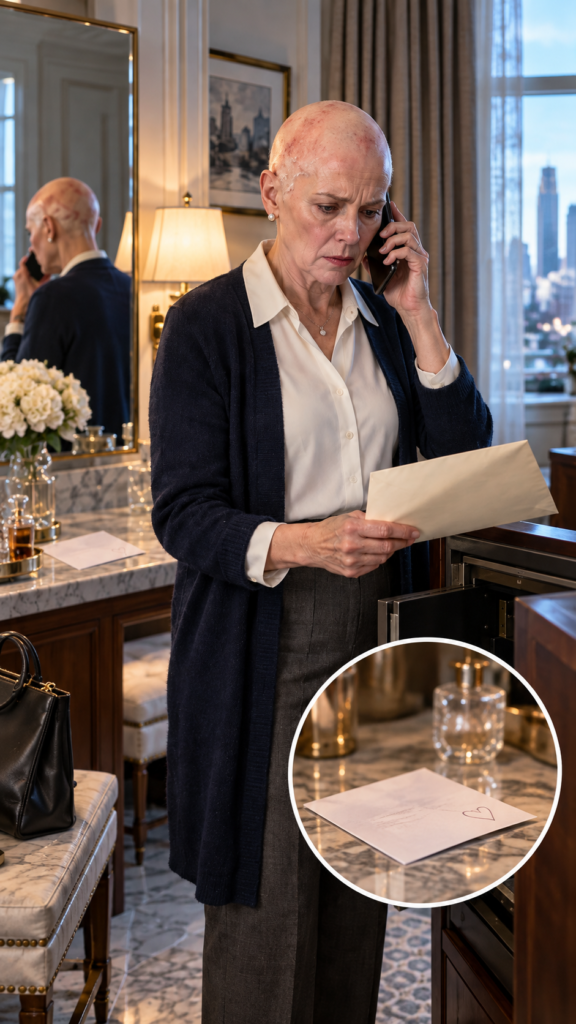
I woke to fire crawling across my scalp.
For one blurred moment, I remained trapped between sleep and consciousness, reaching instinctively for the thick silver hair that had fallen past my shoulders the night before.
My fingers touched nothing.
No tangled strands.
No uneven haircut.
Only bare, burning skin.
I sat upright so violently that the bedroom tilted around me. Cold morning light seeped through the curtains as I stumbled toward the bathroom, one hand pressed against my head.
Before I switched on the light, I smelled antiseptic.
Sharp.
Clinical.
Deliberate.
Then I faced the mirror.
The woman staring back at me looked like a stranger.
Her scalp was raw and unevenly flushed. Tiny fragments of silver hair clung near one ear where the razor had missed them. Her eyes were wide with shock, but the rest of her face had gone terrifyingly still.
Someone had entered my bedroom while I slept.
Someone had stood over me.
Someone had removed every strand of my hair.
A white note had been taped to the center of the mirror.
“Congratulations—you finally have a hairstyle that suits your age.”
A tiny heart had been drawn beneath the sentence.
The handwriting was neat.
The cruelty was effortless.
I peeled the note from the glass. Sweet, expensive perfume rose from the paper.
I knew that scent.
Sabrina.
My future daughter-in-law.
The woman my son, Michael, would marry in only a few hours.
I stared at the cheerful little heart until the shock inside me hardened into something cold and precise.
She wanted me to scream.
She wanted me to call Michael sobbing and beg him to confront her. She wanted Beatrice Langford—the widow who had built half a Boston real estate empire from grief, debt, and sleepless nights—to hide from the wedding because she was ashamed to be seen.
But I did not scream.
I folded the note once and placed it beside the sink.
Then I crossed the cold marble floor and opened the safe in my bedroom.
Inside rested an ivory envelope I had prepared the night before.
The documents authorized a twenty-two-million-dollar transfer to Michael and Sabrina.
Their wedding gift.
It was more than money. It was a penthouse, investments, security, and the beginning of a life most people could never imagine.
It was also my final attempt to keep my son close.
For years, I had convinced myself that generosity could repair what silence had damaged. Every check became an apology for working too much, grieving too long, or failing to become the mother Michael believed he deserved.
Now the envelope felt different.
It no longer felt like a gift.
It felt like a weapon I had nearly placed in Sabrina’s hand.
I returned it to the safe.
The metal door closed with a soft, final weight.
I turned the dial until the lock clicked.
Quiet.
Dry.
Final.
Not one dollar would move.
I called Avery Whitman, our family attorney.
He answered on the second ring.
“Beatrice,” he said calmly. “Ready to finalize the transfer?”
“No.”
The word came out steadier than I expected.
A pause followed.
“I want everything placed on hold immediately,” I continued. “No transfer. No access. No exceptions.”
His voice sharpened.
“Has something happened?”
I looked at my reflection.
At the burning skin.
At the silver fragments near my ear.
At Sabrina’s note beside the sink.
“At the reception tonight, I want you to come to my house,” I said. “We’re rewriting the entire will.”
Silence filled the line.
“Beatrice—”
“Only one thing is wrong,” I told him. “I finally woke up.”
Lucia, my hairstylist of twenty years, arrived less than half an hour later.
When I opened the door, her eyes lifted to my scalp.
Her hand flew to her mouth.
She did not ask who had done it.
Perhaps she saw the answer in my face. Perhaps she understood that speaking the horror aloud would give it more power than it deserved.
Instead, she opened her case.
Lucia fitted me with a soft gray-silver wig that moved naturally around my face. Her fingers worked carefully until every visible sign of what had happened disappeared beneath it.
Then she helped me into my navy silk dress and gray wool coat.
When she finished, I stood before the mirror again.
The woman looking back was no longer stunned.
She was composed.
Elegant.
And dangerous.
St. Andrew’s Church glowed beneath the morning sun. Colors from the stained-glass windows drifted across polished pews while guests whispered and admired the flowers.
I sat near the front as the organ played.
No one knew what lay beneath my silver hair.
No one knew what Sabrina had done.
As I waited for my son to marry her, memories returned with merciless clarity.
I saw Richard’s death certificate trembling in my hands when I was thirty-two.
I heard twelve-year-old Michael asking where his father had gone and why he could not come home.
I remembered skipping meals so my son could have schoolbooks and new shoes. I remembered unanswered applications, humiliating meetings, and nights spent crying where Michael could not hear me.
Then I remembered waking before dawn and trying again.
One duplex became three.
Three properties became buildings.
Building by building, deal by deal, I dragged the Langford name out of grief and turned it into an empire.
I had built a crown for my son.
Somewhere along the way, he had forgotten what it cost me.
Michael rarely demanded anything directly.
He did not have to.
He mentioned a condo, and I bought one.
He spoke about Europe, and I paid for the trip.
He sighed over an expense, and a check appeared.
I gave because I loved him.
I kept giving because I feared that the moment I stopped, he would stop loving me.
Then Sabrina entered his life.
Her insults always arrived disguised as humor. She joked about my age, my clothes, my habits, and the way I spoke. Her eyes moved over me as though I were outdated furniture occupying space in a room she intended to redecorate.
Michael never defended me.
He smiled.
Sometimes he laughed.
Each time, something between us broke a little more.
But shaving my head while I slept was not humor.
It was not teasing.
It was a declaration.
Sabrina believed she had already won.
At the reception, crystal chandeliers poured warm light over white flowers and polished glassware. Music drifted through the ballroom while cameras followed the newlyweds from table to table.
Sabrina looked flawless at the head table.
Her gown glittered beneath the lights. Her smile was radiant, practiced, and perfectly controlled.
When she looked at me, satisfaction flashed briefly in her eyes.
She believed the wig proved I had accepted my humiliation.
Michael barely glanced in my direction.
I sat through the speeches.
I applauded when everyone else applauded.
I smiled whenever the cameras turned toward me.
Inside my purse, the recorder felt heavier than its size should have allowed.
So did Sabrina’s note.
For years, fear had occupied a permanent place inside me—the fear of losing Michael, disappointing him, or being left alone after sacrificing everything to give him a future.
That fear was gone.
In its place was clarity.
The emcee raised his microphone.
“And now, a special moment from the groom’s mother, Mrs. Beatrice Langford.”
Applause swept across the ballroom.
I rose slowly.
Sabrina’s smile tightened.
Michael turned toward me, confusion crossing his face.
I walked beneath the chandeliers as conversations faded and every camera followed me.
At the microphone, I removed one folded piece of paper from my purse and placed it on the podium.
Even from across the room, Sabrina recognized it.
The color drained from her face.
I looked directly at my son.
Then I raised one hand, touched the edge of my silver hair, and began to speak.
Nobody in that room was prepared for what came next.
The first thing I heard was Sabrina’s fork striking her plate.
A small sound.
Bright silver against porcelain.
In the stillness of the ballroom, it might as well have been a gunshot.
I did not look at her.
Not yet.
My fingers found the edge of Lucia’s beautiful work, and with one slow movement, I lifted the wig from my head.
The room inhaled.
Not metaphorically.
Two hundred people drew breath at once.
The sound moved through the ballroom like wind through dry leaves.
Cold air touched my scalp.
For one second, instinct begged me to cover myself. My hand almost rose.
I stopped it.
I had spent the entire morning believing that my naked scalp was evidence of humiliation.
Standing beneath those chandeliers, I understood something else.
It was evidence of survival.
Michael stood so abruptly that his chair scraped backward.
“Mom?”
His face had changed.
The color was gone from it.
I placed the wig carefully beside Sabrina’s note.
Then I unfolded the paper.
“I found this taped to my bathroom mirror this morning.”
Sabrina pushed back from the table.
Her smile returned too quickly.
Too brightly.
“Beatrice, maybe this isn’t the time—”
“It is exactly the time.”
My voice did not rise.
That seemed to frighten her more.
I turned the note toward Michael.
He stared at the handwriting.
His eyes moved over the sentence once.
Then again.
His mouth opened.
No sound came out.
Sabrina stood.
“Oh, come on,” she said, releasing a brittle little laugh. “This is absurd.”
A few guests shifted in their chairs.
No one laughed with her.
I watched Michael’s eyes travel from the note to my scalp.
Then to his wife.
“Sabrina.”
He spoke her name as though he were testing whether it belonged to the woman in front of him.
She lifted both hands.
“It was a joke.”
The recorder inside my purse caught every syllable.
Nobody moved.
Sabrina seemed to realize what she had said only after the words were already hanging in the air.
Her jaw tightened.
“Obviously I didn’t mean for this to become some huge dramatic performance.”
Michael stared at her.
“You did this?”
She rolled her eyes.
It was almost imperceptible.
Almost.
“Hair grows back.”
The woman sitting beside Sabrina lowered her champagne glass without drinking.
Someone near the back whispered, “Oh my God.”
I kept my eyes on Michael.
Not Sabrina.
Him.
Because the deepest wound had never been the razor.
It had been every moment my son had watched me disappear by inches and decided silence was easier.
“Did you know?” I asked.
His head snapped toward me.
“No.”
The answer came immediately.
Then his face changed.
His eyes dropped.
A mother knows the difference between innocence and shame.
“What did you know?”
Michael rubbed both hands over his face.
Sabrina turned toward him sharply.
“Michael.”
He ignored her.
The room had disappeared for him now.
There was only me.
“I knew she was angry about the gift.”
My fingers tightened against the podium.
“What gift?”
“The wedding gift.”
A tremor entered his voice.
“She kept asking when the transfer would clear. She thought you were delaying it because you didn’t trust her.”
Sabrina’s expression hardened.
“I asked one question.”
Michael looked at her.
“You asked every day.”
Silence.
He swallowed.
Then he looked back at me.
“And last night she said you needed to be knocked down a little.”
A coldness settled beneath my ribs.
Michael’s eyes filled.
“I thought she meant another stupid comment. I thought…” He pressed his lips together. “I thought she was being Sabrina.”
Being Sabrina.
Three words.
Three devastating words.
They contained every dinner-table insult I had ignored.
Every joke Michael had laughed away.
Every moment I had allowed cruelty to become personality because acknowledging it would have required action.
Sabrina stepped around the head table.
“Oh, please. Now I’m some monster because I teased your mother?”
Michael turned.
“You shaved her head while she was sleeping.”
“She acts like hair is sacred.”
“You entered her room while she was unconscious.”
Sabrina’s face sharpened.
“She was fine.”
Michael flinched as if she had slapped him.
I had seen that expression on his face once before.
He had been twelve, standing in a hospital corridor after someone explained that his father would not be coming home.
It was the look of a person discovering that reality had already changed before he was ready to accept it.
Sabrina reached for his hand.
He stepped back.
That single step broke something.
I saw it happen in her face.
Not sorrow.
Not remorse.
Panic.
She looked at me then.
Really looked at me.
Her gaze dropped to the note.
Then to my purse.
Then back to my face.
“You’re trying to ruin my wedding.”
“No,” I said. “You did something cruel on your wedding morning. I simply refused to hide it for you.”
Her nostrils flared.
“This is because you’ve never accepted me.”
I almost smiled.
Not because anything was funny.
Because the line was so familiar.
For years, I had accepted everything.
I had accepted insults.
Entitlement.
Silence.
I had accepted a relationship with my son in which my usefulness was easier for him to express than his love.
“I accepted too much,” I said.
Michael closed his eyes.
Sabrina’s voice rose.
“Michael, say something.”
He opened them.
She pointed toward me.
“She’s humiliating us in front of everyone.”
He looked at my bare scalp.
Then at the note she had written.
“No,” he said quietly. “You humiliated her.”
The sentence changed the room.
I felt it in the way people shifted.
The way Sabrina stopped breathing for half a second.
The way Michael’s shoulders finally lowered, as though telling the truth had cost him something and freed him at the same time.
She stared at him.
Then her panic became anger.
“Do you understand what she’s doing? That money is ours.”
There it was.
Not the cruelty.
Not even the confession.
The truth.
Michael’s face went still.
Sabrina heard herself too late.
She tried to correct it.
“I mean—it was promised to us.”
I reached into my purse.
The ivory envelope was not there.
It remained locked in my safe.
But I did not need it.
“The transfer was stopped this morning.”
Sabrina blinked.
“What?”
“Twenty-two million dollars,” I said. “No transfer. No access. No exceptions.”
Her expression emptied.
For the first time since I had known her, there was no cleverness left in it.
Only shock.
Michael turned toward me.
I waited for the accusation.
The anger.
The wounded entitlement I had trained him, year after year, to believe was love.
Instead, he looked down.
“Good.”
Sabrina spun toward him.
“What did you say?”
Michael lifted his head.
“I said good.”
She laughed once.
A hard, unbelieving sound.
“Do you have any idea what you’re giving up?”
He looked at her for a long time.
Then he glanced at me.
When he answered, his voice was barely above a whisper.
“Apparently I gave up something more important a long time ago.”
My throat closed.
I hated that the words hurt.
I hated that I wanted to believe them.
Most of all, I hated how quickly the old part of me wanted to rush toward him and forgive everything simply because he had finally said one beautiful sentence.
So I stayed where I was.
Healing, I would learn, begins with resisting the temptation to confuse relief with repair.
Sabrina reached for his arm.
Michael moved away again.
“Don’t.”
Her face fractured.
“You’re choosing her?”
“No.”
He looked at the room.
At the guests.
At the flowers.
At the wedding cake waiting beneath crystal light.
Then finally at Sabrina.
“I’m choosing to stop pretending I don’t see you.”
The words seemed to strike deeper than shouting would have.
Sabrina stood absolutely still.
Michael removed his wedding ring.
He did not throw it.
He did not make a spectacle of it.
He placed it carefully on the white linen tablecloth between them.
“I can’t do this.”
For the first time, Sabrina looked frightened.
Not financially.
Not socially.
Personally.
Because consequences had finally reached her.
She whispered his name.
Michael shook his head.
“No. You don’t get to call this a misunderstanding.”
Her eyes filled, but the tears came too late to soften what everyone had already heard.
“I made one mistake.”
Michael’s mouth twisted.
“One?”
He looked toward me.
The shame on his face was unbearable.
“I let you make dozens.”
Then he turned back.
“This was just the first one I couldn’t pretend was funny.”
The ballroom remained silent long after he finished speaking.
There was no applause.
I was grateful.
This was not a victory.
It was a family breaking open so the rot could finally be seen.
Sabrina looked around the room, searching for an ally.
Faces turned away.
A cousin studied his plate.
One of her friends stared at the floor.
Even the photographer had lowered his camera.
Sabrina’s shoulders rose and fell.
Then she gathered the skirt of her gown and walked out.
Her heels struck the ballroom floor in sharp, furious beats.
Nobody followed her.
The doors closed.
And the silence afterward was the quietest sound I had ever heard.
I turned toward the microphone.
My hands had begun to tremble.
Not from fear.
From release.
“I’m sorry,” I said to the guests. “There won’t be another speech.”
Then I looked at Michael.
“This part is private.”
He nodded.
I picked up my wig.
But I did not put it back on.
I carried it in my hand as I walked away from the podium.
That mattered.
More than I understood at the time.
Outside the ballroom, the corridor was dim and cool.
I had gone only a few steps when Michael called after me.
“Mom.”
I stopped.
He approached slowly.
For years, I had watched him move toward me whenever he wanted something.
This time his hands were empty.
“I’m sorry.”
I looked at him.
His eyes were wet.
“So am I.”
His face crumpled slightly.
I continued before he could misunderstand.
“I’m sorry I taught you that money would always arrive before consequences.”
He lowered his gaze.
“I’m sorry I made you think every hurt could be paid around instead of talked through.”
“Mom—”
“I love you.”
His eyes lifted.
“But I am not giving you the money.”
“I don’t want it.”
“You might tomorrow.”
“I won’t.”
“We’ll see.”
The words were not cruel.
They were honest.
Michael nodded.
A long silence passed between us.
Then he said, “I should have defended you years ago.”
“Yes.”
The answer hurt him.
I let it.
Not to punish him.
Because protecting him from truth was how we had arrived here.
He wiped his cheek with the heel of his hand.
“I don’t know how to fix this.”
“You don’t.”
He looked lost.
“You start by not asking me to make it easy for you.”
He nodded again.
Then I walked away.
Alone.
For the first time in years, being alone did not feel like abandonment.
It felt like space.
Avery was waiting at my house when I returned.
He stood in the library with a leather portfolio beneath one arm and stopped speaking when he saw my bare head.
I placed Sabrina’s note on the desk.
Then I placed the recorder beside it.
Avery did not touch either.
“What do you want to do?”
The old answer rose automatically.
Protect Michael.
Preserve appearances.
Avoid scandal.
Pay for peace.
I sat down.
“First, the transfer remains frozen.”
“Done.”
“Second, the will changes.”
He opened the portfolio.
“How?”
I stared through the dark window behind him.
For decades, nearly every important financial decision I had made ended with one question.
What will this leave Michael?
That night I asked a different one.
“What can it leave that matters?”
Avery waited.
I told him.
Not all at once.
The idea came slowly.
Housing grants for widowed parents.
Emergency assistance for families one illness or funeral away from losing everything.
Education funds for children whose lives had been altered by the death of a parent.
Small-business capital for women rebuilding after grief, divorce, displacement, or financial dependence.
The exact people I had once been.
The people I had nearly forgotten while building towers high enough to convince myself I had escaped them.
Avery took off his glasses.
“Beatrice.”
“Yes?”
“You’ve been thinking about this longer than tonight.”
I looked at him.
“No.”
Then I realized he was right.
Perhaps I had been thinking about it since I was thirty-two years old and counting coins at a kitchen table after Richard died.
I simply had not known the thought had a name.
We worked until after midnight.
Michael did not call.
I was grateful for that too.
At one seventeen in the morning, Avery closed the final folder.
The twenty-two million dollars that had almost become a wedding gift would become the first funding for the Langford Second Start Foundation.
Michael would still inherit something someday.
But not an empire designed to keep him dependent on a dead woman’s guilt.
What remained for him would be reasonable, protected, and clear.
Love without leverage.
Security without worship.
A legacy without a leash.
When Avery left, I went upstairs.
Lucia’s wig rested where I had placed it.
For several minutes, I stared at it.
Then I put it back in its box.
The next morning, I drank coffee beside the kitchen window with nothing on my head.
Sunlight touched every uneven place Sabrina had left behind.
I did not hide.
Three days later, Michael called.
“I’ve started the process of ending the marriage.”
I closed my eyes.
I felt no triumph.
Only exhaustion.
“Sabrina has an attorney,” he continued. “She says you set her up.”
“I expected that.”
“She says the recording was planned.”
“It was.”
He went quiet.
I added, “I planned to protect myself. I did not plan what she chose to say.”
“I know.”
Another pause.
Then Michael said, “I told my lawyer the truth.”
I gripped the coffee cup.
“All of it?”
“All of it.”
He drew a breath.
“Even the parts that make me look terrible.”
For once, I did not rescue him from the discomfort.
“Good.”
Over the following weeks, the story moved through channels I could not control.
Attorneys spoke.
Statements were taken.
The note was preserved.
The recording was copied.
People who had spent years laughing politely at Sabrina’s remarks suddenly remembered them with astonishing clarity.
I did not enjoy that.
Collective courage often arrives suspiciously late.
Still, it arrived.
Sabrina’s insistence that the shaving had been a harmless joke collapsed against her own words at the reception and the physical evidence she had left behind.
There was no dramatic courtroom spectacle.
No cinematic confession beneath fluorescent lights.
Reality was quieter.
She accepted responsibility.
Michael continued ending the marriage.
The financial life Sabrina had imagined with him vanished because it had never truly belonged to either of them.
And for the first time, she faced a consequence I had not purchased, softened, negotiated, or made disappear.
Her power ended not because I destroyed her.
It ended because I stopped protecting everyone from the truth.
Michael and I did not reconcile quickly.
I would not allow it.
For months, we met every other Sunday at a small café halfway between our homes.
He paid for his own coffee.
The first time he did it, I almost laughed.
Such a small thing.
Such an enormous thing.
We talked.
Sometimes badly.
Sometimes not much at all.
He told me when he was ashamed.
I told him when I was angry.
He admitted that my money had made it easy to postpone becoming accountable.
I admitted that giving it had made me feel indispensable.
“That wasn’t fair to you,” I said one morning.
Michael looked down at his cup.
“No.”
Then he added, “But what I did with it wasn’t fair to you either.”
That sentence stayed with me.
Not because it erased anything.
Because it did not try to.
Lucia came every Thursday during the first month.
At first she checked my scalp.
Then she simply brought lunch.
Silver fuzz began to appear.
Soft.
Uneven.
Mine.
One afternoon, she stood behind me in the bathroom where the note had once been taped.
Her fingertips brushed the new growth.
“Do you want me to shape it when it gets longer?”
I studied my reflection.
For most of my life, I had worn my hair long.
Richard had loved it.
Michael remembered it.
Sabrina had believed taking it would take something essential with it.
“No,” I said.
Lucia smiled.
“Not yet?”
“Maybe never.”
By spring, I wore it short.
Not because it suited my age.
Because it suited me.
The foundation opened its first office in one of my older buildings.
I had renovated that property twenty-seven years earlier with money I barely possessed and confidence I had borrowed from desperation.
Now the ground floor held warm offices, a children’s reading corner, legal-aid desks, financial counselors, and a kitchen where coffee always seemed to be brewing.
On opening morning, I arrived before everyone else.
Or so I thought.
Michael was already there.
He wore jeans and an old sweater, kneeling beside a bookshelf with a screwdriver between his fingers.
I stopped in the doorway.
“What are you doing?”
He looked up.
“Losing a fight with Swedish furniture.”
I laughed.
The sound surprised both of us.
He smiled.
Then the smile faded into something gentler.
“I volunteered.”
“I heard.”
“You didn’t arrange it?”
“No.”
“Good.”
He returned to the shelf.
I watched him for a moment.
“What made you choose Saturdays?”
He shrugged.
“I used to think your buildings were the reason I didn’t have enough of you.”
His hand stopped turning the screw.
“Maybe I should learn what they actually meant.”
I could not answer.
So I walked over, sat on the floor beside him, and held the crooked shelf steady while he tightened it.
That was how healing often arrived.
Not with speeches.
With two people on the floor trying to make something stand straight.
Months passed.
The foundation helped its first families.
A widow with two children kept her apartment after her husband’s medical bills emptied their savings.
A mother opened a small bakery after leaving a marriage in which every dollar had been controlled by someone else.
A boy whose father died unexpectedly started university with tuition covered.
I read every file.
At first Avery told me I did not need to.
I told him he was wrong.
Their stories were not numbers.
Neither had mine been.
One afternoon, almost a year after the wedding, Avery arrived at my office carrying an ivory envelope.
For a moment, I could not breathe.
It looked almost identical to the one I had locked in my safe that morning.
He placed it on my desk.
“What is this?”
“Michael asked me to give it to you.”
My stomach tightened.
“A request?”
Avery smiled faintly.
“No.”
I opened it.
Inside was a single sheet of paper.
Not a contract.
Not a financial statement.
A resignation.
Michael had formally declined the remaining special financial provisions I had left for him outside the ordinary inheritance structure.
At the bottom, beneath his signature, he had written one sentence by hand.
I want whatever I receive from you next to be something money cannot carry.
I read it twice.
Then a third time.
My vision blurred.
Avery looked toward the window, granting me privacy without leaving.
There are moments when the heart understands before the mind catches up.
For years, I had believed Michael’s dependence proved I had failed him.
Then I believed Sabrina’s cruelty proved I had lost him.
But the truth was more painful and more hopeful.
We had failed each other.
And because we had both finally admitted it, neither of us was trapped there forever.
That evening, I drove to Michael’s apartment.
He opened the door wearing socks and an expression of immediate concern.
“Is everything okay?”
I held up the letter.
His shoulders dropped.
“Oh.”
“Why?”
He leaned against the doorframe.
“Because every time you gave me something expensive, I told myself it meant we were okay.”
I said nothing.
“So I never had to ask whether we actually were.”
His eyes met mine.
“I don’t want to do that anymore.”
I stepped inside.
His apartment was smaller than the places I had once bought for him.
There were dishes drying beside the sink.
A coat thrown over a chair.
A stack of books on the floor because he apparently had not conquered all forms of furniture assembly.
It looked imperfect.
Lived in.
His.
He made tea.
We sat at the kitchen table.
For a while, neither of us spoke.
Then Michael reached into a drawer.
“I have something else.”
I raised an eyebrow.
“If it’s another legal document, I’m leaving.”
He almost smiled.
“It isn’t.”
He placed an old photograph on the table.
Richard.
Michael.
Me.
Michael was about eight years old, sitting between us on the front steps of the first duplex Richard and I had ever dreamed of owning.
I had forgotten the photograph existed.
On the back, in Richard’s handwriting, were seven words.
Build a home, not just a house.
My hand began to shake.
“Where did you find this?”
“In a box I’ve had since Dad died.”
“You kept it?”
“I kept everything.”
The words broke something open inside me.
Not a wound.
A door.
Michael looked at the photograph.
“I think Dad knew both of us better than we knew ourselves.”
I touched Richard’s handwriting.
For years, I had built houses.
Then buildings.
Then an empire.
I had told myself I was doing it for Michael.
But somewhere along the way, walls had become easier than conversations.
Money had become easier than vulnerability.
Security had become easier than love spoken plainly.
The foundation suddenly made sense in a way it never had before.
The twenty-two million dollars Sabrina had expected to receive had not merely been redirected.
It had returned to the promise Richard and I had once made before there was an empire at all.
Build a home.
Not just a house.
That was the beautiful thing neither Sabrina nor I could have imagined on the morning she shaved my head.
By trying to humiliate me, she had forced me to see what I had spent decades avoiding.
My fortune was never meant to be a crown for my son.
It was meant to become shelter.
Michael watched me cry without reaching too quickly to stop it.
That was new too.
Finally, he asked, “Can I hug you?”
Not assumed.
Asked.
I nodded.
He came around the table.
When his arms closed around me, I felt the twelve-year-old boy who had lost his father.
The grown man who had failed me.
The son who was trying.
And for the first time, I did not need to separate them.
I held him.
Not because everything was forgiven.
Not because everything was forgotten.
Because healing had finally become more important than keeping score.
A year and a half after the wedding, the foundation opened its third family housing program.
Michael still volunteered on Saturdays.
Lucia became an unofficial fixture at every event, claiming someone had to prevent me from giving speeches with crooked collars.
Avery complained constantly about paperwork and then quietly donated his own time to the legal-aid clinic.
My hair grew into a short silver crop.
I kept it that way.
Sometimes strangers complimented it.
I always smiled.
They could not know why.
Sabrina became a name that appeared less and less in our conversations.
That was perhaps the clearest proof that her power was gone.
She was no longer the center of the wound.
She was simply part of the history that had forced us to stop lying to ourselves.
Michael never remarried during those first years.
I never asked him to.
His life was his.
That was another lesson I had learned too late and, thankfully, not too late to use.
We built a different relationship.
One without invoices.
One without rescue.
One without fear disguised as generosity.
Some Sundays he disappointed me.
Some Sundays I disappointed him.
Then we talked.
It was astonishing how ordinary healthy love could feel after years of performing around pain.
On the second anniversary of that wedding morning, Michael came to my house for dinner.
No chandeliers.
No orchestra.
No photographers.
Just soup warming on the stove and rain tapping softly against the windows.
He arrived carrying bread.
“Did you buy that?” I asked.
He looked offended.
“I made it.”
I examined the misshapen loaf.
“You should have bought it.”
He laughed.
So did I.
We ate at the kitchen table.
After dinner, Michael washed the dishes while I dried them.
At one point, I caught our reflection in the dark kitchen window.
For years, mirrors had frightened me.
The bathroom mirror with Sabrina’s note.
The ballroom cameras.
The woman beneath the wig who had believed she was about to lose her son if she finally stopped paying for his love.
Now the reflection showed an old woman with short silver hair standing beside her grown son while he complained about where I kept the dish towels.
Nothing dramatic.
Nothing expensive.
Nothing anyone would photograph.
It was the happiest picture of my life.
Michael handed me the final plate.
His fingers brushed mine.
“Mom?”
“Yes?”
“I’m glad you woke up.”
I looked at him.
This time, the words did not belong to anger.
They belonged to both of us.
“So am I.”
Outside, the rain softened.
Inside, the kitchen was warm.
Michael put the last plate away, and neither of us hurried to leave.
For the first time in decades, there was nothing left to buy, nothing left to prove, and nothing left between us that silence could hide.
We were simply home.






