“Go eat in the restroom,” my daughter-in-law told me before twenty-four guests—and when my son lowered his eyes instead of defending me, I quietly took back everything they thought belonged to them.
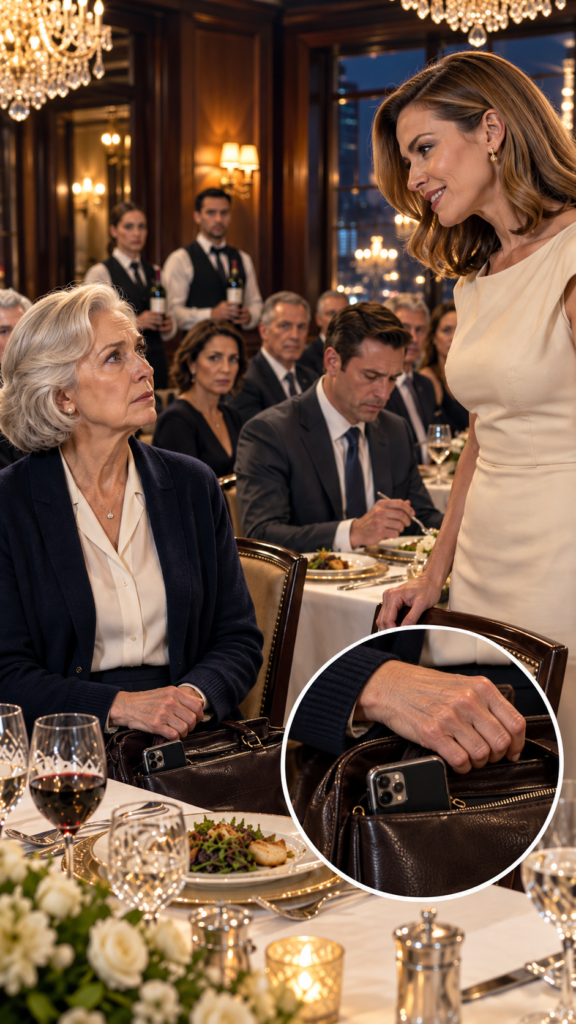
The private dining room fell silent.
Crystal glasses stopped halfway to painted lips. Forks hovered above white linen. Along the wall, two servers froze with bottles of wine cradled carefully against their chests.
Tessa stood beside the final empty chair, one manicured hand resting possessively across its back.
“There’s no chair for you, Wilma,” she announced, making certain every guest could hear. “You’re used to being invisible. You’ll be more comfortable in there.”
Then she laughed.
Not nervously.
Not like someone who had suddenly realized she had gone too far.
She laughed as though the room belonged to her, the celebration existed because of her, and my son belonged to her most of all.
This was supposed to be Reid’s special night.
After years of chasing approval from executives who remembered his quarterly numbers but forgot his birthday, my son had finally earned the promotion he had always wanted.
The imported flowers, the elaborate tasting menu, the carefully selected wine pairings and the absurd gold-leaf cake Tessa claimed would “photograph better” had all been chosen for him.
And I had paid for every dollar of it.
No one at the table knew.
I had asked the restaurant manager to keep my name off the reservation. I had never needed applause for helping my son. I was content to remain Reid’s quiet mother—the older woman in low heels and a navy coat whom people greeted politely before turning toward younger, brighter conversations.
Tessa looked around the table, waiting for approval.
A few people laughed with her.
Not because the insult was funny.
They laughed because cruelty, when delivered confidently enough, can sound like permission to weak people.
I did not look at them.
I looked at Reid.
My son sat three chairs away with his eyes fixed on his plate. His fingers remained wrapped around his fork, but he did not lift it.
He did not say, “Tessa, stop.”
He did not offer me his seat.
He did not even look at me.
For one long second, the room disappeared.
I saw the little boy I had carried into emergency rooms after midnight, his feverish face pressed against my shoulder.
I saw the teenager standing beside a broken car, pretending he was not frightened because he could not afford the repairs.
I saw the grown man whose debts I had quietly covered and whose failures I had softened so carefully that he never had to feel their full weight.
I had protected his confidence for years.
Somewhere along the way, he had mistaken my silence for weakness.
That was the moment the pain changed shape.
Tessa had humiliated me.
Reid had allowed her to do it.
And sometimes permission from your own child cuts deeper than hatred from a stranger.
I slowly buttoned my navy coat.
The small movement unsettled Tessa. Her smile flickered as she watched my hands.
She had expected tears.
Perhaps she wanted my voice to tremble. Perhaps she imagined I would cause a scene she could later retell, casting herself as the exhausted daughter-in-law forced to tolerate an overly sensitive older woman.
Instead, I gave her nothing.
“Enjoy your dinner,” I said.
Tessa blinked.
Reid finally shifted in his chair, but he still did not raise his head.
I turned and walked toward the door while twenty-four people suddenly became fascinated by their plates.
Behind me, no one spoke.
Outside, the cold night air struck my face, sharp and clean.
I walked several blocks before finding an empty bench beneath a streetlamp. Cars whispered across the wet pavement. The restaurant windows glowed warmly in the distance, their golden light making the building look far kinder than anything that had happened inside it.
I sat down and removed my phone from my purse.
My first call was to my attorney.
He answered immediately.
For eleven months, a buyer had been circling the freight company I had built from one leased truck, a borrowed office chair and a thousand mornings that began before sunrise.
Men had laughed when I told them I owned the company.
Banks had called me risky.
Competitors had called me temporary.
Forty-two years later, my trucks crossed four states, and the final purchase offer was waiting on my attorney’s desk.
“One hundred sixty-five million dollars,” he reminded me carefully. “Wilma, are you absolutely certain?”
I stared at the glowing restaurant windows.
Inside, Reid was probably still staring at his plate.
Tessa was probably explaining why everything that had happened was somehow my fault.
“Yes,” I said. “Accept the offer. Close the sale.”
My attorney went quiet.
He understood what that decision meant.
For years, I had resisted selling because I believed the company might become Reid’s future. I had imagined him learning the business, taking responsibility and carrying forward the life I had spent decades building.
But an inheritance is not only money.
It is trust.
And Reid had just shown me what he did with mine.
My second call was to the restaurant manager.
“This is Mrs. Tate.”
His voice changed instantly.
“Good evening, Mrs. Tate.”
“Remove my card from the reservation.”
A brief pause followed.
“Should I inform your party?”
I pictured Tessa smiling beneath the chandeliers, convinced she had finally placed a crown on her own head.
“No,” I replied. “Wait until they ask for the check.”
Then I returned to my small apartment on Sycamore Street.
It was not the mansion Reid and Tessa displayed online. My home had no marble floors, towering chandeliers or carefully staged family photographs.
It was quiet.
It was honest.
And nothing inside it pretended to love me while calculating what I could provide.
At 9:07, Reid called.
I watched the phone vibrate against the table until the screen went dark.
At 9:12, he called again.
At 9:18, a third call appeared.
By 9:23, I was seated in my favorite chair, my coat folded beside me and my hands resting calmly in my lap.
When the phone rang again, I answered.
“Mom?”
Reid’s voice sounded tight, stripped of the confident tone he used around his colleagues.
“There’s been a mistake.”
“What kind of mistake?”
“The restaurant says the payment method was removed.”
Voices murmured behind him. Glass touched glass. Somewhere nearby, Tessa was speaking sharply to someone.
Reid lowered his voice.
“The bill is almost four thousand dollars. Everyone is still sitting here.”
“How unfortunate.”
He inhaled.
“Tessa is humiliated.”
I leaned back in my chair.
“Is she?”
“Mom, please. Can you fix this?”
In the background, Tessa’s voice cut through the phone.
“Ask her if she’s paying or not.”
She was still confident.
Still demanding.
Still convinced I was small enough to control.
“Put me on speaker,” I said.
“Mom—”
“Now, Reid.”
Silence.
Then came a soft click.
The distant voices vanished.
Twenty-four guests were listening.
Tessa was listening.
And for the first time that night, Reid had no plate to stare at and nowhere to hide.
“I have an announcement,” I said calmly. “And every person sitting at that table is going to hear it.”
Nobody in that room was prepared for what came next.
A chair scraped against the restaurant floor.
It was faint through the speaker, but in the silence it sounded startlingly loud.
I waited.
I wanted Reid to feel the stillness he had left me standing inside earlier. I wanted Tessa to hear what a room sounded like when no one was laughing for her.
Then I said, “I paid for tonight.”
No one answered.
“The flowers. The wine. The tasting menu. The cake. All of it.”
A glass touched the table with a small, brittle click.
Tessa found her voice first.
“That’s not—”
“Tessa.”
I did not raise my voice.
She stopped anyway.
“You had your turn to speak to me in front of everyone. Now I am speaking.”
The silence that followed was different.
At the restaurant, people were no longer waiting for entertainment. They were listening because they had finally understood that the woman sent toward the restroom had been the woman quietly hosting them.
I could hear someone shift in a chair.
Then Reid whispered, “Mom…”
“There is more.”
His breathing changed.
I knew that sound. I had heard it when he was seventeen and had backed my car into a mailbox. When he was twenty-six and had admitted he could not make his rent. When he was thirty-eight and had called me after midnight because another investment he swore was safe had collapsed.
It was the sound he made when he realized consequences had finally reached the room.
“For years,” I said, “I intended the freight company to become part of your future.”
Nothing moved on the other end.
Even Tessa was quiet.
“I thought you would learn it. Earn responsibility inside it. Maybe one day lead it.”
Reid inhaled sharply.
“What do you mean, intended?”
I looked across my little apartment.
At the lamp I had repaired instead of replacing.
At the coffee table with one faint scratch near the corner.
At the quiet walls Tessa considered too modest for photographs.
Then I told him.
“This evening, I accepted the buyer’s offer.”
The silence lasted so long that I wondered whether the connection had dropped.
Reid finally spoke.
“What offer?”
“One hundred sixty-five million dollars.”
A woman at the table gasped.
Somebody whispered something I could not make out.
Tessa’s chair moved violently.
“You sold the company?”
Her voice had changed completely.
There was no amusement in it now.
No polished superiority.
Only disbelief.
“Yes.”
“You can’t just do that.”
I almost smiled.
I did not.
“Tessa, I have owned that company for forty-two years. I can do exactly that.”
“This is insane.”
“No,” I said. “What was insane was believing I could protect my son from every consequence and somehow still teach him character.”
Reid made a sound that was barely a word.
“Mom.”
“I paid debts you should have paid. I fixed problems you should have solved. I made your life softer every time it became uncomfortable.”
My throat tightened then, because truth does not stop hurting simply because you are the one finally brave enough to say it.
“I thought I was helping you.”
Reid said nothing.
“I was preventing you from growing up.”
The sentence landed harder on me than on him.
For years, I had told myself that generosity was always love.
But love without boundaries can become another kind of fear.
Fear that if you stop giving, people will stop coming.
Fear that if you say no, you will discover whether they wanted you or merely the shelter you provided.
Tessa broke the silence.
“So this is revenge?”
“No.”
“Because of one joke?”
There it was.
The shrinking of cruelty into humor.
The oldest refuge of people who do not want to apologize.
“It was not a joke.”
“Oh, please.”
Then another voice entered.
Reid’s.
“Tessa, stop.”
Two words.
Nothing more.
But I closed my eyes.
Because that was the sentence he should have spoken when I was still standing beside that empty chair.
Tessa apparently understood the same thing.
“What did you say?”
“I said stop.”
“Reid—”
“No.”
His voice shook, but he did not retreat.
“You told my mother to eat in a restroom.”
“You sat there.”
“I know.”
“You laughed too.”
“I didn’t laugh.”
“You did nothing.”
Reid’s answer came after a long pause.
“That was worse.”
I covered my mouth with one hand.
Not because I was ready to forgive him.
I was not.
But because for the first time that night, he had stopped trying to defend himself.
Tessa’s voice sharpened.
“So now you’re taking her side because you think she’s cutting you out?”
Reid did not answer immediately.
When he did, his voice was low.
“No. I’m taking responsibility because I should have done it before I knew anything about the money.”
That sentence changed the room.
I could hear it.
Not applause.
Not approval.
Just the slight release of people who had been holding themselves very still.
Then the restaurant manager spoke somewhere near the table.
“Mr. Tate?”
Reid answered.
“Yes?”
“The balance will need to be settled tonight.”
For one absurd second, I wanted to laugh.
Not at them.
At the simple justice of ordinary things.
A bill had been presented.
Someone responsible had to pay it.
No mother was going to appear magically behind the problem and make it disappear.
Tessa said, “This is humiliating.”
The words came through clearly.
I looked at my own hands.
They were perfectly still now.
“Yes,” I said. “It is.”
She said nothing.
Then I added, “Remember that feeling.”
I ended the call.
The apartment became silent.
No dramatic music.
No victory.
No sudden relief.
Only the small hum of the refrigerator from the kitchen and my own breath leaving my body slowly.
I sat there for several minutes before realizing tears had finally reached my face.
They were not the tears Tessa had wanted.
They were not tears of public defeat.
They came because somewhere in that restaurant was a little boy I had loved so fiercely that I had confused protecting him with preparing him.
And that mistake belonged partly to me.
My phone rang again.
My attorney.
I wiped my face before answering, though he could not see me.
“The buyers accepted your authorization,” he said. “We can proceed.”
I looked toward the dark window.
“Proceed.”
“Wilma, there is still time before final closing. If you want me to slow anything down—”
“No.”
He waited.
“I need this to be final.”
“All right.”
“One more thing.”
I heard his pen move.
“I want a portion of my proceeds set aside for the people who built that company with me.”
He went quiet.
“What are you thinking?”
“Retention bonuses. Retirement support for the longest-serving employees. Education grants for employees’ children. Something real.”
“That can be structured.”
“And the buyer cannot use it as a publicity stunt.”
A faint laugh came through the phone.
“That part may be more difficult.”
“Then make it expensive for them to ignore me.”
His laugh became warmer.
“There’s the Wilma Tate I know.”
For the first time that night, I smiled.
The restaurant call ended just before ten.
Reid arrived at my apartment at 11:41.
I knew it was him before I opened the door.
He had knocked twice, stopped, then knocked once more softly.
When I opened it, he looked older.
His tie was gone. His collar was open. His hair, always carefully arranged, had fallen forward at one temple.
He stood in the hallway with both hands visible at his sides.
No flowers.
No gift.
No request hidden behind politeness.
“Can I come in?”
I stepped aside.
He entered slowly.
His eyes moved across my living room as though he were seeing it for the first time.
He looked at the old lamp.
The worn armchair.
The narrow kitchen.
Then at my navy coat folded over the chair beside me.
His face tightened.
“I paid the bill.”
“Good.”
“I put it on my card.”
“Good.”
“Tessa wanted to split it among the guests.”
I said nothing.
“I told her no.”
“Why?”
“Because they were invited. We hosted them.”
I studied him.
He swallowed.
“That’s what you would have said.”
“No,” I replied. “That is what an adult should say.”
His eyes dropped.
This time, I let them.
We stood there for several seconds.
Then Reid sat on the edge of the sofa without being asked.
“I’m sorry.”
I remained standing.
He looked up.
“I know that is not enough.”
“No.”
“I keep hearing her say it.”
I waited.
“And I keep seeing you look at me.”
His voice broke slightly.
“Not at her. At me.”
I sat across from him.
“You were the person in that room who mattered.”
“I know.”
“No, Reid. I don’t think you did.”
His hands folded together.
“I think you believed silence kept you out of the conflict.”
He stared at his knuckles.
“It did not. Your silence made a choice.”
He nodded once.
A tear slipped down his face.
He did not wipe it away.
“I was afraid of Tessa being angry.”
The honesty of it hurt more than an excuse would have.
“So you let her be cruel to me instead.”
“Yes.”
The word barely came out.
He bent forward and covered his face.
I had seen my son cry only a handful of times as an adult.
Every instinct in me rose to cross the room.
To touch his shoulder.
To tell him I understood.
To make his shame easier.
I stayed where I was.
That was my first boundary.
It felt like cruelty.
It was not.
After a while, Reid lowered his hands.
“Did you really sell it because of tonight?”
“I accepted the offer because tonight showed me something I had refused to see.”
“That I’m a coward?”
“That you were not ready to inherit something you had not learned to respect.”
He flinched.
I continued.
“The company employs people who have spent twenty years earning what they have. Some started before you finished college. Some worked nights while raising children. Some came in during snowstorms because freight still had to move.”
He stared at me.
“I was prepared to place all of that into your future because you were my son.”
I leaned back.
“That was not fair to them.”
His mouth opened, then closed.
“I never thought of it like that.”
“I know.”
That answer hurt him.
It was supposed to.
He left just after one in the morning.
At the door he stopped.
“Are you cutting me out of your life?”
I looked at him.
“I am cutting money out of our relationship.”
His face changed.
“If there is still a relationship underneath it, we will find out.”
He nodded slowly.
Then he walked down the hallway alone.
Tessa called six times the next morning.
I did not answer.
She sent three messages.
The first blamed me.
The second accused me of trying to destroy her marriage.
The third began with, “I’m sorry you felt embarrassed.”
I deleted none of them.
I saved them.
Not as ammunition.
As reminders.
There are apologies that open doors, and there are apologies designed only to get the lock removed.
Hers was the second kind.
Three days later, Reid came back.
He carried a paper grocery bag.
“I brought soup.”
I stared at it.
“Did you make it?”
He looked embarrassed.
“No.”
I raised an eyebrow.
“I bought it from the place on Grant.”
“That is at least honest.”
The corner of his mouth moved.
It was the first nearly normal moment between us.
He ate with me at my small kitchen table.
He did not mention the sale.
He did not mention inheritance.
He did not mention Tessa until I asked.
“We’re staying apart for a while.”
I put down my spoon.
“Because of me?”
“No.”
His answer came immediately.
“Because of us.”
He rubbed his thumb along the edge of his napkin.
“I told her I needed her to admit what she did was cruel. Not inappropriate. Not misunderstood. Cruel.”
“And?”
“She said I was choosing you over my wife.”
He looked at me.
“I told her kindness should not require choosing sides.”
I said nothing.
“She left.”
There was pain in his face.
Real pain.
I did not celebrate it.
A marriage breaking is not a trophy, even when one person has behaved badly.
“What do you want?”
“I don’t know yet.”
“That is allowed.”
He looked surprised.
For years, every problem Reid brought me had received an answer.
A phone number.
A check.
A plan.
This time, I gave him uncertainty and let him carry it.
The sale closed eleven weeks later.
On the morning I signed the final documents, rain tapped softly against the attorney’s conference-room windows.
The contract sat in front of me thick enough to stop a door.
My attorney placed a pen beside my hand.
“Last chance.”
I looked at the signature line.
For forty-two years, the company had measured my life.
Its first office had smelled like burnt coffee and diesel from the yard.
I had slept there twice during my first winter because a storm shut down the highway and I refused to leave drivers stranded without someone answering the radio.
I knew the sound of our oldest loading dock door.
I knew which terminal roof leaked first during spring rain.
I knew the names of people’s spouses, children and, eventually, grandchildren.
Selling was not easy simply because the number was large.
My hand trembled.
Then I signed.
The attorney placed his hand over the papers before gathering them.
“It’s done.”
I breathed in.
Nothing about the room changed.
No bells.
No applause.
Just rain.
Then he slid a second folder toward me.
“What is this?”
“The employee package.”
I opened it.
The final structure was better than I had imagined.
Long-serving employees would receive substantial closing bonuses.
A retirement reserve would protect workers near the end of their careers.
A fund would help employees’ children with trade schools, community colleges and universities.
The buyer had agreed to retain the workforce under terms my attorney had fought over for weeks.
I stared at the pages until the words blurred.
“You did all this?”
“You insisted.”
“No.”
I looked up.
“I asked.”
He smiled.
“You have never understood the difference.”
At the transfer meeting that afternoon, I stood in front of more than two hundred employees in the largest warehouse.
I had prepared a speech.
I used almost none of it.
I looked at faces I had known for decades.
“You made this company worth buying,” I told them.
Someone shouted, “You made it worth building.”
People laughed.
My throat closed.
I lowered my notes.
“I almost made a mistake with this place.”
The warehouse quieted.
“I thought legacy meant handing something to family.”
I looked across the crowd.
“I was wrong.”
A few people shifted.
“Legacy is leaving something in the hands of people who understand what it costs.”
I told them about the bonuses.
The retirement reserve.
The education fund.
For three full seconds, no one reacted.
Then a sound rose from the back of the warehouse.
Not cheering at first.
Crying.
One of our oldest drivers, a broad-shouldered man who had worked for me for thirty-one years, covered his face with both hands.
That broke the room.
Applause rolled through the building.
People stood.
Some shouted my name.
I hated being the center of attention.
That afternoon, I let them do it.
Reid stood near the back.
I had not invited him.
One of the dispatch supervisors had.
When our eyes met, he did not wave.
He simply put his hand over his heart.
Then he applauded with everyone else.
He did not approach me until the warehouse was nearly empty.
“I didn’t know you were doing that.”
“You were not supposed to.”
He nodded.
“It’s better.”
“What is?”
“This.”
He looked around the warehouse.
“Better than giving it to me.”
There was no self-pity in his voice.
That mattered.
“I hope someday,” he said, “I become the kind of man you could have trusted with it.”
I studied him.
“That is the first sensible thing you have said about the company.”
He gave a small laugh.
Then his face grew serious.
“Tessa and I are separating permanently.”
I waited.
“She still says the dinner was only a joke. She says everything after that happened because you overreacted.”
“And what do you say?”
“I say everything after that happened because we had built a life where nobody told her no.”
He looked down.
“Including me.”
There it was.
Not blame.
Ownership.
Their separation became final months later.
Tessa did not disappear.
People rarely vanish neatly from the damage they create.
She sent me one handwritten letter.
Unlike the messages, it contained no excuse.
She wrote that she had spent years confusing status with security. That she had liked the way people moved around her when she appeared confident. That humiliating me had made her feel powerful for perhaps thirty seconds, and she had lost far more than thirty seconds could ever have been worth.
She did not ask me to forgive her.
That was the first thing she had done that made forgiveness seem remotely possible.
I wrote back four sentences.
I told her I hoped she built a life that did not require anyone else to feel small.
I told her I wished her no harm.
I told her I was not ready for a relationship with her.
And I told her peace did not require access.
Then I mailed the letter and let the matter end.
Reid changed more slowly.
That was how I knew it was real.
He did not arrive one morning transformed.
He stumbled.
He apologized too quickly sometimes.
Once, he asked whether I thought selling the company had been financially “optimal,” then stopped himself halfway through the sentence and laughed with embarrassment.
“Never mind.”
“Good choice.”
He began seeing a therapist.
He told me only because I asked why he could no longer have dinner on Thursdays.
He stopped bringing me problems wrapped as emergencies.
He stopped asking what I thought before making every difficult decision.
He began calling simply to ask whether I had seen the first snow.
Or whether my radiator was making that strange sound again.
Or whether I wanted coffee.
Sometimes I said no.
He learned that no did not mean rejection.
I learned the same thing.
Almost a year after the dinner, my attorney called and asked me to come to the old freight terminal.
“I no longer own it,” I reminded him.
“I know.”
“Then why am I going?”
“You will survive not knowing for twenty minutes.”
I drove there on a bright October morning.
The yard looked different under the buyer’s new management.
Fresh paint.
New safety markings.
Same diesel smell.
Same metallic clatter from the loading docks.
A group of employees stood inside the old dispatch office.
Reid was among them.
I stopped.
“What is this?”
My attorney grinned.
“You are very difficult to surprise.”
“I dislike surprises.”
“We know.”
One of the dispatchers stepped forward carrying a small wooden box.
I looked from him to Reid.
“What did you do?”
Reid lifted both hands.
“This wasn’t my idea.”
“That sounds suspiciously defensive.”
People laughed.
The dispatcher opened the box.
Inside was a brass key.
Old.
Scratched.
Heavy.
For a second, I did not understand.
Then I recognized the faded red paint near the teeth.
My breath stopped.
“No.”
The dispatcher smiled.
“Yes.”
It was the key to the first leased truck.
The truck had been returned more than forty years earlier.
I had assumed the key was gone with it.
“How?”
“One of the mechanics kept it,” he said. “Said you threw it at him once when the starter died.”
“I did not throw it.”
A voice from the back called, “You absolutely threw it.”
Laughter filled the office.
I picked up the key.
The brass was warm from the dispatcher’s hand.
Attached to it was a small tag engraved with five words.
YOU GOT US HOME.
My vision blurred.
I looked at Reid.
He was crying openly.
“So this is the surprise?”
“Part of it.”
I narrowed my eyes.
He smiled.
The attorney handed me another envelope.
Inside was a photograph.
The first truck.
The borrowed office chair sat beside it in the open bay, crooked and ugly and unmistakable.
I laughed through my tears.
Then I turned the photograph over.
The back was covered in signatures.
Drivers.
Dispatchers.
Mechanics.
Bookkeepers.
Warehouse workers.
People who had stayed ten years, twenty years, thirty.
At the bottom, in Reid’s handwriting, was one final line.
I thought your legacy was what I might inherit. I finally understand it is what other people carry forward.
I read it twice.
Then a third time.
When I looked up, Reid did not move toward me.
He waited.
That mattered too.
I crossed the space between us.
I put my arms around my son.
For a moment, he stayed perfectly still.
Then he held me.
Not tightly.
Not desperately.
Just enough.
“I’m still sorry,” he whispered.
“I know.”
“I’ll probably always be sorry.”
“Then make it useful.”
He laughed into my shoulder.
“I’m trying.”
“I know that too.”
That winter, I hosted dinner in my apartment.
Not twenty-four people.
Six.
Reid brought bread.
My attorney brought wine far too expensive for the meal.
Two longtime employees came with their spouses.
The restaurant manager came too, because somewhere along the way he had become someone I genuinely liked.
There were no imported flowers.
No gold-leaf cake.
No photographs arranged for strangers online.
The table barely fit the food.
Someone had to place the salad bowl on the windowsill.
Halfway through dinner, my attorney knocked over his wine and blamed the size of the table.
Everyone laughed.
Real laughter.
The kind that leaves no victim behind.
I stood to bring out dessert.
Reid rose immediately.
“I’ll get it.”
“You don’t know where it is.”
“You have lived here for decades and your kitchen has eight cabinets.”
“Seven.”
He opened the wrong one.
Everyone laughed again.
When he returned carrying the pie, he stopped beside my chair.
For one second, neither of us moved.
I looked at the empty seat.
He looked at me.
There was no grand speech.
No apology.
No audience waiting for the correct performance.
Reid simply placed one hand on the back of my chair and pulled it out for me.
“Mom.”
That was all.
I sat down.
He pushed the chair gently toward the table, then took the seat beside mine.
Outside, snow had begun falling over Sycamore Street, softening the parked cars and quieting the city.
Inside, six people passed plates from hand to hand.
Someone poured coffee.
Someone argued cheerfully over the last piece of pie.
The old brass truck key rested in a small dish near my lamp, catching a thin line of warm light.
For most of my life, I had believed love meant making sure everyone else had a place.
It took me seventy years to understand that love also meant refusing to remain where mine had been taken away.
Reid reached across the table and nudged the last piece of pie toward me.
I nudged it back.
He cut it in half.
And in the small, honest home I had once thought too ordinary to impress anyone, my son pulled his chair closer to mine, the snow kept falling, and for the first time in years, I did not have to wonder whether I belonged at the table.
I knew.






