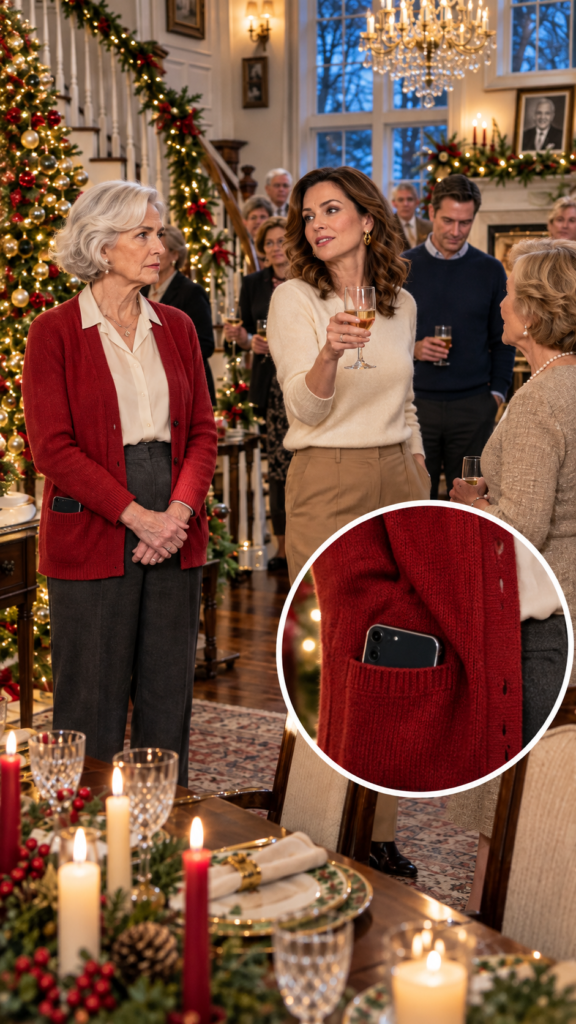
At my own Christmas open house, my daughter-in-law raised her glass and told my neighbors, “Carol still lives here, of course, but we’re slowly transitioning the place to our generation”—and my son smiled into his cider as if forty years of my life had already become someone else’s inheritance.
I did not argue.
I did not embarrass her.
I simply handed her the guest book, stepped into the hallway, and made one quiet phone call.
By dessert, the card she had been using to play lady of my house went silent.
The house smelled like cinnamon cider, pine garland, and the honey-glazed ham I had been basting since sunrise.
Outside, our northern Virginia cul-de-sac looked almost too perfect to be real.
Porch lights glowed against the early winter darkness. Wreaths hung from nearly every door. A delivery van idled near the HOA mailbox while neighbors crossed my driveway carrying cookie tins, gift bags, wine bottles, and those warm, polite smiles people bring when they expect an ordinary Christmas gathering.
But inside my house, something had shifted.
My name is Carol Whitman.
I am seventy-one years old, widowed, and that house was never simply a nice place to entertain neighbors.
It was forty years of mortgage payments.
Birthday candles burned down to wax puddles on the dining room table.
School projects drying overnight beside cereal bowls.
It was my husband Frank repainting the shutters every spring, even when his knees had begun aching badly enough that I begged him to hire someone.
And inside the pantry door were pencil marks recording every inch our son Andrew had grown until he became too tall—and too embarrassed—to stand still while his father measured him.
Frank had built a life with me there.
After he died, every room seemed to keep a little of him.
But to my daughter-in-law, Kelsey, the house had become something else.
A stage.
And I had become the aging woman she apparently needed to move gently out of the frame.
She floated through my living room that evening in a cream sweater and gold earrings, laughing beside my fireplace as though she had been welcoming people into her home for years.
She touched guests lightly on the arm.
Accepted compliments on the garland.
Smiled when someone admired the flowers.
Nodded graciously when people praised the catered trays arranged across my dining room.
“We wanted to keep the tradition alive,” she kept saying.
We.
Such a small word.
Such an efficient little thief.
Because Kelsey had ordered those flowers with my card.
She had booked the caterer through my account.
She had charged extra chairs to the household line Frank and I had opened years earlier for real emergencies.
Roof damage.
Medical expenses.
A furnace failure in January.
Not for Kelsey’s performance of inheritance while I was still alive enough to watch it happen.
But she had told everyone she was “taking over some responsibilities.”
So people thanked her.
For my house.
My food.
My money.
My Christmas.
I said nothing.
Then Mrs. Holloway from two doors down paused near the staircase and looked upward.
“I’ve always loved this staircase, Carol,” she said. “It makes the whole house feel so elegant.”
Before I could answer, Kelsey gave a soft laugh.
It was the kind of laugh people use when they want to sound modest while accepting credit they never earned.
“Well,” she said, glancing toward me, “Carol still lives here, of course, but we’re slowly transitioning the place to our generation.”
The room did not go silent.
That would have been easier.
Instead, a few people chuckled.
Quietly.
Awkwardly.
As if Kelsey had made some harmless joke about redecorating.
That almost made it worse.
I looked toward Andrew.
My son stood beside the fireplace holding a cup of cider.
Frank’s photograph sat on the mantel inches from his shoulder.
For one second, I waited for him to say something.
Anything.
Mom owns this house.
Kelsey, don’t talk about her like that.
There is no transition.
But Andrew only lowered his eyes and smiled into his cup.
Like he had not just heard his wife erase me inside the home where his father’s picture still watched over us.
I looked at him for one second longer.
He never looked back.
Something inside me became very still.
Not broken.
Not angry.
Finished.
I crossed to the entry table and picked up the guest book.
Then I walked over to Kelsey and placed it carefully into her hands.
“Would you mind keeping track of who came?” I asked.
Her face brightened immediately.
“Of course.”
She hugged the book lightly against her chest, already enjoying the responsibility.
Already believing I had surrendered one more piece of the evening.
She thought I had handed her the party.
I had handed her a witness list.
I thanked the neighbors near the doorway and excused myself without raising my voice.
Then I stepped into the hallway.
From there, I could still hear Kelsey laughing beneath the chandelier Frank had installed himself.
I reached into the pocket of my red cardigan and pulled out my phone.
My hands were perfectly steady.
The bank answered on the third ring.
I kept my voice low.
“Yes,” I said. “I’d like to remove an authorized user from the holiday account. Effective immediately.”
The woman on the other end paused.
She verified my information.
Then she asked whether I was certain.
Through the archway, I watched Kelsey standing beneath my chandelier, smiling at my neighbors as if the house had already chosen her.
“I’m very sure.”
I ended the call and returned to the party.
No announcement.
No confrontation.
No scene.
For the next hour, Kelsey continued smiling.
Until dessert.
The cheesecake had just been placed on the kitchen island.
Coffee was brewing.
Someone had started cutting slices while Christmas music played softly from the living room.
Then I noticed Kelsey staring at her phone.
Tap.
Pause.
Tap again.
Her smile disappeared.
The caterer wanted the final payment.
The florist still had a balance.
The rental company had sent an invoice for the extra chairs.
Kelsey tried the card again.
Declined.
Her fingers moved faster.
Declined.
She glanced toward Andrew.
Whispered something.
His expression tightened.
A minute later, my son appeared beside me.
“Mom?”
I looked up from my coffee.
His voice dropped.
“Kelsey says the account is locked.”
I took one slow sip.
“No,” I said.
Andrew frowned.
Across the room, Kelsey was staring directly at me now.
For the first time that evening, she did not look like the woman taking over a family tradition.
She looked like someone who had just discovered the floor beneath her belonged to somebody else.
I set my cup down.
“It’s not locked.”
Andrew waited.
Then I looked past him at my daughter-in-law.
“It just stopped obeying someone else’s name.”
Kelsey’s face changed.
Not dramatically.
Just enough.
The confidence drained first.
Then came the calculation.
Then something much closer to fear.
Because in that moment, she understood the money was only the first thing I had taken back.
And on the hallway table, beneath the edge of a Christmas runner, another paper was waiting.
A paper Kelsey had not seen.
A paper Andrew did not know I had prepared.
And it had nothing to do with Christmas.
Nobody in that room was prepared for what came next.
Kelsey’s thumb stopped moving over her phone.
For several seconds, no one said anything.
The coffee maker clicked behind her. Somewhere in the living room, Bing Crosby kept singing softly about Christmas as if the house had not just changed temperature.
Andrew glanced toward Kelsey, then back at me.
“What did you do?”
His voice was quiet, but there was something in it I had not expected.
Not concern for me.
Alarm.
I looked at my son and realized he was not asking why I had removed Kelsey from the account.
He was asking how much farther I had gone.
That distinction mattered.
I walked past him toward the hallway table.
My slippers made almost no sound on the hardwood.
Behind me, conversations that had been pretending to continue finally died altogether.
Mrs. Holloway stood near the staircase with her half-finished coffee held in both hands.
No one moved toward the door.
I lifted the edge of the Christmas runner and pulled out the paper.
Andrew’s eyes followed it.
Kelsey’s did too.
“This,” I said, “is an amendment to my estate plan.”
Andrew went pale.
Kelsey recovered first.
She gave a short breath that tried to become a laugh.
“Carol, this is ridiculous. We’re having a Christmas party.”
“No,” I said. “I’m having a Christmas party.”
Her mouth closed.
I held the paper against my palm.
I had met with my estate attorney three days earlier.
Not because of one party.
Not because of flowers or chairs or a catering bill.
Those were symptoms.
The reason was a phrase I had heard too many times over the previous months.
When we redo the kitchen.
When we open the wall.
When we take over the garden.
When we move your bedroom downstairs.
Always we.
Always later.
Always spoken as though my future had already been reduced to a logistical problem they were patiently preparing to solve.
I had spent months telling myself Kelsey was enthusiastic.
That Andrew was trying to help.
That grief had made me territorial.
That perhaps I was being sensitive.
Then my lawyer had asked one simple question.
“Carol, have you actually told them you want any of this?”
I had sat across from her and stared at my own hands.
“No.”
That answer had embarrassed me more than it should have.
The amendment removed Andrew as the person who would eventually control the administration of my estate.
The house would remain mine for as long as I lived.
After my death, it would be handled by an independent executor under instructions I had chosen.
It would not simply drop into Andrew’s hands like a set of keys left on a counter.
No one would be able to treat my life as a waiting room for their inheritance.
Andrew stared at the page without taking it.
“You changed everything?”
“I changed what needed changing.”
“Without talking to me?”
The question struck me so strangely that I almost smiled.
“Andrew, you were standing three feet away when your wife announced to my neighbors that my house was being transitioned to your generation.”
His eyes flicked toward the floor.
“That isn’t the same thing.”
“No,” I said. “It isn’t.”
I waited until he looked at me again.
“It’s worse.”
Kelsey set her phone down hard on the island.
“Oh, come on.”
Mrs. Holloway flinched at the sound.
Kelsey looked around the room, suddenly aware of how many people were still watching.
Her voice lowered.
“You’re making this into something ugly.”
I felt something cold and clear settle through me.
“I didn’t announce my retirement from my own home.”
“I was joking.”
“No, you weren’t.”
“You’re twisting it.”
“No.”
My voice stayed calm.
“That is what frightened you, Kelsey. I heard you correctly.”
The room became so quiet that I could hear the faint pop of a log in the fireplace.
Andrew rubbed a hand over his mouth.
“Mom, can we please do this privately?”
I turned toward him.
“I wanted privacy when she said it.”
His hand dropped.
“But you smiled.”
That landed.
I watched it land.
His shoulders changed first, sinking just slightly beneath his sweater.
For a moment, he looked less like the middle-aged man standing in my dining room and more like the boy who used to stare at the floor when he had broken something and hoped silence might repair it.
Kelsey looked at him.
“Say something.”
Andrew did not.
She stepped toward him.
“Andrew.”
He closed his eyes for half a second.
And then the truth came out in the worst possible way.
Not from me.
From her.
“You told me this was the plan.”
Andrew’s eyes snapped open.
Kelsey’s face was flushed now.
“You told me your mother was eventually giving you the house.”
No one moved.
I could hear my own heartbeat.
Andrew stared at Kelsey as if she had slapped him.
“Kelsey.”
“You did.”
“Stop.”
“You said there was no point being precious about the money because someday it was all going to be ours anyway.”
The silence afterward was absolute.
My fingers tightened around the estate paper.
Not because I thought I might drop it.
Because I suddenly needed to feel something solid.
Andrew looked at me.
I saw the exact moment he understood that denial would make it worse.
“Mom.”
I took one step backward.
He followed.
I raised my hand.
He stopped.
There are moments when a family breaks loudly.
Doors slam.
Voices rise.
People say cruel things they later claim they never meant.
And then there are moments when it breaks almost politely.
A son looks at his mother.
A mother realizes she has been defending him inside her own mind for months.
And one sentence quietly removes the last place left to hide.
I swallowed.
“How long?”
Andrew’s face tightened.
“It wasn’t like that.”
“How long have you been telling her this house would be yours?”
He looked toward the fireplace.
Toward Frank.
That hurt more than if he had looked anywhere else.
“After Dad died,” he said.
The words barely carried across the room.
My breath left me.
Frank had been gone three years.
Three years.
For three years, Andrew had apparently been describing my home in the future tense.
I looked toward the pantry.
I could not see the pencil marks from where I stood, but I knew exactly where they were.
Andrew at six.
Andrew at eleven.
Andrew at seventeen, rolling his eyes while Frank laughed and told him to stand straight.
I wondered when a child stopped seeing the wall where his father measured him and started seeing square footage.
Kelsey folded her arms.
“Well, there. At least we’re being honest.”
I turned toward her.
She mistook the movement for agreement.
“You know what?” she continued. “Maybe I got ahead of myself. Fine. But Andrew made it sound like you wanted us involved. He said you didn’t want to deal with things anymore.”
Andrew looked sick.
I asked him, “Did you say that?”
He rubbed both palms over his face.
“I said you were tired after Dad died.”
“That was not my question.”
His hands dropped.
“Yes.”
Mrs. Holloway slowly lowered her coffee cup onto a side table.
The porcelain made a tiny sound.
That sound somehow broke the paralysis in the room.
One of my neighbors looked away.
Another stared at Andrew with an expression I could not read.
I realized then why public humiliation feels so different from private cruelty.
In private, people can rewrite what happened.
They can say the tone was misunderstood.
They can claim no one meant it that way.
But twenty people had heard Kelsey.
And now twenty people had heard Andrew.
The story could no longer be edited later.
I placed the estate amendment on the hallway table.
Then I looked at both of them.
“I want you to leave.”
Andrew’s head lifted.
“Mom.”
“Tonight.”
Kelsey laughed once, sharply.
“You’re throwing us out over a joke?”
“No.”
I looked directly at my son.
“I’m asking you to leave because I need to know what my house feels like when no one inside it is waiting for me to disappear.”
Andrew’s face folded.
Not dramatically.
His jaw simply trembled once before he caught it.
Kelsey grabbed her coat from the chair near the entryway.
She moved quickly now, every gesture irritated and efficient.
“Fine.”
Andrew did not move.
She stared at him.
“Are you coming?”
He looked at me.
I could see the question in his face.
Not whether I loved him.
Whether love was enough to let him stay.
It wasn’t.
Not that night.
I opened the front door.
Cold December air came rushing into the hallway.
Andrew’s eyes filled, but he blinked the moisture back.
“Mom, I’m sorry.”
I held the door.
“I believe you’re sorry this happened.”
He flinched.
I hated hurting him.
I hated that the truth required it.
“But I don’t know yet if you’re sorry for what you did.”
He stood there another second.
Then he nodded.
He put on his coat.
Kelsey was already halfway down the driveway.
Andrew followed her.
The door closed behind him.
No one in the house spoke.
I rested my forehead against the wood for one breath.
Only one.
Then I turned around.
Twenty faces were watching me.
And suddenly I was exhausted.
Mrs. Holloway crossed the hallway before anyone else moved.
She did not hug me.
I was grateful for that.
She simply picked up my coffee, which had gone cold, and said, “I’ll make you another one.”
My throat tightened.
“Thank you.”
That was enough.
People began moving again.
Not leaving.
Helping.
Mr. Holloway carried used plates toward the kitchen.
Someone wrapped the remaining cheesecake.
Someone else turned down the Christmas music.
A neighbor I barely knew collected empty wineglasses without saying a word.
No one tried to make me explain.
No one told me I had been brave.
They simply helped me put my house back in order.
Near midnight, the last guest left.
Mrs. Holloway stayed.
We stood at the kitchen island under the soft light above the stove.
The caterer had taken away the serving trays.
The flowers Kelsey had ordered still stood in their expensive glass vases.
I stared at them.
“They are beautiful,” I said.
Mrs. Holloway followed my gaze.
“Yes.”
“I resent them.”
“That’s allowed.”
I laughed.
It came out unexpectedly.
Small and tired.
But real.
She smiled.
Then she reached across the island and covered my hand with hers.
“Carol.”
I looked at her.
“You are still here.”
That nearly undid me.
Not because it was profound.
Because it was simple.
And because all evening people had spoken around that fact as though being seventy-one meant I had already become a memory.
I nodded.
“I am.”
The next morning, sunlight fell across the kitchen floor in pale winter rectangles.
The house was painfully quiet.
I made coffee.
Then I called my attorney.
I told her to finalize everything.
Not out of anger.
That surprised even me.
Anger had burned off during the night.
What remained was clarity.
Andrew would no longer be the person responsible for managing my affairs.
The house would never pass automatically into his control.
My accounts would be separated from every convenience arrangement I had made after Frank died.
Every authorized user would be reviewed.
Every recurring charge would be mine because I had chosen it, not because someone assumed I would keep paying.
My attorney paused.
“Are you certain?”
Two people had asked me that question in less than twenty-four hours.
The bank.
Now her.
I looked through the kitchen doorway toward the pantry.
“Yes.”
This time the word felt different.
Not defensive.
Free.
The vendors contacted me over the next several days.
I paid for the food my guests had eaten.
I paid the florist because the flowers were already in my home.
I paid what was genuinely mine.
But the extra upgrades Kelsey had ordered for herself—the additional decorative pieces, special rentals, and last-minute additions she had authorized—were redirected to her.
There was no dramatic lawsuit.
No police officer at anyone’s door.
No revenge.
Just invoices.
Boundaries can look surprisingly ordinary on paper.
A week passed before Andrew called.
I watched his name glow on my screen until the phone nearly stopped ringing.
Then I answered.
“Hi.”
He was quiet.
“Hi, Mom.”
Neither of us knew what came next.
Finally, he said, “Can I come over?”
I looked around the living room.
The tree was still up.
Frank’s photograph was still on the mantel.
For the first time since Christmas, I did not feel afraid of what Andrew might take from the room.
“Come alone.”
He arrived forty minutes later.
No Kelsey.
No flowers.
No apology gift.
I noticed that immediately.
He stood on the porch with his hands shoved into his coat pockets.
I opened the door but did not step aside right away.
“Are you alone?”
“Yes.”
I let him in.
He stopped near the staircase.
The exact place where Kelsey had said the words.
He looked toward it.
Then toward me.
“I’ve replayed that night about a hundred times.”
I said nothing.
He took off his coat slowly.
“I smiled.”
“Yes.”
“I keep thinking if I had just said something—”
“This isn’t about one smile.”
“I know.”
His voice cracked.
He looked down.
“I know that now.”
We sat at opposite ends of the living room sofa.
Frank used to sit between us during football games.
The empty cushion felt like a third person listening.
Andrew rubbed his thumb over the edge of his wedding ring.
“I did tell Kelsey the house would probably be mine.”
I waited.
“I don’t know when I started thinking about it that way.”
“After your father died.”
His face tightened.
“Yes.”
“Why?”
He was silent for so long I thought he might not answer.
Then he said, “Because Dad dying scared me.”
That was not what I expected.
He stared at his hands.
“He was just here. Then suddenly he wasn’t. And I started thinking about everything changing. You getting older. The house. What would happen eventually.”
He swallowed.
“And instead of being afraid of losing you, I turned it into planning.”
My eyes burned.
Andrew continued.
“I made it practical because practical things don’t hurt.”
He looked toward the fireplace.
“I told myself I was being responsible.”
“But you were planning my absence.”
His mouth trembled.
“Yes.”
There it was.
No excuse.
No softening.
Just yes.
I let the silence sit between us.
He wiped his palms on his trousers.
“Kelsey liked the idea of the house.”
“I know.”
“I liked that she liked it.”
That hurt differently.
He looked ashamed.
“It made me feel successful. Like Dad had built something and I was going to inherit it and somehow that meant I had done something too.”
I leaned back.
My son had finally said the ugliest part out loud.
And because he said it without asking me to rescue him from it, something in me loosened.
Not forgiveness.
Not yet.
Space.
Andrew took a breath.
“Kelsey and I are staying apart for a while.”
I looked at him.
“I didn’t ask you to leave your wife.”
“I know.”
“This cannot become my fault.”
“It isn’t.”
He met my eyes.
“We had problems before Christmas.”
I said nothing.
“She thinks I betrayed her because I didn’t defend what I had told her.”
He gave a tired laugh with no humor in it.
“She’s not wrong about that part.”
He rotated his wedding ring once.
“But I also realized I had spent years agreeing with whoever was in front of me.”
The sentence sounded painfully familiar.
With Kelsey, he agreed.
With me, he stayed silent.
Conflict had become the only inheritance Andrew was determined not to claim from his father.
Frank had hated confrontation too.
But Frank had never mistaken silence for innocence.
Andrew looked at me.
“I’m seeing someone.”
“A therapist?”
He nodded.
I nearly smiled.
“Your father would have hated that.”
Andrew laughed.
I did too.
Then both of us stopped because for one impossible second Frank felt close enough to interrupt.
Andrew’s eyes filled.
“I miss him.”
“So do I.”
He bent forward, elbows on his knees.
“I think I stopped letting myself miss him because it made me feel like a child.”
I looked at the gray beginning near his temples.
“You’re allowed to be my son without becoming my owner.”
His head lifted.
The words hung between us.
Then he nodded.
“I know.”
“You’re also allowed to be angry when I say no.”
“I know.”
“And I am allowed to disappoint you.”
“I know.”
“You don’t get the house because you survived me.”
His face broke then.
He covered his eyes.
“I know.”
This time, I moved closer.
Not enough to erase what had happened.
Enough to put my hand between his shoulder blades.
He cried quietly.
No speech.
No dramatic apology.
Just my forty-six-year-old son bent forward beneath the same roof where I had once held him through fevers and nightmares, finally grieving something that had not happened yet.
Me.
It took months to rebuild what Christmas had exposed.
Andrew came by every Sunday.
At first, he asked before touching anything.
“Can I take the recycling?”
“Can I change that bulb?”
“Do you want me to shovel the walk?”
The politeness was almost painful.
Eventually, it became natural.
Not permission asked out of fear.
Respect.
Kelsey did not come.
She sent one letter in February.
It was four pages long.
The first page defended herself.
The second blamed Andrew.
The third described how humiliated she had felt at the party.
I nearly stopped reading.
Then I reached the fourth.
There, for the first time, she wrote one sentence without decoration.
I treated your life like a future asset.
I read it twice.
There was no request for forgiveness after it.
No demand that I understand.
She wrote that she was moving into an apartment while she and Andrew decided what remained of their marriage.
She had paid the outstanding invoices.
She would not contact me again unless I invited her.
I folded the letter.
I did not feel victorious.
That surprised me.
For months, I had imagined that justice would feel warm.
It didn’t.
It felt quiet.
Like a door clicking shut in another part of the house.
Andrew and Kelsey eventually divorced.
There was no spectacular final fight.
No scandal.
No last attempt to claim the house.
Their marriage ended the way many marriages end when the future they were building together turns out to have been constructed partly from assumptions neither person was willing to examine.
Andrew took responsibility for his part.
Kelsey took hers.
And then they went separate ways.
Her place in my life ended there.
Not with hatred.
With distance.
Sometimes distance is the kindest form of finality available.
Spring returned slowly.
The snow disappeared from the edges of the cul-de-sac.
Frank’s daffodils came up beside the mailbox.
I almost cried when I saw them.
He had planted them badly.
Too close together.
Every spring I used to complain.
Every spring he promised to move them.
He never did.
I sat on the front steps one morning drinking coffee while yellow heads crowded together in the dirt.
For the first time in years, I did not think about who would own the house after me.
I thought about who owned the morning.
Me.
That summer, I repainted the shutters.
Not myself.
I am seventy-one, not stupid.
I hired someone.
Andrew stood in the driveway while the painters worked and looked up at the ladder.
“Dad would hate this.”
“Your father nearly fell off that ladder when he was sixty-eight.”
“He would still hate it.”
“Yes.”
We both smiled.
Then Andrew glanced at me.
“What color are you doing next time?”
I looked at him.
He caught himself.
“When you decide to do them next time.”
The correction was small.
I noticed.
So did he.
“Same color,” I said.
He nodded.
“Good choice.”
By autumn, the house felt like mine again.
Not because anyone had given it back.
Because I had stopped apologizing for taking up space inside it.
I joined a walking group.
I started having lunch with Mrs. Holloway every Thursday.
I replaced the old mattress in the guest room because I wanted to, not because someone had suggested turning it into a downstairs bedroom for me.
I bought a ridiculous blue armchair Frank would have hated and placed it beside the living room window.
Every time I looked at it, I smiled.
Then December came.
The invitation list for my Christmas open house sat on the kitchen counter.
I stared at it for three days.
Finally, I called Mrs. Holloway.
“I don’t think I can do it.”
She was quiet.
“Then don’t.”
“That’s it?”
“What did you expect?”
“A speech.”
“I’m too old to give speeches before lunch.”
I laughed.
Then she said, “But if you’re asking whether Kelsey gets to keep Christmas forever just because she ruined one of them, I think you already know the answer.”
So I had the party.
Smaller.
No caterer.
No rented chairs.
No expensive flowers.
I made the ham myself.
Andrew arrived at noon with grocery bags.
He stood in the kitchen doorway.
“Where do you want these?”
I pointed.
“Counter.”
He set them down.
Then he looked toward the staircase where the garland waited in a box.
“Want help?”
“Yes.”
He climbed three steps.
Then stopped.
“Like Dad used to do it?”
My throat tightened.
“Yes.”
“Okay.”
He wrapped the garland carefully around the banister.
Not exactly like Frank.
Close enough.
By five, neighbors began arriving.
Mrs. Holloway brought cookies.
Someone brought wine.
Someone else brought a poinsettia even though I already had three.
The house filled with voices.
Warm ones.
Ordinary ones.
No one praised anyone for taking over.
No one spoke about transitions.
People simply came inside.
At seven, I noticed something on the entry table.
The guest book.
The same one.
I had not opened it since the previous Christmas.
For a second, I could see Kelsey again holding it against her cream sweater, pleased with the responsibility I had handed her.
I almost put it away.
Then Mrs. Holloway saw me.
“Oh,” she said. “You found it.”
Something in her voice made me look down.
“What did you do?”
She smiled.
“Open it.”
I opened the cover.
The first pages contained names from the previous Christmas.
Exactly what I expected.
Then I turned the page.
There was Mrs. Holloway’s handwriting.
Carol and Frank brought soup the week we moved in, before we had even unpacked our bowls.
I stared at it.
Below that was another entry.
Frank taught my daughter how to change a tire in this driveway.
Another.
Carol sat with me on this porch the night my mother died.
Another.
Andrew broke our front window with a baseball in 1989. Frank made him apologize before he paid for it.
I laughed aloud.
Andrew heard me from across the room.
“What?”
I turned another page.
More handwriting.
More memories.
Neighbors had filled almost twenty pages.
Christmases.
Snowstorms.
Graduations.
Block parties.
Frank lending tools he never got back.
Me feeding someone’s cat.
Andrew riding his bicycle down the hill too fast.
The year our furnace failed and half the neighborhood brought space heaters.
The year Frank dressed as Santa and frightened a toddler so badly he cried.
My vision blurred.
“When did you do this?”
Mrs. Holloway touched the edge of the book.
“Last year.”
I looked at her.
“After Andrew and Kelsey left, people didn’t know what to say.”
She smiled softly.
“So I told them not to say anything.”
I looked back at the pages.
“I told them to write down what this house actually meant.”
My hand went to my mouth.
The guest book.
I had handed it to Kelsey because I wanted witnesses.
I thought I was documenting the night someone tried to erase me.
Instead, while I was too hurt to notice, the people around me had turned it into evidence of something entirely different.
A life.
Not an asset.
Not a property.
Not an inheritance.
A life.
I turned one more page.
There was Andrew’s handwriting.
It was recent.
I knew because his letters had changed since childhood, but the way he formed his capital A had not.
Dad measured my height inside the pantry door because he wanted proof I was growing.
I spent too long thinking growing meant eventually taking his place.
It doesn’t.
Home is not what I inherit when Mom is gone.
Home is where she is while she is here.
I stopped breathing.
When I looked up, Andrew was standing several feet away.
He had not moved closer.
He was waiting.
The room around us continued softly—glasses, laughter, Christmas music, the low murmur of people who loved one another imperfectly and came anyway.
I closed the guest book.
Then I crossed the room.
Andrew’s eyes filled before I reached him.
I put my arms around my son.
He held me carefully at first.
Then tighter.
“I’m sorry, Mom.”
I rested my cheek against his shoulder.
“I know.”
Those two words were not absolution for everything.
They did not erase Christmas.
They did not return the years when he had imagined my absence more easily than he had imagined my aging.
But forgiveness, I had learned, was not pretending the wound never happened.
It was deciding whether the person standing in front of you had learned how not to make it again.
I pulled back.
“You want some cider?”
He laughed through the tears.
“Yeah.”
“Good.”
I handed him a cup.
Then I pointed toward the fireplace.
“Stand over there.”
He looked confused.
“Why?”
I picked up Frank’s photograph from the mantel.
“Because your father is blocking the garland in every picture.”
Andrew laughed.
A real laugh.
The kind I had not heard in years.
I moved the photograph six inches to the left.
Then I stopped.
Frank smiled at me from behind the glass.
For decades, I had believed preserving a life meant keeping everything where it had always been.
The furniture.
The traditions.
The shutters.
The photograph.
But maybe that was not what home required.
Maybe home survived because people were allowed to move things.
Carefully.
With permission.
Without erasing what came before.
Mrs. Holloway called from the dining room that the ham was ready.
Someone cheered.
I picked up the guest book and carried it with me.
As I passed the pantry, I opened the door.
The pencil marks were still there.
Andrew at six.
Andrew at eleven.
Andrew at seventeen.
Near the highest mark, Frank had written the date in his crooked block letters.
I touched it with one finger.
Andrew stopped beside me.
For a moment, neither of us spoke.
Then he smiled.
“Dad made me stand there twice because I kept lifting my heels.”
“I know.”
“You told on me.”
“I was married to the man.”
“That’s betrayal.”
“That’s marriage.”
He laughed.
I closed the pantry door.
Not because I was finished remembering.
Because dinner was waiting.
The dining room glowed beneath the chandelier Frank had installed himself.
My neighbors filled the chairs.
Andrew carried the cider.
Mrs. Holloway complained that someone had stolen her napkin.
The ridiculous blue armchair was visible through the archway.
Outside, snow had begun falling so lightly that it seemed suspended beneath the streetlights.
I stood for one second at the head of the table.
No one had assigned me the place.
No one needed to.
Andrew looked up.
“You coming, Mom?”
I looked around the room.
At the faces.
At the candles.
At the house that had held forty years of noise, grief, mistakes, forgiveness, death, birth, silence, Christmases, and second chances.
Then I sat down.
“Yes,” I said.
“I’m here.”






