My future daughter-in-law shaved my head while I slept on my son’s wedding morning—and still expected me to arrive smiling, remain silent, and hand her twenty-two million dollars.
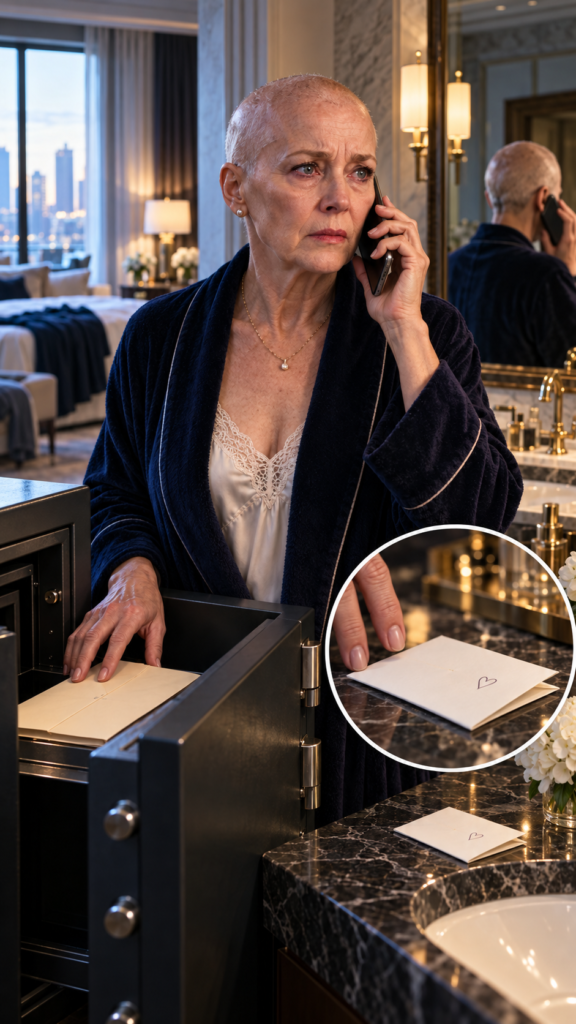
I woke with a strange burning across my scalp. Still drifting between sleep and consciousness, I reached for the thick silver hair that had fallen past my shoulders the night before. My fingers touched nothing. Not tangled strands. Not a ruined haircut. Bare skin. I sat upright so quickly that the bedroom tilted. Cold morning light slipped through the curtains as I stumbled toward the bathroom, one hand pressed against my head. Before I switched on the light, I smelled antiseptic. Sharp. Clinical. Deliberate. Then I faced the mirror. For one suspended second, I did not recognize the woman staring back at me. Her scalp was raw and unevenly flushed. Tiny fragments of silver hair clung near one ear where the razor had missed them. Her eyes were wide, but the rest of her face had gone frighteningly still. Someone had entered my bedroom while I slept. Someone had stood over me. Someone had removed every strand of my hair. A white note had been taped to the center of the mirror. “Congratulations—you finally have a hairstyle that suits your age.” A tiny heart had been drawn beneath the sentence. The handwriting was neat. The cruelty was effortless. I peeled the note from the glass, and a familiar perfume rose from the paper—sweet, expensive, and impossible to mistake. Sabrina. My future daughter-in-law. The woman my son Michael would marry in only a few hours. I stared at that cheerful little heart until the shock inside me hardened into something cold and precise. She wanted me to scream. She wanted me to call Michael in tears and beg him to confront her. She wanted Beatrice Langford—the widow who had built half a Boston real estate empire from grief, debt, and sleepless nights—to hide from the wedding because she was ashamed to be seen. But I did not scream. I folded the note once and placed it beside the sink. Then I walked barefoot across the cold marble floor to the safe in my bedroom. Inside rested an ivory envelope I had prepared the night before. The documents authorized a twenty-two-million-dollar transfer to Michael and Sabrina. Their wedding gift. It was more than money. It was a penthouse, investments, security, and the beginning of a life most people could never imagine. It was also my final attempt to keep my son close. For years, I had convinced myself generosity could repair what silence had damaged. Every check had become an apology for working too much, grieving too long, or failing to become the mother Michael believed he deserved. Now the envelope felt different in my hands. It no longer felt like a gift. It felt like a weapon I had nearly placed in Sabrina’s hand. I returned it to the safe. The metal door closed with a soft, final weight. I turned the dial until the lock clicked. Quiet. Dry. Final. Not one dollar would move. I called Avery Whitman, our family attorney. He answered on the second ring. “Beatrice,” he said calmly. “Ready to finalize the transfer?” “No.” The word came out steadier than I expected. A pause followed. “I want everything placed on hold immediately,” I continued. “No transfer. No access. No exceptions.” His voice sharpened. “Has something happened?” I looked at my reflection. At the burning skin. At the silver fragments near my ear. At Sabrina’s note beside the sink. “At the reception tonight, I want you to come to my house,” I said. “We’re rewriting the entire will.” Silence filled the line. “Beatrice—” “Only one thing is wrong,” I told him. “I finally woke up.” Lucia, my hairstylist of twenty years, arrived less than half an hour later. When I opened the door, her eyes lifted to my scalp. Her hand flew to her mouth. She did not ask who had done it. Perhaps she saw the answer in my face. Perhaps she understood that speaking the horror aloud would give it more power than it deserved. Instead, she opened her case. Lucia fitted me with a soft gray-silver wig that moved naturally around my face. She adjusted it with careful fingers until every sign of what had happened disappeared beneath it. Then she helped me into my navy silk dress and gray wool coat. When she finished, I stood before the mirror again. The woman looking back was no longer stunned. She was composed. Elegant. And dangerous. St. Andrew’s Church glowed beneath the morning sun. Stained-glass colors drifted across the polished pews while guests whispered and admired the flowers. I sat near the front as the organ played. No one knew what was beneath my silver hair. No one knew what Sabrina had done. As I waited for my son to marry her, memories returned with merciless clarity. I saw Richard’s death certificate trembling in my hands when I was thirty-two. I heard twelve-year-old Michael asking where his father had gone and why he could not come home. I remembered skipping meals so my son could have schoolbooks and new shoes. I remembered unanswered applications, humiliating meetings, and nights spent crying where Michael could not hear me. Then I remembered waking before dawn and trying again. One duplex became three. Three properties became buildings. Building by building, deal by deal, I dragged the Langford name out of grief and turned it into an empire. I had built a crown for my son. Somewhere along the way, he forgot what it had cost me. Michael rarely demanded anything directly. He did not have to. He mentioned a condo, and I bought one. He spoke about Europe, and I paid for the trip. He sighed over an expense, and a check appeared. I gave because I loved him. I kept giving because I feared that the moment I stopped, he would stop loving me. Then Sabrina entered his life. Her insults always arrived disguised as humor. She joked about my age, my clothes, my habits, and the way I spoke. Her eyes moved over me as though I were outdated furniture occupying space in a room she intended to redecorate. Michael never defended me. He smiled. Sometimes he laughed. Each time, something between us broke a little more. But shaving my head while I slept was not humor. It was not teasing. It was a declaration. Sabrina believed she had already won. At the reception, crystal chandeliers poured warm light over white flowers and polished glassware. Music drifted through the ballroom while cameras followed the newlyweds from table to table. Sabrina looked flawless at the head table. Her gown glittered beneath the lights. Her smile was radiant, practiced, and perfectly controlled. When she looked at me, satisfaction flashed briefly in her eyes. She believed the wig proved I had accepted my humiliation. Michael barely glanced in my direction. I sat through the speeches. I applauded when everyone else applauded. I smiled whenever the cameras turned toward me. Inside my purse, the recorder felt heavier than its size should have allowed. So did Sabrina’s note. For years, fear had occupied a permanent place inside me—the fear of losing Michael, disappointing him, or being left alone after sacrificing everything to give him a future. That fear was gone. In its place was clarity. The emcee raised his microphone. “And now, a special moment from the groom’s mother, Mrs. Beatrice Langford.” Applause swept across the ballroom. I rose slowly. Sabrina’s smile tightened. Michael turned toward me, confusion crossing his face. I walked beneath the chandeliers as conversations faded and every camera followed me. At the microphone, I removed one folded piece of paper from my purse and placed it on the podium. Even from across the room, Sabrina recognized it. The color drained from her face. I looked directly at my son. Then I raised one hand, touched the edge of my silver hair, and began to speak.
The first sound that came through the microphone was my breath.
Not trembling.
Not broken.
Just one quiet inhale that traveled through the ballroom and seemed to pull every conversation, every clink of crystal, every restless movement into silence.
“This morning,” I said, “I woke up and discovered that someone had entered my bedroom while I was sleeping.”
Michael’s expression changed before anyone else’s did.
His shoulders stiffened.
Across the room, Sabrina did not move.
I looked at her for only a second before continuing.
“I reached for my hair.”
My fingers slid beneath the edge of the wig.
“And there was nothing there.”
A chair creaked somewhere behind me.
I lifted the wig from my head.
Cold ballroom air touched my bare scalp.
The reaction was not loud. That made it worse.
A woman near the front covered her mouth. Someone farther back whispered my name. One of the photographers lowered his camera before slowly raising it again, as though even he was uncertain whether witnessing the moment was an intrusion or a responsibility.
Michael stared at me.
His face emptied.
“Mom…”
I placed the wig beside the folded note.
“No,” I said softly.
It was not cruel.
It was simply the first time in years I had not rushed to make his discomfort easier.
I unfolded the paper.
Sabrina’s tiny heart appeared beneath the sentence.
“I found this taped to my mirror.”
I read it aloud.
“Congratulations—you finally have a hairstyle that suits your age.”
The silence afterward seemed to stretch beyond the room.
Michael turned toward Sabrina.
She had lost the practiced bridal smile.
Her lips parted, but no sound came.
I watched my son look at the note.
Then at her.
Then back at me.
“What is this?” he asked.
Sabrina blinked quickly.
“I don’t know.”
Her voice was too fast.
Michael took one step toward her.
“That handwriting…”
“Michael.”
“You write your sevens like that.”
Sabrina’s eyes flashed.
“It’s a stupid note. Anyone could have written it.”
I almost admired how quickly she recovered.
Almost.
She straightened the front of her gown and looked around the ballroom as though inviting everyone else to recognize how unreasonable the situation had become.
“This is our wedding reception,” she said. “Can we not turn it into some kind of performance?”
Something inside Michael’s face shifted.
Not fully.
But enough.
For years, I had watched him choose the easiest version of every uncomfortable truth. He smiled when she mocked me because defending me would create friction. He accepted what I gave because asking himself why I gave it would require honesty. He let silence do the work of betrayal for him.
Now there was nowhere for silence to hide.
I placed both hands against the podium.
“You’re right,” I said. “This is your wedding reception.”
Sabrina’s chin lifted.
“So I’ll keep this simple.”
I looked at Michael.
“The twenty-two-million-dollar transfer I prepared for the two of you has been stopped.”
A sound moved through the room.
Not quite a gasp.
More like hundreds of people inhaling at once.
Sabrina’s control shattered.
“What?”
The word came out before she could catch it.
Michael looked at her.
Then at me.
“You stopped it?”
“Yes.”
“Why didn’t you tell me?”
The question hurt more than I expected.
Not because he asked it.
Because his first instinct was still the money.
I saw the realization arrive in his eyes almost as soon as the words left his mouth.
His face tightened.
He looked down.
For the first time that day, he seemed ashamed.
Sabrina did not.
She stepped away from the head table.
“You can’t do that.”
I met her eyes.
“I already did.”
Her heels struck the floor sharply as she came toward the podium.
Guests shifted aside.
Michael reached for her arm, but she pulled away.
“After everything we planned?”
I heard Avery’s voice in my memory.
No transfer. No access. No exceptions.
I remained still.
Sabrina stopped several feet from me.
“You promised that money.”
“I promised a gift.”
“It was supposed to happen today.”
Her breathing had changed.
Quick.
Shallow.
The microphone remained live between us.
I watched Michael notice it.
He glanced toward the speakers mounted around the ballroom.
Then back to Sabrina.
She did not.
“You humiliated yourself over a haircut,” she snapped.
The room froze.
Michael’s head turned.
Very slowly.
Sabrina heard what she had said.
Too late.
I touched the recorder inside my purse.
Still running.
Still capturing everything.
Michael’s voice dropped.
“A haircut?”
Sabrina swallowed.
“That’s not what I meant.”
“You said haircut.”
“Michael, don’t.”
He stared at her.
“You knew.”
She looked toward me, and hatred replaced panic.
For the first time since I had met her, Sabrina stopped pretending.
“It grows back.”
Michael’s face went white.
A woman at the nearest table began quietly crying.
I did not know her well.
Perhaps she had a mother.
Perhaps that was enough.
Michael moved closer to Sabrina.
“You went into my mother’s bedroom while she was sleeping?”
Sabrina’s eyes filled, but the tears had no softness in them.
“She has controlled everything since I met you.”
My hand tightened around the edge of the podium.
“She buys things, and everyone calls it love. She makes herself essential, and then everybody has to worship her for surviving.”
Michael flinched.
Some of those words had come from somewhere familiar.
From conversations I had never heard.
From resentments I had sensed but never faced.
Sabrina turned on him.
“You complained about it too.”
There it was.
The hidden truth arrived not with a scream but with six quiet words.
Michael looked as though she had struck him.
I looked at my son.
He did not deny it.
The room seemed to disappear around us.
“What did you tell her?” I asked.
His throat moved.
“Mom…”
“What did you tell her?”
He stared at the floor.
“That sometimes I felt like everything came with a string.”
The words found the old wounds with perfect accuracy.
I said nothing.
Michael continued because there was nothing left to protect.
“I told her I hated feeling like I owed you.”
My fingers went cold.
He looked at my bare scalp.
His eyes filled.
“But I never told her to do this.”
Sabrina laughed once.
A sharp, disbelieving sound.
“No. You just handed me the code to her house.”
My gaze snapped to Michael.
His face collapsed.
“I gave her the temporary access code,” he said. “For the wedding week.”
“Why?”
He closed his eyes.
“She said she might need to pick up things from the house.”
I waited.
He opened them again.
“I didn’t ask what.”
That hurt differently.
Not because he had planned what happened.
He had not.
I could see that now.
But carelessness can become permission when it is given to someone cruel.
Michael had spent years looking away.
Sabrina had simply learned how far looking away would let her go.
I folded the note once more.
Carefully.
Exactly as I had that morning.
“You didn’t shave my head, Michael.”
He looked at me.
“But you taught her that disrespecting me had no consequence.”
His mouth opened.
Nothing came out.
I turned toward Sabrina.
“And you mistook my fear of losing my son for weakness.”
Her face hardened.
“You think this makes you powerful?”
“No.”
I picked up my wig.
“I think waking up makes me free.”
Sabrina’s expression twisted.
Then she made the mistake that ended everything.
She turned to Michael and said, loud enough for the entire ballroom to hear, “You told me she’d cave. You said she always caves when you stop calling her.”
Michael recoiled.
I did not.
Because the sentence explained years of my life in one clean cut.
The silences.
The delayed replies.
The sudden warmth after a check cleared.
The vacations.
The condos.
The dinners where I paid for twenty people and went home alone.
I had thought I was buying time.
Sometimes I had been buying access to my own son.
Michael stared at Sabrina as though seeing himself reflected in her cruelty.
Then he looked at me.
His lips trembled.
“Did I do that to you?”
I could have protected him.
The old Beatrice would have.
She would have rushed across the room, touched his face, told him he was still grieving his father, told him motherhood did not keep receipts.
But love without truth had brought us here.
“Yes,” I said.
He closed his eyes.
A tear slid down his cheek.
Sabrina stepped closer to him.
“Michael, she’s manipulating you.”
He opened his eyes.
“No.”
His voice was quiet.
So quiet Sabrina leaned toward him.
He took off his wedding ring.
Her face changed.
“Michael.”
He looked at the ring in his palm for several seconds.
Then placed it on the head table beside her untouched champagne.
“You shaved my mother’s head while she slept.”
“I was angry.”
“You broke into her bedroom.”
“You gave me access.”
“I gave you a code.”
His voice cracked.
“I did not give you permission to hurt her.”
Sabrina reached for him.
He stepped back.
That small movement broke something final.
She stared at the space between them.
“You’re choosing her?”
Michael shook his head.
“No.”
He looked at me.
“I’m choosing to stop pretending I don’t know right from wrong.”
Sabrina stood beneath the chandeliers in a wedding dress that had probably cost more than my first duplex.
For the first time all day, she looked small.
Not because anyone humiliated her.
Because there was no one left willing to protect the version of herself she had created.
I picked up the microphone one last time.
“The reception is over for me.”
Then I turned toward Michael.
“So is the money.”
He nodded.
No argument.
No panic.
Just a broken, quiet nod.
I walked out carrying my wig in one hand.
I did not put it back on.
Lucia met me near the coatroom.
She had been standing against the wall with tears on her face.
When she saw me, she opened her arms.
I stepped into them.
For twenty years, she had touched my hair with gentleness.
That night, with no hair left to touch, she held me by the shoulders instead.
“You don’t have to be strong right now,” she whispered.
The sentence almost undid me.
My knees weakened.
Lucia caught me.
I pressed my face against her shoulder and cried for the first time since waking.
Not because of my hair.
Not because of Sabrina.
Because a mother can spend decades surviving for a child and still discover she has been afraid of that child’s absence.
Because there are griefs no fortune can insulate.
Because I finally understood how much of my life had been organized around not being abandoned again.
Richard had died.
Michael had grown away from me.
And I had spent years throwing money into the distance between those two losses.
That night, Avery arrived at my house at nine seventeen.
I remember because the grandfather clock in the hall struck once while I opened the door.
He saw my scalp.
His professional calm vanished.
“Beatrice.”
“I’m all right.”
“No,” he said.
It was strangely comforting.
“No, you are not.”
We sat at the dining-room table where Michael had done homework as a boy.
The ivory envelope rested between us.
I removed the unsigned transfer documents.
Then Sabrina’s note.
Then the recorder.
Avery listened to the recording without interrupting.
When Sabrina’s voice said, It grows back, his jaw tightened.
When she admitted Michael had given her the code, Avery glanced at me.
When she said Michael used silence to make me cave, I looked away.
At the end, Avery switched off the recorder.
“What do you want to do?”
I stared at the papers.
“For once, I don’t want to decide from fear.”
So we did nothing quickly.
That was the first change.
The next morning, I gave the note and recording to the appropriate authorities and told the truth exactly once.
I did not call anyone to influence the process.
I did not make threats.
I did not use my name.
I let Sabrina face what she had done without money softening the floor beneath her.
The matter moved slowly, as real consequences often do.
But it moved.
Her public admission, the note, the recording, and the evidence of her unauthorized entry could not be laughed away as a joke.
Months later, the legal case ended with Sabrina accepting responsibility for the break-in and assault rather than forcing everyone through a public trial.
There were court-ordered consequences, financial penalties, and restrictions that made the truth permanent in a way even she could not edit.
But by then, the legal outcome almost felt secondary.
Her real power had broken the moment people stopped calling cruelty humor.
Michael left the wedding reception alone.
For three days, I heard nothing.
On the fourth afternoon, the doorbell rang.
I opened the door without my wig.
My scalp had begun healing. The redness was fading. Tiny silver growth had appeared across the crown like frost.
Michael stood on the front step.
No flowers.
No gift.
No dramatic apology arranged for effect.
He held a ring of keys.
“The condo,” he said.
I looked at them.
“I don’t want them.”
His eyes dropped.
“You bought it.”
“I know.”
“I’ve been living inside things you bought for so long I stopped asking what any of it cost you.”
“You think returning keys fixes that?”
“No.”
He swallowed.
“That’s why I’m not asking you to forgive me.”
For once, he did not enter until I stepped aside.
We sat in the kitchen.
Not the formal sitting room.
Not the office where contracts were signed.
The kitchen where he had eaten cereal before school while I pretended not to be exhausted.
Michael kept both hands around a mug he never drank from.
“I laughed when she mocked you.”
“Yes.”
“I let her make you smaller because defending you would have made my life harder.”
“Yes.”
“I knew you gave me things because you were afraid.”
That one surprised me.
I looked at him.
He stared into the untouched coffee.
“I knew.”
The honesty was ugly.
And necessary.
“I told myself you liked giving,” he said. “That it made you happy. But sometimes I knew exactly what I was doing when I pulled away.”
His voice broke.
“I knew you would call. Then offer dinner. Then offer something.”
I sat very still.
“I hated feeling bought,” he whispered. “So I punished you by making you buy me.”
There are apologies that ask to be excused.
And there are apologies that simply place the truth on the table and accept whatever happens next.
That was the first time my son gave me the second kind.
I reached across the table.
Not for his hand.
For the keys.
I pushed them back.
“Keep the condo for now.”
He looked up sharply.
“This is not forgiveness.”
“I know.”
“You will pay every expense yourself. Taxes. Fees. Repairs. Everything.”
He nodded.
“And if you ever use silence to punish me again, I will let the silence stay.”
His eyes filled.
“I understand.”
“I hope you do.”
He stood to leave.
At the doorway, he turned.
“Mom?”
“Yes?”
“Can I call you tomorrow?”
The question was so small it nearly broke my heart.
“Call because you want to talk to me.”
“I do.”
“Then call.”
He did.
Not every day.
That would have been too easy.
Some calls were awkward.
Some lasted four minutes.
Some ended with both of us frustrated.
But there were no checks afterward.
No transfers.
No expensive apologies.
We began learning how to have a relationship that could survive an empty envelope.
Michael ended his marriage.
The process took time, paperwork, painful conversations, and more shame than he ever described in detail.
I did not manage it for him.
I did not hire someone to make it painless.
When he asked Avery for a referral, Avery gave him a name and nothing more.
Michael handled the rest himself.
Months passed.
My hair returned.
At first it grew in unevenly, soft as down.
Lucia trimmed it every few weeks at my kitchen table because I could not bear the salon mirrors yet.
One afternoon, while silver curls collected around the chair, I caught her looking at me.
“What?”
She smiled.
“Nothing.”
“Lucia.”
“You look like yourself.”
I touched the short wave near my temple.
“No.”
I smiled back.
“I think I finally do.”
That spring, Avery and I finished rewriting my estate plans.
Michael was not disinherited.
But he was no longer the center of everything I had built.
Most of the fortune would eventually fund housing for widowed parents and families rebuilding after sudden loss.
Not charity designed for photographs.
Long-term housing.
Childcare.
Legal help.
Job training.
The things I had needed when Richard died and twelve-year-old Michael asked questions I was too frightened to answer.
We called it the Richard Langford Home Fund.
When I told Michael, he was quiet.
Then he said, “Dad would have loved that.”
“I hope so.”
“And the twenty-two million?”
I looked at him.
“What about it?”
His cheeks reddened.
“Nothing.”
For the first time in his adult life, Michael Langford asked me about money and then chose not to ask for any.
Six months after the wedding, Avery called me into his office.
There was something strange in his voice.
“Beatrice, I need you to come down here.”
My stomach tightened.
“Is something wrong?”
“No.”
A pause.
“Actually, I think something may finally be right.”
When I arrived, Michael was already there.
He stood near the window with his hands in his pockets.
Avery placed a folder on the table.
“What is this?”
Michael looked terrified.
Not guilty.
Terrified.
“Open it.”
Inside was a deed transfer.
I read the first page twice.
Then a third time.
The condo.
The one I had bought for him years earlier.
Transferred not back to me.
Transferred to the Richard Langford Home Fund.
I stared at Michael.
“You gave it away?”
He shook his head.
“No.”
His mouth trembled slightly.
“I gave it somewhere.”
The condo was worth millions.
It was the largest thing I had ever given him before the failed wedding transfer.
I could barely speak.
“Where are you living?”
“A rental.”
“Michael.”
“I can afford rent.”
“That isn’t the point.”
“It is for me.”
He stepped closer.
“All my life, whenever something frightened me, I looked for the softest place to land. And you kept putting cushions under me.”
I looked down at the deed.
“I need to know I can stand without them.”
My vision blurred.
He continued.
“There’s one condition.”
I laughed through the tears.
“Of course there is.”
His face softened.
“The first family who lives there doesn’t get told my name.”
I stared at him.
“Why?”
“Because I don’t want gratitude.”
Something inside me gave way.
Not painfully.
Like ice melting after a winter so long I had forgotten water could move.
I stood.
Michael did not step forward.
He waited.
That mattered.
“Come here,” I said.
He crossed the room.
I wrapped my arms around my son.
For one second, he remained rigid.
Then he folded against me.
He was no longer twelve.
I was no longer thirty-two.
But somewhere inside that embrace were the boy who had lost his father and the woman who had mistaken providing for healing.
“I’m sorry,” he whispered against my shoulder.
“I know.”
“I love you.”
I closed my eyes.
This time there was nothing after the sentence.
No request.
No amount.
No fear.
“I love you too.”
The first family moved into the condo three weeks later.
A widowed mother with two children.
I never met them on move-in day.
That had been Michael’s request.
No cameras.
No speeches.
No Langford name displayed in the lobby.
But Avery sent me one photograph afterward.
Two children sitting cross-legged on the living-room floor eating pizza from paper plates while their mother stood at the window with both hands covering her face.
Behind them, Boston stretched beneath the evening sky.
I recognized the room.
I had once bought it because I thought luxury might keep my son near me.
Now it was keeping strangers safe.
That was the beautiful part I had never understood while building my empire.
Money could not purchase love.
But freed from fear, it could still become shelter.
By summer, the short silver waves around my face had grown thick enough that Lucia stopped bringing the wig.
She placed it inside its box one afternoon and closed the lid.
“Keep it?” she asked.
I considered the question.
Then shook my head.
“No.”
She smiled.
“Good.”
Michael joined me for dinner that evening.
He arrived carrying groceries.
Groceries.
I laughed so hard when I saw the paper bags that he looked offended.
“What?”
“You have never brought groceries into this house in your life.”
“That cannot be true.”
“It is absolutely true.”
He looked into the bag.
“I bought too many tomatoes.”
“Your father did that.”
Michael went still.
Then smiled.
Not the practiced smile he had worn beside Sabrina.
A softer one.
“I wish I remembered more about him.”
I took the tomatoes from his hands.
“I can help with that.”
We cooked badly.
Richard had been the real cook.
Michael burned the onions.
I oversalted the sauce.
Lucia arrived halfway through because I had forgotten she was dropping something off, and somehow she stayed for dinner.
Then Avery appeared at the door with documents that could have waited until Monday and accepted a plate before I could stop him.
Four people ended up around my kitchen table.
No chandeliers.
No cameras.
No twenty-two-million-dollar envelope.
Michael laughed at something Lucia said.
I watched him.
For years, I had imagined peace as the absence of loss.
I had been wrong.
Peace was knowing loss had come, had changed us, had stripped away what we used to hide behind—and discovering there was still something worth keeping when it was finished.
Later, after everyone left, Michael helped me carry dishes to the sink.
At the doorway, he hesitated.
I knew that hesitation now.
It meant he wanted something.
My old fear flickered.
Then he said, “Can I come next Sunday?”
I smiled.
“Yes.”
“No occasion?”
“No occasion.”
“No money?”
“Definitely no money.”
He laughed.
“Good.”
He kissed my forehead.
Right above the place where silver hair had begun growing back strongest.
Then he left.
I stood alone in the quiet kitchen, listening to his footsteps disappear down the front walk.
For once, I did not rush to the window to make sure he turned back.
I did not wonder how long it would be before he called.
I did not think about what I could offer him next.
On the counter sat one final remnant from the morning everything changed.
The ivory envelope.
I had kept it empty.
Not as a threat.
As a reminder.
I carried it to the fireplace, opened the screen, and laid it over the embers.
The paper curled slowly.
Then caught.
Twenty-two million dollars had once been my last attempt to keep my son.
In the end, losing that gift had given both of us something money had never managed to buy.
A choice.
He had chosen to return without being paid.
And I had finally chosen to believe that anyone who truly loved me was free to leave.
The flames softened to orange.
In the dark window above the sink, my reflection looked back at me.
Short silver hair.
Bare face.
No wig.
No armor.
From somewhere outside came the faint sound of Michael laughing as he reached his car.
I touched the new silver wave above my temple, turned off the kitchen light, and smiled into the quiet house that no longer felt empty.






