Margaret Vance was sixty-two years old, a retired head librarian, a widow who had spent the better part of her life believing that quiet sacrifice was the highest form of love. She had sold the home where she raised her daughter, the house where her late husband Daniel had read the Sunday paper every morning in his blue armchair, and she had used the proceeds to secure a five-bedroom property in Bellevue for Emily and her husband Jason. She had done it because Emily sat at her kitchen table and cried, and because Emily mentioned children someday, and that single word had unlocked every door in Margaret’s heart.
The occupancy agreement was clear. Emily and Jason would cover the mortgage, taxes, insurance, and maintenance, then refinance within eighteen months. Their signatures were on every page. For a while, they kept their word. Then Jason lost a major client, the payments stopped, and Margaret kept covering the bills because Emily was her only child and every missed payment arrived wrapped in panic and promises.
While Margaret carried the financial weight alone, Emily and Jason renovated a bathroom, hosted dinner parties, traveled, and installed a new wine refrigerator. Their guests admired the beautiful house and the elegant life the couple had built. No one knew an aging widow’s retirement savings were holding the entire illusion together.
Jason’s mother, Beatrice, knew. She also treated Margaret as though she were an embarrassing visitor. She called Margaret’s career as a librarian “quaint” and introduced her to guests as Emily’s “sweet little bookish mother.” She removed Daniel’s blue armchair from the living room because she said it ruined the balance of the space. Margaret later found it buried in the garage beneath boxes, the same chair where Emily had curled up with a childhood fever, the same chair Daniel had loved every Sunday morning for decades.
Emily had promised she would keep that chair forever. When Margaret looked hurt, Emily whispered that moving it was only temporary. Temporary became the word Emily used whenever she wanted her mother to accept something permanent.
The guest suite Emily had promised would always belong to Margaret became storage for coats and exercise equipment. Thanksgiving was taken away with an excuse about a rental that supposedly lacked room, and days later Margaret saw photographs of Beatrice’s friends seated comfortably by the fireplace. There had been space for nearly everyone except her.
Then, in the early hours of a December morning, a text message arrived. Emily said Beatrice wanted an intimate family gathering for Christmas and asked Margaret not to make things difficult. That intimate gathering included neighbors, coworkers, and women from Beatrice’s tennis club. Margaret sat alone in her bedroom while Seattle rain struck the window, read the message four times, and typed one word back: “Understood.”
She did not call. She did not cry. She opened the fireproof box in her closet and spread the deed, the occupancy agreement, years of payment records, and Jason’s written promises to refinance across her kitchen table. Then she called her attorney, Samuel Henderson, who reviewed every page and reminded her of something she had almost forgotten. The title had never transferred. The agreement was still valid. They were in serious default.
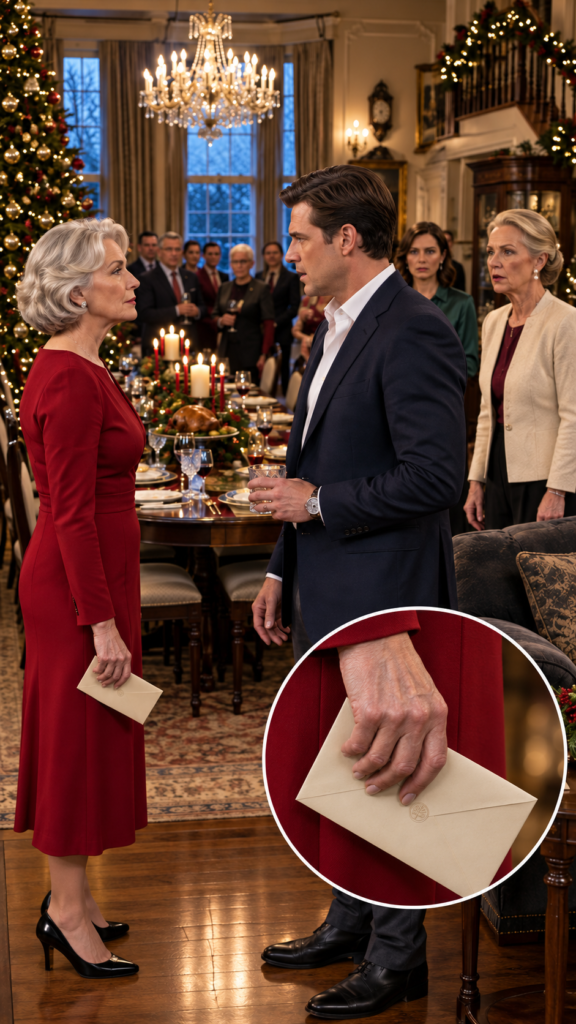
On Christmas Eve, Margaret drove to Bellevue in a crimson dress, red lipstick, and the diamond earrings Daniel had given her before he died. She carried one cream-colored envelope. Jason opened the door holding a drink and his smile cracked the moment he recognized her. Beatrice rose from the sofa inside Margaret’s house and announced this was a private family gathering. Margaret stepped inside and handed Jason the envelope. He read the legal heading, then the first paragraph, and the color drained from his face. Beatrice snatched the document and read it herself. For the first time, she understood that Margaret had not come to beg for a seat at the table.
The room went completely still. Beatrice demanded to know what an occupancy agreement was. Jason admitted he was supposed to have refinanced four years ago and never had. Emily admitted she had known enough to stop it and kept hoping Jason would fix things first. Then she said something that cut through everything: she had started resenting her own mother, not for doing anything wrong, but because every bill Margaret paid made it harder to pretend they were who everyone thought they were.
Jason turned to Beatrice and asked her to leave. Emily, to everyone’s shock, said the same. Beatrice left. The guests followed. The turkey sat untouched, candles burned low, and the three of them sat at that beautiful holiday table and finally told each other the truth.
The outcome was not dramatic or cruel. Jason and Emily met with Samuel, reviewed their finances honestly, and accepted that they could not refinance responsibly. They agreed to move. Samuel gave them enough time to find a rental and leave the property in good condition. Margaret did not supervise their search or pay their deposit. Those were the first gifts she gave them after Christmas. The gifts of not rescuing them.
They moved into a two-bedroom apartment with thin walls and folding chairs around the kitchen table. Jason took a smaller, steadier job. Emily returned to work full time. Beatrice eventually sent Margaret a four-page handwritten letter without excuses, admitting she had mistaken Margaret’s restraint for permission. Margaret did not forgive her that day, but she believed the letter.
The Bellevue house sold the following spring. The proceeds restored what remained of Margaret’s retirement savings and ended years of financial bleeding she had grown so used to she had stopped noticing it.
Eleven months after Christmas, Emily called and asked Margaret to come over. When Margaret arrived, Emily slid a small photograph across the table. Margaret stared at the gray shapes, the white curve, the tiny measurements in the corner, and then she understood. A baby. She sat down without meaning to and laughed and cried until she could barely breathe. Emily had also retrieved Daniel’s blue armchair from storage, had it professionally cleaned and repaired at the same upholstery shop Daniel had used years before, and brought it to the apartment so the baby would have somewhere to rest.
Their daughter, Rose, was born the following June. The first Christmas after her birth was held at Margaret’s house, small and slightly crooked and entirely hers. The tree leaned. One string of lights failed at dessert. The turkey cooked too fast. Nobody cared. After dinner, when Rose grew restless, Margaret sat in Daniel’s blue chair and took the baby into her arms. Rose settled almost immediately, her tiny fingers curling against Margaret’s crimson sweater while rain tapped softly against the window.
Emily knelt beside the chair and rested her head on Margaret’s shoulder and said she was glad her mother had come that Christmas. Margaret said she was too. Some wounds do not vanish. But if the people involved are willing to stop pretending, willing to sit in the silence of what they have done and let the truth land without softening it, healing becomes possible. Not perfect. Not painless. Possible.
A home is not the place you pay for. It is the place where you are allowed to belong without begging. That Christmas, with Rose sleeping against her chest and everyone she loved moving quietly through a warm room, Margaret finally had that.






