He walked into that grand hall carrying a tray.
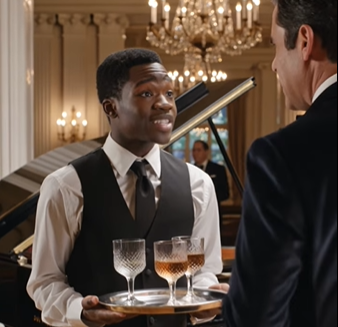
That was all anyone saw — a young man in a white server’s uniform, quiet and efficient, moving between guests who barely glanced at him. The evening was exactly what it was supposed to be: polished, expensive, and carefully controlled. Crystal glasses caught the chandelier light. Laughter floated through the room like something rehearsed. The host stood at the center of it all, silver-haired and impeccably dressed, the kind of man whose confidence had long since crossed the line into arrogance.
Nobody gave the young server a second thought.
That was their first mistake.
The second came when he sat down at the piano.
No one invited him. No one gave permission. He simply set down his tray, crossed the room, and lowered himself onto the bench as if he had been walking toward that moment his entire life. The guests exchanged glances — amused, confused, slightly offended on behalf of their host. A murmur moved through the crowd. Surely someone would stop this. Surely the evening would return to its proper shape.
Then his fingers touched the keys.
And everything changed.
The melody that filled the hall was not famous. It had never been published, never performed in any concert hall, never recorded for any audience outside that house. It was private music — the kind that belongs to a single soul, written in solitude and meant to stay there. It belonged to one woman, one heartbreaking stretch of time, and one locked music room upstairs that no one had entered since she vanished from this family’s life.
Yet here it was.
Every note was perfect. Every phrase breathed exactly the way it was meant to breathe. The young man played it not like someone who had studied it, but like someone who had grown up hearing it through the walls of whatever room he was allowed to sleep in.
The host set his glass down slowly.
He took one step toward the piano, then another. The arrogance drained from his face so quickly that he suddenly looked older than he had all evening — older and somehow smaller.
“Who taught you that?” he asked.
The pianist’s hands never broke rhythm.
The silence around that unanswered question was unbearable. Every guest in the room felt it pressing against their chest. Finally, without lifting his eyes from the keys, the young man replied.
“The woman you told everyone abandoned the family.”
No one moved.
Not politely still, not curiously still — still in the way a room goes quiet when money and reputation suddenly fail to protect a lie that has been carefully maintained for years. The kind of stillness that arrives when something private and shameful steps into the light without warning.
The host’s throat tightened. His jaw worked, but no sound came.
The pianist let the final phrase soften beneath his fingers, but he did not stop playing. His hands moved over the keys with a tenderness that felt like memory — like someone replaying the most important lesson they ever received, long after the teacher was gone.
“She never finished that piece,” the host said at last.
It was meant to sound dismissive. It came out desperate.
Only then did the pianist look up.
His eyes were calm. Not cold, not angry — just absolutely certain. And somehow that was worse than any outburst could have been.
“No,” he said quietly. “She didn’t.”
A pause that felt like a door swinging open.
“She ran out of time after you broke her right hand.”
Somewhere near the back of the hall, a woman set her champagne glass down on the floor because her fingers had simply stopped trusting themselves to hold it. Guests who had been whispering to each other went completely silent. Even the staff near the doors seemed to stop breathing.
The host stared at the young man as if the years between that night and this one had just come crashing down around his feet.
“That’s a lie,” he said.
But the words arrived too late. Too thin. Too frightened to carry any real conviction.
Because there is a difference between how innocent people deny something and how guilty ones do. Innocent people deny the act. Guilty people deny the story. They attack the telling of it because they cannot honestly attack the truth inside it.
The young man rose from the bench slowly, with the unhurried dignity of someone who has been patient for a very long time.
And now the room saw what had been visible all along, if anyone had thought to look.
The small musical-note tattoo on his wrist was not decoration. It matched — precisely, unmistakably — the opening bars of the unfinished melody handwritten in the framed portrait hanging above the fireplace. The portrait of the missing wife, painted beside the piano that no one else in this household had ever been permitted to touch.
He stood before the room in his server’s uniform, and he no longer looked like staff. He looked like something long overdue — like an inheritance arriving after years of being deliberately lost in the mail.
The host’s face had gone ash-pale.
The young man’s voice remained steady, almost gentle, when he finally said the one sentence that turned the entire hall cold.
“She didn’t leave you a son in secret.”
The older man stopped breathing.
“She left you a witness.”






