There was only a small silver clasp resting in the boy’s open palm.
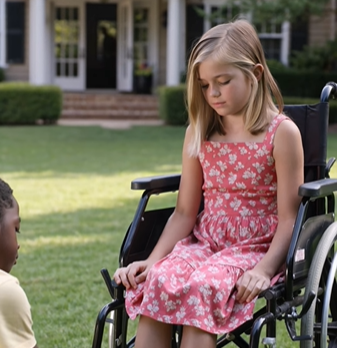
Small. Delicate. And achingly familiar — not because the girl had worn it recently, but because she had worn it the day everything in her life was turned upside down forever.
Her lips parted slowly, as if the words themselves were afraid to come out.
“That was mine,” she whispered.
The boy looked at her with eyes far too calm, far too knowing, for someone his age. “I know,” he said simply.
Behind them, her father was crossing the yard at a near run, footsteps tearing through the grass, his face carved with a kind of panic that only a parent carries — the kind that arrives too late and knows it. But in that moment, the two children held the center of something fragile and enormous, and nothing around them seemed to matter.
The girl dropped her gaze back to the clasp.
She noticed it right away — the way the hinge was bent, slightly, deliberately. And there, wrapped around the metal so delicately it was nearly invisible until the water washed away the grime, was a strand of thin transparent thread. The kind used to bind something tight without being seen. The kind that leaves no obvious mark. The kind that no child should ever recognize on sight.
Her breathing turned unsteady.
“I thought they cut it off at the hospital,” she said softly, almost to herself.
The boy shook his head. “No,” he said, his voice barely above a murmur. “It was twisted too tight.”
By then, her father had reached them, breathless and trembling. “What is going on?” he demanded, looking between the two children with wide, terrified eyes.
The girl looked up at him — but not with confusion this time. Not with the helpless blankness he had grown used to seeing on her face in the years since the accident. This time, she looked at him with memory. With the sharp, terrible clarity of something long buried finally breaking through the surface.
The boy rose slowly to his feet and held out the ankle clasp.
“I found it under the porch boards,” he said steadily. “The maid told me she hid it there after the fall. She said she hid it because no one would listen to her.”
The father went completely still.
Not because of the clasp. Because of three words.
After the fall.
That phrase had become the architecture of their entire household — a story everyone had quietly agreed to live inside. A fall. An injury. A child who never walked the same way again. A tragedy that made no one guilty and everyone sad and everything somehow manageable.
But the girl was crying now, and it wasn’t the soft, resigned crying of someone grieving old pain. It was something rawer than that. Something that had been sealed behind years of silence and was finally, finally, forcing its way out.
“It wasn’t the stairs,” she whispered.
The yard went quiet in a way that felt total.
The boy did not look at the father. He looked only at the girl, gentle and steady, as if he already knew what she needed to do next and was simply waiting beside her until she was ready.
“Tell him,” he said softly.
The girl’s hands tightened on the arms of her wheelchair. Her knuckles whitened. And then she spoke the sentence that broke the afternoon wide open — that cracked something in the air itself and let all the cold truth pour through.
“I stopped moving,” she said, her voice trembling but clear, “after she locked it on and told me not to scream.”
The father’s face went completely hollow. Empty in the way that only happens when a person realizes, in a single breath, that the life they understood was never real. He already knew exactly who she was referring to. That was the worst part of all. He didn’t have to ask. The name lived in him already, attached to memories of laughter and warmth and a future he had been building with his whole heart.
The boy placed the silver clasp carefully into the father’s open hand.
And only then did the father turn it over and notice what had been engraved on the inside of the metal, small and precise and deliberate.
A date.
Not the date of the accident. Not the date his daughter had lost the use of her legs. But the date of his engagement party — the celebration that had filled their home with flowers and champagne and the kind of joy that makes people believe they are finally safe.
That was the moment he understood that this had never simply been about cruelty or rage or one terrible night. This had been planned. Timed. Executed with a purpose that chilled him to the bone, because it meant someone had looked at his happiness and decided to dismantle it — not out of madness, but out of cold, calculated intention.
He stood there in the afternoon light holding the clasp, unable to speak, unable to move.
And his daughter, still crying, looked up at him with eyes full of something that broke his heart more than any of the rest of it — not anger, not blame, but a quiet, devastated love.
“I thought,” she whispered, “that if I told you, you’d still choose her anyway.”






