She had only meant to take a short walk.
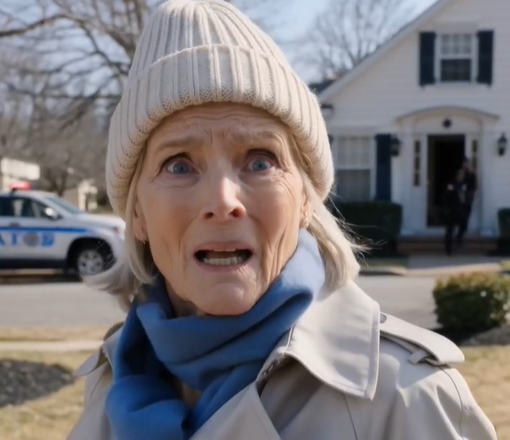
That was all. A quiet afternoon stroll through the neighborhood, the kind an older woman takes when the silence inside her own home becomes heavier than the air outside. She had passed that house dozens of times before without a second thought. It was just another house on just another street — faded paint, a sagging porch, curtains that never seemed to move.
But something made her slow down that day.
Maybe it was instinct. Maybe it was the kind of bone-deep awareness that only comes after a lifetime of paying attention to things most people choose to ignore. Whatever it was, she slowed. She looked up. And there, in the upstairs window, she saw something that made her stomach drop straight to the pavement.
A small hand pressed flat against the glass.
Not waving. Not playing. Pressing — the way someone presses when they are running out of time to be seen, when the window is the only thing standing between them and disappearing completely. The hand was there for only a second before it vanished. But a second was enough. Some images don’t need long to burn themselves into your memory forever.
She kept walking. Her feet carried her forward on autopilot, all the way to the corner, because stopping felt dangerous. But at the corner, she stopped anyway.
Not because she was brave. She would be the first to tell you she was not a brave woman. She stopped because she had lived long enough to understand the difference between the fear of danger and the weight of guilt — and standing there on that corner, she felt both pressing down on her at the same time.
She looked back carefully.
A police officer was standing on the porch of that house. He was watching the street with the kind of stillness that had nothing to do with keeping peace and everything to do with keeping watch. Not watching the house behind him. Not watching his partner. Watching the street. Watching to see who might cause a problem.
That was when the truth began to take shape in her mind.
He had never asked her name. He had never explained the screams she had heard earlier — the ones she had almost convinced herself were from a television left on too loud. He had only told her, in that flat and practiced voice, to keep moving. He had only offered her silence like a warning wrapped in a suggestion.
She moved behind the thick trunk of a leafless tree and pulled out her phone with hands she could not keep still. She did not call for help. Not yet. First, she needed to be sure. She needed to see.
She zoomed in on the upstairs window.
It was empty now. The small hand was gone. But on the inside of the glass, drawn slowly and carefully by a single finger into the fog of someone’s breath, were three unfinished letters:
H — E — L
There had not been enough time to finish the word.
She could not breathe. She could not move. She stood behind that tree and felt something ancient and certain rise up inside her chest — the knowledge that what was happening inside that house was real, and that she might be the only person on that street who understood it.
Then the front door opened again.
The second officer stepped out carrying a large black trash bag. He carried it too carefully. Too slowly. The way you carry something you do not want anyone to question. Behind him, just before the door swung shut, she caught a glimpse of the hallway inside — and there, lying on its side near the bottom of the staircase, was a single red shoe.
A woman’s shoe.
Just one.
The first officer turned his head toward the corner. Even from that distance, she felt his gaze find her. She watched his posture change — the casual ease of a man doing his job dissolving instantly into something sharper, something calculated. He said something quietly to his partner. The second officer looked up too.
Both of them now knew she had not walked away.
She stepped back slowly, phone still clutched in both hands, mind racing through every option she had and every risk attached to each one. Who do you call when the people who are supposed to protect you are the ones standing guard at the door?
And then her phone lit up.
An unknown number. No name. No greeting. No explanation.
Just a text message. Just six words.
Six words that confirmed everything she feared — and told her, without a single doubt, that someone inside that house was counting on her not to walk away.
She read the message twice. Then she looked back at the house one final time.
The curtain on the upstairs window moved.
Just slightly. Just enough.
She made her decision.






