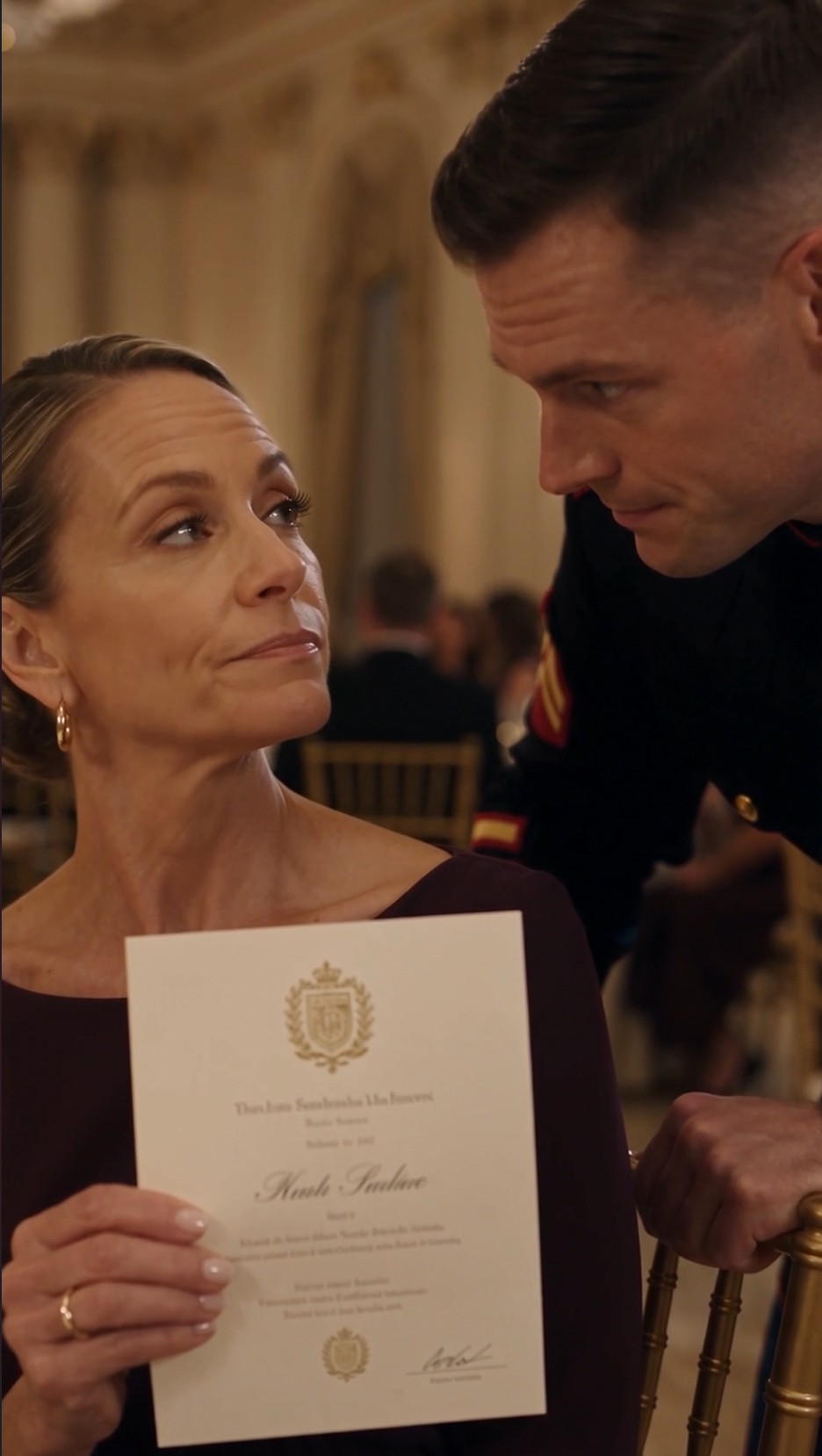
The billionaire’s hand trembled so violently that the paper nearly slipped from his fingers. He read it again, slower this time, as if his mind simply refused to accept what his eyes were seeing. The restaurant around him buzzed with the low hum of polite conversation, the soft clinking of crystal glasses, the murmur of wealth and comfort. None of that mattered anymore. Not after what was written on that page.
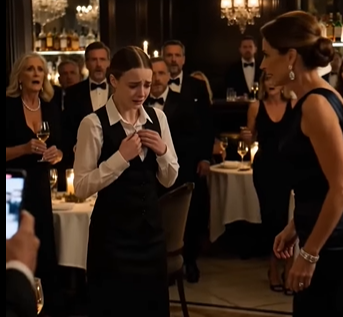
He stood completely still in the middle of the candlelit dining room, a man who had built empires from nothing, who had stared down boardrooms and markets and storms that would have broken lesser men. And yet, in that moment, he looked like someone had just reached into his chest and pulled out something vital.
The waitress who had handed him the note stood frozen a few feet away, her tray still balanced in one hand, tears streaming silently down her face. She had carried this secret to this restaurant, to this table, for reasons she was only beginning to understand herself.
“What does it say?” she whispered.
He didn’t answer her. He wasn’t looking at her yet.
He was looking at the elegant woman seated across the room — the one draped in diamonds, the one who had just moments ago humiliated this young waitress in front of the entire restaurant, throwing a scene that left staff and guests alike stunned into uncomfortable silence.
“No,” the woman said immediately, rising slightly from her chair. “Don’t look at me like that.”
His voice, when he finally spoke, was stripped of everything warm. “Sofia disappeared the night I was supposed to meet her at Gare de Lyon.”
The waitress stopped breathing.
“She told me,” he continued, each word measured and deliberate, “that only three people knew about that meeting.”
The room seemed to contract around them, as if the walls themselves were leaning in to listen.
The woman in diamonds shook her head too quickly, her composure fraying at the edges. “You cannot seriously believe this girl over me—”
But the waitress spoke softly, almost to herself. “My mother told me. She said a woman wearing diamonds came before midnight that night.” Her voice was barely above a whisper, yet the room heard every word. “She said the woman told her that you had changed your mind. That you never truly loved her. And that if she stayed… she and the child would be destroyed.”
The color drained from the wealthy woman’s face.
Around them, dinner guests quietly lifted their phones. No one pretended not to watch.
The billionaire looked back down at the note. There was one final line at the bottom, written in hurried, uneven handwriting — the kind a person writes when they are running out of time, or running out of hope:
If our daughter survives, she will have my eyes and your silence.
His breath caught in his throat.
Slowly, as if the movement cost him something enormous, he lifted his eyes to the young waitress standing before him.
Her tears.
Her eyes.
The way she held her chin up even when she was clearly terrified.
It hit him like a physical force. Those were Sofia’s eyes. That was Sofia’s expression — the one she wore whenever the world was falling apart around her and she was determined not to let anyone see it. He had loved that expression. He had been afraid he would never see it again.
The waitress looked back at him with a question she already seemed to know the answer to — and was almost too frightened to hear confirmed.
“My mother passed away last winter,” she said quietly, steadying herself. “Before she died, she made me promise to come to this restaurant on this exact date… and to wear the pendant where you could see it.”
He stepped closer, unable to look away from her face.
The woman in diamonds made one last attempt. “She’s lying. Sofia left because she was ashamed. She ran away.”
The waitress turned to face her, trembling but standing firm. “Then why did my mother write your initials on the back of the photograph?”
The entire room went still.
He flipped the photograph over.
There, faded but unmistakable, were two letters etched in soft pencil on the back of the image. The woman’s initials. Undeniable. The kind of evidence a desperate mother leaves behind because she knows she may not live long enough to speak the truth herself.
His expression changed completely. Not grief. Not confusion. Something harder, and far more certain.
Recognition.
He looked at the crying young woman before him — this girl who had grown up without a father, who had waited tables to survive, who had worn a pendant into a room full of people who never imagined she belonged there.
Then he looked back at the woman in diamonds — at the carefully constructed mask that was finally, irrevocably cracking.
And in front of every witness in that candlelit room, he said in a voice low and unwavering:
“You didn’t throw that tray because you thought she was just a servant.”
He held the woman’s gaze without flinching.
“You threw it because the moment you saw her pendant… you knew exactly whose daughter she was.”
No one moved. No one spoke. The truth had finally arrived — late, painful, and impossible to take back. And for the first time in years, the silence in that room wasn’t the silence of comfort or wealth or polished social grace.
It was the silence of a secret that had finally run out of places to hide.