Nobody moved.
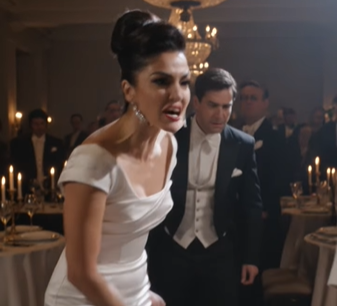
Not the guests seated at their polished tables. Not the servers frozen mid-step with trays in hand. Not even the wealthy woman who had just raised her hand and slapped a young waitress across the face — right there, in front of an entire room full of people who suddenly forgot how to breathe.
The husband stood motionless, his eyes locked on the girl’s face as if he were seeing a ghost step out of the soft glow of candlelight. Something in him had shifted the moment she walked closer. Something old and buried and painful.
His voice came out rough, barely above a whisper.
“What was your mother’s name?”
The girl steadied herself. Her cheek was still red. Her eyes were glassy with tears she refused to let fall. She swallowed hard before she answered.
“Isabella.”
A stunned murmur moved through the dining room like a wave. Spoons clinked against china. A chair scraped the floor. Someone near the window drew a sharp breath.
The wealthy wife covered her mouth with one perfectly manicured hand.
The elderly pianist at the corner of the room quietly closed his eyes.
Because Isabella was not simply the name of someone who had passed away long ago. She was something far more complicated than that. She was the family’s greatest shame — hidden beneath layers of wealth, deliberate silence, and rooms that had been locked for decades. A story too dangerous to tell and too painful to fully bury.
The waitress wiped at her tears with the back of her hand, but her fingers were still trembling when she reached into her apron pocket and withdrew a small, worn photograph.
“My foster mother worked in your family’s private wing,” she whispered, her voice barely holding together. “Before she passed, she gave me this photo. She told me that if your family ever called me shameless — if they ever treated me like I was nothing — I should bring them the face they paid to erase.”
The husband took the photograph. He turned it over slowly, as if some part of him already knew what he would find on the back.
The handwriting was faded. But he recognized it instantly.
It was his mother’s handwriting.
He read the words aloud, though he never meant to.
Take the child tonight. The estate cannot survive two female heirs. Change her name. Burn the record.
The room seemed to tilt on its axis.
His wife stared at him in undisguised horror.
From the corner, the old pianist spoke quietly, his voice heavy with something that had clearly stayed with him for years.
“I remember that night,” he said. “There was smoke coming from the upper hall. Isabella was screaming for her baby. Your mother came downstairs carrying a blanket — but there was no child inside it.”
A collective gasp rippled through every table in the room.
The waitress’s voice cracked entirely.
“My foster mother said Isabella survived long enough to hand me over. She begged her to run — to get me out before your mother’s people came back.”
The husband looked like the ground beneath his feet had simply disappeared.
His family had told him the infant did not survive.
That Isabella herself had passed away not long after.
That there was nothing left — no one left — to save or to grieve.
But the truth was standing right in front of him. In a waitress uniform. Crying beneath the chandeliers of a restaurant where she had just been publicly humiliated by people who had no idea who she actually was.
Then she reached into her apron one more time.
She placed a small object on the table.
A tiny silver heir tag — old, scratched at the edges, dulled by decades. But the family crest was still visible. And beneath it, a single word, carefully engraved.
Claire.
The husband nearly dropped the photograph.
The pianist whispered from his bench, “That was the infant heiress tag…”
The waitress nodded through her tears.
“That was my name before your mother paid someone to erase it.”
His wife took a slow step backward, as if every carefully constructed lie that had held the family together was suddenly becoming visible all at once — and she no longer wanted to be standing too close when it all came down.
Then the restaurant doors opened.
An older woman stepped inside.
His mother.
She saw the photograph in his hand. She saw the silver tag on the table. She saw the young woman’s face — and she stopped where she stood, completely still.
The pianist looked at her with quiet, unmistakable disgust.
“She lived,” he whispered. “The child lived.”
The older woman’s lips parted. But nothing came out.
The husband looked at her the way a person looks at someone they suddenly do not recognize at all.
“You left a living child behind?” he whispered.
When her voice finally returned, it was thin and fractured.
“I was saving this family.”
The waitress let her tears fall freely now.
“No,” she said. “You were saving the money.”
No one in that restaurant could speak after those words landed.
Not after learning about the destroyed record. Not after the truth about the missing heiress. Not after realizing that the young woman who had been slapped and shamed in public — treated as though she were invisible, as though she had no right to even be in the room — was never chasing wealth or status or attention.
She was the daughter they had deliberately erased so the inheritance would pass cleanly to someone else.
And there, beneath the crystal chandeliers, with the whole room as her witness, the truth finally completed itself.
The girl they had humiliated as if she were nothing…
had walked back in carrying the photograph, the name, and the undeniable face of the heiress her own family had been willing to burn out of history.
Some things buried deep enough eventually find their way back to the surface — not loudly, not with warning, but quietly, painfully, and with devastating precision. And when they do, no amount of wealth, influence, or carefully maintained silence is enough to keep them underground any longer.