She walked in quietly, the kind of quiet that comes from years of learning not to take up too much space.
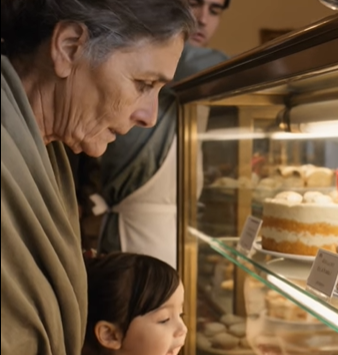
The old woman held the little girl’s hand like it was the only thing keeping her standing. Her coat was worn at the elbows. Her shoes had seen too many winters. But her chin was up, and her eyes were soft — the way eyes get when a person has cried so much that sadness becomes a kind of dignity.
The little girl pressed her nose against the glass display case, her breath fogging the surface as she stared at a pink cake decorated with white roses. It was the most beautiful thing she had ever seen in her short life.
“Grandma,” she whispered, “is that the kind of cake Mama used to love?”
The old woman squeezed her hand tighter and didn’t answer right away.
An employee noticed them first. He looked them up and down the way some people do when they’ve already decided someone doesn’t belong. His voice came out flat and cold.
“Can I help you, or are you just here to look?”
The little girl shrank back. The grandmother straightened.
“It’s her birthday today,” the old woman said gently. “I just wanted her to see something pretty.”
The employee’s expression didn’t soften. “This isn’t a museum. If you’re not buying, I’m going to have to ask you to move along. You’re slowing down the line.”
A few customers glanced over. Nobody said anything. The silence was the kind that presses down on your chest.
The old woman nodded slowly, reached into her coat pocket, and pulled out a small change purse. She counted out what she had, coin by coin, right there on the counter.
It wasn’t enough. Not even close.
She had known it wouldn’t be. But she’d wanted her granddaughter to at least see the cake.
She was just about to apologize and leave when a voice came from the back of the shop.
“Wait.”
The manager had been watching from the doorway of his office. He was a man somewhere in his forties, with flour dust on his sleeves and the look of someone who had grown up inside a bakery. He walked out slowly, his eyes fixed on the old woman’s face.
Something about her stopped him cold.
He set down the cake box he was carrying. His voice dropped.
“My mother searched for someone for years,” he said carefully. “A woman who used to run a bakery on the east side of town. She always said that woman didn’t leave the night of the fire by choice.”
The old woman went completely still.
Her eyes, already glistening, spilled over.
“I didn’t,” she whispered.
The entire bakery went quiet. Even the employee who had been so dismissive didn’t make a sound.
The manager looked at the child, then back at the grandmother. He asked gently, “Who is she?”
The old woman tried to answer. Her voice gave out before she could.
But the little girl looked up with wide, trusting eyes and said simply, “I’m Anna. Grandma says my mama loved birthday cakes.”
That single sentence broke something open in the room.
The old woman covered her mouth, but the sob came through anyway. Her whole body shook with the weight of years she had carried without setting down.
The manager’s face shifted — something between recognition and heartbreak crossing it slowly.
“Your mother,” he said quietly, “was her daughter?”
The grandmother nodded, tears streaming freely now.
“She was with me the night of the fire,” she said. “We were closing the old bakery when the oven in the back exploded. I got out.” Her voice cracked completely. “She didn’t.”
A ripple of sharp, quiet gasps moved through the room.
Little Anna looked up at her grandmother, confused and frightened by all the emotion swirling around her. The old woman dropped to her knees right there on the bakery floor — her old joints protesting — and pulled the child close.
“I told you she went to heaven, baby,” she whispered through tears. “I told you she loved cakes. I just couldn’t bear to tell you she died trying to save me.”
Several customers were openly weeping now, strangers dabbing at their eyes, pretending not to.
The manager stood still, visibly shaken. His mother had told him this story more times than he could count — about the woman who had taught her every recipe she knew, about the daughter who perished in the flames, about how a bakery that had once been the heart of a neighborhood had vanished overnight in smoke and grief.
And now here she was. The woman from the story. Standing in his shop in a worn coat, counting pennies, just trying to give her granddaughter one small, beautiful moment on her birthday.
He turned toward the employee. His jaw was set.
“That woman,” he said evenly, “gave this city half the recipes we still sell today.”
The employee’s lips trembled. He didn’t speak.
The manager turned to the display case, lifted out the pink cake with white roses — the exact one Anna had been staring at — and began adding candles. Then he placed a box of pastries beside it. Then a box of warm bread, the kind that fills a room with the smell of something safe.
He carried everything to the counter and crouched down in front of Anna until they were eye to eye.
His voice broke as he smiled.
“Princesses absolutely get cakes like this on their birthdays,” he said. “And so do the bravest little girls.”
Anna’s eyes went wide. She stared at the cake like she was afraid it might disappear.
Then the manager looked up at the grandmother and said softly, “My mother told us that if we ever found you, we were to thank you properly.”
He stepped into his office and returned carrying an old framed photograph. In it stood a younger version of the woman before him — flour on her apron, laughing — beside a woman who must have been his mother. And beside them both, a teenage girl, grinning and holding a tray stacked high with birthday cakes.
Anna stepped forward. Her small fingers touched the glass.
“That’s my mama,” she breathed.
The grandmother fell apart completely. There are no other words for it. She wept the kind of tears that have been held back for years — the kind that carry names and faces and a fire that took everything.
The bakery was silent except for the sound of her crying and the quiet of everyone around her, bearing witness.
And what had begun as a humiliation — an old woman being hurried out the door with her coins — ended with a birthday cake, a photograph, a truth finally spoken out loud, and a lost piece of family found again, in the most unexpected place, surrounded by strangers who would remember it for the rest of their lives.