The golden lights still gleamed across the diamond cases. Reflections trembled across the polished black marble floor. Elegant customers stood frozen somewhere between spectacle and disbelief, their phones half-lowered, no longer certain whether they were witnesses, intruders, or quiet participants in something far older than tonight’s accusation.
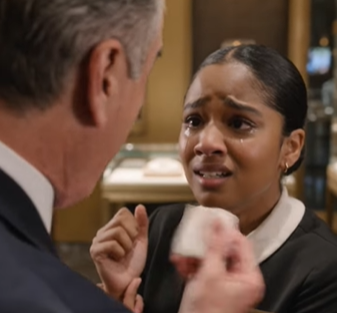
Moments earlier, the scene had looked painfully simple. A wealthy woman shouting. A young sales assistant in tears. A missing bracelet. A public humiliation moving so fast that the room mistook cruelty for certainty. But the paper now resting in the jeweler’s aged hands had changed the shape of everything. This was no longer a theft accusation. It looked like the reopening of a wound that someone powerful had spent two decades trying to keep sealed.
The young assistant stood exactly where she had been dragged, her breathing still uneven, one hand pressed against her torn pocket. Tears continued sliding down her face, but the expression behind them had shifted. She was still frightened, yes, but no longer only frightened. The fear had deepened into something heavier — the awful recognition of someone watching a family warning come true in real time.
The note had lived folded inside her mother’s wallet for years, then passed quietly into hers with instructions too strange for a child to fully understand. Never show the name unless one of them accuses you first. As a young girl, she had thought it sounded like bitterness, or grief, or the kind of final sentence adults leave behind when pain has outlived explanation. Now, standing under luxury lighting in front of strangers who had just watched her humiliated and searched, she finally understood what her mother had truly meant. The accusation was not an accident. It was the key that made the hidden name dangerous.
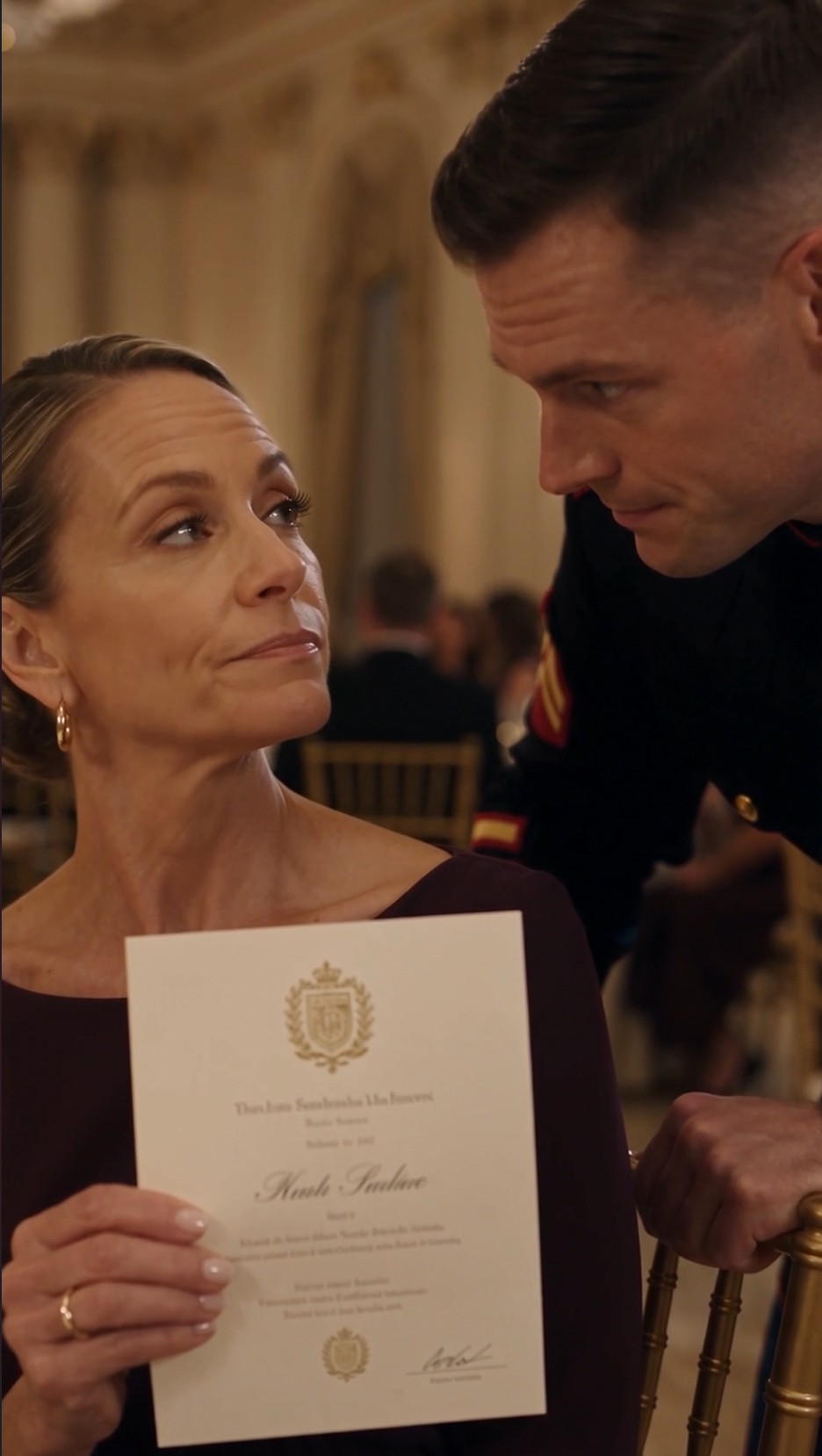
The older jeweler unfolded the paper carefully and explained, with visible difficulty, that the document was not an ordinary receipt. It was an internal archival record from a bridal commission completed two decades earlier — an extraordinary diamond set designed for a private wedding that had been spoken of in Milan’s finest social circles for only a few weeks before being quietly erased from conversation. The set had included a bracelet, a necklace, earrings, and a tiara, all prepared for a bride whose surname had once appeared in the boutique’s highest-tier records and then vanished as though it had never existed at all. The removal, he said, had not happened through routine archival updates. It had been ordered. Quietly. Personally. Completely.
A murmur moved through the boutique like a slow tide.
The woman in the black designer dress had gone pale enough that even the warm golden lighting could not soften what was now visible on her face.
The jeweler looked at her steadily and said the name on the note had belonged to the bride who never officially wore the collection.
That sentence changed the entire room.
Because now this was no longer about a missing bracelet or stolen luxury merchandise. It was about a wedding that never happened, a family name intentionally erased from record, and a crying young woman standing in the center of the boutique with that same surname hidden in her torn pocket. The customers could feel the pattern forming before they fully understood the details. The violent accusation had erupted too fast. The humiliation had escalated too cleanly. The wealthy woman had not simply been angry. She had panicked. And panic in rooms like that rarely comes from loss alone. It comes from recognition.
The assistant swallowed hard and said her mother had worked as a seamstress by the time she was old enough to remember her clearly. She was quiet, often unwell, and strangely fearful around anything connected to high-end weddings. She never entered jewelry stores. She never spoke the family surname aloud in public places. Yet every year, on one particular date, she would take out that same folded note, stare at it for a long time, and lock it away again without a word. When she became ill enough to understand she would not recover, she gave the note to her daughter and said only this: If they ever accuse you the way they accused me, make them say the name themselves first. At the time, those words had felt cruelly incomplete. Standing here now, they sounded exact.
The wealthy woman tried to interrupt, but the jeweler silenced her with a look that carried the weight of twenty years.
He said he remembered the bride. Not from gossip. Not from magazine photographs. From fittings. She had come into the boutique three times before the wedding date, carrying herself with a quiet softness that made everyone lower their voices around her. She was not loud, not demanding. She arrived like someone stepping carefully into a future she wanted to trust but did not entirely trust. On the final fitting, she asked one unusual question — whether collection records could ever be removed from a family archive if a marriage did not take place. He had laughed gently, assuming it was nerves. She had not laughed back. One week later, the bridal set was locked away, the wedding was quietly canceled, and all staff were personally instructed never to repeat the surname again.
The assistant’s lips parted slowly. “My mother was supposed to be that bride?” she asked.
The old man did not answer immediately. That silence was answer enough.
The jeweler then revealed the detail that turned the atmosphere from scandal to something far more unsettling. The woman in black was not a loosely connected client with passing ties to the old commission. She was the daughter of the man who had originally paid for the entire collection. Her father had commissioned the set. Her mother, however, was not the vanished bride. Her mother had married him less than a year after the wedding was canceled.
That truth landed the way glass breaks in an empty room — quiet, total, and impossible to undo.
The assistant stared at the woman in black. The woman in black did not deny it. That silence exposed her far more completely than any spoken confession could have done. The room could now see clearly what had truly happened. The bracelet accusation had not erupted because a young employee looked guilty. It had erupted because a wealthy woman recognized, in one brutal instant, a girl with the wrong face and a hidden document standing too close to a piece of jewelry tied to the part of her family’s history that was never supposed to resurface.
The assistant finally looked up, her voice quiet enough that every person in the room leaned slightly forward to hear.
“You didn’t accuse me because of the bracelet,” she said.
Her eyes moved once to the note in the jeweler’s hand.
“You accused me because my mother’s name survived longer than your family wanted it to.”