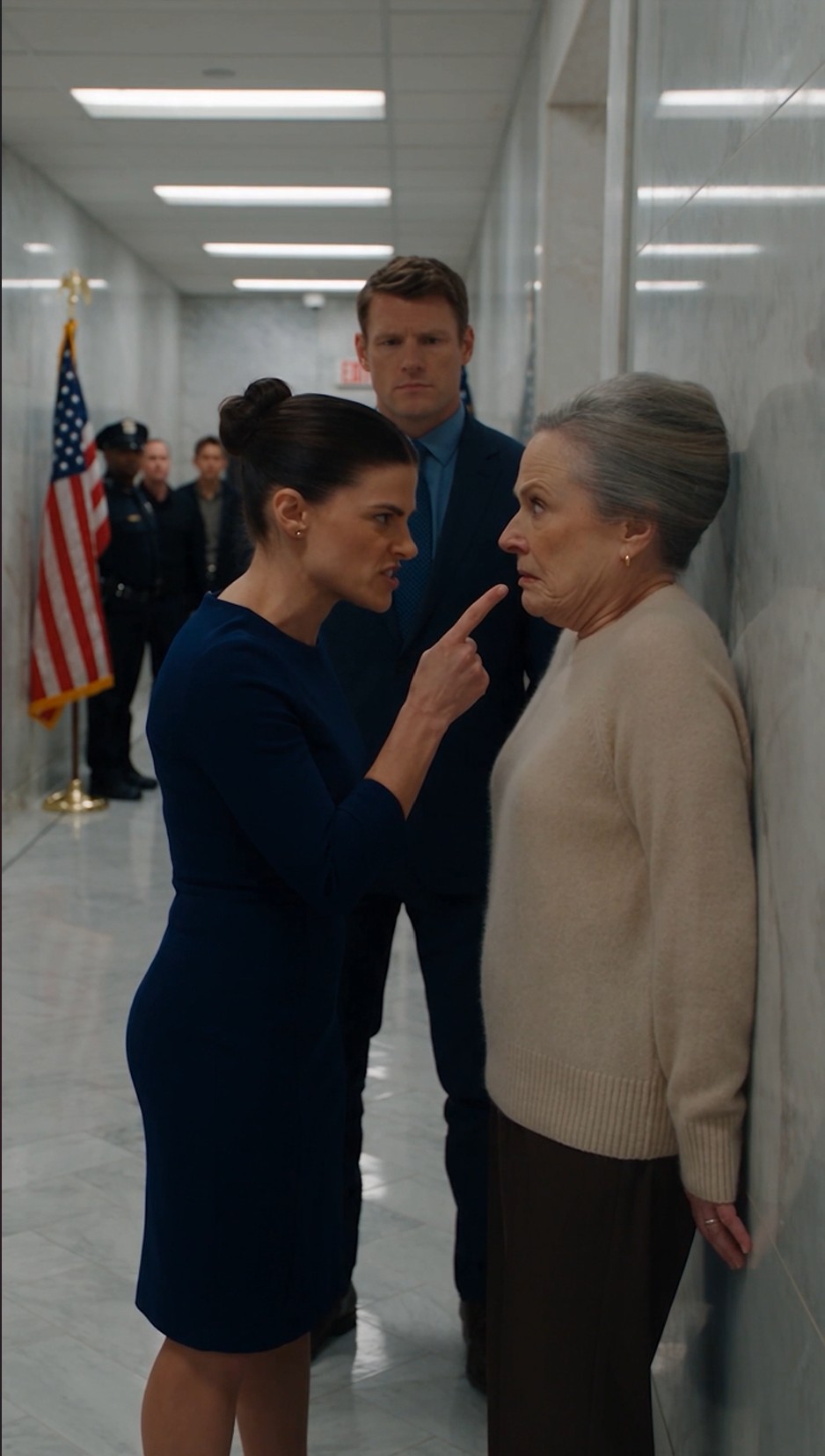
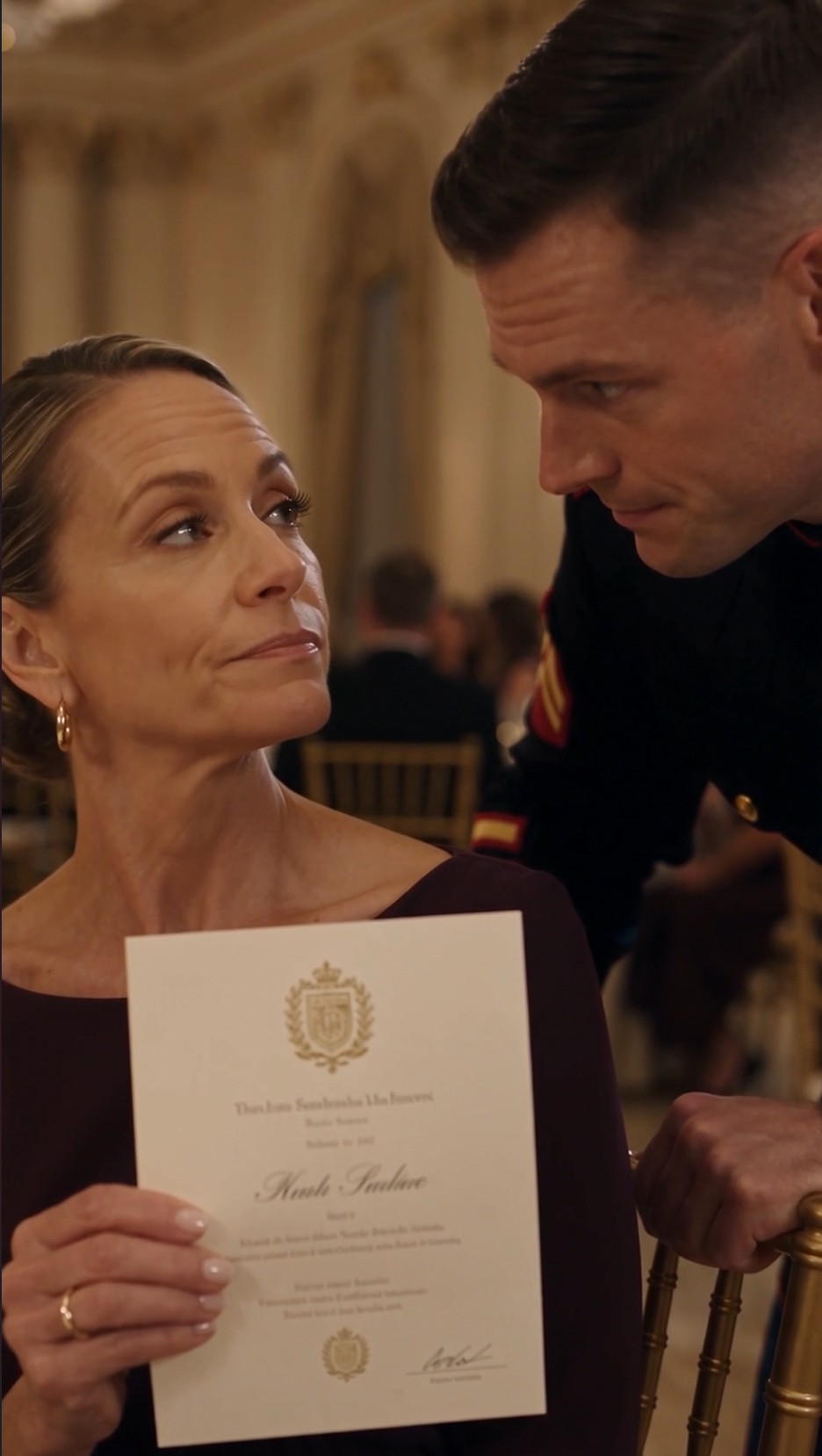
The chandeliers still shimmered above a room that had, just moments before, been perfectly willing to believe the easiest story. Candlelight trembled over untouched champagne glasses. Waiters stood frozen beside silver trays. Guests who had raised their phones in anticipation of gossip no longer looked amused. The mood had shifted too quickly for entertainment. Because what entered the room next was not another accusation — it was proof. And proof had a way of turning everything upside down.

Only moments earlier, the room had been ready to accept the simplest version of events: a young waitress, a missing necklace, and a wealthy woman whose volume alone made accusation sound like verdict. That is often how it works in spaces like these. The powerful speak loudly, and the powerless absorb the blow. But this particular evening had not read the script it was handed.
The young waitress stood slightly bent, one hand pressed against the nearest table, trying to keep herself upright. Tears still ran down her face. Strands of hair had come loose around her shoulders from being yanked — yanked in front of strangers, in front of cameras, in front of people who watched without stepping forward. Her apron pocket hung half-torn. The humiliation had wrapped itself around her like something physical. But underneath the fear in her eyes, something else was beginning to surface — first confusion, then a slow and devastating realization.
If the necklace had been found inside the wealthy woman’s own handbag, then this had never been about finding the truth. It had been a performance from the very beginning.
The woman in silver tried to speak. Her voice came out, but it no longer commanded the room the way it had before.
“That’s absurd,” she said. “Someone must have put it there.”
The billionaire looked at her without blinking.
“Someone did,” he replied. “The question is whether you want me to explain how.”
That line settled over the tables like smoke from a fire no one had noticed until it was already burning.
He did not raise his voice. Men with real authority rarely need to. He explained calmly that the necklace had been discovered by security at the entrance — not by accident, but because her own handbag had triggered an alert. The alert came after she had demanded, loudly and repeatedly, that no one be allowed to leave until the so-called thief was identified. She had created the urgency herself. She had manufactured the chaos. She had pushed the staff into panic and the young waitress into public shame. And in doing so, she had made the one mistake that arrogance almost always makes — she believed the scene would obey her before the facts had a chance to arrive.
A murmur moved through the dining room like a current.
The waitress slowly lifted her eyes.
He continued. The necklace was not buried deep in the bag or hidden with any real effort. It was found inside the inner silk compartment, tucked beneath a compact and a folded evening glove. Not dropped in accidentally. Not brushed in without awareness. Placed deliberately. And when security reported this upstairs, he had come down himself — only to walk into a public humiliation already well underway.
That, more than anything else, seemed to be what genuinely disturbed him.
Not the lie. Not the staged theft. But the choice of target.
The waitress had been selected with a brutal kind of simplicity. She was young. She was working. She had no power in that room and no voice loud enough to fight back quickly. She was, in other words, exactly the kind of person that certain people in certain rooms expect to crumble before anyone thinks to ask harder questions.
The woman in silver’s composure continued to drain with each sentence, but he was not finished. The dining hall footage, he said, had already been reviewed. It showed the woman removing the necklace herself during a tense exchange at the table, letting it fall briefly into her own lap, and then slipping it into her handbag while those around her were momentarily distracted. Moments later, she had stood and begun shouting. There had been no theft. No missing jewel. No mystery to unravel. Only an accusation launched before her own dinner companions could expose what had actually been happening at that table.
Now the room leaned in with a different kind of hunger.
Because the scandal had shifted entirely. It was no longer about a necklace.
The billionaire glanced toward the table where the woman had been seated. Sitting there, completely still, was a man whose face had gone rigid and pale. Even those who knew nothing of the evening’s backstory could see from his expression that he was part of the real story. And indeed he was. The dinner, the billionaire said with quiet precision, had never been a celebration. It had been a confrontation. The woman in silver had arrived that evening expecting a public proposal before dessert — and instead had discovered that the man she came with had spent the last month building something with someone else.
A silence deeper than shock settled over the room.
Then came the final detail.
The other woman was not hidden in some distant city or anonymous situation. She worked in the restaurant.
Every eye moved to the waitress.
She stopped breathing for a moment.
The wealthy woman looked at her too, and suddenly the entire chain of events became visible before a single additional word was spoken. The accusation had come so immediately. The pocket had been torn open before anyone searched anywhere else. This was never about recovering jewelry. It was about making sure the young woman in the apron was disgraced before anyone in the room understood why the evening had already fallen apart beyond repair.
“I didn’t even know he was with anyone,” the waitress whispered.
And that made it worse for everyone watching.
Cruelty had outrun certainty entirely. The wealthy woman had not paused long enough to know whether the waitress was guilty of anything at all. She had simply needed someone smaller to absorb public punishment before the truth could humiliate her first.
Security had found one final detail inside the handbag — a small note card from the table florist, with two words written in the woman’s own handwriting on the back: blame her. Whether it had been written in rage or cold calculation no longer mattered. The accusation had never been impulsive. It had direction and a name.
The waitress looked down at a small photograph that had fallen from her torn pocket — a picture of an older woman and a child, now creased from hitting the marble floor. Her private life, tender and quiet, had been ripped open in public because someone wealthier needed a shield. That understanding changed something in her face. She was still crying. But the helplessness was gone.
Something steadier had entered her posture.
The billionaire stepped aside slightly, as though he understood the next moment did not belong to him.
The young waitress, still shaking, still tear-streaked, lifted her eyes to the woman who had dragged her forward and called her a thief beneath the chandeliers.
And in a voice so soft it forced the entire room to lean toward her, she said:
“You never wanted your necklace back.”
Her throat tightened, but she held on.
“You just needed someone smaller than you to destroy — before the truth reached your table.”