There are moments in life when the ground shifts beneath your feet without warning. One minute you’re standing at a fairground parking lot at dusk, the summer air still warm and sweet with cotton candy, and the next minute a child is holding out a small pink wristband, and the entire world as you knew it begins to quietly come apart at the seams.
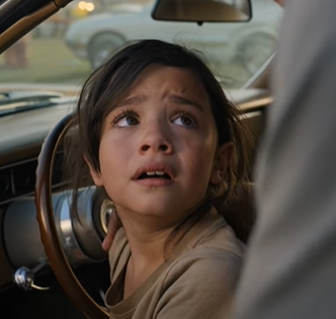
That was exactly the kind of moment this father found himself in.
The fair glowed behind them like nothing bad had ever happened there. Laughter drifted through the cooling evening air. Somewhere in the distance, a game buzzer sounded. Children squealed with delight. Families walked by carrying stuffed animals and funnel cakes, completely unaware that right here, at this car, in this parking lot, one family’s story was being rewritten in real time.
The little girl held out the wristband carefully, the way children do when they sense something is important but don’t quite understand why.
He took it from her.
It was pink. Worn. The kind they put on kids at events so they don’t get lost. And written in black marker on the inside was a name.
Mila.
He turned it over in his hands. Too small to belong to a teenager. Too personal to belong to nobody. Too specific to be a coincidence.
“Where did you find this?” he asked, keeping his voice steady for her sake.
She pointed toward the far edge of the parking lot, where the light faded and the noise of the fair became something muffled and distant.
“Near Mom’s car,” she said softly. “By the blue fence.”
His expression shifted.
Not because of the name on the wristband. Not yet.
Because he knew exactly what the blue fence area meant. That section of the lot wasn’t for guests. It was where staff parked. Private. Out of the way. The kind of place you went when you didn’t want to be easily seen.
The little girl kept talking.
Children do that. Once they’ve made the decision to tell you the truth, they give you all of it, because somewhere deep down they understand that adults sometimes need the whole picture before they can help.
“I thought it was mine at first,” she whispered, her voice dropping the way children’s voices do when they’re carrying something too heavy for small shoulders. “But then I heard Mom.”
He went very still. “What did she say?”
The girl looked down at her shoes.
“She said, ‘If she keeps asking for her dad, put the music on louder.'”
The silence that followed was the kind that sits in your chest.
He stared at the wristband. A moment ago it had been strange. Now it felt like something else entirely. It felt like the first piece of a puzzle he hadn’t known he was supposed to be solving.
His daughter’s tears came harder now, spilling over in the quiet way that children cry when they’ve been holding something in for too long.
“I didn’t know if I should tell you,” she said. “But then I saw Mom crying.”
That landed differently than everything else.
Because there’s a difference between the way someone cries when they’ve done something wrong and gotten away with it, and the way someone cries when they’re trapped and they know it. Guilty people panic. Trapped people grieve. And the woman he had built a life with was somewhere in that parking lot, near a blue fence, crying the second kind of tears.
He looked toward the fairground. Then back at his daughter.
“Was she alone?”
The girl shook her head slowly.
“There was a man,” she whispered. “And a little girl with pink shoes.”
The world stopped for just a moment.
Pink shoes.
Suddenly the wristband in his hand didn’t feel like evidence of something suspicious between adults. It felt like something far more serious. It felt like a child who had been brought somewhere she shouldn’t be, by people who were hoping no one would notice.
He looked down at the name again.
Mila.
A little girl asking for her dad, and someone turning up the music so she would stop.
Every instinct in his body shifted from hurt to something more urgent, more protective, the way a person changes when the stakes stop being about them and become about someone who can’t protect themselves.
And then his daughter said the words that made the entire evening go cold.
“Mom told the man, ‘If he sees her first, everything is over.'”
He didn’t move for a long moment.
He just stood there in the fading summer light, holding a pink wristband with someone else’s child’s name on it, while the sounds of the fair carried on around them like nothing in the world had changed at all.
But everything had changed.
Because now the question wasn’t about trust, or loyalty, or what had been happening behind his back.
The question was about a little girl named Mila, with pink shoes, somewhere in that parking lot, crying for a father who didn’t know yet that she needed him to find her.
And he had just found out first.