The rain had been falling for over an hour, the kind of cold, steady rain that empties city streets and makes strangers walk faster, heads down, eyes forward. Nobody stops. Nobody looks up. That’s just how it goes.
But he stopped.
He almost didn’t. He was late, his coat was soaked through at the shoulders, and his mind was somewhere else entirely — the way it always was these days, drifting back to a life he used to have and a family he lost. He had learned, over the years, to keep moving. Standing still hurt too much.
Then he saw her.
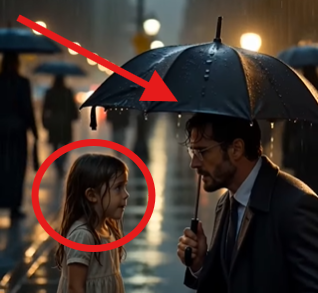
She was small — maybe six, maybe seven — standing at the edge of the sidewalk beneath an awning that barely kept her dry. In her hands she held a bouquet of flowers, slightly wilted from the damp, and she was looking at every person who passed with the kind of hopeful, patient expression that only children can manage. The kind that hasn’t yet learned disappointment.
He slowed his pace.
She was soaked. Her shoes were dark with water, and her hair was plastered against her forehead. But she wasn’t crying. She was just standing there, steady as she could manage, holding her flowers like they were the most important thing in the world.
He walked over and crouched down to her level.
“Hey,” he said gently. “You okay?”
She nodded quickly, the way kids do when they don’t want to admit they’re scared. “I’m selling flowers,” she said. “For my mom.”
He reached into his pocket and handed her some money — more than the flowers were worth, but that didn’t matter. She handed him the bouquet with both hands, very carefully, the way you hand something precious to someone you trust.
That’s when he saw it.
On her small wrist, half-hidden beneath her sleeve, was a bracelet. Delicate. Silver. A single charm shaped like a crescent moon.
His breath stopped.
He had held that bracelet before. He had paid for it himself, standing in a little jewelry shop on a Tuesday morning, heart pounding with a kind of joy he didn’t know what to do with. It was the day his daughter was born.
“Where did you get that?” he asked, his voice barely above a whisper.
She looked down at her wrist. “My mom gave it to me,” she said simply. “She said someone who loved us very much gave it to her a long time ago.”
His hands were trembling now.
“What’s your name?” he asked.
She looked up at him with wide, steady eyes. “Lena.”
The name hit him like a wave crashing through a wall he’d spent years building.
He closed his eyes. When he opened them again, they were full of tears he was desperately trying to hold back.
“Lena,” he repeated, barely breathing. “That’s… that’s not possible.”
She looked frightened then, her little face tightening with worry. “Did I say something wrong?”
He shook his head quickly and pressed his hand to the back of his neck, trying to hold himself together. “No, sweetheart. Not at all.”
He looked at the bracelet again. He looked at her face — the shape of her eyes, the way her lower lip trembled just slightly, the way she was trying so hard to be brave even while standing there cold and soaked in the rain.
And in that moment, he knew.
His knees nearly gave way beneath him.
“That bracelet,” he said softly, his voice cracking at the edges, “I bought it the day my daughter was born.”
The little girl blinked slowly. Then she looked at him the way children look at something they don’t quite understand but feel deeply in their chest.
He let out a long, broken breath. “I loved her mother,” he whispered. “I never stopped.”
Her lips trembled. “Then why didn’t you come back?”
The question tore straight through him.
He swallowed hard past the tightness in his throat. “I tried,” he said. “I looked for you both. But she was gone. I couldn’t find her. I couldn’t find you.” His eyes filled again, and this time he didn’t fight it. “I thought I had lost you both forever.”
She stared at him through the rain, completely still, water dripping quietly from the edge of the awning between them.
Then, very quietly, in a voice so small it nearly disappeared into the sound of the rain, she asked the question that broke him completely open.
“Are you my dad?”
He looked at her like the whole world had narrowed down to just her face.
“Yes,” he said, his voice shaking so hard the word barely made it out. “I’m your dad.”
For one suspended, breathless second, neither of them moved.
Then the bouquet slipped from her fingers and landed softly on the wet pavement, and she stepped forward and threw herself into his arms with everything she had.
He caught her instantly, pulling her against his chest, wrapping his arms around her small shaking body, crying quietly into her wet hair while she gripped the front of his coat with tiny trembling hands like she was afraid that if she let go, he would disappear again.
They stayed like that for a long moment, the rain falling around them, the rest of the world rushing past without noticing.
Then she whispered against him, so quietly he almost missed it. “She’s really sick. Mom is really sick.”
He pulled back just far enough to look at her face — her red-rimmed eyes, her tear-streaked cheeks, the frightened love behind every feature.
“Take me to her,” he said.
She nodded, wiping her face with the back of her hand. And still holding his hand as tightly as she could, she turned and led him through the rain.
Some reunions don’t arrive with music or fanfare. They arrive soaking wet, on a quiet street corner, in the hands of a little girl who never stopped believing someone would come back. And sometimes, against every odd, someone does.