She walked into the jewelry store slowly, leaning on a worn wooden cane, her coat slightly frayed at the edges, her shoes scuffed from years of wear. Nobody rushed to greet her. Nobody smiled. The saleswoman behind the counter glanced up once, assessed her in a single breath, and looked away.
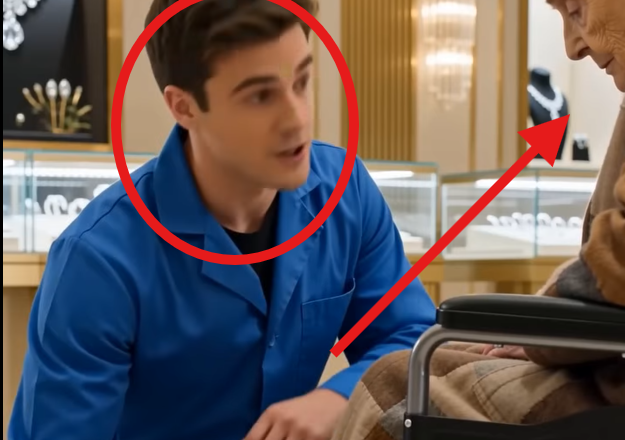
But one young worker noticed something else entirely. He noticed that her shoe had come undone.
Without a word, without hesitation, he crossed the floor, knelt down beside her chair, and quietly retied it. He didn’t make a scene. He didn’t look around for approval. He simply saw a person who needed a small kindness, and he offered it — freely, without expecting anything in return.
The elderly woman looked down at him with eyes that held decades of quiet wisdom.
She said nothing yet. But she remembered everything.
The saleswoman’s attitude had been clear from the moment the old woman stepped through the door. There was no warmth in her greeting, no patience in her posture. In her eyes, this visitor was an inconvenience — someone who didn’t belong among the gleaming glass cases and crystal chandeliers. She had made her judgment instantly, and she had worn it openly on her face.
That kind of cruelty doesn’t always announce itself with harsh words. Sometimes it lives in a turned shoulder, a dismissive glance, a tone of voice that says you are not worth my time. The saleswoman had mastered that quiet form of unkindness without even realizing how deeply it spoke to her character.
Then the elderly woman reached into her bag and produced an envelope.
She held it out to the young worker still standing nearby.
“Read it,” she said softly.
His hands trembled slightly as he broke the seal. Inside was a legal document, folded carefully alongside an old black-and-white photograph. The photo showed a younger version of the woman standing in front of this very store, arm in arm with a man in a fine suit, both of them smiling beneath the same chandelier that still hung above them today.
The young worker whispered, “This is you?”
She nodded with quiet dignity.
“My husband built this store,” she said. “He used my wedding ring as the first piece displayed in the window.”
The saleswoman stepped back. Her face had gone pale.
“No… the owner is supposed to come next week.”
The elderly woman met her eyes without anger, without triumph.
“I am the owner.”
The store fell completely silent.
The young worker read further down the document, his eyes widening with every line. She was transferring ownership. She had come — not to shop, not to browse — but to decide who was truly worthy of carrying forward what she and her late husband had built together with love, sacrifice, and devotion.
She looked slowly around the room at the staff behind the counters.
“You all saw a woman who looked poor, old, and inconvenient,” she said, her voice steady and unhurried. “You made your decision about who I was before I ever spoke a word.”
Then she looked at the young man beside her.
“But he saw someone whose shoe had come loose. That was all he needed to see.”
His eyes filled with tears he tried hard to hold back.
“I just didn’t want you to feel alone,” he said simply.
The woman smiled — a smile that carried both sadness and deep warmth, the kind that only comes from a life fully lived and losses deeply felt.
“My husband used to say that character is what a person does when they believe no one is watching and there is nothing to gain.”
The saleswoman’s voice cracked when she finally spoke.
“I’m so sorry. I didn’t know who you were.”
The elderly woman looked at her for a long, measured moment.
“No,” she replied gently but firmly. “You’re ashamed because you’ve discovered I have power. That is not the same thing as being sorry. Real regret doesn’t wait for consequences.”
There was nothing cruel in her words. Only truth — the kind that cuts because it’s accurate, not because it’s meant to wound.
The young worker lowered the document and looked at her with disbelief.
“What does this mean for me?”
She touched the photograph with trembling, gentle fingers — the way you touch something irreplaceable.
“It means this store needs a new manager,” she said. “Someone whose first instinct is to kneel down instead of look away.”
He stared at her. “Me?”
She nodded.
“Kindness should never have to ask permission to belong somewhere. Especially not here.”
There are moments in life that rearrange everything quietly — no fanfare, no grand announcement. This was one of them. A young man who had simply acted from his heart, with no audience, no reward in sight, found himself standing in a new life because one woman had been paying attention all along.
The elderly woman turned toward the necklace display case, her gaze softening with something private and tender.
“And now,” she whispered, “please show me the necklace my husband designed for our fiftieth anniversary. I’d like to see it one more time.”
The young worker stood, wiping his eyes carefully, and moved to open the case with steady hands and a full heart.
And in that moment, for the first time all day, every diamond in that room — no matter how rare, no matter how brilliant — was not the most precious thing present.
The most valuable thing standing in that store was the quiet proof that decency still exists, that goodness is still seen, and that the people who treat others with dignity when there is nothing to gain are the ones who, in the end, inherit everything worth having.
Some lessons arrive dressed in worn coats and scuffed shoes. The wisest among us recognize them immediately. The rest of us spend our lives learning why we should have.