The shove came without warning.
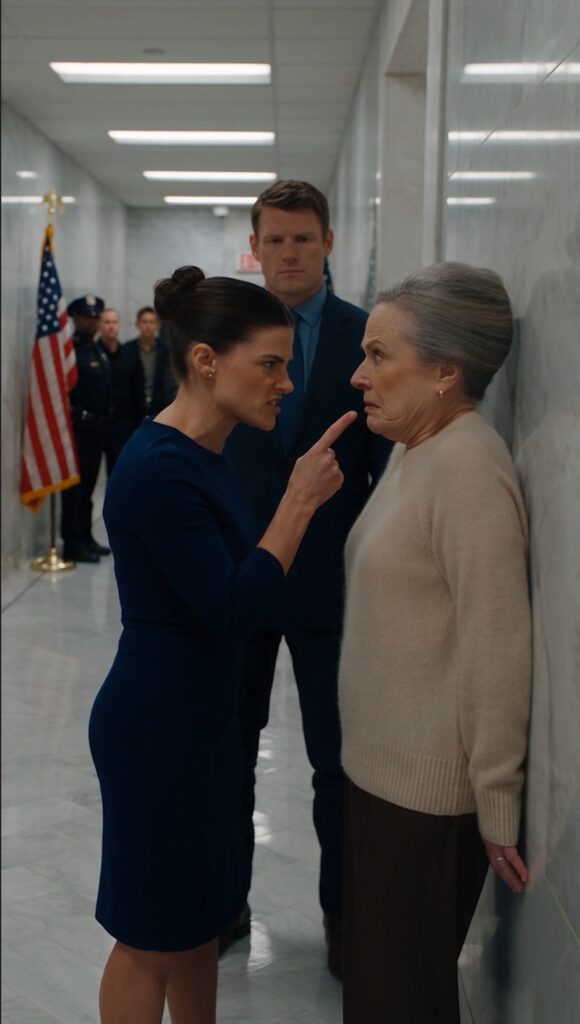
One second, I was standing outside Courtroom 4B. The next, my shoulder struck cold marble—and my daughter-in-law was calling me “a filthy old woman” while my only son watched from three steps away.
He saw everything.
He did nothing.
My name is Helen Warren. I turned seventy that morning beneath the courthouse’s unforgiving fluorescent lights, with pain burning down my back and Clara standing in front of me as though I were the one who should be ashamed.
The sound of the impact had traveled down the corridor.
A security officer straightened. Two attorneys stopped talking. A clerk holding a stack of files froze and stared.
David stared too.
Just not at me.
His eyes stayed fixed on the polished floor.
I had raised that boy alone. Worked double shifts. Skipped meals when money was tight. Sat through every Saturday game and held him through the night after his father walked out.
Years later, after his first legal internship, David had hugged me on these very courthouse steps.
“I’m going to make you proud, Mom.”
I remembered those words as he stood silently beside the woman who had just shoved me into a wall.
Clara moved closer.
Navy designer dress. Red lipstick. Immaculate nails. Expensive perfume.
Everything about her was polished.
Especially the smile.
“You’re an embarrassment to this family,” she said softly.
I pressed one hand against the marble until my balance returned. My shoulder throbbed beneath my cardigan, but I kept my face still.
Clara glanced at the people watching.
Then she lifted her chin.
“You should’ve stayed home. This hearing has nothing to do with you.”
She turned toward David.
“Get her out of here. She’s humiliating us.”
Finally, my son looked up.
For one foolish second, hope returned.
I imagined hearing two words.
Enough, Clara.
Instead, David swallowed.
“Mom… maybe you should wait downstairs.”
Something inside me went very quiet.
The shove had hurt.
That sentence hurt more.
Around us, strangers suddenly became fascinated by walls, files, phones—anything that spared them from witnessing what a son had just chosen not to defend.
I nodded once.
“Of course.”
Clara smiled.
She thought she had won.
I walked away without arguing while David followed his wife through the doors of Courtroom 4B.
Neither of them looked back.
Neither noticed the security officer straighten as I passed.
Or the clerk’s expression change.
Or the court officer at the end of the hallway give me a small, respectful nod.
I reached an unmarked side door and stepped inside.
The private room beyond it was familiar.
Very familiar.
I removed my cardigan and placed it carefully over a chair. Facing the small mirror, I adjusted the silver pin holding my gray hair and smoothed my sweater.
Then I looked toward the garment waiting beside the desk.
Black wool.
Heavy shoulders.
I touched the fabric.
It carried years of arguments, testimony, carefully constructed lies, and the quiet moment when truth finally stripped those lies bare.
Outside, chairs scraped against the courtroom floor.
An officer called everyone to order.
I slipped one arm into the black robe.
Then the other.
A sharp knock stopped me.
“Helen?”
It was the clerk from the hallway.
“You need to see this before you go in.”
She pushed an envelope through the opening.
David’s name was written across the front.
Then I saw the case number.
My fingers stopped moving.
I knew that number.
David wasn’t sitting inside Courtroom 4B simply to support his wife.
Someone had tried to keep whatever was inside this envelope off my bench.
Beyond the wall, the courtroom fell completely silent.
I looked down at my son’s name one last time.
Then the side-door handle began to turn.
And nobody inside that courtroom knew what was about to walk through it. 👇
The handle stopped halfway.
The clerk stood on the other side, breathing harder than the short walk down the corridor could explain. Her face had lost its color.
“Judge Warren,” she whispered. “There’s more.”
I looked at the envelope again.
The seal had already been broken.
“Who gave you this?”
“It was in the supplemental filing box. Misfiled under a closed matter.” She hesitated. “I recognized Mr. Warren’s name when I was checking this morning’s documents.”
David’s name looked strangely unfamiliar beneath my fingers.
For a moment, I was not a judge standing ten feet from my courtroom.
I was a mother holding something that might change the shape of her son’s life.
“Has counsel seen it?”
“Not this copy.”
“Then make copies for both sides. Immediately. And notify them on the record that supplemental material has been located.”
Her shoulders loosened slightly.
“Yes, Your Honor.”
She turned, then stopped.
“And Judge?”
I looked up.
Her eyes moved toward my shoulder.
“I saw what happened outside.”
The pain beneath the robe seemed to sharpen at the reminder.
“So did several other people.”
“I know.”
I folded the envelope closed.
“Preserve whatever security footage exists. Write down exactly what you witnessed while it’s fresh. Don’t discuss it with anyone who doesn’t need to know.”
She nodded.
There was something almost protective in the way she closed the door behind her.
I stood alone.
Through the wall came the low murmur of people waiting for authority to enter the room.
I had spent decades learning that the most dangerous moment in any courtroom was not when someone shouted.
It was when everyone became quiet.
I opened the envelope.
The first page was a financial disclosure.
The second was correspondence.
The third carried David’s signature.
By the fourth, I had to sit down.
Not because I did not understand what I was reading.
Because I understood it perfectly.
The case before me involved disputed transfers from a family-controlled account connected to Clara. Her attorneys had characterized several transactions as authorized movements made with David’s knowledge.
The documents in my hand told a different story.
David had objected.
Repeatedly.
He had demanded that his name be removed from filings he believed were inaccurate. He had written that he would not sign a revised declaration unless the transactions were fully disclosed.
And then there was the final message.
Short.
Careful.
Terrified.
If anything happens to me professionally or personally, preserve the original records.
I read it twice.
The black robe suddenly felt heavier.
My son had known.
Worse, he had been afraid.
A soft knock came again.
“Judge Warren?”
I closed the file.
“Come in.”
The court officer opened the door just enough to look at me.
“We’re ready.”
I rose.
The ache in my shoulder followed me.
So did David’s words from the hallway.
Mom… maybe you should wait downstairs.
I understood now that there might have been more inside that sentence than shame.
But understanding was not forgiveness.
Not yet.
I walked through the side door.
“All rise.”
The courtroom stood.
Clara turned first.
Her expression changed so quickly that, had I blinked, I might have missed it.
The confidence vanished.
Her lips parted.
Her face emptied.
Beside her, David looked toward the bench.
He stopped breathing.
For one suspended second, mother and son stared at each other across the courtroom.
He saw the robe.
He saw where I was walking.
And I watched him understand what Clara had not known outside those doors.
I was not an unwanted old woman who had wandered into their hearing.
I was the judge assigned to Courtroom 4B.
I took my seat.
“You may be seated.”
Chairs lowered almost simultaneously.
Clara remained standing half a second too long.
David touched her elbow.
She sat.
I placed the envelope beside the case file.
Clara’s eyes followed it.
That frightened me more than surprise would have.
She recognized it.
I looked toward counsel.
“Before we proceed, the court has been made aware of supplemental materials that were apparently placed in an incorrect filing location. Copies are being provided to counsel now.”
A bailiff crossed the courtroom.
Paper changed hands.
Clara’s attorney began reading.
His forehead tightened.
David did not reach for the copy.
He kept looking at me.
I addressed both attorneys.
“Given the nature of these materials, we will take a brief recess so counsel can review them.”
Clara suddenly leaned toward her lawyer.
Her whisper was too low to make out.
His answer was not.
“Stop talking.”
The room shifted.
Not loudly.
But power has a sound when it begins to leave someone.
Sometimes it sounds like a chair creaking beneath a body that has suddenly become uncertain.
I rose.
“All rise.”
Back in chambers, I removed my glasses and pressed two fingers against the bridge of my nose.
The responsible choice was obvious.
Painful, but obvious.
I could not preside over a case in which my son had become materially involved.
Whatever Clara had done to me outside the courtroom made the conflict even clearer.
I called the presiding judge.
I explained the family relationship, the hallway incident, and the newly discovered documents.
There was a long silence.
“You’re recusing?”
“Yes.”
“You understand that means another judge takes it from here.”
“I do.”
“And the hallway matter?”
“Treat it exactly as you would if she had shoved anyone else in this courthouse.”
Another pause.
“Helen.”
“Yes?”
“You don’t have to be made of stone just because you wear a robe.”
I looked at my cardigan hanging over the chair.
“I know.”
But for years, perhaps I had forgotten.
When I returned to the courtroom, Clara was standing beside the defense table with both hands pressed flat against it.
David sat several feet away.
The distance between them had appeared during recess.
I announced my recusal.
Clara’s head snapped up.
For the first time that morning, relief touched her face.
It lasted only until I continued.
“The supplemental materials will remain part of the record and will be transferred, with all appropriate chain-of-custody documentation, to the reassigned judge.”
Her relief disappeared.
“The courthouse security incident that occurred before this hearing is separate from this matter and will be handled through ordinary procedure.”
Clara’s fingers curled against the table.
“Your Honor—”
Her attorney caught her wrist.
“Do not.”
I looked at David.
He was pale.
“Court is adjourned pending reassignment.”
The gavel came down once.
I left through the side door.
My knees nearly failed me when it closed.
I caught the edge of the desk.
The room was silent except for the clock.
Then someone knocked.
Not the clerk.
Three soft knocks.
I knew them.
David had knocked on my bedroom door that way as a child whenever he had a nightmare.
Three quiet taps.
Always three.
“Mom?”
I closed my eyes.
The word went through me harder than Clara’s hand had.
I did not answer immediately.
“Mom, please.”
I opened the door.
David stood in the corridor alone.
His tie had been loosened. His face looked older than it had an hour earlier.
He looked at my shoulder.
Then at the floor.
“I’m sorry.”
I waited.
His mouth trembled.
“I should’ve stopped her.”
“Yes.”
“I should’ve said something.”
“Yes.”
“I wanted to.”
That hurt.
I stepped into the doorway.
“Wanting to defend someone is not the same as defending them, David.”
“I know.”
“Do you?”
He finally met my eyes.
“I’ve been trying to keep everything from exploding.”
“And while you were doing that, what happened to you?”
His jaw tightened.
I thought he might retreat.
Instead, he sat on the bench outside chambers and covered his face.
“I signed things.”
My stomach tightened.
“Things I shouldn’t have signed.”
“The documents say you later objected.”
“I did.”
He dragged his hands downward.
“She told me the transfers were temporary. Then she said the accountants had approved them. When I asked questions, she said I was paranoid. When I refused to sign the revised statement, she threatened to tell my firm I had authorized everything.”
His voice broke.
“I thought I could fix it quietly.”
I sat beside him, leaving a small space between us.
“Why didn’t you come to me?”
A bitter little laugh escaped him.
“Because you’re Judge Helen Warren.”
I turned toward him.
“And?”
“And you spent my whole life teaching me that truth matters. That signatures matter. That you don’t put your name on something unless you can stand behind it.”
He looked at his hands.
“I was ashamed.”
There it was.
Not an excuse.
A wound.
I remembered the boy who once brought home a broken neighbor’s window and confessed before anyone had asked.
I remembered telling him courage was not avoiding mistakes.
It was walking back toward the damage.
“David.”
He looked at me.
“Did Clara know you preserved those records?”
“Yes.”
“Did she know you sent copies somewhere?”
His silence answered first.
Then he whispered, “Yes.”
A door opened behind us.
Clara stood at the far end of the corridor.
Her attorney was nowhere in sight.
Her face was no longer polished.
“You.”
She was looking at David.
He stood.
“Clara, don’t.”
“You gave her the records.”
“No.”
“You liar.”
She came toward us.
The same security officer who had witnessed the shove moved instantly from his station.
“Ma’am, stop there.”
Clara ignored him.
“You destroyed everything.”
David did something then that he had failed to do earlier.
He stepped between us.
“Enough, Clara.”
Two words.
The same two words I had imagined in the hallway.
They came too late to erase anything.
But they came.
Clara stared at him.
“You’re choosing her?”
David’s shoulders rose with one slow breath.
“No. I’m choosing to stop lying.”
Her face changed.
Not anger.
Fear.
The officer approached.
“Ma’am, I need you to come with me regarding the incident in the hallway.”
Clara looked at me.
“You’re doing this.”
I stood.
“No.”
My voice was quiet.
“You did.”
The security footage was clear.
So were the witness statements.
But the shove became the smallest of Clara’s problems.
The reassigned judge ordered a full evidentiary review of the disputed transactions. The preserved records David had referenced were obtained through proper process.
Original account statements were compared with the filed disclosures.
Dates did not match.
Amounts had been omitted.
Communications contradicted sworn representations.
And one document that supposedly carried David’s authorization had been altered after he signed an earlier version.
The truth did not arrive dramatically.
It arrived page by page.
Signature by signature.
Timestamp by timestamp.
That was what finally broke Clara’s control.
She could argue with people.
She could insult me.
She could intimidate David.
She could smile while telling a lie.
But she could not make timestamps become different timestamps.
She could not make original records disappear once they were preserved.
She could not force everyone in the room to pretend anymore.
Weeks later, I sat in the back row of another courtroom.
No robe.
No bench.
Just my charcoal cardigan buttoned over the shoulder that had finally stopped aching.
David sat near the front with his attorney.
Clara sat at the opposite table.
She did not look back.
The proceedings addressed the financial misconduct and the false representations connected to it. The hallway assault was handled separately through the courthouse process.
I did not celebrate when consequences were imposed.
Justice looks cleaner from a distance.
Up close, it is often grief with paperwork.
Clara lost the leverage she had built through concealment. The disputed financial claims collapsed under the original records. The altered documentation was referred for further investigation, and orders were entered preventing her from controlling or moving the contested funds while the remaining matters were resolved.
Her professional reputation, carefully constructed around certainty and appearances, fractured under evidence she could no longer explain away.
When she stood to leave, she looked smaller.
Not physically.
The room simply no longer rearranged itself around her.
David watched her go.
His eyes were wet.
I understood then that a person could be relieved to escape someone and still grieve the life they had believed they were building together.
Outside, he found me near the courthouse steps.
The same steps where, years earlier, he had promised to make me proud.
He stopped several feet away.
“Mom.”
I waited.
“I’m separating from Clara.”
I nodded.
“I’m cooperating with everything. Even if it costs me my job.”
“Good.”
His face tightened at the word.
“You’re not going to tell me it’ll be okay?”
“No.”
He looked surprised.
“I don’t know if it will be okay.”
A cold wind moved between the courthouse columns.
“What I can tell you is that whatever happens next will belong to the truth. You can build from that.”
He looked down.
“I disappointed you.”
“Yes.”
The word hurt both of us.
I did not soften it.
Then I added, “But disappointment is not the end of love.”
His eyes lifted.
I had not seen my son cry in years.
He did not make a sound.
He simply stepped toward me and stopped.
“Can I hug you?”
That question nearly undid me.
I opened my arms.
He held me carefully, as if he still remembered the bruise beneath my cardigan.
For a few seconds, he was forty-something years old.
Then his forehead touched my shoulder, and he was seven again.
“I’m sorry,” he whispered.
“I know.”
“I was scared of her.”
“I know.”
“I hated myself for being scared.”
I held the back of his coat.
“Fear is not shameful, David.”
He pulled away enough to look at me.
“What you do while you’re afraid matters.”
He nodded.
This time, I believed he heard me.
Repair did not happen on those courthouse steps.
It began there.
There is a difference.
For months, David and I learned how to speak without pretending.
Sometimes he called and I answered.
Sometimes I let the phone ring because I was not ready.
Sometimes he came to dinner and washed dishes afterward without being asked.
Sometimes we sat across from each other for twenty minutes and said almost nothing.
He began counseling.
He told his firm the truth before the investigation forced him to.
There were consequences.
He lost responsibilities.
He was placed under review.
For a while, he believed his legal career was finished.
But because he had preserved records, objected in writing, and eventually cooperated fully, the picture was more complicated than the one he feared.
He was not cleared of every bad decision.
Nor should he have been.
He had signed documents without sufficient care.
He had stayed silent too long.
He accepted that.
And slowly, painfully, he began becoming someone who could live without hiding from what he had done.
One rainy Sunday evening, he came to my house carrying groceries.
“You bought too much,” I said.
“You always say that.”
“Because you always buy too much.”
He smiled.
It was the first smile I had seen on him in months that did not look borrowed.
We cooked soup.
Nothing elaborate.
Carrots. Celery. Potatoes. Chicken.
He chopped onions badly.
I corrected him.
He accused me of having impossible standards.
I told him that was rich coming from a lawyer who once alphabetized his baseball cards.
Then we both laughed.
The sound surprised us.
David set down the knife.
His smile faded into something softer.
“I missed this.”
I stirred the pot.
“So did I.”
He leaned against the counter.
“Why didn’t you ever tell Clara what you did?”
I looked at him.
“What?”
“That you were the judge assigned to 4B.”
“I assumed my son had mentioned his mother’s occupation to his wife.”
He winced.
“I did. Years ago. She thought you were retired.”
“I had taken senior status, not vanished from the judiciary.”
“I know.”
The rain tapped against the kitchen window.
Then David said something that made me put down the spoon.
“She didn’t think you mattered.”
I turned.
He looked ashamed even saying it.
“She thought because you lived simply, drove the same car forever, wore old cardigans, never talked about money or your career at dinner… that you were insignificant.”
For a moment, I remembered Clara’s face in the corridor.
Filthy old woman.
Embarrassment.
Stay home.
I looked down at my hands.
Age had changed them.
The knuckles were larger now. The skin thinner.
But they were the same hands that had packed David’s school lunches.
The same hands that had studied casebooks at midnight.
The same hands that had signed my first judicial oath.
“Then she misunderstood the wrong things,” I said.
David nodded.
“She misunderstood you.”
“No.”
I looked toward the rain.
“She misunderstood what gives a person value.”
Spring came slowly that year.
By then, the major proceedings connected to Clara’s conduct had reached their resolution. The financial orders were final. The evidence had survived every attempt to minimize it. The consequences could not be reversed by charm, intimidation, or another version of the story.
Clara and David’s marriage ended.
I saw her only once more.
It happened outside the courthouse.
She was walking down the steps as I was going up.
We stopped.
For several seconds, neither of us spoke.
Her clothes were still expensive.
Her hair was still immaculate.
But there was no audience now.
No David standing nearby.
No one to humiliate.
She looked at me.
“Are you happy?”
I considered the question.
“No.”
That seemed to surprise her.
“You ruined my life.”
I held her gaze.
“I didn’t falsify your records.”
Her jaw tightened.
“I didn’t move the money.”
She looked away.
“I didn’t shove a seventy-year-old woman into a courthouse wall.”
Her face flickered.
I did not raise my voice.
“You kept believing consequences were something other people caused.”
For once, Clara had nothing to say.
I moved past her.
“Helen.”
I stopped.
Her voice was smaller.
“Did David ever love me?”
I turned.
That question was not mine to answer.
So I did not pretend it was.
“You’ll have to live with what you did to the love you were given.”
I walked inside.
I never saw her again.
My final year on the bench was quieter than the one before it.
I heard arguments.
Signed orders.
Listened to frightened people tell the truth badly and confident people tell lies beautifully.
But something in me had changed.
I noticed silence differently.
Whenever someone hesitated before answering, I remembered David staring at the polished courthouse floor.
Silence could be cowardice.
It could also be fear.
Sometimes it was both.
I became more patient without becoming softer on facts.
That distinction mattered to me.
On my final day, the courtroom staff gathered after the last case.
There were flowers.
Cake.
Too many speeches.
The clerk who had handed me the envelope stood near the back.
When everyone began leaving, I called her over.
“You saved more than a filing that morning.”
She shook her head.
“I did my job.”
“So did the security officer.”
“Yes.”
“And that is often how people save one another.”
She smiled.
Then she handed me a small box.
“What is this?”
“Not from me.”
Inside was my silver hairpin.
I stared at it.
“I wore this today.”
“No, Judge.”
My hand went automatically to my hair.
A different pin held it.
The silver one in the box was older.
Scratched along one edge.
My breath caught.
I knew it.
I had lost it decades earlier.
The clerk handed me a folded note.
“Your son asked me to give you this after your last case.”
I opened it.
Mom,
You probably don’t remember the night before your first judicial interview.
I do.
You thought I was asleep.
I came into the kitchen because I heard you crying.
You were sitting at the table with your interview papers, and this pin was beside your coffee. You kept saying you couldn’t afford the suit, couldn’t afford the babysitter, couldn’t afford to fail.
The next morning, the pin was on the floor after you left.
I picked it up.
I was nine.
I kept it because I thought if you became a judge, maybe someday it would prove I had been there before anyone else knew you could do it.
I should have returned it years ago.
But I think I understand now why I kept it.
You spent your life believing you had to make me proud.
The truth is, I was proud of you first.
I sat down.
The empty courtroom blurred.
For decades, I had remembered those years as sacrifice.
Double shifts.
Skipped meals.
Night classes.
Exhaustion.
David asleep beneath my coat while I studied.
I had believed he remembered only what I could not give him.
The vacations we never took.
The shoes bought one size too large so he could grow into them.
The dinners stretched across two nights.
But somewhere inside those difficult years, a nine-year-old boy had been watching his mother refuse to quit.
I pressed the old silver pin into my palm.
The beautiful twist was not that my son had finally become proud of me.
He always had been.
He had simply lost himself for a while.
And now he was finding his way back.
That evening, David was waiting outside.
No suit.
No tie.
Just a sweater, jeans, and two paper cups of coffee.
“You got it?”
I held up the box.
His face turned red.
“You kept this for sixty-one years?”
“I forgot I had it for about twenty of them.”
I laughed.
Then I cried.
Not elegantly.
Not quietly.
I stood on the courthouse steps at seventy years old and cried while my grown son put down two cups of coffee and wrapped both arms around me.
This time, he did not hesitate.
Neither did I.
Months later, on my seventy-first birthday, David cooked dinner at my house.
The soup was too salty.
The bread was slightly burned.
I ate everything.
Afterward, we sat on the porch beneath a warm evening sky.
My black robe had been packed away.
My courthouse identification was in a drawer.
The old cardigan hung over the back of my chair.
David looked toward me.
“You know what’s strange?”
“What?”
“I spent years thinking making you proud meant becoming impressive.”
I smiled.
“And now?”
“Now I think it means becoming honest.”
I reached over and squeezed his hand.
“That’s a much harder career.”
He laughed.
The porch light came on automatically as the sun disappeared.
Somewhere down the street, children were riding bicycles home.
A dog barked behind a fence.
David gathered our empty glasses and carried them inside.
I stayed where I was.
For once, there was nowhere I needed to be.
No courtroom waiting.
No argument to hear.
No lie to untangle.
No frightened son standing three steps away pretending not to see me.
Through the kitchen window, I watched David rinse the glasses and place them carefully on the drying rack.
Before my retirement ceremony, I had begun wearing the old silver pin again.
That evening, it held my gray hair in its usual bun.
I touched it once.
Then David looked through the window and caught me watching him.
He smiled.
Not the embarrassed smile of the man outside Courtroom 4B.
Not the frightened smile of someone trying to keep a collapsing life intact.
It was the open, uncomplicated smile of the boy who had once waited on courthouse steps and told me he would make me proud.
I smiled back.
He turned off the kitchen light and came outside.
Then my son pulled his chair beside mine—not three steps away this time, but close enough that our shoulders touched—and together we watched the last light disappear from the sky.