“You need to move, ma’am.”
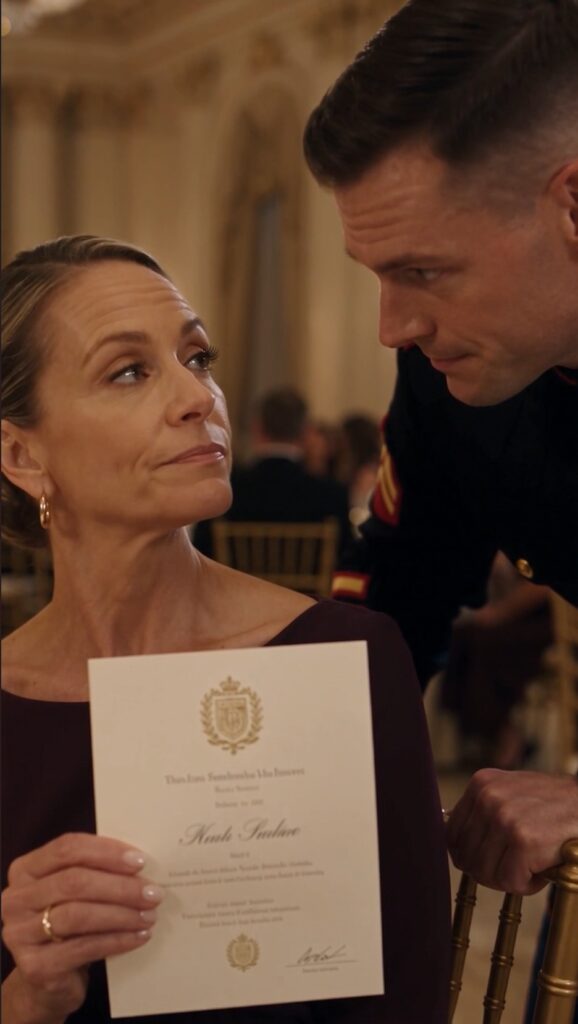
Colonel Derek Maddox stopped beside Eleanor Bennett’s chair before she had even unfolded her napkin.
Eleanor looked up at him, then at the place card resting beside her plate.
“I believe this is where I was assigned.”
Derek did not touch the card.
He looked at Eleanor instead.
His gaze traveled over her simple navy dress, pearl earrings, and silver hair.
“This table is reserved for honored guests.”
Eleanor rested one hand beside the invitation she had carried into the ballroom.
“Yes.”
The single word made Derek’s expression tighten.
Around them, dinner conversations continued beneath the bright chandeliers.
A string quartet played near the far wall.
Servers crossed the ballroom carrying trays of sparkling water and champagne.
Derek leaned closer.
“What rank was your son?”
Eleanor’s fingers became still.
“He isn’t serving anymore.”
Derek gave a small, knowing smile.
“Then there’s even less reason for you to be sitting here.”
A young server passing behind Eleanor slowed.
Two guests at the neighboring table stopped talking.
Eleanor watched Derek carefully.
“Are you certain?”
Derek straightened.
He signaled toward a banquet employee.
“Move her to the back.”
The employee froze for half a second.
Derek’s voice lowered.
“You’re only the mother of a soldier.”
Eleanor held his gaze.
No anger crossed her face.
No embarrassment either.
She simply picked up her purse.
“All right.”
She stood.
The chair legs slid softly across the ballroom floor.
Derek stepped aside as though the matter had been resolved.
Eleanor walked toward the rear of the hall.
Several guests watched her pass.
Derek returned to his table near the stage.
His smile returned before he even sat down.
Eleanor reached the final row of tables.
A banquet employee pulled out a chair for her.
“I’m very sorry, ma’am.”
Eleanor looked at his name tag.
The young man was named Caleb.
“You didn’t make the decision, Caleb.”
He glanced toward Derek.
“I still don’t like it.”
“That speaks well of you.”
Caleb gave an uncomfortable smile.
Eleanor sat.
From the back of the ballroom, the stage looked smaller.
The room belonged to Fort Liberty’s annual military families memorial gala.
Hundreds of officers, veterans, donors, spouses, and community leaders filled the hall.
The event was being held at a convention hotel in Fayetteville, North Carolina.
American flags stood behind the stage.
Gold stars decorated the centerpieces.
Photographs of fallen service members lined the entrance hall outside.
Eleanor had arrived twenty minutes earlier without an escort.
She had asked no one to announce her.
That had apparently been a mistake.
At least, Derek thought it was hers.
Eleanor placed the folded invitation beside her plate.
She could still see her original table.
It sat only a few yards from the stage.
Derek had returned to speaking with a group of business donors.
He laughed easily now.
Nothing in his posture suggested doubt.
Caleb returned with a glass of water.
“Can I bring you anything else?”
“No, thank you.”
He hesitated.
“That card really had the front table number?”
Eleanor looked at him.
“It did.”
Caleb’s jaw tightened.
“I thought so.”
“Don’t get yourself in trouble.”
He nodded reluctantly.
Then he left.
At Derek’s table, Brigadier General Marcus Hale was speaking with two executives from a defense manufacturing company.
Derek listened closely.
He had spent months positioning himself for that evening.
Everyone at Fort Liberty seemed to know why.
A new military family scholarship foundation was being formed.
Its first executive director would oversee one of the largest privately funded education programs associated with the installation.
Derek wanted the position.
He wanted it badly.
The job would begin after his scheduled retirement from active service.
It offered influence, prestige, national connections, and a salary exceeding anything he had earned in uniform.
More importantly, it offered a second career that still placed him near powerful people.
Derek had built his reputation around being near powerful people.
That evening, he believed many of them were sitting at his table.
He had shaken their hands.
He had memorized their companies.
He had remembered their spouses.
He had laughed at the correct jokes.
He had even asked which universities their children attended.
Eleanor watched him from the rear.
Derek never once looked back at her.
A woman seated nearby leaned toward Eleanor.
“Did they change your table?”
Eleanor turned.
The woman appeared to be in her early sixties.
A small gold pin identified her as a Gold Star family member.
“It seems they did.”
The woman frowned.
“I saw what happened.”
Eleanor smiled faintly.
“So did half the room.”
“My name is Susan Parker.”
“Eleanor Bennett.”
Susan’s expression changed almost imperceptibly.
“Bennett?”
“Yes.”
Susan studied her.
“Have we met?”
“I don’t believe so.”
Susan appeared ready to ask another question.
Then the quartet stopped.
An announcement asked everyone to take their seats.
Derek settled into his chair.
He adjusted the front of his dress uniform.
A woman beside him whispered something.
He answered without looking toward the back.
Susan’s hand stopped halfway to her water glass.
For several seconds she stared at Eleanor, her lips slightly parted, as if a memory had finally found the name it had been searching for.
“Bennett,” she whispered again.
Eleanor turned toward her.
Susan’s eyes moved to the folded invitation beside Eleanor’s plate.
“Your son,” she said carefully. “What was his first name?”
The room dimmed before Eleanor could answer.
A spotlight came on above the stage.
Applause spread across the ballroom as Brigadier General Marcus Hale rose from the front table and walked toward the lectern.
Eleanor looked forward.
Susan did too, but the question remained between them.
Marcus waited until the applause faded.
“Every year,” he began, “we gather in a room like this and use words such as sacrifice, service, family, and remembrance.”
His voice carried easily through the hall.
“But those words are dangerous if they become ceremonial.”
A few heads lifted.
Marcus looked across the tables.
“Sacrifice is not a centerpiece. Service is not a photograph. Family is not a category on an invitation.”
At the front table, Derek nodded solemnly.
Eleanor saw it.
For the first time that evening, something almost like weariness touched her face.
Susan noticed.
“You know him?” she whispered.
Eleanor shook her head once.
“No.”
Marcus continued.
“The foundation we announce tonight began with a promise made several years ago. It was not a promise made by generals, corporations, or institutions.”
He paused.
“It was made by a family.”
Susan inhaled sharply.
Eleanor lowered her eyes.
That was enough.
Susan covered her mouth.
“Oh, my God.”
Several people at their table turned.
Eleanor gave Susan a small look, almost pleading.
Please.
Susan understood.
She lowered her hand.
But she could no longer hide what was in her eyes.
At the front, Marcus began speaking about military children whose education had been interrupted by deployments, injuries, deaths, and financial hardship.
Behind him, a large screen illuminated.
The first photograph appeared.
It showed a young soldier in field uniform.
Eleanor stopped breathing.
The room disappeared around her.
She knew the photograph.
She had taken it herself.
Her son had been standing on the back steps of her house, complaining that the morning sun was in his eyes.
He had laughed immediately afterward.
She remembered that laugh better than she remembered what she had eaten yesterday.
On the screen beneath the photograph appeared a name.
Captain Daniel Bennett.
Susan reached beneath the table and found Eleanor’s hand.
Eleanor did not pull away.
At the front table, Derek’s smile vanished.
His eyes went first to the screen.
Then to Marcus.
Then, slowly, toward the back of the ballroom.
For the first time since forcing Eleanor from her chair, he looked directly at her.
Eleanor was not looking at him.
Marcus’s voice softened.
“Captain Bennett died after years of service that affected far more people than he ever knew.”
The ballroom was completely silent.
“He left behind no children of his own. But he had spent much of his career helping the children of soldiers under his command—quietly, privately, often with money his own family did not know he was giving.”
Eleanor closed her eyes.
That part still hurt.
Not because Daniel had hidden it.
Because she had discovered it only after there was no longer anyone to tease about it.
Marcus looked toward the photograph.
“His mother discovered receipts, tuition payments, bookstore charges, and handwritten notes after his death.”
Derek had gone pale.
Susan squeezed Eleanor’s fingers.
Marcus continued.
“When Mrs. Bennett asked what could be done with the money her son had left behind, she did not ask for a memorial statue.”
A murmur moved through the room.
“She asked whether we could help another military child go to school.”
Marcus smiled faintly.
“That conversation became a fund. The fund attracted donors. Those donors attracted others. And tonight, that small promise becomes the Bennett Military Family Education Foundation.”
The name appeared across the screen.
Derek’s chair shifted.
The sound was tiny.
Eleanor heard it anyway.
Marcus glanced toward the front table.
“We had intended to introduce the person without whom none of this exists from Table One.”
His brow tightened.
He looked at the empty chair beside Derek.
Then he looked down at a card on the lectern.
A staff member hurried toward the stage and whispered into his ear.
Marcus’s expression changed.
Not dramatically.
That made it worse.
His gaze lifted.
He searched the ballroom.
“Mrs. Eleanor Bennett?”
Every face seemed to turn at once.
Eleanor remained seated.
Susan whispered, “Go.”
Eleanor’s hand tightened around her purse.
Across the room, Derek stood abruptly.
“General, I can explain—”
Marcus did not look at him.
“Mrs. Bennett?”
Eleanor rose.
A strange sound moved through the ballroom—not quite applause, not yet. It was the collective realization of hundreds of people understanding that something had happened before they knew exactly what it was.
Caleb stood near the service doors.
His eyes widened when he saw Eleanor.
Marcus descended from the stage.
He walked past Table One.
Past Derek.
Past the donors.
All the way to the final row.
When he reached Eleanor, his face held a mixture of confusion and concern.
“Mrs. Bennett, why are you back here?”
Eleanor glanced toward Derek.
The colonel was still standing.
The whole ballroom followed her gaze.
Derek swallowed.
Eleanor could have answered immediately.
She did not.
That silence changed the room.
Marcus looked from Eleanor to Derek.
Then to the empty place at Table One.
His jaw tightened.
“Mrs. Bennett?”
Eleanor spoke quietly.
“Colonel Maddox believed my seat had been assigned incorrectly.”
Marcus’s eyes fixed on Derek.
Derek stepped away from his chair.
“There was a misunderstanding.”
Caleb’s face changed.
Susan stood.
“No,” she said.
The single word traveled farther than she probably intended.
Derek looked toward her.
Susan’s hands trembled, but she did not sit.
“I was close enough to hear it.”
Derek’s expression hardened.
“This is an official event. I’d suggest—”
“I heard you too.”
Another voice came from the neighboring table.
Then another.
The young server who had slowed behind Eleanor raised his hand slightly.
“So did I, sir.”
Silence returned.
Derek looked around as if searching for a friendly face.
A few minutes earlier, he had known everyone important in the room.
Now no one seemed willing to meet his eyes.
Marcus’s voice became very calm.
“What did you say?”
Derek looked at Eleanor.
For the first time, the confidence was gone.
“I was trying to maintain the seating protocol.”
Eleanor said nothing.
Marcus waited.
Derek continued.
“She arrived alone. There was some uncertainty regarding her status.”
Caleb took one step forward.
“Her place card was correct.”
Derek turned sharply.
Caleb stopped.
Fear flickered across the young man’s face.
Then he straightened.
“I checked it, sir.”
Marcus looked at Caleb.
“What happened?”
Caleb swallowed.
“Colonel Maddox told us to move Mrs. Bennett to the back.”
Derek’s voice sharpened.
“That’s enough.”
Caleb flinched.
Eleanor saw it.
So did Marcus.
“No,” Marcus said. “It isn’t.”
Derek’s mouth closed.
Marcus turned back to Caleb.
“Finish.”
Caleb looked at Eleanor.
She gave him the smallest nod.
“He said the front table was for honored guests.”
A muscle moved in Marcus’s cheek.
“And?”
Caleb hesitated.
Susan answered for him.
“He told her she was only the mother of a soldier.”
No one moved.
Derek looked suddenly smaller beneath the chandeliers.
The medals on his uniform still caught the light.
The rank on his shoulders had not changed.
But something more important had.
The room no longer bent toward him.
Marcus stared at Derek for a long moment.
Then Eleanor spoke.
“General.”
Marcus turned.
“I don’t want Daniel’s name used to humiliate another person.”
Derek looked at her.
The surprise in his face was almost painful.
Eleanor continued.
“My son would have hated that.”
Her voice remained steady, though one hand had begun trembling beside her dress.
“But I also don’t want what happened ignored.”
Marcus nodded.
“It won’t be.”
Derek took a breath.
“Mrs. Bennett, I apologize.”
Eleanor looked at him.
His eyes flicked briefly toward Marcus.
Then toward the donors.
That tiny movement told her everything.
“You’re apologizing to the room,” she said.
Derek froze.
“I’m standing here.”
The words were not loud.
They did not need to be.
Derek’s face reddened.
Eleanor stepped closer.
“You looked at my dress. You looked at my age. You asked about my son’s rank. And when you believed I had nothing useful to offer you, you decided I did not belong near the people you wanted to impress.”
Derek opened his mouth.
Eleanor lifted one hand.
He stopped.
“You did not know who Daniel was.”
Her voice faltered for the first time.
She steadied it.
“You did not know who I was.”
A breath.
“And that is precisely why your apology matters.”
Derek stared at her.
Eleanor’s eyes were wet now.
“If you had known my name before you moved me, you would have treated me differently.”
Derek said nothing.
“That is the problem.”
Marcus lowered his gaze.
Around the ballroom, people were utterly still.
Eleanor looked toward Caleb.
“You were kind before you knew my name meant anything.”
Caleb blinked rapidly.
She looked at Susan.
“You were kind before you knew.”
Then she looked back at Derek.
“Character is what remains when you believe the person in front of you cannot help you.”
Derek’s shoulders dropped.
For once, he had no answer.
Marcus turned to an aide.
“Colonel Maddox will not participate in the foundation presentation tonight.”
Derek stared at him.
“General—”
“Sit down.”
The order was quiet.
Derek sat.
But the evening did not end there.
It could not.
Marcus escorted Eleanor toward the stage, and when she passed Table One, no one tried to guide her toward the empty chair.
Instead, the entire ballroom rose.
The applause began somewhere near the rear.
Eleanor hated standing ovations.
Daniel had hated them too.
He used to say that applause made ordinary decency sound heroic.
But this applause did not feel like celebration.
It felt like recognition.
Eleanor reached the stage and turned toward hundreds of faces.
For one terrible second, she could not speak.
Daniel’s photograph was behind her.
Twenty feet tall.
Alive in a frozen instant.
She looked at it.
“You chose the worst picture,” she whispered.
Laughter broke through the tension.
Marcus smiled.
Eleanor looked back at the audience.
“My son hated that photograph.”
Another ripple of laughter.
“He said the sun made him squint.”
Her smile disappeared slowly.
“I told him he was lucky I hadn’t made him wear a tie.”
The room softened with her.
Eleanor placed both hands on the lectern.
“I did not come here tonight because I wanted anyone to know my name.”
She glanced toward the rear table.
“I came because Daniel believed military families should never have to prove that their sacrifices were important enough to deserve a seat.”
Derek lowered his eyes.
Eleanor did not look at him again.
She spoke for six minutes.
She talked about Daniel.
Not Captain Bennett.
Daniel.
The boy who once ruined a washing machine by leaving crayons in his pockets.
The teenager who was terrified of disappointing his father.
The young officer who called his mother from overseas and pretended he had eaten when she could hear hunger in his voice.
She spoke about the families who waited.
The spouses who learned to sleep beside silent phones.
The children who changed schools.
The parents who grew older between deployments.
And the families who received the knock at the door that divided their lives forever into before and after.
When she finished, there was no immediate applause.
There was something better.
Silence.
Real silence.
The kind that meant people were still carrying the words.
Then Susan began clapping.
Caleb joined her.
The room rose again.
This time Eleanor let herself cry.
Later, when dinner resumed, Marcus asked Eleanor whether she wanted Derek removed from the ballroom.
She shook her head.
“No.”
Marcus studied her.
“You’re certain?”
“He should sit through the rest of it.”
Derek did.
For nearly two hours.
He sat while scholarship recipients were introduced.
He sat while Gold Star families were recognized.
He sat while people he had spent months cultivating walked past him to speak with Eleanor.
Nobody publicly insulted him.
Nobody needed to.
His isolation was complete.
Near the end of the evening, Marcus asked Derek to remain behind.
The donors left first.
Then the officers.
Then the families.
Caleb was helping clear glasses when Eleanor found Susan waiting near the photographs in the entrance hall.
Susan stood in front of Daniel’s picture.
“I knew him,” she said.
Eleanor stopped.
Susan touched the edge of her gold pin.
“My daughter was Lieutenant Rachel Parker.”
Eleanor’s breath caught.
Susan looked at her.
“Daniel was her company commander.”
The name reached across years.
Eleanor remembered a handwritten note she had found among Daniel’s belongings.
Rachel.
She had never known the last name.
Susan’s eyes filled.
“My daughter died three years before your son.”
Eleanor moved beside her.
Neither woman spoke for a moment.
Susan continued.
“Rachel had a little boy.”
Eleanor looked at her.
“Evan?”
Susan began crying.
“Yes.”
Eleanor covered her mouth.
The hallway blurred.
One of the tuition receipts.
One of the bookstore accounts.
One of the names Daniel had never explained.
Evan Parker.
“He paid for Evan’s school,” Eleanor whispered.
Susan nodded.
“For two years.”
Eleanor’s knees weakened.
Susan caught her arm.
“He told us it came from an anonymous military family fund. I didn’t know it was him until after he died.”
Eleanor pressed her fingers against her lips.
“That idiot.”
Susan laughed through tears.
“Yes.”
“He never told me.”
“He made me promise.”
Eleanor shook her head.
“That sounds like him.”
They stood beneath Daniel’s photograph and laughed while they cried, two mothers connected by children neither of them could bring home.
Across the ballroom, another conversation was beginning.
Marcus closed the doors.
Derek stood before him with two senior officers and the chair of the foundation’s independent board.
The executive director position had not yet been formally awarded.
By midnight, Derek was no longer under consideration.
But Marcus refused to let that be the only consequence.
The following morning, statements were collected from Caleb, Susan, the server, Eleanor, and several guests.
What had happened at the gala became part of a formal review of Derek’s conduct connected to his remaining active-duty responsibilities and his candidacy for the civilian foundation role.
The foundation board conducted its own review.
People who had previously remained quiet began speaking.
Some described smaller incidents.
A junior officer remembered being dismissed in front of donors.
A military spouse described being spoken over when she questioned a family-support proposal.
A civilian employee recalled Derek becoming suddenly attentive only after learning who her father was.
None of those stories alone destroyed a career.
Together, they revealed a pattern.
The board withdrew Derek’s candidacy permanently.
His planned second career at the foundation disappeared before it began.
There would be no prestigious office.
No foundation salary.
No position built around representing the families he had sorted by usefulness.
Derek completed the remainder of his military obligations without the farewell trajectory he had imagined.
Months later, Eleanor received a letter from him.
It was handwritten.
She almost threw it away.
Instead, she made tea and sat at her kitchen table.
The letter contained no excuses.
Derek wrote that losing the foundation position had initially made him furious.
He had blamed Marcus.
Then the witnesses.
Then Eleanor.
Eventually, he wrote, there had been nobody left to blame without lying to himself.
One sentence made Eleanor stop.
I knew how to recognize rank, but I had forgotten how to recognize service when it wasn’t wearing a uniform.
Eleanor folded the letter.
She did not forgive him because he had finally found the right words.
Forgiveness was not a prize she owed him for self-awareness.
But she believed the letter.
That was enough.
She placed it in a drawer.
Then she went outside.
Spring had reached Fayetteville.
Daniel’s scholarship foundation had received more applications than anyone expected.
Eleanor had resisted taking an official position.
Marcus asked three times.
She refused three times.
On the fourth attempt, he changed the question.
“Will you at least help us choose the people who do?”
Eleanor narrowed her eyes.
“That is manipulation.”
“Yes, ma’am.”
“Poorly disguised.”
“I’m a general, not an actor.”
She laughed.
“All right.”
The foundation eventually hired Dr. Maya Collins, the daughter of a retired Army medic and a former public-school counselor who had spent fifteen years working with military children.
During her final interview, Maya said something Eleanor never forgot.
“If a family has to impress us before we help them, then we’ve built the wrong foundation.”
Eleanor looked at Marcus.
Marcus looked at Eleanor.
Neither needed to say anything.
Maya got the job.
Caleb received something too.
Not because Eleanor demanded it.
That mattered to her.
One of the hotel executives had watched him speak during the investigation despite knowing it could cost him his job.
Several months later, Caleb was promoted into the hotel’s events management training program.
When he called Eleanor to tell her, he sounded embarrassed.
“I think you had something to do with this.”
“I did not.”
“Mrs. Bennett.”
“I wrote one letter.”
Caleb laughed.
“That is having something to do with it.”
“I described what you did. You did the rest.”
Susan became part of Eleanor’s life almost accidentally.
Coffee became lunch.
Lunch became Sunday dinners.
Sometimes they spoke about Daniel and Rachel.
Sometimes they deliberately did not.
Evan was twenty-one when Eleanor finally met him.
He was tall, nervous, and studying engineering.
When Susan introduced them, Evan stood in Eleanor’s doorway holding flowers like a boy arriving for a school dance.
“I don’t know what I’m supposed to say,” he admitted.
Eleanor looked at him for a long time.
“You don’t have to say anything.”
He swallowed.
“Your son changed my life.”
Eleanor’s eyes filled.
“He would be annoyed to hear you say that.”
Evan laughed uncertainly.
“Why?”
“He disliked being thanked.”
That made Evan smile.
Then he reached into his backpack.
“I brought something.”
It was an envelope.
Old.
Creased.
Eleanor recognized Daniel’s handwriting before Evan handed it to her.
Her heart stopped.
“Where did you get this?”
“Your son gave it to my grandmother.”
Susan stood behind him, already crying.
“He told me not to give it to Evan until he finished high school,” she said. “And Evan wouldn’t let me give it to you until tonight.”
Eleanor looked between them.
“Why tonight?”
Evan smiled.
“Because I got the scholarship.”
Eleanor stared at him.
“The Bennett scholarship?”
He nodded.
“I applied without telling Grandma.”
Susan raised both hands.
“He absolutely did.”
Eleanor sank slowly into the chair beside the door.
For several seconds, she could only hold the envelope.
Daniel had touched it.
That fact alone made the paper feel impossibly heavy.
She opened it.
Inside was one sheet.
Daniel’s handwriting leaned slightly to the right, exactly as it always had.
Eleanor read silently.
Halfway through, she began crying.
Susan knelt beside her.
Evan remained standing, uncertain whether to move.
Eleanor finally looked up.
“He wrote this before the foundation existed.”
Susan nodded.
“What does it say?”
Eleanor looked down again.
Daniel had written about Rachel.
About Evan.
About the strange responsibility of surviving people you loved.
Then, near the bottom, he had written something Eleanor read three times.
If anything ever happens to me, don’t let Mom turn my memory into something sad. Give her something useful to do. She’ll complain, but she’ll do it.
Eleanor laughed so suddenly that Evan jumped.
Susan began laughing too.
“That sounds like him?”
“Exactly like him.”
There was one final sentence.
Eleanor could barely read it aloud.
And make sure she knows there will always be a seat for her wherever my people gather.
Nobody spoke.
The room became very still.
Eleanor lowered the letter into her lap.
For months, she had thought the gala had been about a chair.
About humiliation.
About a colonel who had decided she did not belong at the front.
Now she understood why that moment had cut so deeply.
Daniel had spent his life quietly making room for people.
Children.
Widows.
Soldiers.
Families.
People who could offer him nothing.
And on the night his work became a foundation, his mother had been told there was no room for her.
Yet somehow, even years before that night, Daniel had already answered.
There will always be a seat for her.
Eleanor pressed the letter against her chest.
Evan crouched in front of her.
“I can decline the scholarship if this feels strange.”
Eleanor stared at him.
Then she reached out and tapped his knee.
“Don’t you dare.”
He laughed.
“I mean it.”
“I know.”
“You’re going to finish engineering school.”
“Yes, ma’am.”
“And if you waste Daniel’s money, I will haunt you while I’m still alive.”
Susan covered her face.
Evan laughed until he cried.
So did Eleanor.
A year later, the foundation held its second annual gala.
The ballroom looked much the same.
Chandeliers.
Flags.
Gold stars.
Photographs.
But one thing had changed.
There was no special table reserved for the most powerful people in the room.
Maya had redesigned the seating.
Donors sat beside scholarship families.
Generals sat beside young spouses.
Executives sat beside enlisted parents.
Gold Star families were scattered throughout the room rather than displayed together like symbols.
Marcus complained that nobody could find anybody.
Eleanor told him that was the point.
Caleb, now wearing an event manager’s badge, found her near the entrance.
“Mrs. Bennett.”
She smiled.
“Caleb.”
He looked down at the seating chart.
“I have a problem.”
Eleanor raised an eyebrow.
“Should I be worried?”
“Your table is full.”
She stared at him.
He managed to keep a straight face for almost three seconds.
Then he grinned.
Eleanor hit his arm lightly with her program.
“Very funny.”
“I’ve been waiting a year.”
“You’re terrible.”
“I learned from military families.”
Susan appeared behind Eleanor.
Evan was with her.
He had completed another year of engineering school and carried himself differently now.
Not more proudly.
More securely.
As though he had finally stopped wondering whether he deserved the opportunities other people had fought to give him.
The quartet began playing.
Eleanor looked across the ballroom.
For a moment, she saw Daniel everywhere.
Not literally.
Not as a ghost.
In gestures.
A young officer pulling out a chair for an elderly father.
A donor listening while a military spouse spoke.
A child reaching for two desserts while his mother pretended not to notice.
Caleb helping a veteran navigate the crowded aisle.
Susan laughing.
Evan carrying Daniel’s old letter inside the breast pocket of his jacket.
Marcus walked toward Eleanor.
“We’re starting.”
“I know.”
“You’re speaking.”
“I said five minutes.”
“You always say five minutes.”
“And you always give me seven.”
“Because you use nine.”
She smiled.
Then Marcus held out his arm.
Eleanor looked at it.
“I can walk.”
“I know.”
She took it anyway.
They moved toward the tables.
Near the center of the ballroom, Eleanor saw her place card.
ELEANOR BENNETT.
Nothing underneath.
No title.
No designation.
No explanation of whose mother she was.
Just her name.
Beside it was an empty chair.
Eleanor stopped.
For one brief second, the ballroom from a year earlier returned—the scrape of chair legs, Derek’s lowered voice, the long walk toward the back.
Then Evan pulled out the chair.
“For you,” he said.
Eleanor looked at him.
At Susan.
At Caleb.
At Marcus.
At Daniel’s photograph beyond them.
Her eyes filled, but this time grief did not arrive alone.
It came carrying gratitude.
Memory.
Purpose.
And something that had taken her years to recognize as peace.
She sat.
Evan took the chair beside her.
Susan sat on the other side.
The lights dimmed.
Conversation softened.
And before Marcus could reach the stage, Caleb quietly placed one extra place setting beside Eleanor’s plate.
She looked up.
“What is this?”
Caleb nodded toward Daniel’s photograph.
“No one’s sitting there.”
His voice softened.
“I just thought the table should remember who brought everyone together.”
Eleanor touched the empty plate.
Then she smiled.
Not the careful smile she had worn the year before.
A real one.
Warm and unguarded.
Around her, chairs shifted as families settled in, glasses caught the chandelier light, and the quartet moved into the opening notes of Daniel’s favorite song.
Eleanor rested one hand on the empty chair beside her.
For the first time in years, the space did not feel empty.
It felt saved.
And surrounded by the people her son had quietly gathered long before any of them understood what he was building, Eleanor finally knew she was exactly where Daniel had always intended her to be.
Home.