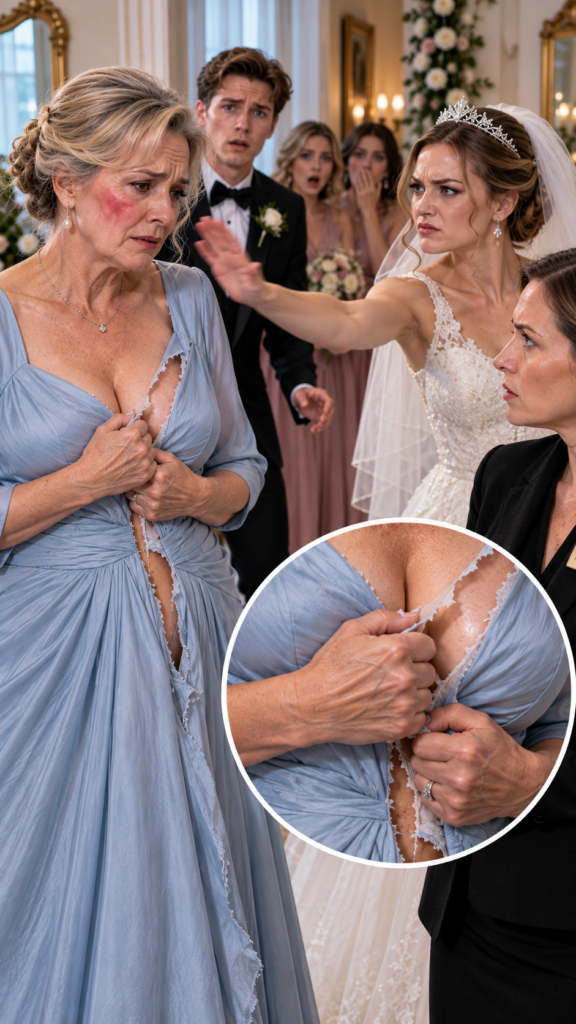
“My future daughter-in-law slapped me across the face fifteen minutes before she was supposed to marry my only son. Then Madison grabbed the front of my pale blue gown and ripped it open from the neckline almost to my waist while six bridesmaids stared at me in shock. I stood there holding the torn fabric together with both hands, my cheek burning, and heard her say, “Now maybe you’ll be too embarrassed to walk into MY ceremony.” What happened next hurt far more than the slap.
My name is Claire Hale, and I was sixty-two years old that afternoon. I had buried my husband, David, six years earlier, retired after twenty-three years as an elementary school principal, and learned how to keep functioning even when grief made ordinary mornings feel impossible. I thought I understood humiliation and loss. I had no idea my own son was about to teach me a new kind.
The argument had begun over something almost ridiculous. Madison’s sister, Lauren, had rushed into the hallway because the loop on Madison’s cathedral veil had torn, and she remembered I carried a small sewing kit in my purse. I repaired the veil in four minutes, packed my needle away, and was preparing to leave the bridal suite. Then Madison noticed two place cards had been moved at the family table.
She immediately accused me of changing her seating chart. I told her I had touched nothing except her veil, and Lauren tried to confirm it, but Madison was already angry. For nine months, I had deliberately stayed out of her wedding plans because I knew she was sensitive about my involvement. I had chosen none of the flowers, food, music, invitations, or decorations.
There was only one reason my name appeared on the venue contract. Ethan and Madison lived three states away when Bellamy House unexpectedly became available, and my son had called me begging me to secure the date before another couple took it. I signed the agreement and paid the initial deposit, then promised them a fixed contribution toward the wedding. I wanted my son to begin married life with a beautiful memory instead of debt.
Madison never seemed to see my help that way. Standing in her wedding gown, she suddenly demanded to know what I had told Ethan the night before about their spending. I stared at her because I had not spoken to Ethan about the wedding budget the previous night at all. That should have been my first warning that something else was going on.
“You told him this wedding had gotten out of control,” she accused me. “You told him I was taking advantage of you.” I told her neither statement had come from me, but she kept pushing, insisting I had been using the contract to remind everyone the wedding existed because of my money. The angrier she became, the more I noticed something strange beneath that anger.
She looked afraid.
At the time, I didn’t understand what she had to fear from me. I simply told her she was getting married in minutes, and we could discuss whatever was upsetting her afterward. I turned toward the door because I refused to fight with a bride on her wedding day. That was when she stepped forward and struck me.
The slap cracked through the bridal suite. Before I could even process it, she seized the front of my gown and pulled hard enough to tear the fabric nearly to my waist. Lauren shouted her sister’s name, and another bridesmaid gasped. Madison only looked at me with a strange satisfaction.
I didn’t scream or hit her back. I gathered the torn sides of my dress in my hands, picked up my purse, and said quietly, “I hope nobody ever treats you the way you just treated me.” Madison rolled her eyes and told me not to become dramatic. I walked out because I still believed leaving quietly was the most dignified thing I could do.
Then I found Ethan standing in the hallway.
He looked from the red mark on my cheek to the ripped dress I was clutching closed. For half a second, I saw genuine shock in his face, and I thought my son would finally ask me what Madison had done. Instead, Madison rushed out behind me and started talking first. She claimed I had entered the bridal suite criticizing everything and reminding her that I had paid for the venue.
Lauren appeared in the doorway and softly said, “That’s not what happened.” Ethan barely seemed to hear her. He rubbed both hands across his face as though the real crisis was that two difficult women had chosen the worst possible moment to argue. I watched him and felt something cold begin forming inside me.
“Your fiancée hit me,” I said.
He looked at Madison, then back at me. “Can we deal with this after the wedding?” he asked. I reminded him that she had also ripped my dress, and he lowered his voice as guests and staff moved somewhere beyond the hallway. “Mom, please don’t make a scene.”
Those six words changed something between us.
For most of Ethan’s life, I had been the safe person. If his father got angry, I calmed things down; when Ethan made mistakes, I helped him repair them; when he needed money, advice, forgiveness, or somewhere to land, I was there. After David died, that habit became even stronger because Ethan was the family I had left closest to me. I had never realized that unconditional love could slowly teach someone that hurting me carried no immediate consequence.
In that hallway, I understood exactly what Ethan was doing. He was afraid Madison would punish him if he challenged her, but he believed I would still love him even if he disappointed me. Between the woman who might explode and the mother who always forgave him, I was the safer person to hurt. So he chose me.
“All right,” I said quietly. “I won’t make a scene.”
Relief flashed across his face.
Then I added, “I’m going home.”
That relief vanished instantly.
I walked into the small family sitting room and locked the door. In front of the mirror, I removed the pearl earrings David had given me on our twenty-fifth anniversary and placed them carefully inside my purse. My cheek was still hot, but humiliation was turning into something colder and clearer.
I was reaching for the door when someone began pounding hard enough to rattle the frame. “Claire, please open up,” wedding coordinator Natalie Greene called from outside. “We have a serious problem.” When I opened the door, she was holding a thick cream-colored contract folder against her chest, with Ethan behind her and Madison farther down the hallway.
Madison pointed at me. “She’s leaving.”
Natalie didn’t move.
Instead, she opened the folder, looked straight at Madison, and said, “There’s a problem. The woman you just threw out is the only person authorized to approve this wedding.”
For the first time that afternoon, Madison stopped smiling.
And suddenly nobody was looking at my torn dress anymore.
The hallway became so quiet I could hear the faint music drifting through the closed ballroom doors.
Madison’s finger was still pointed at me, but it had begun to tremble.
“What does that mean?” Ethan asked.
Natalie looked at him, then at me.
“It means your mother is the contracting client for Bellamy House. Any final authorization, changes to the event order, and approval of the remaining venue charges require her signature.”
Madison gave a sharp little laugh.
“That’s ridiculous. Everything was finalized weeks ago.”
Natalie’s expression didn’t change.
“No. It wasn’t.”
Something inside Madison’s face tightened.
It happened so quickly I might have missed it if I hadn’t spent twenty-three years watching children lie about broken windows, missing homework, and playground fights. Fear didn’t always look like panic. Sometimes it looked like irritation arriving half a second too fast.
Natalie opened the folder wider.
“There are several change orders that were submitted after the original agreement. I have been waiting for Claire’s authorization.”
Ethan looked at Madison.
“What change orders?”
“Nothing important,” she said immediately.
Natalie’s eyes flicked toward her.
“That isn’t accurate.”
Madison’s face flushed.
“Natalie, this is not the time.”
“No,” I said.
My voice surprised even me.
Everyone looked at me.
I pressed one hand more firmly over the torn front of my gown.
“I think this is exactly the time.”
Madison stared at me as though I had violated some agreement between us.
For months, that had been our unspoken arrangement. She could push. I would absorb it. She could make small comments about my clothes, my age, my opinions, the way I pronounced certain restaurant names, the fact that I still wrote thank-you notes by hand.
I would smile.
She could roll her eyes when Ethan called me for advice.
I would change the subject.
She could tell people I worried too much, talked too much, helped too much.
I would remind myself that she was the woman my son loved.
But something had shifted.
Maybe it was the slap.
Maybe it was the sound of fabric tearing in her fists.
Maybe it was my son asking me to postpone being hurt until it was convenient for him.
Whatever it was, I no longer felt any urge to make this easier for them.
Natalie turned one page in the folder.
“The original contribution and venue package were clear. These later requests increased the amount significantly.”
Ethan’s jaw tightened.
“How significantly?”
Madison stepped toward him.
“Ethan, we already discussed this.”
“No.” His eyes stayed on Natalie. “You and I discussed a number last night. You told me my mother knew about it.”
My breath caught.
There it was.
The fear I had seen in Madison’s face in the bridal suite.
She hadn’t been angry because I had spoken to Ethan.
She had been terrified that I had.
I looked at my son.
“Is that why she thought I talked to you?”
Ethan finally met my eyes.
“Yes.”
One word.
No excuse attached to it.
Madison shook her head hard enough to move the edge of her veil.
“This is insane. We have two hundred people waiting.”
Lauren had stepped out of the bridal suite now.
She was pale.
“Madison.”
Her sister swung around.
“Not now.”
Lauren swallowed.
“I think it has to be now.”
Madison’s expression changed.
It wasn’t fear this time.
It was warning.
Lauren saw it too.
Her hands closed at her sides, but she didn’t retreat.
“You kept telling them Claire would approve everything,” she said.
Nobody moved.
Madison stared at her.
Lauren’s voice shook on the next sentence, but she kept going.
“You told the florist that. You told the venue staff that. You said Claire always gave Ethan whatever he asked for, so it wouldn’t matter.”
“Lauren, shut up.”
Ethan flinched.
Not because Madison had raised her voice.
Because of how naturally the words came out.
Lauren looked at her sister for a long moment.
Then she said, very softly, “You hit her.”
Madison’s lips parted.
“You watched me.”
“Yes.”
“She was provoking me.”
“No.”
Lauren’s eyes filled, but her voice steadied.
“She fixed your veil.”
The sentence landed harder than shouting would have.
Madison looked around the hallway as though searching for someone who would put the world back the way it had been fifteen minutes earlier.
No one did.
Ethan turned toward me.
I saw something terrible happen in his face.
He began to understand the order of things.
Not just the slap.
Not just the dress.
He was realizing that Madison had accused me of interfering because she needed me to be the problem before anyone looked closely at what she had been doing.
He rubbed his mouth with one hand.
“Mom.”
I looked away.
I wasn’t ready for that word.
Not from him.
Not yet.
Natalie closed the folder gently.
“I need a decision, Claire.”
Madison spun toward her.
“She doesn’t get to decide whether I get married.”
Natalie remained calm.
“She decides whether Bellamy House proceeds under the agreement she signed.”
“Fine. Ethan can sign it.”
“He cannot replace the contracting client fifteen minutes before the ceremony.”
“I’ll sign it.”
“You are not the contracting client.”
Madison’s face hardened.
“Then change it.”
Natalie shook her head.
“That is not something I can do in this hallway.”
Madison turned to Ethan.
“Say something.”
He stared at her.
For the first time since I had known her, she looked genuinely uncertain around him.
Not annoyed.
Not impatient.
Uncertain.
“Did you tell me my mother approved those extra costs?” he asked.
Madison exhaled through her nose.
“Oh my God, Ethan.”
“Did you?”
“They were wedding expenses.”
“That isn’t what I asked.”
She glanced at me.
There was so much resentment in that look that I almost stepped backward.
Almost.
“Yes,” she snapped. “Because she was paying for the wedding.”
“No,” I said.
Madison laughed bitterly.
“You signed the venue.”
“I promised you a fixed contribution.”
“You’re his mother.”
“Yes.”
“So?”
The word echoed.
I studied her.
For the first time, I realized she truly did not understand.
“My being his mother does not make everything I have belong to both of you.”
Her face went still.
Ethan lowered his head.
I could see the shame moving through him before he said anything.
Because he understood that sentence applied to him too.
Madison crossed her arms.
“This is unbelievable.”
“No,” Ethan said.
His voice was quiet.
She looked at him.
He lifted his head.
“What’s unbelievable is that I’m standing here trying to figure out whether you lied to me about my mother’s money after you hit her.”
Madison blinked.
The silence stretched.
Then she did something I had seen her do before whenever Ethan came close to disagreeing with her.
Her face softened.
Her voice changed.
“Baby.”
I watched my son’s shoulders tense.
“We’re stressed,” she said. “Both of us. This wedding has been insane. Your mother came in there, and everything just—”
“Stop.”
Ethan’s voice cracked on the word.
Madison stared at him.
He looked terrified.
But he didn’t take it back.
“You hit my mother.”
“She was—”
“You hit her.”
Madison’s eyes flashed.
“And where were you when she spent nine months making me feel like I was borrowing her son?”
I almost spoke.
Ethan did first.
“She stayed out of the wedding.”
“That’s what she says.”
“That’s what I asked her to do.”
Madison’s mouth closed.
He took one slow breath.
Then another.
I could see his father in him suddenly.
Not because David had been fearless. He wasn’t. David hated confrontation so much that he once drove twenty minutes back to a restaurant because the waiter had given him someone else’s credit card and he couldn’t bear to point it out in front of the table.
But when something mattered, David planted his feet.
Ethan finally did.
“I’m not getting married today.”
Madison’s face emptied.
The words seemed to hang between them.
Somewhere beyond the ballroom doors, the music stopped.
Maybe a coordinator had signaled the musicians.
Maybe someone had simply realized the ceremony should have begun already.
Madison whispered, “What?”
Ethan’s eyes shone.
“I’m not marrying you.”
“You’re upset.”
“Yes.”
“We can deal with this later.”
My stomach tightened at the words.
Ethan heard them too.
His eyes moved to me.
He knew.
That was exactly what he had said to me.
Can we deal with this after the wedding?
He looked back at Madison.
“No.”
She took a step toward him.
“Ethan.”
“No.”
This time his voice didn’t break.
“You don’t get to ask me to postpone seeing who you are because the timing is inconvenient.”
Madison stared at him.
Then at me.
And suddenly the mask fell away.
“This is what you wanted.”
She pointed at me again.
“You wanted this from the beginning.”
I felt every eye in the hallway turn toward me.
Months earlier, I would have defended myself.
I would have listed every dinner I had paid for without comment, every dress appointment I had declined, every opinion I had swallowed.
I would have tried to prove I was a good mother.
Instead, I said, “No.”
That was all.
Madison waited.
When nothing else came, her face twisted.
“You think you won?”
“I think my face hurts.”
Her eyes dropped to my cheek.
For one brief second, something like shame appeared.
Then it vanished.
Lauren covered her mouth.
Ethan looked away.
Madison’s hand slowly lowered.
Natalie stepped closer to me.
“We can stop the event,” she said quietly. “I’ll handle the guests.”
I looked at Ethan.
His face had gone pale.
This was supposed to be the happiest day of his life.
Instead, he was standing in a hallway beside a woman he had expected to marry, learning what fear had persuaded him not to see.
He looked like a child again.
But he wasn’t one.
That mattered.
“What do you want?” I asked him.
Madison’s head snapped toward me.
Ethan stared at the floor.
When he answered, his voice was barely audible.
“I want it stopped.”
Natalie nodded once.
Madison made a sound I had never heard from another adult before. Not quite a sob. Not quite a laugh.
“You’re canceling our wedding because your mother got slapped?”
Ethan looked at her.
“No.”
He swallowed.
“I’m canceling because you slapped her, lied to me, tried to make her responsible for money she never agreed to spend, and then expected me to protect you from the consequences.”
Madison’s eyes filled.
For a moment I wondered if he would move toward her.
He didn’t.
Neither did I.
Lauren did.
Not to comfort her.
She quietly reached up and removed the loose end of Madison’s veil from where it had caught on a brass door handle.
The same veil I had repaired minutes earlier.
Madison looked at her sister’s hands.
Then at mine, still clutching my torn gown.
Something in her face collapsed.
But apologies did not come.
She turned and walked back into the bridal suite.
The door shut behind her.
Nobody followed for several seconds.
Then Lauren looked at Ethan.
“I’ll stay with her until Mom and Dad get here.”
He nodded.
Lauren turned to me.
Her chin trembled.
“Claire, I’m sorry.”
“You told the truth.”
“I should have done it sooner.”
I thought about how easy it is to judge courage after the danger has passed.
Then I thought about the way she had stood in that doorway and contradicted her sister while everyone else was frozen.
“You did it when it mattered.”
Her eyes closed briefly.
Then she went after Madison.
Natalie began making calls.
Quiet calls.
Professional calls.
No announcements about betrayal.
No public humiliation.
The guests were told there had been a private family emergency and the ceremony would not proceed.
Some people whispered.
Some stared.
Most simply collected coats, flowers, programs, and children.
Life dismantled itself surprisingly fast.
A wedding that had taken nine months to build disappeared in less than an hour.
I remained in the sitting room.
Natalie found safety pins and a small emergency sewing kit, but my hands shook too badly to repair the gown.
So she helped me pin it closed.
Neither of us mentioned the irony.
When she finished, she stepped back.
“It will get you home.”
“That’s all I need.”
She hesitated.
“Claire, about the contract.”
“Not today.”
“Of course.”
“I’ll honor what I legitimately agreed to pay.”
She nodded.
“But nothing I didn’t authorize.”
“Understood.”
“And I want a complete copy of every change request.”
“You’ll have it.”
I picked up my purse.
My fingers brushed the pearl earrings inside.
For the first time all afternoon, I nearly cried.
Not because of Madison.
Because David had given me those pearls at a restaurant where he had been so nervous about the surprise that he dropped one of them into the bread basket.
I remembered laughing until tears ran down my face.
I remembered Ethan at twelve, mortified by us.
I remembered having a family before I ever understood that families could survive and still become something unrecognizable.
The door opened softly.
Ethan stood there.
He had removed his boutonniere.
He held it in one hand.
“Can I come in?”
I looked at him.
“Not yet.”
His face crumpled.
He nodded immediately.
“All right.”
I expected him to leave.
He didn’t.
He sat down on the floor outside the doorway.
Not blocking it.
Not speaking.
Just waiting.
I stared at the strip of carpet between us.
“You don’t have to sit there.”
“I know.”
“I’m going home.”
“I know.”
“I don’t want you coming with me.”
His eyes closed.
“I know.”
That hurt him.
I could tell.
For once, I let it.
I walked past him.
He stood but didn’t touch me.
At the end of the hallway, I looked back.
He was still standing where I had left him, holding the crushed boutonniere.
My son had chosen me too late that afternoon.
But for the first time, he seemed to understand that being sorry did not entitle him to be immediately forgiven.
That mattered too.
For three days, I did not answer his calls.
He left one voicemail the first night.
“Mom, I’m safe. I won’t keep calling. I just need you to know I’m sorry.”
The second night, he sent a text.
I love you. I understand if that doesn’t help right now.
On the third morning, flowers arrived.
I almost threw them away.
Then I saw the card.
There was no apology written on it.
Only four words.
No response required. Ethan.
I put the flowers in water.
That was not forgiveness.
But it was the first thing he had done in years that did not ask me to take care of his feelings.
A week later, I agreed to meet him at my kitchen table.
He looked exhausted.
No ring.
No wedding photographs.
No Madison.
He sat across from me with both hands wrapped around a cup of coffee he barely touched.
“I ended the engagement.”
I nodded.
“She moved out yesterday.”
I waited.
He looked toward the window.
“I keep replaying the hallway.”
“So do I.”
His eyes came back to mine.
“I saw your face.”
I said nothing.
“And I still asked you not to make a scene.”
His mouth tightened.
“I’ve tried to find a version of that sentence that makes me sound less awful.”
“There isn’t one.”
“I know.”
Silence filled the kitchen.
He rubbed his thumb against the coffee cup.
“I was afraid of her.”
That was the first excuse he offered.
I could have rejected it.
Instead, I asked, “And what did you think I was?”
His eyes filled immediately.
“Safe.”
There it was.
The truth.
I leaned back in my chair.
“Safe doesn’t mean disposable, Ethan.”
“I know.”
“No. You know now.”
He bowed his head.
A tear fell onto his hand.
I let him wipe it away himself.
“I kept thinking love meant I should keep the peace,” he whispered.
“Peace for whom?”
He looked at me.
That question stayed in the room a long time.
Eventually he said, “Her.”
“And the cost?”
“You.”
I nodded.
He cried then.
Quietly.
Not dramatically.
His shoulders shook while he stared down at his untouched coffee.
I did not move around the table to comfort him.
That might sound cruel.
It wasn’t.
My whole life with Ethan, I had rushed toward his pain before he had time to understand it.
That morning, I loved him enough to stay seated.
He had to feel the weight of what he had done without handing it back to me to carry.
Months passed.
He began seeing a counselor.
He never used therapy as proof that I should trust him again.
He simply went.
He paid me back for every wedding expense that had been his responsibility, a little at a time, even after I told him I did not need the money.
“It isn’t about what you need,” he said.
That sentence stayed with me.
Madison never contacted me directly.
Lauren did.
She wrote a letter.
Six pages.
She did not ask me to forgive her sister. She did not explain the slap away with stress or pressure or childhood wounds.
She simply told me the truth.
Madison had become increasingly controlling during the engagement. Lauren had watched her dismiss Ethan, mock him, threaten to cancel plans when he disagreed, and then become affectionate whenever he started pulling away.
Lauren had told herself it was none of her business.
Until the bridal suite.
At the end of the letter, she wrote one sentence I read three times.
I am sorry I learned the difference between staying out of something and standing by while it happens.
I kept the letter.
Not because I needed evidence.
Because I understood the sentence.
By spring, Ethan and I had reached something that was not quite our old relationship.
I was grateful for that.
The old relationship had been built partly on me having no edges.
The new one had boundaries.
He called before visiting.
He stopped assuming holidays.
He asked before borrowing.
When I said no, he did not punish me with silence.
When he apologized, he stopped adding explanations after the apology.
Small things.
Enormous things.
Then one Sunday afternoon, nearly six months after the wedding that never happened, Ethan came to my house carrying a small cream envelope.
My stomach tightened at the color.
He noticed.
“It’s not from Bellamy House.”
I almost laughed.
Almost.
We sat at the dining table.
He placed the envelope between us but didn’t push it toward me.
“There’s something I never told you.”
I waited.
His face had changed over those months.
Not older exactly.
Less protected.
“I moved the place cards.”
For a second I thought I had misunderstood him.
“What?”
“At the wedding.”
My hands went still.
“The two place cards Madison accused me of moving?”
He nodded.
“I moved them the night before.”
I stared at him.
“Why?”
He looked down.
“Because she had seated you at the far end of the family table.”
Something tightened behind my ribs.
“She said it was because the photographers needed symmetry.”
A sad smile touched his mouth.
“I knew that wasn’t why.”
I could barely breathe.
“So I moved your card.”
“Where?”
“Beside mine.”
The room blurred.
He kept speaking.
“I switched another card so you could sit next to me. I didn’t tell her.”
“Why not?”
He met my eyes.
And there was the boy inside the man again.
“Because I was afraid she’d make me put it back.”
I closed my eyes.
All at once I saw the bridal suite differently.
Madison staring at those moved cards.
Madison accusing me.
Madison demanding to know what I had told Ethan.
Her fear.
Her anger.
The tiny crack in the control she had been trying to maintain.
“You should have told her it was you.”
“I know.”
“You should have told me.”
“I know.”
“You should have stood beside me before she ever raised her hand.”
His voice broke.
“I know.”
I opened my eyes.
He did not look away.
Then he slid the cream envelope toward me.
Inside was one place card.
Mine.
Claire Hale.
The ink had been smudged slightly at one corner.
“I found it in a box of wedding things when I finished moving out,” he said.
I ran my thumb over my name.
For months, I had remembered those place cards as the ridiculous beginning of the worst day of my life.
Now one of them was resting in my hand like proof of something more complicated.
My son had failed me terribly.
But before he failed me, he had tried—quietly, weakly, secretly—to make a place for me beside him.
It did not erase the hallway.
It did not erase the six words.
It did not erase the moment he chose the person he feared over the mother he trusted.
But it told me something I had needed time to understand.
People do not always begin changing when they finally become brave.
Sometimes they begin much earlier, in tiny frightened acts no one sees.
Moving a place card.
Questioning a bill.
Noticing a lie.
Feeling the first uncomfortable certainty that love should not require fear.
I looked at Ethan.
“You understand moving a card wasn’t enough.”
“Yes.”
“You needed to move yourself.”
Tears filled his eyes.
“I know.”
I reached across the table.
Not to rescue him.
Not because everything had been repaired.
I simply turned my hand palm up.
He stared at it.
Then he placed his hand in mine.
His fingers were warm.
For a long time neither of us spoke.
That summer, I wore David’s pearls again for the first time.
Ethan noticed immediately.
We were having dinner at my house.
Nothing elaborate.
Roast chicken, potatoes, green beans, and a bottle of wine David would have complained was too expensive before drinking two glasses of it.
Ethan had arrived early and asked what he could do.
I gave him the silverware.
He set the table.
I did not follow behind him correcting anything.
When we sat down, there were only two plates.
Two glasses.
Two people trying to learn how to be family without one of them disappearing inside the needs of the other.
Halfway through dinner, Ethan looked at the empty chair that had once been David’s.
“I wish Dad could see us now.”
I touched one pearl earring.
“He probably would have told us both we were being stubborn.”
Ethan laughed softly.
Then his eyes filled.
“Yeah.”
Outside, evening settled over the yard.
The windows darkened until the kitchen reflected back at us.
For years after David died, I had hated that moment of nightfall.
The glass would turn black, and suddenly I could see myself sitting alone inside the house we had chosen together.
That night, the reflection looked different.
I saw a sixty-two-year-old woman who had finally learned that dignity was not the same thing as silence.
I saw a son who had learned that love without courage could still cause harm.
I saw an empty chair that no longer felt like proof that everything good had ended.
And beside my plate, Ethan had placed the old cream wedding card with my name on it.
I looked at him.
He gave a small, embarrassed shrug.
“I thought maybe it finally belonged where I meant it to be.”
My throat tightened.
I picked up the card.
Then I moved it away from my plate and placed it gently between us.
Not because I needed a reserved seat anymore.
Because I finally understood that I did not have to earn my place in the lives of people who loved me.
Neither did I have to stay where love required me to become smaller.
Ethan lifted his wineglass.
“To Mom.”
I shook my head.
He paused.
I lifted mine.
“To learning.”
His mouth curved into a real smile.
“To learning.”
The glasses touched with a soft clear sound.
And when the last light disappeared beyond the windows, I caught our reflection in the glass again—David’s pearls at my ears, my son beside me, and my own face calm between them.
For the first time in years, home did not feel like the place where I waited for someone I loved to come back.
It felt like the place where I had finally come back to myself.






