I woke up at 6:17 on the morning of my only son’s wedding with my scalp burning.
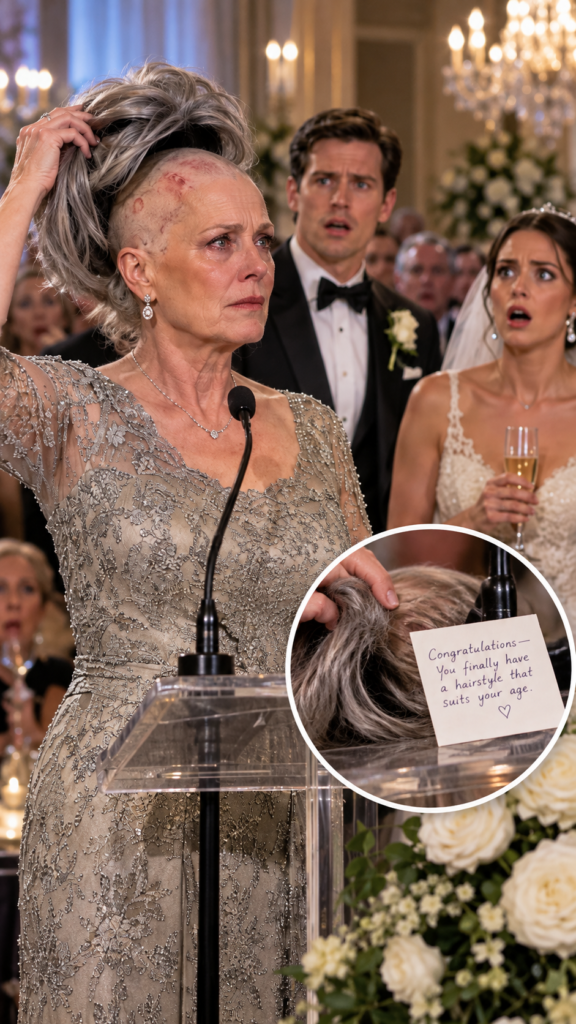
Half asleep, I reached for the long silver hair I had worn for years, but my fingers touched bare, scraped skin instead. When I sat up, pieces of my hair were scattered across my pillow, my duvet, and the bedroom carpet. Someone had been standing over me with a razor while I slept. I stumbled into the bathroom and nearly screamed when I saw myself in the mirror. Most of my hair was gone, a few jagged silver patches remained near one ear, and the skin above my temple was red where the razor had cut too deeply. Beside the sink was a damp hand towel carrying the sharp smell of antiseptic. Whoever had done this had not acted on impulse—they had come prepared, shaved me carefully enough not to wake me, and even cleaned the blood afterward. Then I saw the note taped neatly to my mirror. “Congratulations—you finally have a hairstyle that suits your age,” it said, with a tiny heart drawn underneath. I recognized the handwriting, but even if I hadn’t, the paper carried the sweet orange-blossom-and-vanilla perfume my future daughter-in-law Sabrina wore everywhere. In only a few hours, she was supposed to marry my only son, Michael. For three years, Sabrina had found small ways to humiliate me while making each insult sound like a joke. She mocked my age, my clothes, my hair, the way I spoke, even the fact that I sometimes called restaurants instead of using an app. Whenever I objected, she smiled and said I was too sensitive, and Michael usually told me she was only joking. Somehow, I always became the one expected to apologize so everyone else could move on. I had tolerated it because Michael was my only child. His father died when Michael was twelve, and after that I built my entire life around making sure my son never felt the financial fear I had lived through. I started with one struggling duplex and spent nearly three decades building a real-estate company known across Boston. I survived bankers who dismissed me, contractors who underestimated me, sleepless nights, debt, and grief—but when it came to Michael, I had one weakness I could never seem to overcome. I kept rescuing him. When he wanted a better apartment, I bought one; when his first business failed, I covered the losses; when he traveled, I paid; and when Sabrina fell in love with an expensive penthouse overlooking the Charles River, I quietly began arranging that too. Every check became my private apology for the school plays I had missed and the nights I spent working while another person tucked my son into bed. Somewhere along the way, I started confusing being needed with being loved. That was why the ivory envelope inside my bedroom safe suddenly mattered so much. Inside were documents authorizing a twenty-two-million-dollar wedding gift for Michael and Sabrina, enough to fund the penthouse and establish investments that could secure their future for decades. I had planned to present it at the reception as one final grand gesture from a mother who still felt guilty for working too hard when her son was young. But standing there with razor burns on my scalp, the envelope no longer looked like love. It looked like permission. Permission to disrespect me and still expect my money. Permission for Michael to ignore every insult because I would always forgive. Permission for Sabrina to believe that whatever she did, I would smile politely, write the check, and protect her from consequences because I was terrified of losing my son. So I put the envelope back inside the safe and made a phone call I had never imagined making on Michael’s wedding morning. “Freeze everything,” I told my attorney, Avery Whitman. I ordered him to stop the penthouse transaction, the investment structure, and every pending transfer that required my authorization. When he asked what had happened, I told him only that I was physically safe, then gave him one more instruction. After the reception, I wanted my entire will reviewed. I almost called Michael next. A part of me still wanted my son to burst through my door, see what had happened, and choose me without hesitation. But then I imagined telling him I suspected Sabrina and hearing those familiar words again: “Mom, you know how she is. She was probably joking.” I realized I could not survive being dismissed one more time while the cuts were still fresh. Instead, I called Lucia, my hairstylist. She arrived less than half an hour later, stopped dead when she saw me, then gently cleaned the cuts and fitted me with a natural silver-gray wig. She kept telling me I did not have to attend the wedding, and for several minutes I considered staying home. Then I understood that staying home was probably exactly what Sabrina expected. If I disappeared, she could tell everyone I was jealous, emotional, difficult, sick, or trying to ruin Michael’s day. If I appeared, smiled, and said nothing, she would learn that humiliating me carried no consequences at all. So I chose a third option: I would attend, I would watch, and I would finally stop protecting cruelty simply because exposing it might embarrass someone I loved. Before leaving, I slipped Sabrina’s note into my handbag and switched on the small recorder I normally used for business notes. At St. Andrew’s Church, guests complimented my “new hairstyle,” and photographers flashed cameras as though nothing in the world was wrong. Michael saw me before the ceremony, looked at my hair for barely two seconds, said it looked nice, and never asked why it had changed overnight. I told myself he was nervous, because making excuses for my son was another habit I had spent years perfecting. Then the organ began, and Sabrina entered in white. She looked beautiful, polished, and completely composed. Halfway down the aisle, her eyes found mine, and her gaze went immediately to my silver hair. For one brief second, I saw something that had nothing to do with bridal happiness. Satisfaction. During the photographs, Sabrina slipped an arm around my waist and leaned close enough for her perfume to surround me. “Love the hair,” she whispered while smiling toward the camera. “Much more flattering.” I kept my expression steady and quietly asked, “Better than this morning?” Her body went rigid for one second. She did not answer, but the recorder inside my handbag captured the silence. Later, at the reception, she came behind my chair and said she was “so glad” I had attended because she had worried I might be “too upset.” When I asked what she thought I would be upset about, she told me she did not want drama and whispered that Michael deserved one day that was not about me. Then the emcee lifted his microphone and announced a special moment from the groom’s mother. Sabrina immediately raised her champagne glass because she believed she knew what was coming—the penthouse, the investments, the twenty-two million dollars. I walked to the podium, placed her note where everyone could see it, and looked directly at my son. Three hundred wedding guests turned toward me. “Most of you probably noticed that I changed my hair today,” I said. A few people laughed politely, but Sabrina did not move. I reached one hand toward the edge of my silver hair and added, “Actually, I didn’t.” Then I removed the wig. …
The room did not gasp all at once.
The silence came first.
It moved across the ballroom like cold air beneath a door, reaching one table and then another until forks stopped halfway to mouths and the string quartet in the corner faltered into nothing.
Michael stared at me.
Not at my face.
At my scalp.
His eyes followed the raw red line above my temple, the jagged patches Sabrina had left behind, the uneven places Lucia had cleaned only hours earlier. His mouth opened, but nothing came out.
Across the room, Sabrina’s champagne glass remained raised.
Her fingers had gone white around the stem.
I placed the wig gently beside the note.
“Mom,” Michael finally said.
There was something in his voice I had wanted to hear that morning. Alarm. Fear. Recognition.
It came twelve hours too late.
I looked at him and felt something inside me ache without bending.
“This is what I woke up to on your wedding day.”
He took one step toward me.
I raised my hand.
He stopped.
The movement was small, but I watched him understand it. His mother, the woman who had spent decades stepping aside so he would never be uncomfortable, had just asked him to stay where he was.
Sabrina lowered her glass.
“This is insane,” she said.
Her voice carried farther than she intended.
Every head turned toward her.
She looked around as if the room itself had betrayed her.
“I mean this,” she continued, pointing toward the podium. “Doing this here. Today. In front of everyone.”
I touched the note with one fingertip.
“I found this taped to my mirror.”
Michael’s eyes dropped to the paper.
“What does it say?”
I read it exactly.
No embellishment.
No accusation.
Just the words.
When I finished, someone near the back inhaled sharply.
Michael looked at Sabrina.
She did not look at him.
“Sabrina?”
She set her glass on the nearest table with too much care.
“It was a joke.”
The words were barely audible.
For years, that sentence had ended every argument.
This time, it changed the room.
Michael’s face emptied.
I saw the exact moment memory began assembling itself behind his eyes. Every dinner where she had mocked my clothes. Every comment about my age. Every time I had gone quiet and he had told me not to take it personally.
His jaw tightened.
“You shaved her head?”
Sabrina pressed her lips together.
“I didn’t hurt her.”
Michael looked at the cut above my temple.
Then back at his wife.
“She was asleep.”
“I was careful.”
The sentence fell into the silence like something breaking.
Sabrina heard it too late.
Her eyes widened.
Michael closed his.
For one long second, no one moved.
Then he opened them.
“You did it.”
She folded her arms.
“I was trying to help.”
My stomach turned, but I stayed still.
“Help me?”
“You were going to wear your hair like that in the pictures.”
She stopped.
Her breathing changed.
I watched panic arrive now that she could no longer pretend she had not understood the question.
“That isn’t what I meant.”
Michael stared at her.
“What did you mean?”
She turned toward him.
For the first time all day, the bridal composure disappeared.
“You know how she gets. Everything becomes about her. The hair, the stories, the company, how hard she worked, how much she sacrificed. Everyone always has to know.”
I felt three hundred pairs of eyes move between us.
Once, that would have humiliated me.
Now I only felt tired.
Michael’s voice dropped.
“So you came into her bedroom while she was asleep and shaved her head?”
Sabrina’s eyes filled, but the tears did not soften her face.
“She would have made a scene if I asked.”
I almost laughed.
Not because anything was funny.
Because the cruelty had finally reached a point where excuses could not survive it.
I picked up the note.
“You left this.”
Sabrina looked at it and said nothing.
“The perfume is yours. The handwriting is yours. And when I asked you during the photographs whether my hair looked better than it had that morning, you froze.”
Her gaze snapped toward my handbag.
She knew.
I saw it immediately.
“You recorded me?”
“I recorded my day.”
Her face changed.
Not guilt.
Calculation.
“Michael, she planned this.”
That was when I understood something that hurt more than the razor.
Sabrina still believed the worst thing happening in that room was that she had lost control of the narrative.
She did not see my scalp.
She saw witnesses.
Michael walked toward the podium.
His steps were slow.
When he reached me, his eyes stayed on the cut at my temple.
“How bad is it?”
“Lucia cleaned it.”
“Did you need stitches?”
“No.”
He swallowed.
“Why didn’t you call me?”
The question nearly undid me.
I held his gaze.
“Because I knew what you would say.”
His face tightened.
“No.”
“Yes.”
“I would have—”
“You would have told me she was joking.”
He went completely still.
Behind him, Sabrina shook her head.
“That’s not fair.”
I looked past Michael at her.
“No. It isn’t.”
Michael lowered his eyes.
For years, I had wanted him to defend me.
Now that the moment had finally arrived, I did not want a performance.
I wanted truth.
He rubbed one hand over his mouth.
“I said that.”
I waited.
“More than once.”
“Yes.”
His shoulders fell.
“I made you think you couldn’t call me.”
My throat tightened, but I refused to rescue him from the sentence.
He needed to hear himself finish it.
“I made you think I would protect her before I protected you.”
Sabrina stepped forward.
“Michael.”
He turned.
She stopped.
I had never seen him look at her that way.
Not angry.
Worse.
Clear.
“You knew my mother was asleep.”
Sabrina’s voice sharpened.
“We are not doing this in front of everyone.”
“You already did it in front of her.”
“That makes no sense.”
“You humiliated her for years and I let you.”
His voice cracked on the last word.
He looked at me.
“I let you.”
I felt every old instinct rise at once.
Tell him it was okay.
Tell him he was under pressure.
Tell him relationships were complicated.
Protect him.
I did none of it.
Sabrina glanced at the podium, then at the ballroom.
“What was she going to announce?”
Michael’s head turned slowly.
I saw confusion first.
Then understanding.
Sabrina looked directly at me.
“The penthouse.”
There it was.
Not an apology.
Not even fear of losing her marriage.
The penthouse.
“What about it?” Michael asked.
She ignored him.
“You were giving us that.”
I folded my hands.
“I was.”
The room seemed to contract around her.
“And the investments?”
“I stopped them this morning.”
Her face drained.
Michael stared at me.
“What investments?”
I looked at him.
For the first time that evening, the surprise on his face was entirely genuine.
So Sabrina had known more than he did.
Avery and I had discussed enough details during planning that I had mentioned the structure to Sabrina weeks earlier when she pressed me about long-term arrangements. I had assumed she was asking because she cared about Michael’s future.
Now Michael looked between us.
“How much?”
I hesitated.
Not because I wanted to protect Sabrina.
Because I suddenly understood how grotesque the number sounded in that room.
“Twenty-two million dollars.”
Someone dropped a spoon.
The small silver clatter seemed impossibly loud.
Michael took a step backward.
“You were going to give us twenty-two million dollars?”
“Yes.”
His eyes closed.
Sabrina spoke quickly.
“It wasn’t just money. It was our future.”
“No,” I said.
She turned toward me.
“It was my money.”
Her mouth opened.
I continued before she could speak.
“And I was giving it because I thought generosity could keep this family safe. I was wrong.”
Michael looked at me with something close to horror.
“All those years.”
I knew what he meant.
The apartments.
The business losses.
The trips.
The bills.
“Yes.”
He pressed his fingers against his eyes.
“Mom.”
“I kept paying for things because I thought I owed you.”
“You didn’t.”
The answer came so fast that the room seemed to disappear.
I stared at him.
He looked equally startled by his own certainty.
“You didn’t owe me.”
Sabrina made a frustrated sound.
“Can we please not turn this into therapy?”
Michael turned on her.
“Stop.”
One word.
Quiet.
Final.
She stopped.
I had heard my son angry before.
I had never heard him finished.
He looked at Sabrina’s wedding ring, then at his own.
His thumb moved over the band.
“You need to leave.”
Her expression broke.
“What?”
“I need you to leave.”
“This is our wedding reception.”
“I know.”
“We’re married.”
“I know.”
“Michael.”
He pulled the ring from his finger.
The movement was not dramatic.
That made it worse.
He set it beside her untouched champagne glass.
“I am not going home with you tonight.”
A tremor passed through her mouth.
“You’re choosing her.”
Michael looked at me.
Then back at Sabrina.
“No.”
His voice was almost gentle.
“I’m finally choosing what I should have chosen years ago.”
She stared at him.
“The truth.”
For a moment, I thought she might scream.
Instead, she grabbed her bouquet from the table and pushed through the space between chairs.
No one stopped her.
No one applauded.
No one whispered loudly enough for me to hear.
The ballroom simply opened around her.
That silence followed her all the way to the doors.
When they closed, I realized I was shaking.
Not visibly.
Deep inside.
Like a building after an earthquake, still standing while every beam tested itself.
Michael reached toward me.
Then stopped before touching my arm.
“Can I?”
The question nearly broke me more than anything else had.
I nodded.
His hand settled carefully around my elbow.
He did not pull me into a hug.
He simply stood beside me.
Avery arrived twenty minutes later.
I had texted him from the hallway before the reception began, telling him there was a chance I might need him.
He took one look at my scalp and stopped walking.
Avery had negotiated hostile acquisitions without blinking. I had watched him sit through depositions designed to humiliate him and leave with his tie still perfectly straight.
That night, his eyes filled.
He looked at the note.
Then at Michael.
Then at me.
“Everything is frozen,” he said.
I nodded.
“The penthouse?”
“Stopped.”
“The investment accounts?”
“Never funded.”
“And the trust documents?”
“Unsigned. Nothing transferred.”
Michael exhaled slowly.
Sabrina had not taken the money.
Not one dollar of the wedding gift had left my control.
For the first time all day, I felt something loosen inside my chest.
Avery lowered his voice.
“You also have choices about what happened this morning.”
I knew what he meant.
I looked at Michael.
He did not tell me what to do.
That mattered.
A week earlier, I would have expected him to beg me to keep the family’s problems private.
Instead he said, “Whatever you decide, I’ll tell the truth.”
I made a report the next morning.
Not for revenge.
Not because I wanted Sabrina dragged through humiliation equal to mine.
I did it because waking up to someone standing over you with a razor is not a joke, and I had spent too many years letting polite words disguise things that should never have been permitted.
I gave them the note.
I gave them photographs Lucia had taken before cleaning the cut.
I gave them the recorder.
And Michael gave a statement about Sabrina’s behavior over the years without trying to soften it.
The marriage did not survive the week.
There were lawyers.
There were furious messages from Sabrina.
There were accusations that I had destroyed her life, manipulated Michael, weaponized money, and staged the reception to humiliate her.
I answered none of them.
For the first time, silence did not feel like surrender.
It felt like a locked door.
Michael moved into a small furnished apartment across the city.
When I offered to help, he said no.
My first reaction was almost panic.
“What if you need something?”
“I will.”
“Then call me.”
“I will.”
“With anything.”
He looked at me for a long moment.
“Mom, I need you to let me need something without fixing it.”
The sentence hurt.
Then it healed something.
I nodded.
He began paying his own rent.
He canceled a trip I would normally have funded.
He sold several things he admitted he could no longer afford.
None of it was glamorous.
That was exactly why it mattered.
Three weeks after the wedding, he came to my house carrying a cardboard box.
My scalp had begun to heal. Lucia had trimmed the remaining patches into something even, and for the first time since my twenties, my hair was barely an inch long.
Michael noticed immediately.
He smiled.
Not the careless smile from the church.
A real one.
“You look like yourself.”
I touched the silver stubble.
“I’m not sure I know what that means anymore.”
“I think you’re figuring it out.”
We sat at the kitchen table.
No crystal.
No caterer.
No champagne.
Just coffee and the late-afternoon Boston rain tapping against the windows.
Michael pushed the box toward me.
“I found this while I was going through my old things.”
Inside were school photographs.
Baseball cards.
A broken model airplane.
A program from a middle-school play.
My fingers stopped.
I remembered that play.
I had been in Providence closing on a property that was keeping our company alive.
I had arrived home after midnight and stood outside Michael’s bedroom door crying because I had missed it.
For years, that night had lived inside every check I wrote him.
“I’m sorry,” I whispered.
He shook his head.
“Keep looking.”
Beneath the program was a folded sheet of lined paper.
The edges had softened with age.
At the top, in the uneven handwriting of a twelve-year-old boy, was a school assignment.
The person who makes me feel safe.
I looked at Michael.
He stared down at his coffee.
My hands trembled as I read.
He had written about the months after his father died.
About hearing me work late at the kitchen table.
About waking up once and finding me asleep over bills with a calculator under my hand.
About the duplex.
About paint on my coat.
About how I kept telling him we were going to be all right even when he knew I was afraid.
Then I reached the last paragraph.
I had to stop.
The words blurred.
Michael waited.
I tried again.
My mom misses things because she works a lot. I wish she could come to everything, but I know why she works. She thinks she has to keep me safe now. She already does.
I pressed my hand over my mouth.
All those years.
All those checks.
All that guilt.
“You wrote this?”
He nodded.
“When?”
“Sixth grade.”
“Why didn’t I ever see it?”
“I forgot about it.”
A weak laugh escaped me through tears.
“Thirty years of therapy undone by a cardboard box.”
He laughed too.
Then his face changed.
“I need you to know something.”
I waited.
“I was never angry that you worked.”
My eyes burned.
“I was angry later.”
I flinched.
He reached across the table but did not touch me yet.
“Not because you missed school plays.”
“Then why?”
“Because every time I failed, you made the failure disappear.”
I lowered my eyes.
“I thought I was helping.”
“I know.”
His voice softened.
“That was the problem.”
Rain slid down the windows.
The house smelled like coffee and the rosemary plant on the sill.
Michael looked at the old paper between us.
“I stopped learning how to recover because you always caught me before I hit the ground.”
The truth hurt without cruelty.
I let it.
“And you?” I asked. “Why did you keep letting Sabrina treat me that way?”
His face tightened.
“Because every time she crossed a line, I told myself the next line would be the one that mattered.”
I understood.
Boundaries moved quietly when no one defended them.
“She made me choose between peace and conflict,” he continued. “And I kept calling avoidance peace.”
He looked at me.
“I am sorry.”
Not the quick apology people give when they want discomfort to end.
He stayed there after saying it.
He let me decide what came next.
“I love you,” I said.
His eyes filled.
“But loving you is not going to mean rescuing you anymore.”
He nodded.
“I know.”
“And forgiving you doesn’t mean pretending this didn’t happen.”
“I know.”
“I may get angry again.”
“You should.”
“I may not trust you for a while.”
His voice broke.
“I know.”
Then I reached across the table.
This time I took his hand.
Months passed.
The legal process moved slowly, then quietly.
Sabrina never found a version of what happened that erased the note, the photographs, her own words, or the fact that she had admitted enough in front of hundreds of witnesses to make denial impossible.
The marriage ended.
The penthouse went to another buyer.
The investment structure was dissolved before a dollar entered it.
I revised my will.
Not in anger.
In clarity.
Michael remained my son.
He simply stopped being the center around which every financial decision turned.
Avery helped me separate love from inheritance, generosity from guilt, and family from entitlement.
Lucia came by every few weeks to shape my growing hair.
The first time she ran her fingers through enough silver growth to use scissors instead of clippers, she smiled at my reflection.
“There you are.”
I looked at the woman in the mirror.
The hair was shorter.
The face looked older than I remembered.
The eyes looked calmer.
For once, I did not want to change anything.
Nearly a year after the wedding, Michael invited me to dinner.
His apartment was modest.
The dining table had a scratch along one corner.
Two of the chairs did not match.
He had cooked pasta badly and burned the garlic bread.
I ate every bite.
When I offered to replace the table, he gave me a look.
I laughed.
“Habit.”
“I know.”
“I’m working on it.”
“So am I.”
After dinner, he brought out the old school essay.
He had framed it.
I stared at him.
“You kept it?”
“I thought you should have it.”
He turned the frame around.
On the back, he had written one new sentence.
You never had to buy your way back to me.
My throat closed.
Michael looked suddenly twelve years old again.
Not the boy I had failed.
The boy I had loved so fiercely that fear had distorted what love was supposed to do.
I touched the glass.
“I wish I had known.”
“So do I.”
Then he shook his head.
“Actually, maybe we know now because we were finally forced to stop pretending.”
Outside his window, snow had begun to fall over Boston.
Soft.
Almost weightless.
I stood beside my son and watched it gather along the fire escape.
My hair had grown into a short silver crop by then.
No wig.
No careful waves.
No attempt to look younger.
Michael reached over and touched one small strand near my temple, exactly where the razor had cut me.
The scar had faded to a thin pale line.
“Does it still hurt?”
I thought about the question.
“Sometimes.”
He nodded.
He understood I was not only talking about the scar.
We stood there without trying to repair the silence.
Then he reached for my hand.
Not for money.
Not for rescue.
Not because he needed me to make something disappear.
Just my hand.
I gave it to him.
And for the first time in years, being needed and being loved no longer felt like the same thing.
Love was quieter.
It asked permission.
It told the truth.
It stayed when there was nothing left to buy.
Outside, the snow kept falling over the city I had spent half my life building a future inside.
Beside me stood the son I had nearly lost by giving him too much and asking too little.
Neither of us was who we had been on his wedding morning.
That was not the tragedy I once would have believed it to be.
It was the gift.
Michael squeezed my hand once.
I squeezed back.
And in the warm light of his imperfect little apartment, with burned garlic still lingering in the air and my silver hair catching the reflection from the window, I finally understood that we had not returned to the family we used to be.
We had built one that could survive the truth.






