The moment I opened the door to the room I had kept for myself, I realized my son and daughter-in-law had decided I no longer belonged in my own house. My bed was gone, my antique dresser had vanished, and boxes containing photographs of my late husband had been removed without my permission. In their place were yoga mats, crafting supplies, shelves of candles, and a glowing sign on the wall that said BREATHE. I stood there holding my suitcase, too shocked at first to understand how three years of generosity had turned into this.
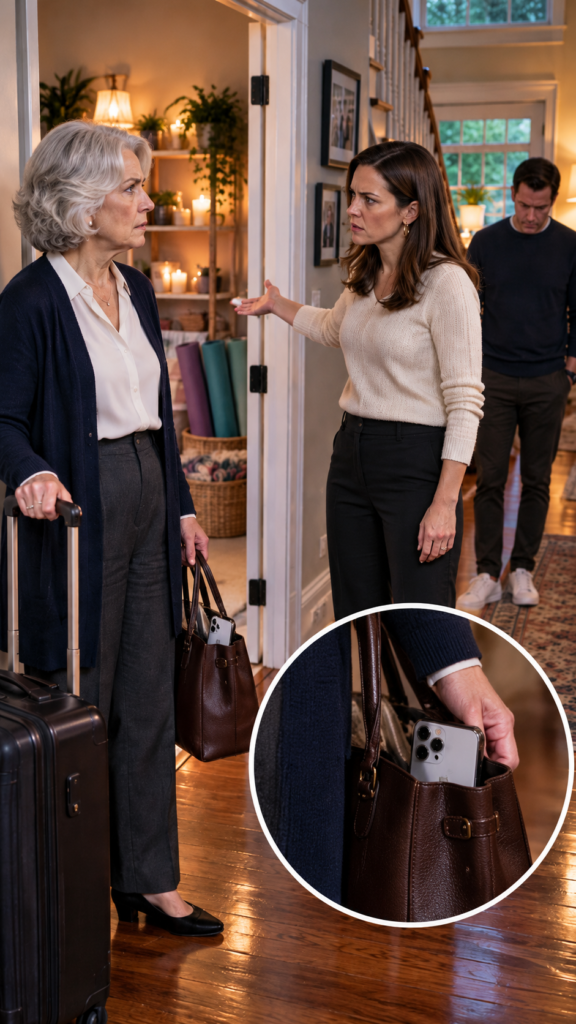
My name is Margaret Thorne, and the house was not some family property with confused ownership. I had bought the four-bedroom colonial with my own money after my husband Richard died, and I had paid for it entirely in cash. The deed was in my name alone, and I continued paying the property taxes, insurance, and every major repair. My son David and his wife Jessica had simply been allowed to live there rent-free while they tried to get ahead financially.
There had been only one firm condition from the beginning. Because I traveled often and sometimes stayed away for months, the furnished first-floor in-law suite would remain mine so I would always have a private place to come home to. David and Jessica agreed without hesitation, and both of them signed a written occupancy agreement confirming it. For nearly three years, I believed that arrangement was understood.
Then I came home from visiting my sister in California and found Jessica waiting in the foyer with her arms crossed. She did not hug me, ask about the drive, or even pretend to be pleased to see me. She watched me pull my suitcase toward my suite with a look I could not immediately understand. The second I opened that door, I understood everything.
I turned and asked where my furniture had gone. Jessica shrugged and told me they had moved it because the room was not being used enough. When I reminded her that the suite had always been reserved for me, she rolled her eyes as though I were an unreasonable guest demanding special treatment. That was when David appeared at the end of the hallway, looking guilty before he had even said a word.
I asked him directly where my belongings were. He told me some of them were in storage, but he would not meet my eyes when he said it. I felt my stomach tighten, because the room had contained more than furniture. It held family photographs, keepsakes from Richard, my grandmother’s quilt, and an antique dresser that had belonged to my mother before it belonged to me.
Jessica did not apologize. Instead, she became angry that I was questioning her at all. She told me she and David were married, that they needed privacy, and that they were tired of me “floating around” whenever I returned from traveling. Then she said the sentence that changed everything between us.
“This is our house now.”
I looked at my son, expecting him to correct her. I expected David to say that the house belonged to me, that they had been given an extraordinary gift, and that his wife had crossed a line by taking apart the one room I had reserved. Instead, he looked down at his expensive sneakers and stayed silent. That silence hurt more than Jessica’s shouting.
Jessica took his silence as permission to go further. She told me to leave, stay in a hotel, buy a condo, or go live with my sister because they had built a life there and did not want me interfering with it. I remember staring at her and thinking about the thousands of dollars I had paid every year so they could live comfortably without rent. Somehow, my help had stopped feeling like help to them and had become something they believed they deserved.
What neither of them seemed to remember was why I had offered the house in the first place. Three years earlier, David and Jessica had been drowning in student loans and living in a cramped apartment with a leaking ceiling and unreliable air conditioning. I wanted to give them breathing room so they could pay down debt, save money, and eventually create something of their own. I never imagined they would begin pretending the thing I owned was already theirs.
I picked up my handbag and suitcase without arguing any further. David finally looked up and asked where I was going, while Jessica watched me as though she had won. I told them only that I needed to step outside and make a phone call. The strange thing was that the moment I walked into the driveway, my hands began shaking even though my mind had become completely calm.
There is a point in some relationships when confusion ends. You stop asking whether people misunderstood your kindness, and you stop looking for the perfect words that will make them appreciate what you have done. You simply accept that they know exactly what they are doing. Standing beside my car that evening, I reached that point with my own son.
I did not call my sister. I did not call a hotel, and I did not call anyone to complain about how cruelly I had been treated. I called Thomas, the attorney who had helped prepare the occupancy agreement before David and Jessica moved in. The moment he heard my voice, he knew something serious had happened.
“They’ve taken over my private suite,” I told him. “They removed my belongings, and they just told me to leave.”
Thomas asked whether I still had the signed agreement. I told him I did, and he immediately reminded me not to promise David or Jessica anything until we had reviewed everything properly. Then he asked a question I had never expected to answer about my own child.
“Margaret, what do you want to do?”
I looked through the front window at the house I had bought with money Richard and I spent decades building together. Jessica was moving behind the curtains as though she were already the owner, and somewhere inside stood the son who had watched her throw me out without defending me. I tightened my hand around the phone.
“I want my house back.”
What I did not know yet was that the missing room was only the beginning. Once I started asking what else David and Jessica had done during those three rent-free years, I would discover that they had not simply taken over my space. They had built an entire life around the assumption that one day, everything I owned would become theirs.
The curtain moved again.
Jessica’s face appeared briefly behind the glass, then vanished. A second later, the porch light went dark.
I stood beside my car with the phone pressed to my ear, staring at the house as if I were seeing it for the first time.
Thomas was quiet for a moment.
“Don’t go back inside tonight,” he said.
Every instinct in me resisted.
“It’s my house.”
“I know.”
The simplicity of his answer nearly broke me.
He asked me to photograph everything I could safely document from where I stood, save every message, and meet him at his office first thing in the morning with the occupancy agreement, deed, tax records, and anything else showing the arrangement.
Then he said, “This is not about whether the house belongs to you. It does. This is about handling what comes next without giving them anything they can turn against you.”
I looked up at the dark porch.
For three years I had tried to make their lives easier.
That night, for the first time, I stopped.
I drove to a small hotel ten minutes away.
Not my sister’s house. Not a friend’s guest room. I needed somewhere no one knew me, where I could set my suitcase beside a bed and hear my own thoughts without someone telling me what I owed them.
The room smelled faintly of detergent and old carpet. I sat on the edge of the mattress without removing my coat.
My phone buzzed.
David.
Mom, can we talk?
Another message came before I answered.
Jessica’s upset. You blindsided us.
I stared at the words until they blurred.
Blindsided.
They had dismantled my bedroom.
Removed my dead husband’s photographs.
Told me to leave my own property.
And somehow I had blindsided them.
I turned the phone facedown.
Twenty minutes later, another message appeared.
Please don’t do anything drastic.
That one was from David too.
I did not respond.
I slept badly and woke before dawn with my jaw aching from clenching it.
At seven, I showered, put on the same clothes, gathered every document I had carried in the locked file case I kept in my car, and drove to Thomas’s office.
He was already there.
Thomas had known Richard and me for nearly twenty years. He had handled the purchase of the colonial after Richard died, and he had been the one who gently suggested a written occupancy agreement when I told him David and Jessica would be moving in.
“Family arrangements get blurry,” he had said then.
I had laughed.
“They’re my children.”
Now he did not remind me of that conversation.
He simply took the folder from my hands and read.
The deed was exactly as I remembered.
My name alone.
The occupancy agreement was even clearer than I remembered. David and Jessica had been granted permission to live in the home without rent while preserving my unrestricted access to the property and exclusive use of the first-floor suite.
Thomas tapped that paragraph once.
“They signed this.”
“I know.”
“Both of them.”
“Yes.”
He looked up.
“And now they’re claiming the house is theirs?”
“Jessica is.”
“What does David say?”
I looked toward the window.
“Nothing.”
Thomas leaned back.
Sometimes silence is an answer even in a law office.
He explained that he would send formal written notice enforcing the agreement, demanding immediate restoration of my access to the suite, an accounting of my belongings, and termination of their occupancy under the provisions they had signed.
He spoke calmly.
No threats.
No dramatic promises.
Just steps.
For the first time since I had opened that bedroom door, I felt the ground beneath me become solid again.
Then Thomas asked, “Where are your belongings?”
“David said storage.”
“Which storage facility?”
“I don’t know.”
His pen stopped.
“Did you authorize them to remove anything?”
“No.”
“Sell anything?”
My stomach tightened.
“No.”
He watched my face.
“Margaret.”
“I don’t know.”
That was the moment fear replaced anger.
Not fear of losing the house.
Fear of learning what had already been lost.
Thomas called David while I sat across from him.
He put the phone on speaker only after David agreed.
My son’s voice sounded small.
“Mom’s there?”
“Yes,” Thomas said.
A pause.
“Hi, Mom.”
I did not answer.
Thomas asked where my belongings had been taken.
David hesitated.
“Most of it is at Lakeview Storage.”
“Most?”
Silence.
I felt my fingers go cold.
Thomas repeated the word.
“Most?”
David exhaled.
“The dresser isn’t there.”
I closed my eyes.
“Where is it?” I asked.
David said nothing.
My voice came out steadier than I felt.
“Where is my mother’s dresser?”
“It’s at a consignment place.”
The room became completely still.
I heard the hum of Thomas’s computer.
A car passed outside.
Somewhere down the hallway, a printer started and stopped.
“Why?” I asked.
David’s answer was barely audible.
“Jessica said you weren’t using it.”
I laughed once.
It was not a happy sound.
“Did you sell it?”
“No. Not yet.”
Not yet.
Those two words went through me like a blade.
Thomas immediately asked for the name and address.
David gave it.
Then I asked the question I had been trying not to ask since the night before.
“Did you help her move it?”
Another silence.
“Yes.”
I looked down at my hands.
Richard used to say that disappointment had weight. I had always thought he meant that metaphorically.
That morning I understood.
It sat on my chest.
Thomas ended the call after instructing David not to move, sell, discard, alter, or give away another item belonging to me.
I remained in the chair.
“I want the dresser back,” I said.
“We’ll get it.”
“And the photographs.”
“Yes.”
“The quilt.”
“Yes.”
I nodded.
Then I whispered, “I want everything back.”
Thomas’s expression softened.
“I know.”
By noon, the consignment shop had confirmed the dresser was still there.
I went with Thomas.
The woman behind the counter looked embarrassed when she saw the documents showing the piece belonged to me.
“It came in three days ago,” she said.
Three days.
While I was packing to come home.
While I was buying a small gift for Jessica at an airport shop because she liked lavender hand cream.
My mother’s dresser had been tagged with a price.
I walked into the back room.
There it stood between a painted cabinet and a set of dining chairs, one drawer slightly open.
I put my hand on the worn brass handle.
My mother had opened that drawer every morning for thirty years.
After she died, I had done the same.
And Jessica had looked at it and seen something taking up space.
Thomas arranged for it to be returned.
I did not cry until we reached the parking lot.
Even then, it lasted only a few seconds.
I pressed the heel of my hand to my mouth, breathed through it, and got back into the car.
We went to Lakeview Storage next.
David met us there.
He looked as though he had not slept.
Jessica was not with him.
He held a small silver key.
For several seconds, neither of us spoke.
Then he unlocked the unit.
My bed frame was leaning against one wall.
Boxes were stacked along the other.
A lamp.
Two chairs.
The framed photograph of Richard taken on our thirtieth anniversary.
My grandmother’s quilt was wrapped in clear protective fabric on the top shelf.
I walked toward it.
My legs felt weak.
I touched the plastic covering.
“She wanted to donate some of this,” David said behind me.
I turned slowly.
He swallowed.
“I wouldn’t let her.”
That should have comforted me.
Instead, it made something inside me ache even harder.
“You wouldn’t let her throw away my things.”
“No.”
“But you let her throw away my place in the house.”
David looked down.
There were the sneakers again.
Expensive, spotless, useless.
“I know.”
“No. I don’t think you do.”
He lifted his eyes.
They were red.
“Mom—”
“You stood there.”
His mouth closed.
“You stood there while she told me to get a hotel. You stood there while she told me to go live with my sister. You stood there while she called my house hers.”
“I was scared.”
“Of what?”
He looked toward the concrete floor.
“Of my marriage.”
I waited.
David rubbed both hands over his face.
“Jessica kept saying you’d barely be home anymore. That you were traveling more. That eventually you’d move to California. She said we were stupid to keep saving for another house when this one would probably be mine someday.”
My stomach turned.
“Probably.”
He nodded miserably.
“At first I told her no.”
“At first.”
“We argued about it.”
“And then?”
His shoulders dropped.
“Then I got tired of arguing.”
There it was.
Not a conspiracy.
Not confusion.
Cowardice.
Ordinary, quiet cowardice.
The kind that can destroy a family while everyone insists they were only trying to keep the peace.
“How long ago did you stop saving?” I asked.
David did not answer quickly enough.
“How long?”
“Almost two years.”
I stared at him.
They had moved into my house to save for their future.
Within a year, they had stopped trying to build one.
“What did you do with the money?”
“Paid debt. Traveled some. Bought things.”
I thought about the expensive sneakers.
The new car Jessica had shown me photographs of.
The weekend trips.
The kitchen appliance upgrade I had paid for because they told me money was tight.
David’s face changed when he saw me putting the pieces together.
“I’m sorry.”
“Did you ever intend to leave?”
He opened his mouth.
Nothing came out.
That was answer enough.
Thomas stepped away, giving us privacy without really leaving.
I looked around at my life stacked in boxes.
“Did you tell people this was your house?”
David closed his eyes.
“Jessica did.”
“And you corrected her?”
His silence returned.
The same silence from the hallway.
Only now I knew how long it had been living with us.
When we returned to the colonial that afternoon, Jessica was waiting in the living room.
She had arranged herself on the sofa as though she were preparing for a negotiation.
Her arms were crossed.
Her face was pale but controlled.
Thomas placed the formal notice on the coffee table.
Jessica barely glanced at it.
“This is ridiculous.”
I remained standing.
David stayed near the doorway.
Jessica looked at him.
“Say something.”
He didn’t.
Her eyes sharpened.
“David.”
He inhaled.
“It’s Mom’s house.”
Jessica stared at him.
The room changed.
It was almost physical.
For three years, her confidence had depended on my son’s refusal to say those four words.
Now he had.
She stood.
“So that’s it? Your mother gets angry and suddenly we have no life?”
I felt something inside me settle.
“You built your life in my house.”
“We built a home here.”
“You removed my bedroom.”
“You were never here.”
“I was here enough to pay the taxes.”
Jessica flinched.
I continued.
“The insurance.”
She looked away.
“The roof repair.”
Silence.
“The furnace.”
David’s face tightened.
“The kitchen you renovated.”
Jessica looked back at me.
“We’re family.”
“Yes.”
My voice broke slightly on the word.
I let it.
“That is exactly why this hurts.”
For the first time, she seemed uncertain.
Only for a second.
Then the anger returned.
“You’d really throw your own son out?”
I looked at David.
Then back at her.
“I didn’t throw either of you out when you needed somewhere to live.”
The room went still.
“I opened my door.”
Jessica’s lips parted.
I stepped closer to the coffee table.
“You closed mine.”
No one spoke.
Thomas did not need to.
The papers between us said enough.
Jessica looked at David again.
“You cannot seriously be okay with this.”
He rubbed his thumb across his wedding band.
“No.”
For one terrible second, hope flashed across her face.
Then he continued.
“I’m not okay with what we did.”
The hope disappeared.
Jessica’s face hardened.
“So now you’re choosing her.”
David’s jaw tightened.
“No.”
He looked directly at his wife.
“I’m choosing to stop lying about whose house this is.”
She stared at him.
Then at me.
Then at Thomas.
I watched the exact moment she understood that the thing she had counted on most was gone.
Not the house.
David’s silence.
Her power had lived inside it.
Without it, she looked suddenly smaller.
Not harmless.
Just exposed.
She picked up her handbag.
“I can’t believe this family.”
I almost answered.
Then I realized I did not need to.
The front door slammed behind her.
The sound traveled through the hallway and into the empty suite.
David stood motionless.
I could see that part of him wanted me to comfort him.
I had comforted him through fevers, breakups, school failures, job disappointments, debt, and every ordinary disaster of growing up.
This time I did not move.
“What happens now?” he asked.
“You follow the notice.”
He nodded.
“And Jessica?”
“That’s between you and Jessica.”
He looked at me as though that answer hurt.
It should have.
Some pain teaches what kindness cannot.
They moved out before the occupancy period ended.
Jessica never returned while I was there.
David packed alone the first weekend.
On the second, a moving truck came.
I stayed in my suite while boxes crossed the hallway outside.
My bed had been returned.
The dresser came back two days later with a shallow scratch along one side. I ran my fingers over it and decided not to have the mark completely removed.
Some things should remember what happened to them.
The glowing BREATHE sign disappeared.
So did the yoga mats.
The shelves came down.
Four pale rectangles remained on the wall where they had been mounted.
I left those too.
For a while.
On David’s final afternoon, he came to my doorway.
He did not enter.
That mattered.
“Everything’s out.”
I nodded.
He handed me a small envelope.
Inside was a check covering the consignment fee, the storage bill, and the first payment toward restoring the room.
I looked up.
“You don’t have to take it,” he said.
“Yes, I do.”
He swallowed.
“Okay.”
I placed the envelope on the dresser.
He stayed in the doorway.
“Jessica and I are separating.”
I had expected it.
Still, my chest tightened.
“I’m sorry.”
He gave a tired little laugh.
“Are you?”
“You’re my son. I don’t want you hurt.”
“I hurt you.”
“Both things can be true.”
His eyes filled.
He blinked quickly.
“She says I betrayed her.”
I looked at him for a long moment.
“Did you?”
“I don’t know anymore.”
“Then figure it out before you ask someone else to answer for you.”
He nodded.
He started to turn away.
Then stopped.
“Mom.”
I waited.
“I need you to know something.”
He walked toward the hall closet and returned with one of the storage boxes I had not yet opened.
He set it gently on the floor.
Across the top, written in thick black marker, were four words.
MOM — DO NOT DISCARD.
I stared at them.
David crouched beside the box.
“Jessica wanted to get rid of the photo boxes and the quilt before you came back. She said if the room was going to be ours, we needed to stop treating it like a museum.”
My throat tightened.
“I moved them to storage myself.”
I looked at the handwriting.
His handwriting.
“I wrapped the quilt. I put the photographs in plastic bins because the cardboard was getting soft.”
He drew a breath.
“I know that doesn’t fix anything.”
“No.”
“I know.”
He looked down.
“I just don’t want you to think I stopped caring about Dad.”
That landed somewhere deep.
I sat on the edge of my bed.
For months afterward, I would remember the next few seconds more clearly than all the shouting.
David remained crouched beside the box.
I looked at the words he had written.
MOM — DO NOT DISCARD.
My son had protected my memories.
And failed to protect me.
Both were true.
That was the hardest part.
People are easier to hate when they have been cruel in simple ways.
David had not been simple.
He had loved me.
He had also betrayed me.
He had resisted Jessica in small private ways while surrendering to her in the moments that mattered most.
I reached toward the box and touched the marker letters.
“You saved these.”
“Yes.”
I looked at him.
“But you didn’t save my room.”
His eyes closed.
“No.”
“You didn’t defend me.”
“No.”
“You let her believe your silence meant agreement.”
His voice cracked.
“Yes.”
I nodded slowly.
“Then don’t ask the good thing you did to erase the bad thing.”
“I won’t.”
“And don’t let the bad thing convince you the good thing meant nothing.”
His eyes opened.
For the first time since I had returned from California, he looked directly at me without shame making him look away.
“I don’t know how to fix this,” he whispered.
“You don’t.”
His face fell.
I continued.
“You rebuild it.”
He breathed in shakily.
“How?”
“One honest thing at a time.”
David rented a one-bedroom apartment twenty minutes away.
It was small.
The kitchen had old cabinets.
The air conditioner rattled.
When I saw it for the first time three months later, I thought of the apartment he and Jessica had lived in before I offered them my house.
The symmetry was painful.
But maybe necessary.
He never asked to move back.
That mattered too.
Every month, a payment arrived.
Sometimes it was small.
Sometimes smaller.
He was repaying the storage costs, the restoration, and finally some of the expenses he had allowed me to carry while he and Jessica lived rent-free.
I never demanded reimbursement for three years.
That had been my gift.
I refused to turn generosity into a weapon simply because someone had abused it.
But I stopped giving without boundaries.
Thomas helped me revise my estate documents.
Not out of revenge.
Out of clarity.
The house would no longer be something anyone could quietly build expectations around.
What happened to it someday would happen according to instructions I had chosen deliberately, not assumptions someone else had rehearsed until they felt like promises.
When David learned I had updated everything, he nodded.
He did not ask what he would inherit.
That was one of the first signs that something in him was changing.
Jessica sent me one message six months after she left.
It was longer than I expected.
She said she had been angry.
She said living in the house had begun to feel normal, and normal had slowly turned into entitlement without her noticing.
She apologized for the room.
For the dresser.
For telling me to leave.
She did not ask to come back.
She did not blame David.
I read it twice.
Then I wrote one sentence.
I accept that you are sorry. I hope you understand why some things cannot go back to the way they were.
She replied.
I do.
That was the last time we spoke.
David and Jessica’s separation became permanent.
I did not celebrate it.
A marriage ending is not a victory.
But neither is a marriage worth saving at the price of truth.
David never spoke cruelly about her afterward.
When I asked him once why, he said, “Because I made my choices too.”
That answer told me more about his progress than any apology could have.
Winter passed.
Then spring.
The pale rectangles on my suite wall bothered me less as the months went by.
One Saturday, David arrived with a small toolbox.
He stood on the porch after ringing the bell.
He still had a key somewhere.
He never used it.
When I opened the door, he lifted the toolbox slightly.
“You said you wanted the holes filled.”
I looked at him.
“I did.”
“Can I?”
The question was so small.
It nearly undid me.
For years, he had walked into my house without asking.
Now he stood outside waiting for permission to repair four nail holes.
I stepped aside.
“Come in.”
He worked quietly.
I sat nearby sorting photographs from the storage box.
Richard on our wedding day.
Richard holding newborn David with an expression of absolute terror.
David at seven with two missing front teeth.
David at sixteen pretending not to cry when our old dog died.
A whole life.
Not perfect.
Not ruined.
A life.
David climbed down from the stool.
He noticed the photograph in my hand.
“Dad hated that sweater.”
I laughed before I could stop myself.
“He absolutely did.”
“He wore it every Christmas.”
“Because you gave it to him.”
David smiled.
A real smile.
Small and sad.
“I thought he liked it.”
“He loved you.”
We sat with that.
Outside, rain tapped gently against the window.
Inside, the house smelled of coffee and fresh plaster.
David looked toward the restored dresser.
The scratch was still visible.
“You kept the mark.”
“Yes.”
“Why?”
I traced the edge of the photograph with my thumb.
“Because restored isn’t the same as untouched.”
He lowered his head.
I thought he might apologize again.
He didn’t.
He understood.
By summer, my sister came from California for two weeks.
She slept upstairs.
I slept in my suite.
Exactly where I belonged.
One evening, the three of us sat on the back patio while cicadas buzzed in the trees and the sky turned orange behind the fence.
David brought dinner.
He stayed until dark.
When he left, my sister watched him walk toward his car.
“He’s different.”
“He’s trying.”
“Are you forgiving him?”
I considered the question.
“I think forgiveness happened before trust.”
She nodded slowly.
“Can that work?”
“It has to.”
Forgiveness, I learned, was not handing someone the same key and hoping they would use it better.
It was putting down the part of the hurt I no longer wanted to carry.
Trust was different.
Trust was rebuilt in inches.
A phone call returned.
A boundary respected.
A door knocked on.
A truth told when silence would have been easier.
By the following Christmas, David and I had found a new rhythm.
He came for dinner.
He brought dessert.
He asked whether I needed help.
He did not take over.
He did not assume.
At one point he walked past my suite and paused.
The door was open.
My grandmother’s quilt lay folded across the end of the bed.
Richard’s photographs were arranged on the dresser.
The room looked almost exactly as it had before.
Almost.
The BREATHE sign was gone.
In its place hung a photograph of the ocean I had taken during a trip after everything happened.
David stood in the doorway.
“Looks good.”
“It feels good.”
He nodded.
Then he glanced toward the dresser.
“Can I show you something?”
He reached into his coat pocket and pulled out a small wrapped package.
Inside was a wooden picture frame.
Nothing expensive.
Nothing elaborate.
I turned it over.
On the back, in David’s handwriting, were six words.
For Mom. For wherever home is.
I looked up at him.
His face changed immediately.
“Too much?”
I shook my head.
“No.”
Inside the frame was a photograph I had not seen in years.
Richard and me on the front steps of our first little house.
We were young.
Poor.
Laughing.
Behind us, the paint on the railing was peeling.
One shutter hung slightly crooked.
Richard had one arm around me.
I had both hands over his.
I stared at it.
“Where did you find this?”
David smiled faintly.
“In the bottom of the box from storage.”
I looked closer.
There was something written along the white edge beneath the photograph.
Richard’s handwriting.
I knew it instantly.
David had not noticed it until he removed the photograph from the old damaged frame.
Three words.
Home is us.
My breath caught.
For a second, the dining room disappeared.
I was twenty-eight again.
Standing beside Richard in front of a house we could barely afford.
Believing home meant a mortgage, fresh paint, furniture, a good roof.
Then I was seventy again.
Standing inside a beautiful colonial I owned outright.
A house that had nearly become a battlefield because all of us had confused walls with belonging.
I touched Richard’s handwriting.
Home is us.
The words did not mean David was entitled to my house.
They meant the opposite.
A building was never proof of love.
Possession was never belonging.
And giving someone shelter did not require giving away yourself.
David watched me.
“Mom?”
I turned the frame toward him.
He read the words.
His eyes filled.
“Oh.”
That was all he said.
Then he sat beside me.
Neither of us spoke for a long time.
Eventually, his hand rested on the table between us.
Not reaching.
Just there.
I covered it with mine.
He looked down at our hands.
“I’m sorry,” he whispered.
Not the frantic apology he had given in the beginning.
Not the kind meant to stop consequences.
This one asked for nothing.
I squeezed his hand.
“I know.”
He breathed out.
“And I forgive you.”
His face folded.
He looked away quickly, but not before I saw the tears.
I let him have the silence.
Some things do not need to be rescued from quiet.
Later that night, after David drove home, I carried the framed photograph into my suite.
I placed it on the antique dresser beside Richard’s other picture.
The scratch along the dresser’s side caught the lamplight.
The grandmother’s quilt rested across the foot of the bed.
My suitcase stood near the closet, half-packed for a trip I planned to take in January.
Travel no longer felt like leaving home vulnerable.
Coming back no longer felt like asking permission.
I turned off the lamp and paused at the doorway.
For years after Richard died, I had thought home was the place where grief became quiet enough to survive.
Then I thought it was the place I could give my son when he needed help.
For a while, David and Jessica had treated it as something they were waiting to inherit.
We had all been wrong in different ways.
I looked once more at Richard’s photograph.
Home is us.
But only when “us” still leaves room for “me.”
I smiled.
Then I closed my bedroom door softly, not because I was shutting anyone out, but because I could.
Outside, the house settled into its familiar nighttime sounds.
The refrigerator hummed.
A branch brushed lightly against the window.
Somewhere upstairs, old pipes clicked as the heat came on.
Nothing dramatic happened.
No one shouted.
No one demanded anything.
No one told me where I belonged.
I climbed into my own bed beneath my own roof, with my mother’s dresser across the room, my grandmother’s quilt at my feet, Richard’s photograph catching a thin ribbon of moonlight, and the certainty that when morning came, every door in the house would still be mine to open.
For the first time in a very long while, that was more than enough.






