My husband put me up for auction at a charity gala and started the bidding at ten dollars. “Who wants this useless wife?” Thomas laughed into the microphone while two hundred wealthy guests clapped as if my humiliation were part of the evening’s entertainment. I stood beneath the chandelier in the navy dress he had chosen for me, keeping my hands folded so no one would see them shaking. Then a calm voice from the back of the ballroom said, “One million dollars.”
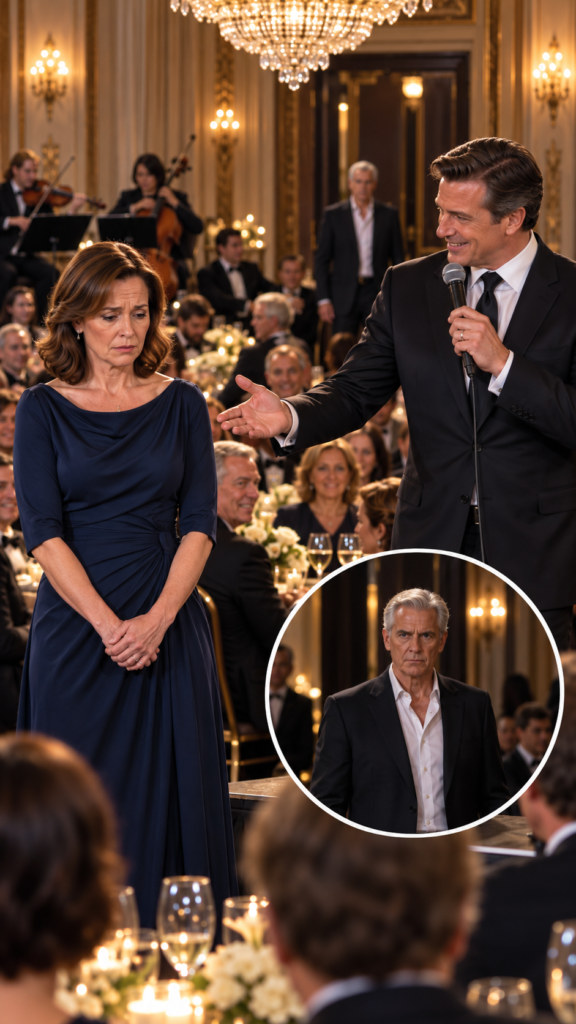
The laughter died so suddenly that even the string quartet stopped playing. Every guest turned toward a silver-haired man standing near the ballroom doors in a dark suit, with no tie and no smile. My husband recognized him before I did, and the color drained from Thomas’s face. That was the first moment I realized the stranger was not there to rescue me from an embarrassing joke—he was there because he knew something Thomas had spent years hiding.
My name is Laura Bennett, and I had been married to Thomas for twenty-two years. To the public, he was charming, generous, and devoted, the celebrated founder of the Family Bridge Foundation. He kissed my cheek when cameras appeared, praised my loyalty in front of donors, and told people he could not manage without me. What no one saw was that I returned the donor calls, corrected the hotel invoices, solved the volunteer problems, remembered every board member’s family, and quietly repaired every mistake before it could damage his reputation.
The gala at the Meridian Hotel was supposed to be Thomas’s greatest night. I arrived three hours early to fix the seating chart, settle a dispute with the caterer, and make sure the sponsors were thanked in the proper order. Thomas arrived late, asked whether everything had been handled, and walked directly toward the photographers. By the time dinner ended, the entire ballroom believed he had created the event alone.
Then he took the microphone and said he wanted to do something fun. He ordered me to stand, called me dependable, loyal, and incredibly boring, then mocked my books, my quiet weekends, and the way I organized our pantry. Each laugh struck harder than the last, but I refused to cry in front of him. Some guests looked uncomfortable, yet not one person stood up and told him to stop.
Finally, Thomas announced that he would auction off dinner with his boring wife for charity. He opened the bidding at ten dollars and joked that even that might be too generous. A man near the front raised his champagne glass and shouted that he would take me for ten, sending the room into another wave of laughter. Thomas looked delighted, because humiliation was only dangerous when the victim refused to participate.
Then came the million-dollar bid.
The silver-haired stranger walked toward us with the steady confidence of a man who did not need permission to command a room. He was not approaching like someone buying dinner with another man’s wife. He was approaching like someone correcting an insult. When he came closer, an old memory stirred inside me—a hospital conference room, rain against the windows, and a sick woman in a silk scarf reading a proposal I had written before my marriage swallowed my name.
Then I recognized him.
Charles Mercer.
More than twenty years earlier, Charles and his late wife, Eleanor, had been among the first donors connected to the foundation Thomas now claimed as his own. I had not seen Charles in decades. Thomas had clearly hoped he never would.
Charles stopped beside me and held out his hand. When he said my name, he did not say it as though I belonged to Thomas or existed only to support him. He said it as though he remembered the woman I had once been. Then he leaned closer and spoke quietly enough that only the nearest tables should have heard.
“I came tonight to fund the woman who built this foundation,” he said, “not the man who put his name on her work.”
Thomas heard every word.
His face turned gray.
The auctioneer asked whether the million-dollar bid was genuine, but Charles said he was speaking to me. For the first time that night, the entire ballroom waited for my answer instead of Thomas’s. My husband gripped the microphone and whispered for me not to embarrass him, as if I were responsible for the cruelty he had just performed. Something inside me broke free.
I pulled the microphone from his hand and faced the crowd. I announced that the bid was accepted, that the full one million dollars would go directly to the Family Bridge Initiative, and that the dinner would happen at a time and place chosen by me. Applause spread through the room, but it sounded different now—uncertain, ashamed, and late. Thomas leaned close and demanded to know what I was doing.
“Ending the auction,” I said.
I walked away before he could stop me, but the night was not over. Margaret Ellison, the foundation’s board chair, asked to speak with me privately. Thomas tried to follow, insisting I was tired and needed to go home, but Margaret reminded him that being my husband was not a board position. Inside a nearby conference room, Charles opened a worn leather folder and placed a yellowed document in front of me.
It was the original foundation proposal.
My proposal.
The title was exactly as I remembered it, and beneath it was the name I had used before my marriage: Laura Whitmore. I touched the page and remembered writing it at a tiny kitchen table while Thomas brought me coffee and told me the idea could change lives. For years, I had believed we built the foundation together.
Then Charles placed a second document beside it.
The letter had been written by Eleanor Mercer, the woman whose early donation helped launch the foundation. It stated that her family’s first major contribution depended on one condition: I was to remain in charge of program development and be officially named as co-founder. I had never seen the letter before. But when Thomas entered the room and saw it on the table, the look in his eyes told me he had.
Margaret asked Thomas directly whether he had received Eleanor’s letter. At first, he dismissed it as old paperwork and claimed everyone had done a little of everything in the foundation’s early years. When I asked why he had never shown it to me, he said the situation had been complicated. Trapped in front of the board chair and the donor he had lied to, Thomas finally admitted the truth.
“Yes,” he said. “I received it.”
One word erased twenty-two years of excuses.
He claimed he had hidden the letter to protect me from pressure, scrutiny, and public judgment. According to him, I hated attention, doubted myself, and would have panicked if I had been publicly recognized as a founder. I reminded him that I had written the proposal, designed the volunteer system, negotiated hospital partnerships, and created the first budgets. He replied that he had built a role better suited to my personality.
That was when I understood my disappearance had never been accidental. Thomas had not forgotten to credit me as the foundation grew. He had made a decision, ignored a donor’s condition, and told people I preferred to remain invisible. Then he repeated that lie for so many years that even I began to believe it.
But Charles had one more thing to reveal.
Six weeks before the gala, he had contacted Thomas and asked whether I was still involved in the foundation. Thomas told him I had never participated in operations and had only helped with occasional social events. When Charles asked to speak with me directly, Thomas claimed my memories of the early years had become unreliable and that discussing the past might upset me. That was why Thomas recognized Charles’s voice the moment he made the million-dollar bid.
Thomas had known Charles might come.
He had known the truth might return.
And instead of protecting me, he had begun telling people I was confused before I ever had the chance to speak for myself.
For several seconds, no one moved.
The ballroom beyond the conference-room wall had started making noise again—chairs shifting, glasses touching tables, people speaking in low voices—but inside that room there was only the faint hum of the ventilation system and the sound of Thomas breathing through his nose.
I stared at him.
“Say it isn’t true.”
He rubbed one hand over his mouth.
“Laura—”
“Say you never told him that.”
His eyes flicked toward Charles.
It was such a small movement. Twenty-two years earlier, I might have missed it. That night, I saw everything.
“You did,” I whispered.
Thomas took a step toward me.
“I was trying to manage a difficult situation.”
Margaret’s chair scraped softly against the carpet.
“A difficult situation?” she repeated.
Thomas turned toward her with the reflexive confidence he used in board meetings.
“Charles appeared after decades asking questions about things that happened before half the current staff was even hired. I didn’t know what he wanted. I was protecting the organization.”
“No,” Charles said.
His voice was quiet.
“You were protecting the version of yourself the organization believed.”
Thomas’s jaw tightened.
The words landed harder because Charles did not raise his voice.
I looked down at Eleanor’s letter again.
My name was there.
Not Thomas’s explanation of me. Not his interpretation of what I wanted. My actual name, attached to an actual condition written by a woman who had looked directly at me across a hospital conference table and believed I belonged in the room.
“How long?” I asked.
Thomas frowned.
“How long have you been telling people I didn’t do this?”
He looked tired suddenly.
“Laura, it wasn’t like that.”
“How long?”
“Over the years, people asked questions.”
“And what did you tell them?”
His silence answered first.
Margaret closed her eyes for one brief second.
Thomas finally said, “I told people you preferred to stay out of the public side.”
“That isn’t what I asked.”
His shoulders rose with an impatient breath.
“I said you weren’t interested in operations anymore.”
I felt my fingers go cold.
“Was I ever asked?”
“You were there.”
“Was I ever asked?”
Thomas looked away.
The room seemed to contract around us.
I remembered evenings when he came home from board dinners and told me everyone had loved the new hospital program. Mornings when he asked me to review speeches before he delivered them. Weekends when I sat at our dining-room table correcting budgets he later described as his strategy.
I remembered asking once, years earlier, whether I should attend more board meetings.
Thomas had kissed the top of my head and said, “Why put yourself through that? You’re happier doing what you’re good at.”
At the time, I had heard tenderness.
Now I heard architecture.
Brick by brick, sentence by sentence, he had built a smaller room around me and called it safety.
Margaret rose from her chair.
“Thomas, I need you to leave.”
He stared at her.
“This is my foundation.”
“No,” she said. “It is not.”
His face changed.
Not dramatically. That would have been easier to watch.
Something simply loosened behind his eyes, as though the room had stopped obeying him.
“Margaret.”
“As board chair, I am telling you to leave this room while I speak with Laura and Charles.”
He gave a short, humorless laugh.
“You cannot be serious.”
“I have never been more serious.”
Thomas looked at me then.
For one terrible instant, I saw the man from our early marriage—the one who brought coffee to my kitchen table, who drove me to hospital meetings when I was too nervous to eat, who told me my ideas were better than anything he could have written.
That man was still somewhere inside his face.
But he had spent twenty-two years choosing himself over him.
“Laura,” he said softly. “Come home with me.”
I almost did.
The habit was that deep.
Then I looked at Eleanor’s letter.
“No.”
One word.
My word this time.
Thomas stood very still.
I had never watched him realize that my obedience was not a permanent resource.
He picked up his jacket from the back of a chair.
At the door, he turned.
“You have no idea what happens if this gets out.”
I looked at him.
“For once, neither do you.”
The door closed behind him.
Margaret did not speak immediately.
Neither did Charles.
I appreciated them for that.
No one rushed to tell me I was brave. No one tried to turn what had happened into an inspiring moment. I sat at the polished conference table with both hands resting beside a twenty-two-year-old letter and let the full weight of my marriage settle where excuses had been.
Margaret finally pulled out the chair across from me.
“I owe you an apology.”
I shook my head.
“You didn’t hide that letter.”
“No,” she said. “But I accepted a story about you because it was convenient.”
I looked up.
Her eyes were wet.
“Three weeks ago, Thomas told me Charles had begun contacting people about the foundation’s early years. He said you were uncomfortable discussing that period and asked me to redirect any questions to him.”
My stomach tightened.
Margaret swallowed.
“He said revisiting old events might confuse you.”
Charles lowered his gaze.
There it was.
The lie had escaped the marriage.
It had become strategy.
“How many people?” I asked.
“I don’t know yet.”
The answer frightened me more than a number would have.
Margaret straightened.
“But I’m going to find out.”
Charles rested his fingertips on the worn leather folder.
“So am I.”
I looked from one to the other.
“No.”
They both stopped.
“I don’t want people investigating my life as if I’m evidence.”
Margaret nodded slowly.
“What do you want?”
It was an ordinary question.
I realized I did not know how to answer it.
For years, Thomas had been the translator between my wants and the world. He told people I hated recognition. He told me public attention would exhaust me. He decided what I was suited for until his decisions began sounding like my personality.
I pressed my thumb against the edge of the old proposal.
“I want the truth separated from the marriage.”
Margaret leaned forward.
“What does that mean?”
“It means no revenge. No humiliation. No replacing his version with another performance.”
My voice shook, but I kept going.
“If the foundation was built on work I did, correct the record. If donor conditions were ignored, say so. If he lied to the board, deal with that as a board.”
I looked toward the closed door.
“And I will deal with my husband as his wife.”
Margaret nodded.
By midnight, the board had been notified of an emergency meeting for the following morning.
Thomas did not wait for me in the hotel lobby.
He did not call during my ride home.
The silence should have felt like punishment.
Instead, for the first time in years, it gave me room to think.
The house was dark when I arrived.
Thomas was sitting at the kitchen table.
Not the dining table where we entertained donors. Not the study where he kept awards and framed photographs.
The kitchen table.
For one second, the sight of him there hurt so badly I had to grip the doorway.
It was where everything had begun.
He looked up.
“I made coffee.”
I almost laughed.
Twenty-two years vanished in the smell of it.
“You used to do that when I was writing.”
“I remember.”
“So do I.”
I set my handbag down but did not sit.
Thomas wrapped both hands around his mug.
“Laura, I know how tonight looked.”
“How it looked?”
“You know what I mean.”
“No. I don’t think I do anymore.”
His mouth tightened.
“The auction was a stupid joke.”
“The auction is not why our marriage is ending.”
He flinched.
I had not planned to say it.
Once spoken, the sentence felt strangely quiet.
Thomas stood.
“Don’t do this because you’re angry.”
“I’m not.”
That frightened him more.
I could see it.
“I was angry when you called me useless,” I said. “I was humiliated when they laughed. But marriages survive cruelty sometimes, Thomas. They survive terrible jokes. They even survive selfishness if the person who caused the wound is willing to look at it.”
He took a step toward me.
“Then let me.”
I shook my head.
“This is not about what you said tonight. It’s about what you said when I wasn’t there.”
He stopped.
“You told people I couldn’t remember my own life.”
“I panicked.”
“For six weeks?”
He looked down.
“For years?”
His silence returned.
I moved to the table and touched the back of the chair where I had once spent nights writing the first program outline.
“You didn’t steal one idea from me.”
“Laura—”
“You stole the evidence that I had ideas.”
His face crumpled for a fraction of a second.
I had expected satisfaction.
There was none.
Only grief.
Thomas sat again.
“I thought if there was one public face, the foundation would survive.”
“Why did the public face have to be yours?”
He closed his eyes.
That was the first honest answer he gave me.
Because he had no answer that made him look good.
“I liked it,” he said finally.
The words were barely audible.
I waited.
“I liked being the person they thanked.”
His eyes stayed on the table.
“I liked walking into rooms and having people know my name. I liked that donors called me. I liked that the press wanted photographs.”
He swallowed.
“And every year it became harder to tell the truth because every year the lie had given me more.”
I sat across from him.
For the first time all night, I saw no performance in his face.
“I loved you,” he said.
“I believe you.”
He looked up sharply.
That hurt him too.
“Then how can you leave?”
“Because loving me did not stop you from erasing me.”
The kitchen clock clicked behind us.
Thomas stared at his coffee until the surface stopped steaming.
“What happens tomorrow?”
“I don’t know.”
“What are you going to tell them?”
“The truth.”
“All of it?”
“Yes.”
His shoulders dropped.
There was the end of his power.
Not in a courtroom.
Not under cameras.
At a kitchen table, with no audience, when he finally understood I would no longer help him edit reality.
The emergency board meeting began at nine the next morning.
I had not slept.
Neither, judging by his face, had Thomas.
Charles placed Eleanor’s letter and the original proposal on the table.
Margaret brought archived foundation materials that staff had pulled overnight.
There were early budgets in my formatting.
Volunteer manuals containing sentences I remembered typing.
Hospital partnership outlines with notes in my handwriting.
Old meeting records referring to “Laura’s intake model” and “Laura’s family-support structure.”
The room became quieter with every page.
Thomas tried once to say that early organizations were collaborative.
Margaret stopped him.
“No one is disputing collaboration.”
She tapped Eleanor’s letter.
“We are discussing concealment.”
Then she looked around the table.
“And misrepresentation.”
One board member removed his glasses.
Another folded her hands.
No one defended Thomas.
The worst moment came when Margaret opened a folder containing correspondence from the previous month.
She looked at me before she spoke.
“I need to tell you something else.”
Thomas’s head lifted.
Margaret’s voice hardened.
“After Charles made contact, Thomas separately told two board members that Laura had become unreliable when discussing the foundation’s history.”
The room went completely still.
Thomas stood.
“That is being taken out of context.”
“Sit down,” Margaret said.
“I was trying to prevent confusion.”
“Sit down.”
“I was protecting this foundation from a donor showing up with twenty-year-old documents and—”
“Sit down.”
Thomas did.
I could hear someone breathing near the window.
One of the board members Thomas had spoken to looked across the table at me.
“I believed him.”
His voice was rough.
“I’m sorry.”
The second board member stared at Thomas.
“You told me she had started mixing up dates.”
Thomas pressed his palms against the table.
“I said her memory of that period was emotional.”
“No,” she said. “You told me she could not be trusted to give an accurate account.”
He had nothing left.
Not because every detail had been proven by some dramatic hidden recording.
Because the people he had recruited into the lie were sitting in the room.
Looking at him.
Remembering.
Margaret asked Thomas to step outside while the board deliberated.
This time, he did not argue.
The vote took less than twenty minutes.
He was suspended immediately from all executive and representative duties while an independent governance review was completed.
He was barred from speaking publicly on behalf of the foundation.
The board authorized a correction of the organization’s founding history and a review of every donor condition connected to the early years.
Three weeks later, after the review confirmed the pattern already visible in the records, Thomas was formally removed from leadership.
His name remained part of the history.
I insisted on that.
Erasing him would have made me too much like him.
But the history was rewritten accurately.
The foundation had been created through work we both did.
The original program architecture, volunteer system, hospital partnerships, and early operating structure had been mine.
And beside the word co-founder, for the first time, appeared my name.
Laura Whitmore Bennett.
When Margaret showed me the corrected page, I stared at it longer than I expected.
“You can change it to Laura Whitmore if you want,” she said.
I shook my head.
“No.”
She waited.
“Whitmore was the woman who wrote the proposal,” I said. “Bennett is the woman who survived what happened after.”
I touched the screen.
“I’m not giving either one away.”
The foundation issued a public statement.
It was factual.
Brief.
No dramatic accusations.
No attempt to turn private pain into fundraising.
Thomas had misrepresented the organization’s founding history and concealed donor correspondence relevant to governance. The record had been corrected. Leadership had changed.
The million-dollar gift from Charles was placed exactly where I had directed it: the Family Bridge Initiative.
Not in my name.
Not in Thomas’s.
In the work.
Reporters called.
For the first time, I answered some of them.
I declined others.
And I discovered something Thomas had never allowed me to learn.
I did not hate being seen.
I hated being performed.
There was a difference.
Margaret asked if I wanted Thomas’s old position.
I said no.
Her eyebrows lifted.
“You don’t have to decide today.”
“I already did.”
I looked through the glass wall at the staff moving between offices.
“I want program development.”
A small smile appeared on her face.
“Again?”
“No.”
I smiled back.
“Finally.”
I agreed to serve for one year while the foundation rebuilt its internal structure.
I attended board meetings.
I spoke when I had something to say.
I stayed silent when I did not.
No one interpreted either choice for me.
Thomas moved out of the house before the end of the month.
The separation was quiet.
He did not fight me over furniture.
He did not make public statements blaming me.
Perhaps his lawyers advised him.
Perhaps, at last, he understood that any attempt to rewrite this part would only prove the point.
We met once before the divorce paperwork was finalized.
A small café.
No donors.
No microphones.
He looked older.
“I’m in therapy,” he said.
I nodded.
“I’m glad.”
“I keep wanting to explain why I did it.”
“Do you know?”
“I’m starting to.”
I waited.
Thomas looked through the window.
“I thought being needed meant being important. Then I started thinking being important meant being the one everyone could see.”
He rubbed his thumb along the edge of his cup.
“And somewhere along the way, your competence started feeling like a threat to the person I wanted people to think I was.”
The honesty arrived twenty years late.
It still mattered.
Not enough to restore the marriage.
Enough to let the truth stop moving.
“I’m sorry,” he said.
“I know.”
“Do you forgive me?”
I looked at him for a long time.
“I don’t know yet.”
He nodded.
That was the first answer I ever gave him that he did not try to improve.
We left separately.
Charles kept his promise about dinner.
Not at an expensive restaurant.
Not at the Meridian.
He chose a small dining room inside the hospital where Eleanor and I had first met, now renovated but still overlooking the same row of windows that caught rain in silver lines.
Margaret joined us.
So did several longtime volunteers.
No photographers.
No auctioneer.
No stage.
Charles raised a water glass.
“To the woman who finally got to choose the table.”
I laughed.
A real laugh.
It startled me.
Later, when everyone else had gone, Charles remained by the window.
He held the worn leather folder again.
“There’s something I didn’t give you that night.”
I looked at him.
“Another letter?”
“Not exactly.”
From an inside pocket, he removed a small cream envelope.
My maiden name was written across the front in Eleanor’s handwriting.
Laura Whitmore.
My breath caught.
“I found it tucked inside her copy of your proposal when I went looking for the donor letter,” Charles said. “I almost opened it twenty-two years ago. She told me not to.”
“Why?”
“She said it belonged to you when you were ready to understand it.”
I looked at him.
“And how exactly were you supposed to know when that was?”
For the first time, he smiled.
“Eleanor had an unreasonable amount of faith in timing.”
My fingers trembled when I opened the envelope.
Inside was one sheet of paper.
Not a legal document.
Not another condition.
A note.
I read it standing beside the same kind of rain-streaked windows where Eleanor had once read my proposal.
Laura,
You keep telling me you do not care whose name people remember as long as the families are helped. I believe you.
But humility is not the same thing as disappearance.
There may come a day when someone louder stands beside your work and is mistaken for its source. If that happens, do not waste your life fighting for applause.
Fight for the truth.
Then go back to the work.
Eleanor
I read it twice.
Then a third time.
The first sound that came out of me was almost a laugh.
Then I covered my mouth.
Charles looked away and gave me privacy without leaving.
That kindness undid me.
I sat down in the nearest chair and cried harder than I had at the gala.
Not because Eleanor had predicted Thomas.
She hadn’t.
She had understood me.
Long before I understood myself.
For years, Thomas had defended what he did by saying I never wanted credit.
In one sense, he had been right.
I had not wanted applause.
I had wanted the work to matter more than my name.
But he had taken my lack of hunger for attention and treated it as permission to erase authorship.
Eleanor had known the difference.
That was the beautiful part.
The truth I had spent weeks reclaiming had not turned me into someone new.
It returned me to someone I already was.
Six months later, the foundation held its first annual program meeting under the new structure.
There was no gala.
No chandeliers.
No photographers waiting at the entrance.
We gathered in a bright community room with folding tables, coffee urns, stacks of program reports, and volunteers arguing cheerfully over where to put the pastries.
Margaret had become stricter about governance.
Charles remained a donor and refused every attempt to name anything after him.
The board created a permanent archive documenting the foundation’s early history, including the work of staff and volunteers whose names had disappeared from public accounts over the years.
That mattered to me more than my corrected biography.
One afternoon, a young program coordinator stopped me in the hallway.
“Ms. Bennett?”
I turned.
She held a binder against her chest.
“I read your original volunteer manual.”
I laughed.
“I’m sorry.”
She grinned.
“It’s actually good.”
“Now I know you’re lying.”
She shook her head.
“There’s a line in it about never making a family repeat the worst thing that happened to them just because our paperwork is disorganized.”
I remembered writing it.
Three in the morning.
Cold coffee.
Thomas asleep upstairs.
The coordinator looked at me.
“We still use that rule.”
For a second, I could not speak.
Not because my name had survived.
Because the work had.
That evening, I drove home before dark.
The house felt different without Thomas.
At first, every room had seemed too large.
Then I began changing small things.
I moved his awards out of the study.
Not into the trash.
Into boxes.
I replaced the enormous photograph from one of his galas with a painting I had bought years earlier and never hung because he said it was too quiet.
I turned the guest room into a reading room.
I stopped organizing the pantry the way he liked it.
That made me laugh more than it should have.
The divorce became final in early spring.
There was no celebration.
No collapse either.
I signed my name, walked outside, and stood under a row of trees just beginning to bud.
Thomas sent one message.
I am sorry for what I made you disappear from.
I read it twice.
Then I put my phone away.
I never answered.
Some apologies are doors.
Others are simply proof that the person on the other side finally saw the room.
I did not need to walk back through.
On the first anniversary of the gala, Margaret asked if I wanted to attend the Meridian event.
The foundation had booked the same ballroom.
For one second, my stomach tightened.
Then I said yes.
I wore navy.
Not the same dress.
Another one.
Chosen by me.
When I entered the ballroom, the chandelier looked smaller than I remembered.
Perhaps humiliation enlarges ceilings.
Charles met me near the doors.
“No bidding tonight,” he said.
“Disappointing.”
“I brought ten dollars.”
I laughed so loudly that a waiter glanced over.
The program lasted forty minutes.
Margaret spoke about the year’s work.
A hospital administrator described the expansion of family-support services.
Two volunteers received recognition.
Then Margaret invited me to the microphone.
I stood beneath the chandelier.
The exact place where Thomas had once asked a ballroom what I was worth.
The room became quiet.
I looked at the microphone.
Then at the faces waiting.
A year earlier, silence had felt like judgment.
That night it felt like space.
“My name is Laura Whitmore Bennett,” I said.
Nothing more for a moment.
I let myself hear it.
Then I spoke about the families.
The volunteers.
The hospital staff.
The people who answered phones after midnight and corrected forms no donor would ever see.
I did not tell the story of my humiliation.
Everyone in the room knew it.
I told the story of the work.
When I finished, the applause rose slowly.
I did not look for Thomas.
He was not there.
I did not look for cameras either.
I looked at Charles.
He touched two fingers to the inside pocket where he once carried Eleanor’s note.
Margaret smiled.
And I stepped away from the microphone before applause could become the point.
Late that night, I returned home and found the kitchen exactly as I had left it.
One cup in the sink.
A book open on the table.
Eleanor’s note resting beneath a small glass paperweight beside the window.
I made tea.
Then I sat at the same table where, more than twenty years earlier, I had written the idea that became a foundation.
For a long time, I listened to the house.
No cameras.
No guests.
No one explaining me.
No one deciding which version of my life other people were allowed to hear.
I touched Eleanor’s letter once, then opened my book.
Outside, the porch light cast a warm circle across the front steps.
And for the first time in twenty-two years, the silence did not feel like disappearance.
It felt like home.






