My daughter-in-law dropped a basket of filthy laundry at my feet, snapped her fingers, and ordered me to cancel brunch so I could clean the house before her parents arrived. She did not ask politely, and she did not even look at me when she spoke. She stood in the kitchen wearing a cream cashmere sweater while my son sat three feet away, staring into his coffee as though he had suddenly gone deaf. That was the moment I realized I had not moved into their home to be loved—I had paid for a house where I had slowly become the unpaid maid.
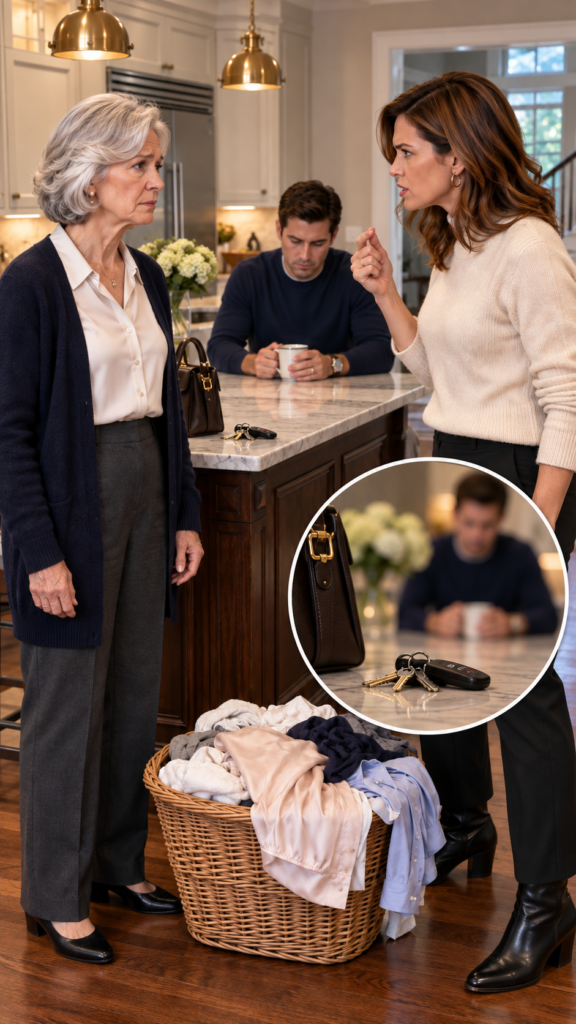
“Did you hear me, Eleanor?” Brooke demanded, tapping her boot against the floor. “I don’t have time to say it twice.” The laundry basket sat between us, overflowing with her silk blouses, Brandon’s shirts, and the private things no grown woman should ever throw at another person’s feet. I looked at my son and waited for him to say something, but he lowered his head instead. His silence hurt more than her command.
A year earlier, my husband Richard had died after thirty-eight years of marriage, leaving me stunned by grief and unable to imagine living alone. Brandon had come to me with tears in his eyes and said he wanted his mother close. Brooke had held my hand and promised we would become one family under one roof. Because I loved my son and trusted them both, I used eighty percent of Richard’s life-insurance money to make the down payment on a beautiful colonial estate in Atlanta.
I even accepted the small downstairs guest room so Brooke could have the master suite and its enormous closets. At first, I cooked because the routine helped me survive my grief, and I cleaned because silence made the house feel unbearable. Then small favors became daily expectations, and requests slowly turned into orders. Before long, I was shopping for groceries, waiting for repairmen, pressing Brandon’s shirts, picking up Brooke’s dry cleaning, and serving dinners for guests who were told I merely “stayed with them.”
That Thursday morning, something inside me finally stopped bending. I lifted my eyes from the basket and said one word clearly enough to cut through the room. “No.” Brooke’s head snapped up, and Brandon finally looked at me as if I had spoken in a language neither of them understood.
“Excuse me?” Brooke asked. Her face showed pure disbelief, not because she had misunderstood me, but because she had never imagined I might refuse. I picked up my car keys and told her to wash her own laundry. Then I walked past her while Brandon called after me to wait.
Outside, my hands shook so badly that I struggled to unlock the car. I had imagined standing up for myself many times, but in those fantasies I always felt strong and victorious. In reality, I felt sick, frightened, and ashamed that it had taken me a full year to say no. Still, I started the engine and drove away while my phone began ringing.
Brooke’s first message appeared before I reached the end of the street. She warned me not to expect her to “cover” for me later, as though I were a careless employee abandoning a shift. Brandon called next, but I let the phone ring while anger replaced the fear in my chest. Instead of driving to brunch, I turned toward downtown Atlanta and headed for the office of Richard’s longtime attorney.
Martin Hale took one look at my face and canceled his next meeting. I told him about the laundry basket, but once I started speaking, the rest came out too—the errands, the humiliations, the household expenses, and the way Brandon had gradually taken over the trust paperwork because he said financial statements upset me. Martin listened without interrupting until I repeated Brooke’s claim that I lived in their house without paying the mortgage. Then he removed his glasses and asked me a question that changed everything.
“Eleanor,” he said carefully, “have you forgotten who legally owns that property?” I stared at him, unsure what he meant, and he turned his computer monitor toward me. The house was not Brandon’s, and it certainly was not Brooke’s. It belonged to the Bennett Family Living Trust, and I was the sole acting trustee.
Brandon was only a beneficiary, which meant he had no authority to control the property or the money unless I resigned, died, or was declared incapable of managing my affairs. Martin explained that I could stop all discretionary distributions immediately. He also told me that the household spending had grown far beyond what Richard had ever intended. When he opened the account records, I saw just how much had been hidden from me.
There were charges for private clubs, spas, luxury stores, expensive restaurants, furniture, jewelry, and a leased SUV. Thousands of dollars had been labeled as household reimbursements, but no receipts had been attached. Statements that once came to me had been redirected to Brandon’s email months earlier. I suddenly remembered him standing beside my laptop, telling me he would organize everything so I would not have to worry.
I asked Martin how much of Richard’s money they had spent in eleven months. When he gave me the total, I gripped the arms of my chair because the number was larger than anything I had imagined. Brandon had told me his salary paid for their lifestyle and the trust only helped with essential household costs. The records proved that someone had been lying to me for nearly a year.
Martin warned me not to act from anger alone, but I was no longer acting only from anger. I was acting because my son had hidden financial records, my daughter-in-law believed I existed to serve her, and both of them were living lavishly with money Richard had spent a lifetime protecting. I authorized the administrator to freeze every nonessential trust card and suspend all personal distributions. The decision took less than ten minutes.
My phone lit up almost immediately. Brandon wanted to know why the household card had been declined, and Brooke demanded that I fix her card at once because she was standing in a florist shop unable to pay for arrangements for her parents’ dinner. Neither of them asked whether I was hurt or why I had left. Their first concern was the money.
When Brandon finally reached me, he said freezing the accounts was an overreaction to a simple disagreement. He insisted Brooke was stressed and claimed I was humiliating them in front of her parents. I told him the cards would remain frozen until every charge was reviewed. Then I ended the call before he could explain away another betrayal.
A moment later, Brooke sent me a message saying that when I returned, we would discuss whether “this living arrangement” was still working. She wrote as though she had the power to decide whether I could stay in the house I had paid for. Martin read the message twice before sliding the original property agreement across his desk. Then he told me my daughter-in-law had just made the next legal step much easier.
By the time I left his office, I was carrying written proof of who owned the house—and a formal notice that could end their right to live there.
The papers felt strangely heavy in my hands when the elevator doors opened onto the parking garage. My phone was still vibrating. Brandon again. Then Brooke.
I stood beside my car and looked down at the formal notice Martin had prepared. For eleven months, I had been afraid of creating conflict in that house. Now I understood the conflict had already been there. I had simply been the person expected to absorb it.
Brandon called again.
I answered.
“Mom, where are you?”
“I’m coming home.”
A pause. Behind him, I heard Brooke’s voice, sharp and impatient.
“Can we please not make this worse?” he asked.
I looked at the property agreement in my hand.
“You should have thought about that before you helped make me a guest in my own house.”
Then I ended the call.
When I pulled into the driveway, another car was already there. Brooke’s parents had arrived early.
For one second, I nearly laughed. Brooke had spent the morning worrying I would embarrass her in front of them. Now the truth was waiting inside before I even opened the door.
I unlocked it with my own key.
Brandon met me in the foyer. The soft avoidance from breakfast was gone. He looked pale and alert, like a man who had finally discovered that silence was not neutral.
“Mom—”
Brooke appeared behind him.
“There you are.”
No hello. No question about where I had been.
She folded her arms across the same cream sweater. “Do you have any idea what kind of scene you caused today? My card was declined in front of people.”
I held her gaze.
“That was your first concern?”
“My parents are here.”
“I noticed.”
“Then maybe we can act like adults until they leave.”
The old version of me would have heard the warning inside those words. Keep the peace. Don’t make anyone uncomfortable.
Instead, I walked into the dining room and placed Martin’s leather folder on the table.
Brooke’s parents rose. Their expressions had the careful politeness of people who knew they had walked into a family argument but did not yet know its shape.
“What’s going on?” her father asked.
Brooke answered first.
“Nothing. Eleanor and I had a ridiculous disagreement, and she decided to freeze our cards.”
“Our cards,” I repeated.
She looked at me sharply.
“Yes. The household cards.”
I opened the folder.
“No. The trust cards.”
The room went still.
I slid the property agreement across the table.
“The house belongs to the Bennett Family Living Trust. I am the sole acting trustee. Brandon is a beneficiary. Brooke has no legal interest in the property.”
Brooke stared at the document, then gave a small disbelieving laugh.
“That’s paperwork. Brandon is your son. This is all eventually his anyway.”
Brandon flinched.
Martin’s words came back to me: Brandon had no authority unless I resigned, died, or was declared incapable.
I turned to my son.
“What exactly did you tell her?”
Brooke looked at him too.
“Brandon?”
He rubbed a hand across his mouth.
“I told her the trust was family money.”
“That is not what I asked.”
His eyes finally met mine.
“I told her we were secure.”
I removed the account summary.
“Private clubs. Spas. Luxury stores. Restaurants. Furniture. Jewelry. A leased SUV. Thousands labeled as household reimbursement without receipts.”
Brooke’s mother slowly sat down.
Her father looked at Brandon. “Did Eleanor know?”
The question landed harder than an accusation.
Brandon stared at the floor.
“The statements,” I said. “Tell them.”
He swallowed.
“I changed the delivery settings.”
Brooke frowned. “What delivery settings?”
“The trust statements,” I said. “They stopped coming to me because Brandon redirected them to his email.”
Her mother whispered, “Why?”
“At first I was organizing things,” Brandon said.
The same excuse he had used beside my laptop.
I said nothing.
His shoulders dropped.
“Then there were charges I knew she’d question.”
Brooke turned toward him. “You told me those were approved.”
“I said Mom didn’t care about every receipt.”
The oven fan hummed in the kitchen. Nothing else moved.
Brooke’s father pushed his chair back. “You were spending her husband’s money while hiding the statements from her?”
Brandon looked at me when he answered.
“Yes.”
I had already seen the records. But hearing my son admit it inside the home I had bought because he said he wanted his grieving mother close hurt in a way no spreadsheet could prepare me for.
Brooke started pacing.
“We’re married. We share finances. If Brandon had access—”
“He didn’t have authority,” I said.
“He’s the beneficiary.”
“He is not the trustee.”
I took out the formal notice.
“This ends your right to live here under the agreement and gives you the move-out deadline stated in the notice.”
Her face went blank.
“You’re throwing us out?”
“I’m ending an arrangement that became abusive.”
“Because of laundry?”
“No.”
I looked at Brandon.
“Because my son hid financial records from me.”
Then I looked at her.
“And because this morning you threw your laundry at my feet in a house I paid for and ordered me to cancel my life so I could serve you.”
Her cheeks flushed.
“I was stressed.”
“You were comfortable.”
That quiet answer seemed to hit harder than shouting would have.
Brooke’s father stood.
“Brooke.”
She swung toward him. “Don’t.”
He looked around the dining room, then back at his daughter.
“I came here believing Eleanor lived with you because you and Brandon had taken her in.”
My skin went cold.
Brooke looked away.
Her mother lowered her eyes.
I stared at Brooke. “You told them that?”
She said nothing.
The room tilted for half a second.
I had been cooking, cleaning, shopping, waiting for repairmen, and paying household expenses while they told people I was the dependent widow they had generously rescued.
I gripped the back of a chair.
Brooke saw the movement.
“This is what I mean,” she said quickly. “She gets overwhelmed. She forgets things. She reacts emotionally, and suddenly everyone acts like I’m a monster.”
Brandon’s head came up.
“Stop.”
“No. Your mother is obviously not thinking clearly.”
The air seemed to leave the room.
Brooke kept going.
“If she can’t manage the trust rationally, maybe someone needs to decide whether she should be managing it at all.”
Brandon stood so fast his chair struck the wall.
“Don’t you ever say that again.”
Brooke froze.
So did I.
“You told me that clause existed,” she said.
My eyes moved to him.
He looked sick.
“I explained the trust. I never said we should use it.”
“You said if she couldn’t manage things—”
“I told you what the document says.”
“And now she’s freezing everything over a laundry basket!”
“No.” His voice cracked. “She’s freezing it because I lied.”
Silence.
For the first time, Brandon stopped hiding behind Brooke’s certainty.
He turned to me.
“I changed the statements because I knew you’d see what we were spending. I told myself I was protecting you from stress. I was protecting myself from answering you.”
His hands trembled.
“I liked the club. I liked the car. I liked people thinking we were doing better than we were. Every time you paid for something, the next thing became easier to justify.”
Brooke shook her head.
“Don’t put this all on yourself.”
“I’m not.”
He looked at her.
“But I’m not putting it on Mom anymore.”
Then he faced me again.
“I watched her throw that basket at you.”
His voice dropped.
“And I looked at my coffee.”
One tear slipped down my cheek.
Brandon’s face crumpled.
“I’m sorry.”
I wiped the tear away.
“I believe you’re sorry right now.”
He nodded.
“But sorry is not the same as safe.”
His eyes closed.
“I know.”
Brooke stared at us as if we had betrayed her by refusing the roles she understood.
Then she reached for the notice.
I put my hand on it first.
“You can read it. You cannot take it.”
“You think I’m just walking away from my home?”
“It was never your home to control.”
Her father stepped forward.
“If you need somewhere to stay after the deadline, you can stay with us,” he said. “But we are not financing this lifestyle.”
Brooke looked stunned.
“You’re taking her side.”
“No. I’m listening to what you did.”
Brooke grabbed her purse and walked out. The front door slammed hard enough to rattle the photographs in the hall.
No one followed her.
Her mother looked at me.
“I owe you an apology. I repeated what she told me—that you were staying here because they were helping you.”
“You didn’t know.”
“I should have asked.”
Her parents left without dinner.
The roast Brooke had put in the oven kept cooking until the timer sounded in the empty kitchen.
Brandon turned it off.
For a while he stood with one hand on the oven handle.
“I’ll leave tonight if you want.”
“You’ll follow the notice.”
He nodded.
“Until then, you will not use my money, my accounts, my cards, or my name to explain your lifestyle. You will not ask me to cook, clean, shop, or manage your life.”
“I understand.”
“And if Brooke speaks to me like that again under this roof?”
He swallowed.
“I won’t stay silent.”
That was better than a promise about what Brooke would do.
Not enough.
But better.
That night I sat in the small downstairs guest room I had volunteered to take a year earlier. My clothes filled half a narrow closet. Richard’s photograph sat beside a lamp Brooke once called dated.
Upstairs, the master bedroom held closets large enough for Brooke’s shoes to have their own shelves.
I looked at Richard’s face.
“I gave away too much,” I whispered.
The room did not answer.
For the first time, I did not mistake silence for agreement.
The financial review lasted three weeks.
Martin worked with the trust administrator and an independent accountant. I attended every meeting.
The club membership was canceled. The leased SUV was returned. Personal luxury purchases paid through the trust were separated from legitimate household expenses. Jewelry and other recoverable items bought with trust money were returned or sold, and the proceeds went back into the trust.
Brandon signed a repayment agreement for the expenses attributed to him.
He did not ask me to forgive the debt.
That mattered.
Brooke hired her own attorney and threatened to challenge the notice. Then her attorney reviewed the trust documents, the redirected statements, and the spending records.
The threats stopped.
She moved out before the deadline.
Her parents helped her pack.
I stayed near the foot of the staircase while boxes crossed the foyer.
At one point Brooke stood in front of me holding a garment bag.
For a second, I thought she might apologize.
Instead she said, “You got what you wanted.”
I shook my head.
“No. I finally stopped giving you what you wanted.”
She left without another word.
Brandon moved out the next morning.
He took his clothes, work files, and the coffee mug he had been holding when Brooke dropped the laundry at my feet.
Before closing the front door, he placed his key on the entry table.
“I found an apartment,” he said.
I nodded.
“It’s small.”
“Small can be honest.”
His eyes lowered.
“Mom, I know I keep saying I’m sorry.”
“You do.”
“I’m going to try to make it mean something.”
“Then don’t tell me. Show me.”
He nodded and walked out.
The house became quiet.
Not the terrible quiet I remembered after Richard died.
This was the sound of space returning to me.
The first thing I did was move upstairs.
I opened the master-bedroom curtains and let morning light flood the room. Brooke had taken her clothes, but traces of her perfume remained, so I opened every window.
Then I carried Richard’s photograph upstairs.
It took four trips to move my clothes from the guest-room closet. On the third, I laughed.
I had spent a year squeezing myself into one corner of a house I owned.
A month later, I went to brunch.
The same brunch I had been ordered to cancel.
One of my friends reached across the table and covered my hand.
“You disappeared on us.”
“I know.”
“Don’t do that again.”
“I’ll try not to.”
Brandon began doing what I had asked.
His repayments arrived when the agreement required them. When he called, he asked whether it was a good time. When he came by, he waited at the door until I invited him inside.
The first time I let him stay for coffee, he carried his cup to the sink and washed it.
I watched from the doorway.
He glanced over.
“What?”
“Nothing.”
A sad smile touched his face.
“I should have been doing this a long time ago.”
“Yes.”
He dried the cup.
“Brooke and I separated.”
I had expected it, but the words still hurt.
“I’m sorry.”
He shook his head.
“We wanted things more than we wanted to look at what they were costing us. I blamed her at first because it was easier. But I signed things. I changed the statements. I let you become the person who made our life work while we pretended we were taking care of you.”
He did not ask me to comfort him.
That mattered too.
Several months later, Martin called.
“No emergency,” he said before I could worry. “I found something.”
When I reached his office, an old cream envelope was waiting on his desk.
My name was written across the front in Richard’s handwriting.
I stopped breathing.
Martin stood.
“It was sealed inside the original trust binder behind an amendment tab. Richard left instructions that it was for you if you ever doubted whether you should remain in control of the trust.”
My hands trembled as I took it.
The seal broke softly beneath my thumb.
Richard’s letter was not long.
He wrote about my habit of giving before anyone asked. Time. Money. Rooms. Comfort.
He wrote that generosity was one of the reasons he loved me.
Then he wrote that generosity without choice could become a kind of disappearance.
I had to stop reading.
Martin turned toward the window, giving me the privacy of pretending not to see my tears.
I continued.
Richard explained that the trust had never been designed because he distrusted Brandon. It had been designed because he trusted me.
He wanted Brandon to benefit from the life we had built, but never by erasing the woman who had helped build it.
At the bottom was one final line.
If love ever asks you to become smaller, Eleanor, that is not the love we built this life for.
I pressed the paper against my lips.
The letter did not make me feel rescued.
It made me feel seen.
Richard had recognized the danger I had never recognized in myself: my willingness to surrender space because someone else wanted it, my instinct to keep peace at any cost, my habit of confusing being needed with being loved.
Martin cleared his throat.
“There’s one more thing. Richard told me that if I ever gave you that letter, I was supposed to ask you a question.”
I looked up.
“Are you living in your own house yet?”
A laugh escaped through my tears.
For the first time since Richard died, remembering him did not feel like falling into an empty room.
“Yes,” I said.
Then I thought about the master bedroom, the open curtains, my friends, and my son waiting to be invited inside instead of assuming the door belonged to him.
“Yes,” I said again. “I am.”
By spring, the house felt like mine without needing to erase every trace of what had happened.
I brought Richard’s reading chair out of storage. I turned the downstairs guest room into a small library. I hired someone for the heavy cleaning once a week.
The first time she asked where I kept the laundry supplies, I almost laughed.
I showed her.
Then I went to lunch.
Brandon visited some Sundays.
Not every Sunday.
We did not pretend the damage had vanished. Some weeks I did not want company, and when I said so, he answered, “Okay. Next week.”
That simple respect became its own kind of apology.
Brooke never returned to the house. Through the attorneys, she signed the final settlement concerning the disputed purchases. Her parents returned several items bought with trust money while she was staying with them.
Her mother sent me a handwritten apology with no excuses in it.
I kept it.
Not because I needed proof that I had been right.
Because accountability, when it finally came, deserved to be recognized.
On the first warm Saturday in June, I invited my brunch friends to the house.
Brandon came too, early, because I had asked him to help carry chairs onto the terrace.
Asked.
That word mattered.
After everyone left, he stood at the kitchen sink washing glasses while evening light stretched across the floor.
Near the pantry sat the wicker laundry basket Brooke had dropped at my feet months earlier.
I had almost thrown it away.
Instead, I had cleaned it and begun using it for fresh table linens.
Now it held folded white napkins from the afternoon.
Brandon followed my eyes.
His hands stopped in the water.
“I remember.”
“So do I.”
I picked up the basket and carried it to the laundry room.
It was lighter than I remembered.
When I came back, Brandon had dried the last glass.
At the front door, he hesitated, then kissed my cheek.
“Good night, Mom.”
“Good night.”
I watched him walk to his car and closed the door gently behind him.
No slam.
No argument.
No one waiting for me to clean up their life.
Upstairs, Richard’s letter rested in the top drawer of my bedside table.
My keys lay beside it.
I touched both before closing the drawer.
Outside, the house settled into the warm summer night with the soft creaks of old wood.
For years, I had thought home was the place where you made room for everyone you loved.
I knew better now.
Home was also the place where you were allowed to remain.
I turned off the lamp, lay back against my own pillows, and listened to the quiet.
This time, it did not sound like loneliness.
It sounded like peace.






