“You’re lucky we even let you sleep here.”
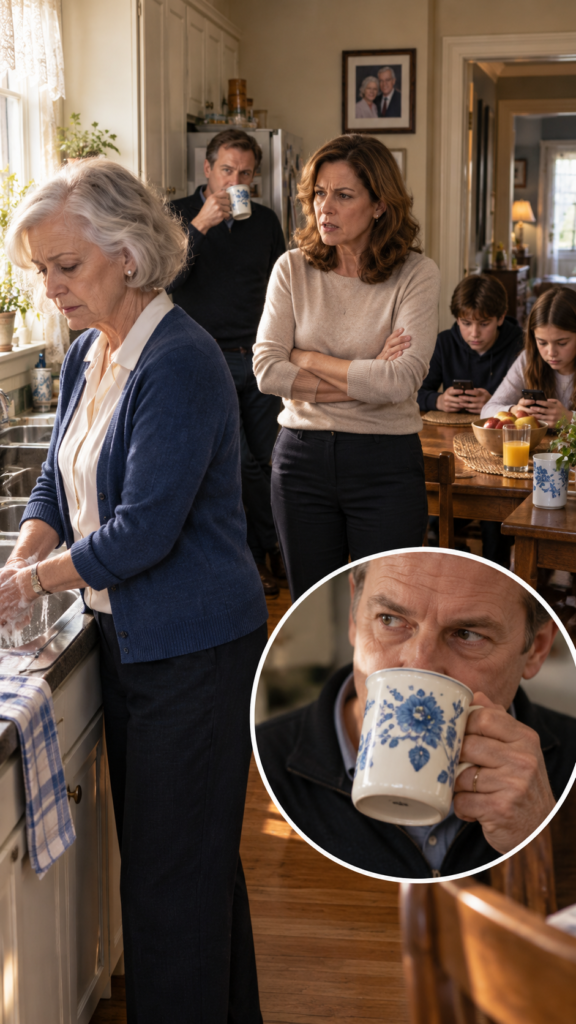
The words landed harder than a slap because they were spoken in the kitchen I had owned for forty-three years. My daughter stood beside my refrigerator while her husband drank from my coffee mug, and neither of them seemed to understand what they had just taken from me.
I shut off the faucet slowly.
Soap clung to my hands. Morning sunlight spilled through the lace curtains Walter had helped me hang nearly twenty years earlier, touching cabinets I had painted myself and floors we had saved years to replace.
Bethany folded her arms.
“You should be grateful, Mom.”
Her husband, Craig, nodded.
My grandchildren kept staring at their phones.
No one said the obvious thing.
This was my house.
Walter and I had bought it in 1981 with overtime shifts, evening bookkeeping jobs, used cars, clipped coupons, and vacations we never took. Every room represented something we had sacrificed for.
After Walter died, the silence became unbearable.
That was when Bethany began worrying about me.
“The stairs are too much.”
“The yard is too big.”
“What if you fall?”
So when she suggested moving in temporarily with Craig and the children, I agreed.
Temporary sounded like love.
They arrived with a moving truck.
Soon Bethany and Craig took the master bedroom because it was “more practical.” Craig turned my dining room into his office. Bethany reorganized my kitchen. My groceries were questioned. My thermostat was adjusted. Friends were expected to call before visiting.
Even my favorite chair disappeared into the garage.
One polite decision at a time, my world became smaller.
And somehow, I became a guest inside the home I still paid taxes and insurance on.
That morning, something finally changed.
I didn’t argue.
I folded the dish towel, placed it beside the sink, and walked away.
Behind me, Bethany sighed.
“We’re only trying to make you understand how things work now.”
She had forgotten who she was speaking to.
Before retirement, I had spent forty years managing a Savannah law office. Attorneys underestimated the gray-haired woman behind the desk until contracts vanished, dates were disputed, or somebody suddenly remembered events differently.
Then they always asked the same question.
“Loretta, do you still have the file?”
I always had the file.
At nine fifteen, after everyone left, I went into the garage.
Behind storage bins and Christmas decorations stood Walter’s old gray filing cabinet.
Inside the second drawer was a dark-blue folder.
PROPERTY DOCUMENTS.
My hands trembled as I opened it.
Tax records.
Mortgage statements.
Insurance papers.
And finally, the deed.
Walter’s name appeared in the property history.
Mine appeared under present ownership.
Bethany’s name was nowhere.
Neither was Craig’s.
No transfer. No shared ownership. No agreement giving them control.
The house belonged to me.
Only me.
I made three copies.
One went into my purse.
Another into a locked drawer.
The third went next door to June Wallace, my neighbor of twenty-seven years.
Then I called Robert Morrison, a retired property attorney from my old firm.
I told him everything.
Chronologically.
Dates. Statements. Actions. Documents.
When I repeated Bethany’s words—“You’re lucky we even let you sleep here”—Robert became quiet.
“Are you certain you want to do this?”
I looked at Walter’s photograph.
“I have never been more certain.”
The next morning, Robert arrived carrying a leather folder.
We reviewed several documents together before he sealed them inside a large envelope bearing my name—and Bethany’s and Craig’s.
After he left, I waited.
At 9:12, Bethany came downstairs.
She noticed the envelope immediately.
“What’s that?”
Craig entered behind her.
“What’s going on?”
Before I answered, three firm knocks struck the front door.
Bethany froze.
Another knock followed.
Slower.
Deliberate.
She looked at me, and for the first time since moving into my home, every trace of confidence had vanished.
“Who is that?”
I rose from the table and picked up the envelope.
“You’re about to find out.”
And nothing inside that house would feel the same after the door opened. 👇
The third knock came before I reached the hallway.
Craig moved first.
“Loretta, don’t open that door.”
I stopped with my hand inches from the knob.
For months, I had obeyed sentences delivered in that tone before I had even realized they were orders.
Turn the television down.
Call before inviting June over.
Don’t buy that brand.
Stay downstairs when the children have friends over.
We need the dining room.
You’ll be more comfortable in the guest room.
That morning, the habit broke.
I opened the door.
A middle-aged man in a gray jacket stood on the porch holding a slim document case. He looked past me toward the kitchen, then checked the names on the papers in his hand.
“Bethany Carter and Craig Carter?”
Neither answered.
The man waited.
Craig came down the hallway, his face already hardening.
“What is this?”
“I’ve been asked to deliver these personally.”
He held out two identical envelopes.
Craig did not take them.
Bethany did.
Her fingers shook against the paper.
The man glanced at me once, gave a small professional nod, and stepped back onto the porch.
“That completes delivery.”
Then he walked down the path.
No siren.
No dramatic announcement.
No crowd gathering outside.
Just the sound of his shoes against concrete and a cardinal singing somewhere in June’s magnolia tree.
The ordinary morning made the moment feel sharper.
Bethany stared at the envelope.
Craig looked at mine.
“What did you do?”
I closed the front door.
“What I should have done when you arrived with a moving truck.”
His jaw shifted.
“Loretta.”
“No.”
The word surprised all three of us.
Even me.
I had not raised my voice.
I did not need to.
Bethany tore open her envelope.
Craig stepped close enough to read over her shoulder.
I watched their faces change line by line.
The documents did not accuse them of a crime.
They did not threaten them.
They did not dramatize anything.
They simply did what paper does best.
They removed ambiguity.
The permission I had given them to live in my home was ending.
They were required to leave by the date printed on the page.
My ownership was identified clearly.
So were theirs.
None.
Bethany lowered the papers.
“You’re throwing us out?”
I looked at her.
“I’m asking you to leave my house.”
“Your grandchildren live here.”
“They lived somewhere else before they lived here.”
Her lips parted.
She looked wounded.
That hurt.
Of course it did.
She was still my daughter.
A boundary does not erase love.
Sometimes it reveals how much love has been asked to survive.
Craig reached for the documents.
“This is ridiculous.”
Bethany let him take them.
He read quickly, then laughed once through his nose.
“You can’t just decide this.”
I almost smiled.
“That is exactly what I can decide.”
“You invited us here.”
“Temporarily.”
“There’s no lease.”
“I know.”
“You can’t put family on the street.”
“No one is putting anyone on the street. You have time to make arrangements.”
“This is our home too.”
The room went still.
Not because he had shouted.
Because he finally said aloud what had been sitting beneath every rearranged drawer, every displaced chair, every casual correction.
Our home too.
I walked back to the kitchen.
Craig followed.
Bethany remained in the hallway for several seconds before coming after us.
I placed my envelope on the table.
Then I turned toward him.
“Show me.”
His forehead tightened.
“Show you what?”
“The document that says this is your home.”
He said nothing.
“The deed.”
Silence.
“The agreement.”
Nothing.
“The transfer I signed.”
His eyes flicked toward Bethany.
I continued.
“The paper that gives either of you ownership.”
Bethany whispered, “Mom.”
I looked at her.
“No. Yesterday you told me I should be grateful you let me sleep here. Today I want to know what gave you the right to say it.”
Color rose along her neck.
“I was angry.”
“You said it twice.”
Her eyes dropped.
Craig tossed the papers onto the table.
“This is getting emotional.”
That sentence almost made me laugh.
For months, emotion had been useful when it belonged to them.
Bethany’s worry justified taking my bedroom.
Craig’s work justified taking my dining room.
The children’s comfort justified controlling the television.
Their schedule justified controlling visitors.
But my anger?
Suddenly emotion was a problem.
I pulled out a chair.
“My entire life is in this house. I am allowed to be emotional about being erased from it.”
Craig looked away first.
Bethany sat across from me.
The earring she had been fastening still lay on the table beside her.
One tiny piece of gold.
One unfinished morning.
“Why didn’t you just talk to me?”
Her question was so quiet that for a moment I almost answered like the mother I had always been.
Gently.
Protectively.
Taking half the blame so she would not have to carry all of hers.
Then I remembered the dish towel folded beneath my trembling hands.
“I did.”
She looked up.
“Every time I asked where my things had gone, I was talking to you.”
Her mouth tightened.
“Every time I said I wanted my friends to visit without permission, I was talking to you.”
She swallowed.
“Every time I hesitated before giving up another room, you saw me.”
I leaned back.
“You just preferred the answer you got when I stopped resisting.”
The refrigerator motor clicked on behind us.
Craig paced toward the window.
“This is insane. We uprooted our lives for you.”
I turned.
“You moved into a paid-off house.”
His head snapped toward me.
The truth of that sentence landed harder than I expected.
Bethany stared at her hands.
“We were helping.”
“At first, maybe.”
That made her look at me.
I had not planned to say it.
But once the words came, I understood they were true.
“When your father died, I believe you were worried about me.”
Her eyes filled immediately.
“I was.”
“I believe you meant it when you said you didn’t want me alone.”
“I didn’t.”
“Then somewhere along the way, being worried about me became deciding for me.”
A tear slid down her cheek.
She wiped it away angrily.
“You don’t understand what it was like.”
“What?”
“Watching Dad die.”
The room changed.
Craig stopped pacing.
Bethany pressed both palms against the table.
“I watched him disappear, Mom. Then I looked at you in this huge house acting like you were fine.”
“I wasn’t fine.”
“You wouldn’t admit that.”
“I was grieving.”
“So was I.”
Her voice cracked.
There it was.
Not an excuse.
Not ownership.
Something older.
Something frightened.
For the first time since they moved in, my daughter did not look like the woman who had reorganized my kitchen or decided where I was allowed to sit.
She looked like a child who had lost her father.
“I kept thinking I was going to lose you too,” she said.
I breathed slowly.
“Then you should have held on to me.”
Her shoulders trembled.
“You tried to hold on to the house instead.”
She covered her mouth.
Craig stared at her as though the conversation had gone somewhere he had not expected.
Then he said the wrong thing.
“We did what we had to do.”
Bethany dropped her hand.
“No.”
Craig looked at her.
She turned toward him.
“No, we didn’t.”
His expression tightened.
“Beth.”
“I was scared. But Mom’s right.”
“Don’t start.”
That phrase changed her face.
It was subtle.
A tightening around the eyes.
A breath held too long.
Perhaps she heard in his voice what I had been hearing for months.
Authority disguised as certainty.
Craig pointed toward the documents.
“You know how expensive it is out there. You know what rent costs. We moved because this made sense for everyone.”
I watched Bethany.
She stared at him.
“For everyone?”
“Obviously.”
Her eyes shifted slowly toward me.
Then toward the dining room.
His office.
The master bedroom upstairs.
The cabinets she had rearranged.
The mug he still used every morning as though it had always been his.
A different kind of silence entered the room.
Not shock.
Recognition.
Bethany stood.
“Did you ever plan for us to move back out?”
Craig blinked.
“What?”
“When we came here. Did you ever actually plan to leave?”
He scoffed.
“That’s not the point.”
“It is now.”
“Bethany.”
“Answer me.”
His jaw tightened.
“We were here. Your mother needed help. The house had room. Why would we throw money away somewhere else?”
Bethany stared at him.
I felt something cold settle through me.
Not because the answer surprised me.
Because it did not.
Craig continued.
“Eventually this place was going to stay in the family anyway.”
Bethany’s face went white.
I did not move.
There it was.
Not a secret scheme.
Not forged paperwork.
Something simpler.
An assumption.
The same assumption that had been living in every room they took from me.
Eventually.
As though my life were merely the waiting period before their inheritance.
Bethany whispered, “Craig.”
He realized too late what he had said.
“I didn’t mean—”
“Yes, you did.”
He ran a hand through his hair.
“Everyone thinks about these things.”
“No,” I said.
He looked at me.
“People think about the future. They do not move into someone’s present and start spending it.”
Craig opened his mouth.
Bethany stood before he could speak.
“Stop.”
He stared at her.
She wiped both cheeks with the heels of her hands.
“Just stop talking.”
For the first time since Walter died, I watched my daughter choose silence instead of letting someone else explain reality for her.
It did not repair what she had done.
But it mattered.
Craig picked up the documents.
“Fine. We’ll talk when everyone’s calmer.”
“No.”
This time Bethany said it.
He turned.
She looked down at the deadline.
“We’ll leave.”
His eyebrows lifted.
“Excuse me?”
“You heard me.”
“You don’t get to decide that alone.”
A sad, strange smile touched her mouth.
Then disappeared.
“Apparently I’ve been deciding too many things in houses that aren’t mine.”
Craig stared at her.
So did I.
He shoved the papers onto the table and walked out.
A few seconds later, the door to the room he had made into his office slammed.
Bethany flinched.
I did too.
Old habits.
She sank back into the chair.
“I’m sorry.”
Two words.
The easiest words in the English language when they cost nothing.
I waited.
Bethany understood.
She nodded once.
“I know that isn’t enough.”
“No.”
She looked toward the hallway.
“What do I do?”
“Leave.”
Her face crumpled.
I reached across the table.
Not to rescue her.
Not to erase the consequence.
I covered her hand with mine.
“And then figure out why loving me became controlling me.”
She stared at our hands.
“Will you ever forgive me?”
“I don’t know.”
That answer hurt both of us.
It was also the first honest thing I had given her without wrapping it in comfort.
Over the next three weeks, boxes returned to the house.
This time they were leaving.
The process was quieter than their arrival had been.
Craig spoke to me only when necessary.
He found a rental on the other side of Savannah and complained about deposits, storage costs, and the inconvenience of moving during the school term.
I did not respond.
Bethany packed differently.
Slowly.
Almost reverently.
She returned my pots to their old cabinet.
My silverware to its old drawer.
My books to the shelves she had cleared.
One afternoon, I found her kneeling in the garage beside my old chair.
She ran a cloth across the wooden arm.
“I shouldn’t have let him move this.”
I stood in the doorway.
“No.”
She looked up.
“You loved this chair.”
“I still do.”
She nodded.
Then she and my grandson carried it inside.
He did not complain.
He did not look at his phone.
He placed it exactly where it had been before.
Near the window.
Across from Walter’s photograph.
“Here?” he asked.
My throat tightened.
“Exactly there.”
He stepped back and looked at it.
“I didn’t know it mattered.”
I touched the worn fabric.
“You didn’t ask.”
His face fell.
Then he nodded.
“I should have.”
That was his apology.
Simple.
Specific.
I accepted it.
My granddaughter apologized two nights later.
She stood at my bedroom door after everyone else had gone downstairs.
My bedroom.
I had moved back into it before they left.
The first night felt strange.
I lay on Walter’s side by accident and cried into the pillow until two in the morning.
But I stayed.
My granddaughter held the doorframe.
“Grandma?”
“Yes?”
“I heard Mom that morning.”
I knew which morning.
She stared at the carpet.
“I should’ve said something.”
“You’re a child.”
“I’m sixteen.”
“You’re still the child in that room.”
She swallowed.
“I knew it was your house.”
I looked at her.
“I know.”
“I just didn’t want Mom mad at me.”
There are moments when forgiveness is not a grand moral decision.
It is simply seeing the fear in someone younger than you and refusing to make them carry the sins of the adults around them.
I held out my arms.
She crossed the room in three steps.
When she hugged me, she shook.
So did I.
On moving day, the house sounded like footsteps and packing tape.
Craig loaded the final boxes without saying goodbye.
At the front door, he paused.
I thought he might apologize.
Instead he said, “I hope this was worth it.”
Bethany closed her eyes.
I looked at him.
“It was.”
He gave one tight nod and walked away.
That was the last time Craig tried to make me feel guilty for owning my own life.
Bethany remained on the porch.
Her car was already packed.
The children waited inside it.
She held the house key in her palm.
For weeks, I had imagined this moment as victory.
It did not feel like victory.
It felt like surgery.
Necessary.
Painful.
Precise.
She placed the key in my hand.
“I’m not asking you to change your mind.”
“Good.”
“I just want you to know I understand why you did it.”
“Do you?”
She looked back through the open door.
At the hallway.
At the kitchen.
At the dining room.
At the house where she had grown up and somehow forgotten I was still growing old.
“I think I’m starting to.”
I closed my fingers around the key.
She leaned forward slightly, uncertain whether she was allowed to hug me.
That hesitation told me more than another apology could have.
I opened my arms.
She came into them.
I did not say everything was all right.
It wasn’t.
But I kissed her temple.
“Go make your own home.”
Her breath caught.
Then she nodded against my shoulder.
When their car disappeared at the end of the street, I stood on the porch until the engine could no longer be heard.
June came over ten minutes later carrying my copy of the deed and a lemon cake.
She did not ask questions.
She looked around the empty hallway.
Then she looked at me.
“Well?”
I started laughing.
I laughed so hard I had to sit down.
June sat beside me on the porch step.
Soon she was laughing too.
Neither of us could have explained why.
Maybe because I had expected freedom to arrive with music.
Instead it arrived with sore muscles, cardboard dust, swollen eyes, and a cake wrapped in aluminum foil.
That evening, June helped me drag Craig’s desk out of the dining room.
We pushed my oak table back into the center.
The scrape of its legs across the floor sounded almost ceremonial.
“Hold on,” June said.
She bent down.
“There’s something underneath.”
I crouched beside her.
Taped beneath the table was a small yellowed envelope.
My name was written across it.
Loretta.
Walter’s handwriting.
For one terrifying second, I could not breathe.
I sat on the floor.
June touched my shoulder.
“You want me to stay?”
I nodded.
The tape had dried nearly brown with age.
Inside was a folded anniversary card.
I remembered the card.
Or thought I did.
Walter had given it to me the night we bought the table for ourselves.
Apparently I had never seen the back.
There, beneath the printed message, he had written one final line.
If we ever get old enough to argue over who owns what, remember this table belongs wherever you are.
I made a sound somewhere between a laugh and a sob.
June pressed her hand over her mouth.
I read it again.
Then again.
For weeks, I had fought to prove the house was mine.
Walter’s words reminded me of something even larger.
The house mattered.
The deed mattered.
The boundaries mattered.
But home had never been the walls.
It had been the life I was allowed to live inside them.
That was the beautiful part Bethany had almost taken from me.
And the part I had finally taken back.
I framed the card.
Not the deed.
The deed returned to the blue folder.
The card went beside Walter’s photograph.
Three months passed.
Then five.
Bethany called every Sunday.
At first our conversations lasted seven minutes.
Weather.
Work.
The children.
Nothing dangerous.
Nothing honest.
Then one Sunday she said, “I found a counselor.”
I sat in my chair by the window.
“For what?”
“For me.”
I waited.
She continued.
“I keep thinking about Dad. And you. And how scared I was after he died.”
Her voice shook.
“I thought if I controlled everything, nothing else could disappear.”
I closed my eyes.
“And did it work?”
“No.”
A long pause.
“I almost made you disappear instead.”
That was the first time I knew she understood.
Not because she apologized.
Because she named what she had done without asking me to soften it.
We talked for forty-three minutes that afternoon.
The next Sunday, fifty.
She did not move back.
I did not offer.
Some boundaries become stronger when love stops treating them as temporary.
Craig never apologized to me.
Bethany stopped asking me to excuse him.
That mattered too.
The children began visiting on their own.
My grandson helped me move boxes in the garage until Walter’s filing cabinet was visible again.
My granddaughter learned where I kept the colander.
Neither rearranged anything.
By spring, my house felt lived in again.
Not preserved.
Not defended.
Lived in.
June came through the back door without calling because I had told her she could.
My friends returned for coffee.
I turned the television as loud as I wanted.
Sometimes I left dishes in the sink overnight simply because no one could tell me not to.
And on quiet mornings, I sat in my restored chair and missed Walter without feeling as though loneliness made me incompetent.
That distinction changed everything.
Nearly a year after the morning at the sink, Bethany came for dinner.
Alone at first.
The children arrived later carrying dessert.
She stood just inside the front door.
“May I come in?”
I looked at her.
There had been a time when that question would have broken my heart.
Now it healed something.
“You may.”
She smiled.
Not confidently.
Carefully.
She walked into the kitchen while I finished the coffee.
Everything was where I wanted it.
The pots.
The silverware.
The thermostat.
The old mug Craig used to take from the cabinet every morning sat beside the coffee machine.
Bethany reached toward it.
Then stopped.
“Can I use this one?”
I looked at the mug.
Then at her.
“Yes.”
She poured coffee.
No one applauded.
No music played.
The world did not announce that we had survived something.
My granddaughter set plates on the oak table.
My grandson argued with June about whether her lemon cake counted as a family recipe.
Bethany laughed.
A real laugh.
The kind I remembered from before grief had made all of us afraid.
I carried the last bowl into the dining room.
Then I saw her looking at the framed anniversary card beside Walter’s photograph.
She read the line beneath the glass.
Her hand rose to her mouth.
“Dad wrote that?”
“Yes.”
Her eyes filled.
“I wish he were here.”
“So do I.”
She looked at me.
“Would he hate me for what I did?”
I thought about Walter.
About his temper.
His loyalty.
His stubbornness.
His ability to forgive without forgetting what had been learned.
“No.”
Bethany breathed out shakily.
“But he would have told you exactly what he thought.”
She laughed through her tears.
“That sounds right.”
I touched her cheek.
“You don’t honor your father by punishing yourself forever.”
Her face crumpled.
“How do I honor him?”
“Do better with what you know now.”
She nodded.
Then she leaned into my hand the way she had when she was six years old and feverish.
For a moment, I saw every version of my daughter at once.
The little girl.
The grieving woman.
The frightened mother.
The person who hurt me.
The person trying to become someone who would not do it again.
Forgiveness did not erase any of them.
It simply allowed me to stop living in the worst one.
We sat down.
My granddaughter reached automatically for her phone.
Then she looked at me.
Slowly, she turned it facedown.
My grandson did the same.
Bethany smiled.
June lifted her coffee.
“To Loretta’s house.”
I raised an eyebrow.
Bethany shook her head.
“No.”
Everyone looked at her.
She lifted her mug.
“To Loretta.”
The room went quiet.
Then glasses and coffee cups touched softly above the table Walter and I had once saved years to buy.
Outside, evening settled over Savannah.
Inside, the lace curtains moved gently in the air from the open window.
My chair sat where I wanted it.
My daughter sat across from me because I had invited her.
Walter smiled from the photograph beside a card none of us had known was waiting beneath the table.
And for the first time since he died, the house was not silent because something was missing.
It was peaceful because nothing was being taken from me anymore.






