The suitcase struck the front lawn so hard that the zipper nearly burst open. In the silence that followed, one command cut through the neighborhood like a blade.
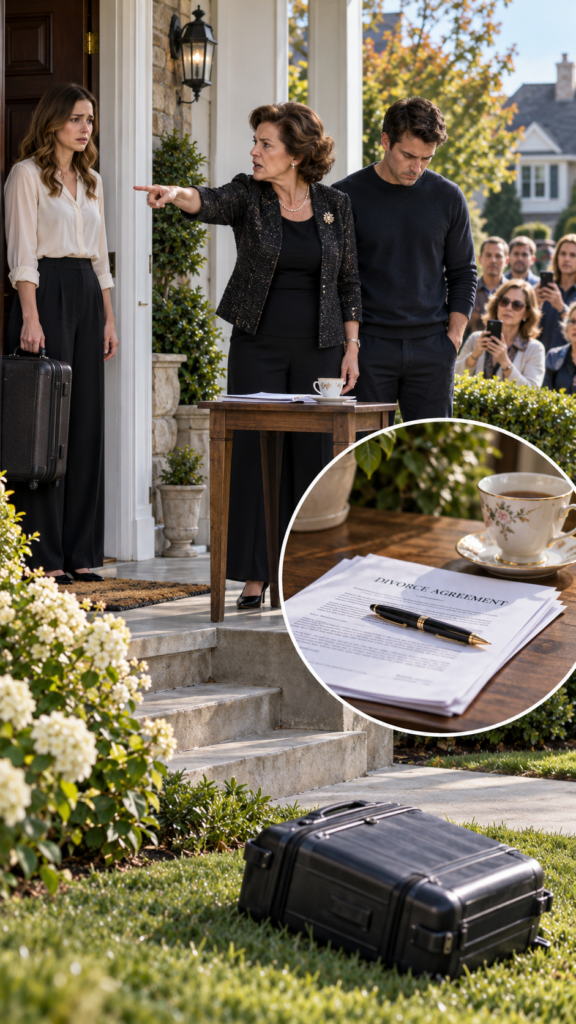
“Sign the divorce papers and get out of my house!”
Margaret Collins stood at the edge of the porch, breathing hard, one hand still extended from throwing Emma Carter’s belongings into the yard.
Across the street, conversations stopped.
A neighbor watering flowers lowered the hose. Two women near a parked car began whispering. Someone farther down the sidewalk lifted a phone and started recording.
Emma remained in the doorway.
Her fingers were wrapped tightly around the handle of a small suitcase containing nearly everything she still owned.
Three years of marriage.
Three years of trying to belong.
And somehow it had ended here, beneath the eyes of people who seemed eager to watch her humiliation.
Margaret looked at her with open contempt.
“You trapped my son with your fake kindness,” she said. “A poor girl like you should never have dreamed of marrying into this family.”
Emma’s gaze dropped toward the porch floor.
She could have answered.
She could have reminded Margaret of every dinner she had cooked, every family gathering she had endured with a smile, every quiet insult she had swallowed because Daniel was worth trying for.
Instead, she said nothing.
That silence made Margaret even angrier.
A cup of hot tea sat on the porch table.
Margaret snatched it up.
Before Emma could move, the tea splashed across the front of her blouse.
A sharp gasp traveled through the crowd.
Emma flinched as the warm liquid soaked into the fabric, leaving dark stains across her clothes. She lifted one trembling hand and wiped a few drops from her face.
Margaret laughed.
“Look at you,” she said. “You can’t even afford a new outfit. My son deserves a wife with money, not someone who grew up counting every dollar.”
Several relatives laughed with her.
One woman folded her arms and shook her head.
“She should have known her place from the beginning.”
For the first time, Emma looked toward Daniel.
He stood only a few feet away.
Close enough to see her shaking hands.
Close enough to hear every word.
Close enough to stop all of it.
He did nothing.
Emma swallowed and forced herself to breathe.
“If divorce is truly what your family wants…”
Her voice was quiet, but the porch became strangely still.
She reached toward the table.
The papers were already waiting.
So was the pen.
Emma picked it up.
For one final moment, she looked directly into her husband’s eyes.
There was no anger in her expression.
That would have been easier.
There was only a fragile, fading hope that Daniel would finally step forward and say enough.
That he would tell his mother to stop.
That he would tell Emma not to sign.
Daniel’s jaw tightened.
Then his eyes dropped toward the ground.
Something inside Emma seemed to go still.
A tear slipped slowly down her cheek.
She lowered the pen.
Her signature appeared at the bottom of the divorce papers.
Margaret released a satisfied breath.
“Finally,” she said. “Now leave before you embarrass this family any further.”
Emma placed the pen down carefully.
No shouting.
No pleading.
No final accusation.
She simply picked up her suitcase and walked down the porch steps.
Behind her, the relatives began murmuring again. Margaret remained near the papers, wearing the unmistakable expression of someone convinced she had won.
Daniel still did not move.
Emma reached the sidewalk without looking back.
That was when a black luxury sedan slowly turned onto the street.
The whispers began to fade.
The car stopped near the house.
Its rear door opened.
An elderly gentleman stepped out, straightened his jacket, and looked toward the scene on the lawn.
Nobody there seemed to recognize him.
Nobody understood why he had come.
And nobody noticed how his expression changed when his eyes found Emma.
What happened in the next few moments would change everything they thought they knew. 👇
The elderly man closed the sedan door with one careful motion.
“Emma Carter?”
Her foot stopped at the edge of the sidewalk.
The sound of her own name, spoken by a stranger with such quiet certainty, made her turn. The suitcase tilted against her leg. For a second, she simply stared at him through tear-blurred eyes.
He was tall despite his age, silver-haired, perhaps in his late seventies, wearing a charcoal suit beneath a dark wool coat. Nothing about him was flashy, but there was a stillness in the way he carried himself that made the murmuring crowd instinctively lower its voice.
“I’m sorry,” Emma said. “Do I know you?”
The question seemed to hurt him.
“My name is Thomas Aldridge.”
He reached inside his coat, removed a leather card case, and held out a business card without stepping too close.
“I represented Evelyn Carter for thirty-two years.”
Emma’s fingers stopped halfway toward the card.
The name landed harder than Margaret’s shouting had.
“My grandmother?”
Thomas nodded.
Behind Emma, someone whispered.
Margaret’s smile vanished.
Emma had not heard Evelyn Carter’s name spoken aloud since she was a child. Her mother had rarely talked about her own family, and when she did, the sentences had always ended too soon.
“She’s alive?”
Thomas’s eyes softened.
“No.”
The word was almost gentle.
“She died six weeks ago.”
Emma’s shoulders dropped a fraction.
She had spent years telling herself she did not care about a woman she barely remembered. Yet grief moved through her with strange force, not for the grandmother she had lost, but for every question that had just become permanently harder to ask.
“I’m sorry,” Thomas said.
Emma looked away.
“I didn’t even know where she lived.”
“I know.”
Margaret stepped off the porch.
“Excuse me.”
Thomas turned his head.
Margaret had recovered enough to rearrange her expression into offended dignity.
“This is clearly a private family matter.”
Thomas glanced toward the suitcase on the grass.
Then toward Emma’s stained blouse.
Then toward the divorce papers still lying on the porch table.
“Yes,” he said. “It appears several private family matters have become rather public.”
Nobody laughed.
Margaret’s face tightened.
“You don’t know what happened here.”
Thomas looked at Emma.
“Did you just sign divorce papers?”
Emma felt Daniel’s eyes rise toward her for the first time since she had left the porch.
“Yes.”
Thomas’s gaze moved to the tea stains on her blouse.
“Were you leaving voluntarily?”
Emma hesitated.
Margaret answered for her.
“She has been manipulating my son for years. This family finally saw through her.”
“Mother.”
Daniel’s voice was barely above a whisper.
Margaret turned sharply.
It was the first time he had spoken.
Too late, Emma thought.
Painfully, impossibly too late.
Thomas returned his attention to Emma.
“I came because I have been trying to reach you for eleven days. Your phone number in the estate records was old. Yesterday, one of our investigators confirmed this address.”
Margaret’s eyes narrowed at the word estate.
Emma noticed.
So did Daniel.
Thomas continued.
“Your grandmother left instructions that certain documents were to be delivered to you personally.”
Emma gave a small, exhausted shake of her head.
“I can’t deal with documents today.”
“You don’t have to.”
Thomas’s voice remained calm.
“There is no decision required today.”
Margaret moved another step closer.
“What documents?”
Thomas looked at her.
“They concern Ms. Carter.”
“She’s still married to my son.”
The sentence came too quickly.
Too eagerly.
The woman who had been ordering Emma off the property less than a minute earlier was suddenly very interested in the legal boundaries of Emma’s life.
Emma saw it.
Daniel saw it too.
His face changed.
Thomas’s expression did not.
“The documents concern assets held in a testamentary trust for Emma Carter alone.”
The street went silent.
Even the neighbor’s garden hose had stopped running.
Margaret blinked.
“What assets?”
Thomas did not answer her.
He looked at Emma.
“Your grandmother left you her home, several investment accounts, and the remaining assets of the Carter family trust.”
Emma stared at him.
The words did not fit inside her understanding of her own life.
Her childhood had been grocery lists calculated down to the dollar.
Winter coats worn one season too long.
Her mother standing at a kitchen table under a weak yellow light, deciding which bill could wait until Friday.
There had been no trust.
No family home.
No investment accounts.
Emma almost laughed, but nothing came out.
“You have the wrong person.”
“I don’t.”
“My mother had nothing.”
Thomas’s jaw shifted.
“Your mother chose to have nothing from Evelyn.”
That sentence changed the air.
Emma’s eyes lifted.
Thomas looked as though he had been waiting years to say the next words to someone who deserved to hear them.
“Your mother walked away from her family’s money when she was twenty-six.”
Margaret made a small sound behind her.
Emma barely heard it.
“Why?”
Thomas glanced toward the crowd.
“This is not the place.”
Margaret stepped forward again.
“If there’s money involved, Daniel has a right to know.”
Daniel turned toward her.
“No.”
Margaret froze.
His voice was still quiet.
But this time it did not bend.
“No, he doesn’t,” Thomas said. “And neither do you.”
Margaret’s mouth opened.
Thomas continued before she could speak.
“The trust was created by Evelyn Carter and is legally separate from Emma’s marriage. Nothing signed on that porch changes that.”
A strange, ugly calculation moved across Margaret’s face before she could hide it.
Emma watched it happen.
The contempt disappeared first.
Then the triumph.
Then something almost resembling concern took its place.
“Emma,” Margaret said, softer now.
Emma flinched as if she had been touched.
Margaret had never used her name that gently.
Not once in three years.
Thomas noticed that too.
“Perhaps,” Margaret continued, “everyone is emotional. There’s no reason to rush away.”
Daniel looked at his mother as though he were seeing a stranger.
Twenty minutes earlier, Emma might have given anything to hear someone ask her to stay.
Now the words made her feel cold.
“You threw my suitcase onto the lawn,” Emma said.
Margaret’s lips parted.
“You poured tea on me.”
“I was angry.”
“You told me I was too poor to belong here.”
Margaret glanced at the neighbors.
“That was said in the heat of the moment.”
Emma looked at the divorce papers.
“No. It was said because you believed it.”
Margaret’s composure cracked.
“I was protecting my son.”
Daniel finally stepped away from the porch column where he had been standing.
“From what?”
Margaret turned toward him.
“Daniel—”
“From what, Mom?”
His voice shook now.
Not with fear.
With shame.
Margaret stared at him.
“She used you.”
Daniel’s eyes moved toward Emma.
He looked at the stained blouse.
The suitcase.
The tear track on her cheek.
Then at his own hands.
“She asked me to defend her,” he said.
Emma’s throat tightened.
“I didn’t.”
Margaret’s expression sharpened.
“This is not the time to turn against me.”
Something inside Daniel seemed to break at those words.
He let out a short breath.
“There it is.”
Margaret went still.
“You don’t think this is about my marriage,” he said. “You think it’s about whether I’m standing with you.”
“Daniel.”
“No.”
The word came louder this time.
Several relatives looked away.
Daniel faced the woman who had controlled every silence in the house for years.
“You humiliated my wife on the front lawn.”
“I was trying to save you.”
“You poured tea on her while I stood there.”
Margaret’s chin trembled with fury.
“And you stood there, Daniel. Don’t put that on me.”
The sentence hit him exactly where it was meant to.
He recoiled.
Emma saw the old pattern in an instant.
Margaret wounded.
Daniel absorbed.
Margaret accused.
Daniel apologized.
It had happened in smaller ways for three years.
She had simply never seen the machinery this clearly.
Daniel swallowed.
“You’re right.”
Margaret’s eyes widened.
He looked at Emma.
“I stood there.”
No excuse followed.
No mention of pressure.
No mention of his childhood.
No claim that he had been confused.
Just the truth.
“I stood there,” he repeated.
Emma’s eyes filled again.
Daniel looked back at his mother.
“And I will have to live with that.”
Margaret folded her arms.
“So now you’re choosing her because some stranger showed up talking about money?”
Daniel’s face hardened.
“No.”
He looked at the suitcase Margaret had thrown onto the grass.
“I’m choosing not to become you.”
The woman who had laughed at Emma earlier lowered her eyes.
Margaret’s face went pale.
Thomas moved closer to Emma.
“My car can take you wherever you want to go.”
Emma nodded.
Then Daniel spoke.
“Wait.”
Her entire body stiffened.
He came down one step, then stopped.
He seemed to understand that he no longer had the right to close the distance between them.
“Emma.”
She looked at him.
“I’m sorry.”
The words were raw.
Small.
Almost useless against what had happened.
Emma tightened her hand around the suitcase.
“I waited three years for you to say something when it mattered.”
Daniel closed his eyes.
“I know.”
“No,” she whispered. “I don’t think you do yet.”
His eyes opened.
She saw love there.
That was the worst part.
Love had not disappeared.
It had simply proven insufficient.
Emma looked toward Thomas.
“I’d like to leave.”
He opened the sedan door for her.
Before she stepped inside, the woman who had said Emma should know her place moved forward from the group of relatives.
Her face had lost all its earlier superiority.
“Emma.”
Emma paused.
“I shouldn’t have said that.”
Emma looked at her for a long second.
The apology sounded sincere.
It also arrived only after power had shifted.
“Not today,” Emma said quietly.
The woman nodded and stepped back.
Emma climbed into the car.
Thomas closed the door.
Margaret remained on the lawn, watching the sedan as though she could somehow drag the last five minutes backward through force of will.
Then Daniel bent down and picked up the suitcase she had thrown.
Margaret exhaled sharply.
“Put that down.”
Daniel straightened.
The suitcase hung from his hand.
“No.”
“Daniel, don’t make a scene.”
He stared at her.
“You already did.”
Margaret’s nostrils flared.
“This is my house.”
Daniel became completely still.
For the first time that afternoon, something like disbelief crossed his face.
Then he gave a short, humorless laugh.
“No.”
Margaret’s expression changed.
Daniel looked up at the house.
“Dad left this house to me.”
Nobody moved.
“You’ve lived here because I never asked you to leave.”
Margaret’s lips lost color.
“You wouldn’t.”
Daniel looked at the divorce papers on the table.
Then at the stain the tea had left on the porch boards.
“I won’t throw your belongings onto the lawn.”
His voice remained steady.
“I won’t humiliate you in front of neighbors.”
Margaret stared at him.
“But you need to find somewhere else to live.”
Her hand went to her chest.
“I’m your mother.”
“And Emma was my wife.”
The silence afterward was enormous.
Daniel lowered the suitcase to the porch.
“You’ll have thirty days. I’ll pay for movers. I’ll make sure you’re safe.”
Margaret shook her head.
“No.”
“Yes.”
“You will regret this.”
Daniel’s face tightened.
“I already regret something.”
He looked toward the disappearing sedan.
“It isn’t this.”
Inside the car, Emma heard none of it.
She sat against the leather seat with her suitcase beside her and watched the familiar neighborhood slide past the window.
Her hands would not stop shaking.
Thomas reached into the console and offered her a folded white handkerchief.
Emma almost smiled.
“Do people still carry these?”
“My generation refuses to surrender completely.”
A small sound escaped her.
Not quite laughter.
Not quite crying.
Thomas looked toward the road and gave her the dignity of not watching as she pressed the cloth against her face.
After several blocks, Emma spoke.
“My mother never told me any of this.”
“I know.”
“She hated rich people.”
Thomas smiled faintly.
“No. Your mother hated what money allowed certain people to excuse.”
Emma turned toward him.
“You knew her?”
“For a long time.”
Thomas’s eyes remained forward.
“Your mother, Sarah, and Evelyn loved each other fiercely. Unfortunately, they were both very good at turning love into a contest neither was willing to lose.”
Emma swallowed.
“What happened?”
“Evelyn believed providing for someone gave her the right to direct them.”
The sentence struck close enough that Emma looked down.
“Your mother wanted to marry your father. Evelyn thought he was beneath her. She threatened to cut Sarah off.”
Thomas paused.
“Sarah saved her the trouble.”
Emma stared at him.
“She left?”
“With two suitcases and less than four hundred dollars.”
Emma looked at the small suitcase beside her.
Something moved through her chest.
Not pain exactly.
Recognition.
“She never went back?”
“No.”
“Even when things were hard?”
“Especially then.”
Emma wiped at her cheek.
“That sounds like her.”
Thomas nodded.
“Evelyn regretted it.”
“Did she apologize?”
“Badly at first.”
Despite everything, Emma smiled.
“That also sounds familiar.”
Thomas’s mouth softened.
“She became better at it with age. But by then your mother had built a life she was protective of. She believed accepting money would reopen the door to control.”
Emma leaned her head against the seat.
The city moved outside in soft blurs.
All her life, she had remembered poverty as something embarrassing.
Something to conceal when Margaret asked what neighborhood she had grown up in.
Something that made expensive restaurants uncomfortable because she still checked prices before reading descriptions.
Now another version of that childhood appeared beside the old one.
Her mother had not failed to reach wealth.
She had walked away from it.
“I need to show you something,” Thomas said.
The sedan turned onto a quieter road lined with old trees.
Twenty minutes later, they stopped before a two-story brick house set behind a low stone wall.
It was beautiful without being grand.
White shutters.
An old oak tree.
A narrow porch.
Windows glowing gold in the late afternoon.
Emma did not move.
Something about the house felt familiar in a way she could not explain.
Thomas got out but waited on the walkway.
Emma eventually followed.
The air had cooled.
Her tea-stained blouse clung unpleasantly against her skin.
Thomas unlocked the front door.
“I can arrange a hotel if this is too much.”
Emma looked inside.
“No.”
Her voice was barely audible.
“I want to see it.”
The house smelled faintly of beeswax, books, and something floral.
Nothing had been staged.
A pair of reading glasses still rested beside an armchair.
A half-finished crossword sat on a side table.
Photographs lined the mantel.
Emma approached them slowly.
There was her mother.
Young.
Laughing.
Standing barefoot in a garden.
Emma touched the frame.
She had never seen that photograph.
Beside it stood another.
Sarah at perhaps twenty-five, holding a baby against her shoulder.
Emma.
Her knees weakened.
Thomas moved a chair toward her without speaking.
She sat.
On the back of the photograph, in faded blue ink, someone had written:
Sarah and Emma. Come home whenever you’re ready.
Emma pressed her thumb against the words.
“Evelyn?”
Thomas nodded.
“She kept waiting.”
Emma closed her eyes.
“Why didn’t my mother tell me?”
“Because hurt can become a kind of inheritance too.”
Thomas sat across from her.
“Your mother wanted you free of the fight she never finished.”
He removed a cream envelope from his coat.
“Evelyn left this for you.”
Emma stared at her name.
Not typed.
Written by hand.
She broke the seal.
The letter began without ceremony.
Emma read slowly.
My dear Emma, if you are holding this, then I have finally run out of time to become the woman I should have been much earlier.
Emma stopped breathing.
She continued.
I loved your mother, but for too many years I confused love with authority. I believed that because I could provide comfort, I had earned obedience. Sarah taught me the cost of that mistake by choosing hardship over a home where love came with conditions.
Emma’s vision blurred.
She wiped her eyes and kept reading.
I was angry when she left. Then I was proud. Then I was ashamed. Pride wasted years that love would have used better.
Emma lowered the page.
The room was completely quiet.
Thomas waited.
She read again.
I know you grew up with less than I could have given you. I also know Sarah gave you something I nearly destroyed in her: the knowledge that dignity is not for sale.
A sob caught in Emma’s throat.
She covered her mouth.
The words on the porch returned.
Poor girl.
Counting every dollar.
Know your place.
For the first time, those memories no longer felt like evidence against her.
They felt like proof of something else.
Her mother had counted every dollar because she had refused to let someone richer decide who she was allowed to love.
Emma looked back at the letter.
There is money here, and a house, and more security than either of you ever had. I hope it makes your life gentler. But if this money becomes the most important thing I leave you, then I will have failed twice.
Emma laughed through her tears.
At the bottom, one final paragraph waited.
If anyone ever asks you to become smaller in exchange for belonging, I hope you do what your mother did. Take what you can carry. Walk through the door. Trust that home is a place where you are not required to beg to stay.
Emma folded forward.
The letter trembled in both hands.
Thomas looked toward the window.
He allowed her to cry without turning the moment into something that needed fixing.
Eventually, Emma whispered, “She did exactly that.”
“Your mother?”
Emma shook her head.
“Me.”
Thomas looked at her.
“This afternoon.”
Understanding moved across his face.
Emma stared at the small suitcase beside the chair.
Her mother had left one controlling house carrying two suitcases.
Years later, without knowing the whole story, Emma had walked away carrying one.
The resemblance was so precise it frightened her.
Thomas leaned back.
“There’s something else you should know.”
Emma braced herself.
He smiled gently.
“We met once.”
She studied his face.
“I don’t remember.”
“Five years ago. Outside St. Anne’s Pharmacy.”
Emma frowned.
Then something surfaced.
Rain.
An elderly man sitting on the curb.
A paper bag split open.
Orange prescription bottles rolling toward the gutter.
“You fell.”
Thomas smiled.
“I tripped. At my age, dignity insists on the distinction.”
Emma stared.
“You were wearing a terrible green scarf.”
“It was a gift.”
“It was terrible.”
He laughed.
The sound warmed the room.
“You stayed with me until my driver arrived.”
Emma remembered.
She had been late for work.
She had missed a bus.
The elderly man had kept apologizing.
She had forgotten him by the end of that week.
Thomas had not forgotten her.
“You told me your name,” he said. “Months later, Evelyn mentioned a granddaughter named Emma Carter. I asked for a photograph.”
Emma’s hand tightened around the letter.
“She knew?”
“That a stranger once helped me when there was absolutely nothing to gain from it?”
Thomas nodded.
“Yes.”
He looked directly at her.
“Your grandmother knew exactly what kind of woman you had become.”
Emma’s eyes filled again.
Margaret’s accusation returned with almost painful clarity.
Fake kindness.
Thomas seemed to understand without Emma saying it.
“Whatever happened on that lawn today,” he said, “do not allow people who misjudged you to rewrite the evidence of your own life.”
That evening, Emma slept in Evelyn’s house.
Not well.
But safely.
She woke twice expecting to hear Margaret’s footsteps outside the bedroom door.
Both times there was only the old house settling around her.
The next morning, sunlight fell across the quilt.
For several seconds Emma did not know where she was.
Then she saw the letter on the nightstand.
Everything returned.
Daniel.
The porch.
The tea.
Her signature.
The black sedan.
Her grandmother.
She sat up and breathed.
Across town, Daniel had not slept at all.
At midnight, a neighbor sent him the video from the lawn.
Daniel watched it once.
Then again.
The third time, he stopped watching Margaret.
He watched himself.
He watched Emma turn toward him after the tea hit her blouse.
He watched her wait.
He watched his own eyes fall.
He paused the video there.
For years, Daniel had told himself silence prevented conflict.
On the screen, silence looked different.
It looked like permission.
He sat alone at the kitchen table until sunrise.
Margaret did not come downstairs.
For the next three weeks, the house changed.
Relatives stopped dropping by.
Two family members who had laughed that afternoon called Daniel privately and admitted they had followed Margaret’s lead because it had always been easier than challenging her.
The woman who had told Emma to know her place mailed Emma a handwritten apology.
She did not ask to be forgiven.
Emma appreciated that.
She put the note away without answering immediately.
Margaret tried every method she knew.
Anger.
Tears.
Guilt.
Silence.
Then anger again.
Daniel did not reverse his decision.
The house had legally belonged to him since his father’s death. Margaret had lived there because Daniel had never imagined asking his mother to leave.
Now he listed it for sale.
When the sign appeared on the lawn, Margaret stood at the front window for almost an hour.
Daniel found her there.
“You’re really doing this.”
“Yes.”
“You’re destroying the family.”
Daniel shook his head.
“No.”
He thought of Emma standing beneath the porch light, tea running down her blouse.
“I’m finally admitting how damaged it already was.”
Margaret turned.
“I gave you everything.”
Daniel’s face tightened.
“You gave me a life where disappointing you felt more dangerous than losing my wife.”
Her eyes widened.
He continued.
“I’m not blaming you for what I did.”
That surprised her.
“I’m blaming me.”
He swallowed.
“And I’m making sure I never become that man again.”
Margaret moved into a smaller condominium across town before the month ended.
No one threw her belongings outside.
No one gathered on the sidewalk.
Daniel hired movers.
He paid the first six months of her fees.
Then he gave her the keys and left.
Her downfall was quieter than her cruelty had been.
There was no crowd when her control disappeared.
No dramatic speech.
Just doors that no longer opened because she demanded it.
Calls that were no longer answered immediately.
Relatives who stopped asking her permission before making decisions.
A son who no longer confused obedience with love.
The house sold two months later.
Margaret never entered it again.
Emma learned about none of that from Daniel.
Thomas told her only when she asked.
By then, Emma had started rebuilding her life in smaller, less dramatic ways.
She replaced the tea-stained blouse.
She unpacked the suitcase.
She returned to work.
She met with the attorney handling Evelyn’s estate and signed only what she understood.
She kept the house.
Not because it was valuable.
Because every room seemed to contain a piece of a family story she had been denied.
One Saturday, Thomas helped her clear a storage closet beneath the stairs.
At the back, they found a narrow wooden box.
Inside were letters.
Dozens of them.
Every one addressed to Sarah Carter.
Most had been returned unopened.
Emma sat on the floor.
She read none of them that day.
She only counted them.
Forty-seven.
Forty-seven attempts, made too late and badly, but made.
At the bottom of the box was one envelope different from the others.
It had been opened.
The handwriting belonged to Emma’s mother.
Thomas went still when he saw it.
“I didn’t know she answered.”
Emma unfolded the page.
Sarah’s message was short.
Mom, I forgive you. That does not mean I can come back to the life we had. I need Emma to grow up knowing love can survive a boundary. Please let her choose you someday if she wants to. Do not buy your way around me. If you love us, respect the distance I am asking for.
Emma read it twice.
Then a third time.
Her mother had forgiven Evelyn.
Not reconciled.
Not returned.
Forgiven.
The distinction settled into Emma slowly.
For months, she had wondered whether keeping the divorce meant she was cruel.
Whether loving Daniel required giving him another chance.
Whether forgiveness demanded reunion.
Her mother’s letter answered a question Sarah could never have known her daughter would someday ask.
Love can survive a boundary.
Emma pressed the page against her chest.
Thomas sat on the floor beside her.
Neither spoke for a long time.
The divorce became final in early spring.
Daniel did not contest anything.
He did not ask for part of Evelyn’s estate.
He did not use lawyers to drag out the process.
His attorney delivered the final paperwork with a sealed letter.
Emma left it unopened for four days.
On the fifth evening, she sat at Evelyn’s kitchen table and read it.
Daniel had written six pages.
There were no excuses.
He wrote about every moment he remembered staying silent when Margaret hurt Emma.
The Christmas dinner when his mother mocked Emma’s job.
The birthday when Margaret deliberately seated Emma away from the family.
The weekend Daniel told Emma she was “too sensitive” after Margaret insulted her mother.
Then the lawn.
I kept telling myself I was protecting peace, Daniel wrote. The truth is I was protecting myself from my mother’s anger and asking you to absorb the cost. I called that neutrality because cowardice was harder to admit.
Emma cried.
But she did not mistake tears for a reason to return.
Near the end, Daniel wrote:
I still love you. I am not writing that to ask you back. Loving you now means accepting that you deserved a husband who spoke before the papers were signed, not after. I hope someday when you remember me, the worst thing I did is not the only thing you can remember. But if it is, I understand.
Emma folded the letter.
Two weeks later, she asked him to meet her at a quiet café.
Daniel looked thinner.
Older somehow.
When Emma entered, he stood automatically.
Then stopped himself from approaching.
“Hi.”
“Hi.”
They sat.
For several seconds neither touched the coffee between them.
Daniel looked at her hands.
“You look well.”
“I’m getting there.”
He nodded.
“So am I.”
Emma studied him.
“Are you seeing someone?”
His eyebrows lifted.
“A therapist.”
For the first time, Emma laughed.
Daniel smiled.
It hurt both of them.
Then the smile disappeared.
“I’m sorry,” he said.
“I know.”
“I don’t expect forgiveness.”
Emma traced one finger along the edge of her cup.
“I do forgive you.”
Daniel’s eyes lifted.
She continued before hope could distort the meaning.
“But I’m not coming back.”
His throat moved.
“I know.”
“I loved you.”
He looked down.
“I still love you.”
Emma breathed carefully.
“Sometimes that isn’t enough.”
A tear slipped down Daniel’s cheek.
He wiped it away with the heel of his hand.
“No.”
Emma thought of Sarah’s letter.
“Forgiveness doesn’t mean returning to the place where you learned you weren’t safe.”
Daniel closed his eyes briefly.
When he opened them, he nodded.
“I hope you’re happy.”
“I hope you become happy too.”
They sat another twenty minutes.
They talked about ordinary things.
A broken kitchen faucet.
A restaurant that had closed.
The neighbor’s dog that still barked at delivery trucks.
Small pieces of a shared life that no longer needed to be weapons.
When they stood to leave, Daniel did not ask for a hug.
Emma did.
It lasted three seconds.
No promises.
No reopening.
Just goodbye.
As spring softened into summer, Evelyn’s old house began to change.
Emma kept the worn dining table.
She repaired the porch.
She planted rosemary near the kitchen steps because Sarah had once written that the smell reminded her of childhood.
Thomas came for Sunday lunch twice a month.
Sometimes they talked about Evelyn.
Sometimes they deliberately did not.
The woman who had mocked Emma eventually received a short note in return.
Thank you for apologizing. I hope next time someone is being humiliated, none of us waits until it is safe to be kind.
The woman kept that note.
Daniel continued therapy.
He maintained distance from Margaret.
Months later, he began seeing her again for coffee in public places, but only after making one condition clear.
Emma’s name was not to be blamed for anything.
The first time Margaret tried, Daniel stood up and left.
The second time, she stopped herself.
It was not redemption.
Not yet.
But it was consequence.
Margaret never regained the authority she once carried through the family.
People loved her where they could.
They no longer obeyed her where they should not.
Emma heard about this without satisfaction.
By then, revenge felt strangely small.
Peace occupied more space.
Almost a year after the afternoon on the lawn, Thomas arrived at Emma’s house carrying a narrow package wrapped in brown paper.
“You found another box?”
“Something better.”
Inside was a framed photograph.
Emma stared.
It showed Evelyn’s front porch nearly thirty years earlier.
Sarah stood at the railing, young and laughing.
Beside her was a little girl in a yellow sweater.
Emma.
“I don’t remember this.”
“You were five.”
Thomas turned the frame over.
Evelyn had written on the back.
Emma always runs toward the door as if she already knows this is home.
Emma covered her mouth.
Thomas looked away, pretending to inspect the bookshelf.
She laughed through tears.
All year, Emma had believed she was entering Evelyn’s house for the first time that afternoon after the divorce.
She had not been arriving somewhere new.
She had been returning somewhere forgotten.
That night, Emma placed the photograph on the mantel beside Sarah’s letter and Evelyn’s final note.
The three women had hurt one another across decades in ways none of them fully understood.
But the chain had broken.
Sarah had walked away rather than surrender herself.
Evelyn had eventually learned that love without freedom became control.
And Emma had inherited both lessons before she ever inherited a dollar.
On the anniversary of the divorce, Emma cooked dinner.
Not because the date deserved mourning.
Because Thomas was coming over.
So were two friends from work and an elderly neighbor who had begun bringing her tomatoes every Wednesday.
The table filled slowly.
Bread.
Wine.
Roasted vegetables.
A pie Thomas insisted he had baked himself, though nobody believed him.
Laughter moved through the old rooms.
No one watched Emma for mistakes.
No one measured her worth against her bank account.
No one reminded her that she had been allowed inside.
After everyone left, Emma carried the last two glasses into the kitchen.
Rain tapped softly against the windows.
She turned off the lamps one by one.
At the bottom of the stairs, she paused.
The small suitcase sat beneath the window.
She had kept it.
The scratch Margaret’s porch had left across one corner was still visible.
Once, nearly everything Emma believed she owned had fit inside it.
Now it held nothing.
Not because she had forgotten what happened.
Because she no longer needed to stay packed for the possibility that someone might decide she did not belong.
Emma rested her hand on the old handle for a moment.
Then she walked upstairs, leaving the suitcase empty beneath the warm window light, because for the first time in her life, she had nothing packed for leaving.






