“”The room fell silent the moment the old woman reached for the family photo.
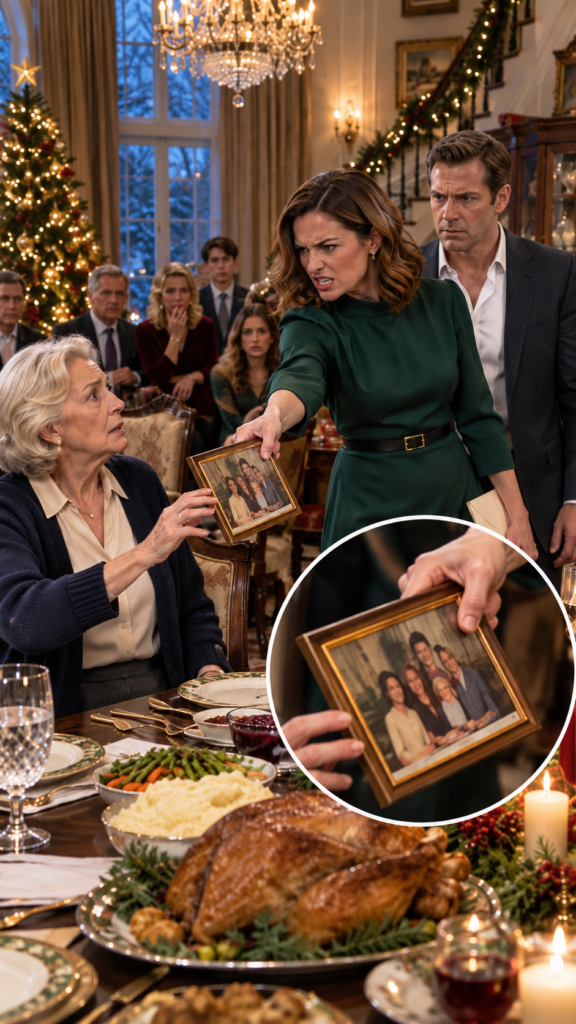
“”Don’t touch it!”” her daughter-in-law screamed, snatching the frame away before hurling a glass of water straight into the elderly woman’s face.
Everyone froze.
Water dripped from the mother’s gray hair as whispers spread across the dining table.
Then, without asking a single question, her son stepped forward.
SLAP!
His hand struck her wrinkled face so hard that she stumbled backward, clutching her cheek in disbelief.
“”I trusted you with everything,”” he shouted. “”How could you leave me with nothing?””
The daughter-in-law smirked and slowly unfolded a document.
“”It wasn’t me,”” she said sweetly. “”Your mother wrote this herself.””
Across the top of the page, in bold letters, were the words:
LAST WILL AND TESTAMENT.
The old woman’s trembling lips parted.
“”No…”” she whispered.
“”I’ve never seen that document before.””
The daughter-in-law’s smile did not disappear.
But something in it tightened.
Only slightly.
The mother noticed.
Her son did not.
He was still breathing hard, staring at her as though the paper in his wife’s hands mattered more than the red mark spreading across his mother’s cheek.
“You expect me to believe that?” he asked.
His voice was lower now.
That made it worse.
The mother slowly removed her hand from her face.
Her fingers were trembling, but when she spoke, her voice was almost unnaturally steady.
“Put it on the table.”
His wife gave a soft laugh.
“Why?”
“Because if you’re going to accuse me with it, I’d like to see what I supposedly signed.”
The room remained so quiet that the candles seemed loud.
Wax shifted inside one of the holders with a faint hiss. Somewhere beyond the dining room, the refrigerator motor clicked on. No one reached for a glass. No one touched their food.
The daughter-in-law looked toward her husband.
He nodded once.
“Give it to her.”
The sweetness vanished from the younger woman’s face.
“You already saw it.”
“I said give it to her.”
That was the first crack.
Not in the document.
In them.
The daughter-in-law placed the pages on the table but kept two fingers resting on the top sheet as though she were reluctant to surrender even that much control.
The mother stepped closer.
Her cheek burned.
She could feel the shape of her son’s hand lingering against her skin long after his palm was gone.
She did not look at him.
Not yet.
Instead, she bent toward the document.
Her eyes moved slowly over the page.
Date.
Paragraphs.
Initials.
Signature.
Then she stopped breathing.
Her daughter-in-law saw it.
“So you recognize it.”
The mother did not answer.
She reached toward the family photograph.
The same photograph her daughter-in-law had torn away from her only minutes earlier.
The younger woman immediately pulled the frame closer to her body.
The movement was too fast.
Too protective.
The son frowned.
“Why are you holding that?”
His wife looked down at the frame as though she had forgotten it was still in her hand.
“I’m not.”
“You are.”
She placed it on the table.
Carefully this time.
The mother looked at her son.
For the first time since he had hit her, their eyes met.
Something passed across his face.
Shame, perhaps.
Or fear.
But she was not ready to give it a name.
“Turn the picture over,” she said.
He stared at her.
“What?”
“The photograph. Turn it over.”
His wife’s hand twitched.
The mother saw that too.
Her son picked up the frame.
It was an old wooden one, polished at the corners from years of being handled. He turned it around.
The cardboard backing was secured by four small metal tabs.
“Open it,” his mother said.
His wife stepped forward.
“This is ridiculous.”
No one responded.
“Seriously? We’re taking apart a picture frame now?”
The mother finally looked at her.
“Yes.”
One word.
Nothing more.
Her son bent the first metal tab upward.
Then the second.
The tiny scrape of metal against wood seemed to stretch across the entire room.
His wife folded her arms.
Her foot began tapping once against the floor.
Then she stopped herself.
The son loosened the backing and lifted it away.
Behind the photograph was a sheet of faded cream paper.
Not a document.
A handwritten note.
He stared at it.
His mother closed her eyes for half a second.
She remembered writing it.
She remembered sliding it behind the picture because she had wanted it to remain with the photograph for as long as the frame existed.
“What is this?” he asked.
“Read the signature.”
He looked at the bottom.
Then at the signature on the will.
His face changed.
At first, he seemed merely confused.
Then he brought the two pages closer together.
The family around the table leaned forward without realizing they were doing it.
The daughter-in-law went completely still.
The mother pointed to the final letter of her surname on the note.
“There.”
Her son looked.
Then she pointed to the same place on the alleged will.
The loops were identical.
Not similar.
Identical.
The upward stroke broke in the same place.
A tiny ink drag beneath the final curve appeared in both signatures.
Even the slight downward hook created when her pen had caught on the grain of the old paper had been reproduced exactly.
Her son stared for several seconds.
“I don’t understand.”
The mother swallowed.
“That signature wasn’t written.”
His gaze lifted.
“It was copied.”
His wife laughed too quickly.
“That proves nothing. People sign their names the same way.”
The mother shook her head.
“No one reproduces an accidental ink drag the same way twice.”
“It’s your signature.”
“It is.”
The daughter-in-law exhaled in relief.
Then the mother finished.
“But I didn’t put it on that will.”
Her son looked down again.
He ran his thumb near the signature without touching it.
The mother’s voice became quieter.
“Someone took it from the note behind that photograph.”
The daughter-in-law’s face emptied.
For the first time that evening, she had no expression prepared.
The son slowly turned toward her.
“You knew that note was there?”
“No.”
The answer came instantly.
Too instantly.
His mother said nothing.
She didn’t need to.
His eyes dropped to his wife’s hand.
There was a small paper cut across her index finger.
A tiny thing.
Meaningless by itself.
Yet his gaze remained there.
“Why did you take the photograph away from her?”
His wife’s nostrils flared.
“Because she was reaching for it during an argument.”
“There wasn’t an argument yet.”
Silence.
He looked at his mother.
She stood with water still darkening the front of her blouse.
Her cheek was swollen.
She had not shouted once.
His face collapsed a fraction.
He looked back at his wife.
“You screamed before she said anything.”
“She knew what she’d done.”
“She said she’d never seen the will.”
“Of course she did.”
“And then she asked for the picture.”
His wife looked around the room.
Every face had changed.
Nobody was looking at the mother anymore.
They were looking at her.
The social wall she had built around herself only minutes earlier had reversed direction.
“I was trying to protect you,” she said.
Her husband’s eyes hardened.
“From what?”
“From her.”
The mother flinched.
Not visibly enough for anyone except her son to notice.
He did.
His jaw tightened.
His wife took a step toward him.
“You’ve spent years wondering what she would do with everything.”
His face sharpened.
“Don’t.”
“You have.”
“I said don’t.”
“You told me yourself you were afraid she would change things.”
The mother looked at him.
That hurt differently.
He could not meet her eyes.
His wife saw the opening and pressed harder.
“You were scared she’d leave you with nothing. I knew that. I knew how much it bothered you.”
“So you made this?”
The question landed quietly.
She shook her head.
“No.”
“Did you make this?”
“I was trying to make you see—”
“Did you make it?”
Her lips pressed together.
The mother’s hand moved to the back of a chair.
She needed something solid beneath her fingers.
Her son’s voice broke on the next word.
“Answer me.”
His wife looked toward the doorway.
Nobody blocked it.
Nobody had to.
If she walked away now, everyone in that room would understand.
Her eyes returned to her husband.
“I never thought you’d hit her.”
His face went white.
The mother closed her eyes.
There it was.
Not an answer.
A confession shaped like an excuse.
A chair scraped somewhere near the end of the table.
Someone whispered, “Oh, God.”
The son stared at his wife as though he no longer recognized the person standing in front of him.
“You made it.”
She began crying.
Not loudly.
Her eyes simply flooded all at once.
“I needed you to understand what could happen.”
“So you forged my mother’s will.”
“I was trying to protect our future.”
“By lying to me?”
“You wouldn’t listen.”
“By making me think she betrayed me?”
“She could have.”
The mother’s fingers tightened around the chair.
Her son took one step backward from his wife.
That movement seemed to frighten her more than shouting would have.
“You don’t know that,” he said.
“She controls everything.”
“No.”
His breathing became unsteady.
“You wanted me to believe she did.”
His wife wiped at her cheek.
“You’re acting like I made you hit her.”
He recoiled.
The words struck the room with almost as much force as his hand had struck his mother.
For a second, he looked as though he might argue.
Then he stopped.
His shoulders dropped.
“No,” he said.
His wife stared.
He turned toward his mother.
“No. You didn’t make me do that.”
His mother said nothing.
His eyes moved to the mark on her face.
“I did.”
The shame in his voice was almost unbearable.
He took a step toward her.
She stepped back.
Barely half a step.
Instinctive.
His entire body froze.
That was the moment he understood what the slap had actually done.
Not to her cheek.
To the space between them.
He stared at the distance she had created.
A distance that had not existed before his hand rose.
His mouth opened.
Nothing came out.
The mother looked at him for a long time.
Then she picked up the forged document.
She folded it once.
Not neatly.
Just enough to carry.
She took the photograph from the table.
Her son finally spoke.
“Mom.”
She stopped.
His voice sounded younger when he said it.
She hated that.
Some part of her still heard the child inside him.
That made what had happened more painful, not less.
“I’m sorry.”
She looked at him.
“I know you are.”
Hope flickered across his face.
She continued.
“But I cannot take care of your guilt tonight.”
The hope disappeared.
She slipped the handwritten note back behind the photograph and pressed the cardboard backing into place.
Her hands were steadier now.
“You believed a piece of paper before you believed me.”
He lowered his head.
“And then you hit me before asking one question.”
“I know.”
“No.”
Her voice shook for the first time.
“You know that happened. You do not know what it cost.”
He closed his eyes.
She picked up her coat from the back of a nearby chair.
Her daughter-in-law whispered, “Where are you going?”
The mother looked at her.
The younger woman’s face had lost all trace of triumph.
“Somewhere I am not required to defend my own name while my dinner gets cold.”
Her son moved toward her.
“I’ll take you.”
“No.”
“Please.”
“No.”
He stopped.
The mother pulled on her coat.
When she reached the doorway, she turned back.
Her gaze moved first to her daughter-in-law.
Then to her son.
“Do not destroy that document.”
His wife stiffened.
The mother continued.
“It may be the only honest thing in this room now.”
Then she walked out.
The front door closed with a soft click.
No dramatic slam.
That somehow made it worse.
Inside, nobody sat down.
The candles kept burning beside untouched plates.
The turkey cooled.
The daughter-in-law began gathering her purse.
Her husband watched her.
“What are you doing?”
“I’m leaving.”
“Yes.”
She stopped.
His voice had changed.
Not angry.
Finished.
“I think you should.”
Her eyes widened.
“You’re throwing me out?”
“I’m asking you to leave before I say something I’ll regret.”
“I did this for us.”
He laughed once.
It was a broken sound.
“You forged my mother’s name.”
“I made one document.”
“You built a lie and put it in my hands.”
“You’re the one who slapped her.”
He stared at her.
“Yes.”
She seemed almost relieved that he agreed.
Then he said, “And I will live with that for the rest of my life.”
The relief vanished.
“But I won’t live with you pretending your lie makes my violence your fault, or my violence makes your lie acceptable.”
Her mouth opened.
He pointed toward the door.
“Go.”
She looked around the dining room for support.
No one moved.
A few people lowered their eyes.
Others held hers.
For the first time that evening, there was nowhere for her to place the blame where it would stay.
She picked up her purse.
At the doorway, she turned.
“If I leave, I’m not coming back.”
Her husband looked at the table.
At the forged will.
At the water still dripping from the edge of his mother’s abandoned napkin.
“I know.”
She waited.
Perhaps for him to stop her.
He didn’t.
The door closed for the second time that night.
This time, the silence that followed felt permanent.
The son remained standing beside the table.
Someone eventually blew out one of the candles.
Another person covered the food.
Small practical gestures.
Things people did when catastrophe had already happened and there was nothing left to prevent.
He sat in his mother’s chair.
Nobody told him not to.
He touched the wet patch where water had fallen from her hair.
His face folded.
He covered his mouth with both hands.
No one comforted him.
Not yet.
Two mornings later, he stood outside his mother’s door.
He had been there for eleven minutes before he knocked.
When she opened it, the bruise on her cheek had darkened.
He stared at it.
She noticed.
“Come in or don’t.”
He stepped inside.
He carried no flowers.
No gift.
No grand gesture.
Only a manila folder.
She looked at it.
“What is that?”
“The document.”
She stiffened.
“And?”
“I had it examined.”
She said nothing.
“The signature was digitally reproduced. The formatting came from a template. The witness section was fabricated.”
His voice caught.
“The law office listed on it never prepared anything for you.”
She absorbed that without visible surprise.
He continued.
“She admitted the rest.”
His mother looked toward the window.
“She said she found the note behind the photograph months ago when she was cleaning the frame. She took a picture of your signature.”
His mother’s eyelids lowered.
“She kept it?”
“Yes.”
“For this?”
“She said she didn’t know then.”
The mother gave him a tired look.
He swallowed.
“I don’t know if I believe that either.”
He placed the folder on a table.
“She’s gone.”
His mother’s expression did not change.
“I filed for divorce.”
Still nothing.
He rubbed his palms against his trousers.
“I’m not telling you because I expect that to fix anything.”
“Good.”
“I’m telling you because you deserve to know she can’t do this to you again through me.”
That made her look at him.
For several seconds, neither spoke.
Then he said, “I keep seeing you step away from me.”
Her eyes filled.
He looked at the floor.
“I have replayed it a thousand times.”
“Don’t.”
He lifted his head.
“Don’t replay the part where I stepped back.”
Her voice remained quiet.
“Replay the part before it. The moment you decided my face was somewhere your anger was allowed to land.”
He went still.
“That is the part you need to understand.”
He nodded.
Tears slipped down his face.
“I don’t have an excuse.”
“No.”
“I wish I did.”
“I’m glad you don’t.”
He looked confused.
She took a breath.
“An excuse would only give you somewhere to hide.”
He sat down slowly.
She remained standing.
“I believed her because part of me was already afraid,” he said. “Not of losing you.”
He paused.
“Of losing what I thought you might leave me.”
His mother shut her eyes.
There was the ugliest truth.
And somehow, hearing him say it plainly hurt less than watching him avoid it.
“I let money become proof of whether you loved me.”
He wiped his face.
“And when I thought the proof was gone, I decided the love must have been gone too.”
She sat across from him.
Not beside him.
Across.
“You were never left with nothing.”
His shoulders trembled.
“I know.”
“No. You don’t.”
She reached for a small wooden box on the side table.
From inside, she removed an envelope.
“This is a copy of my actual will.”
He stared at it.
She did not hand it over.
“You were never removed.”
His mouth opened.
She continued.
“You were provided for. Fairly. Carefully.”
He began shaking his head.
“I don’t want to see it.”
“That may be the first sensible thing you’ve said about my will.”
A sound escaped him.
Half laugh.
Half sob.
His mother’s expression softened for one heartbeat.
Then she put the envelope back inside the box.
“But it has changed now.”
He looked at her.
Fear crossed his face.
She did not rescue him from it.
“I am not punishing you.”
He nodded slowly.
“I understand.”
“I changed one thing.”
He waited.
“You will not be responsible for decisions about my care, finances, or estate if I become unable to make them myself.”
The color left his face.
But he did not argue.
“That is fair.”
“It is necessary.”
“Yes.”
She watched him carefully.
“I still love you.”
His face broke.
She lifted one hand.
“Do not confuse love with trust.”
He stopped himself from reaching for her.
“I won’t.”
“Trust may come back.”
He looked at her.
“It may not come back in the same shape.”
He nodded through tears.
“I’ll take whatever shape you can give me.”
Months passed.
Not magically.
Not cleanly.
He called before visiting.
He never arrived unannounced.
When she said no, he accepted no.
When she said she needed space, he gave it.
He began speaking to someone professionally about anger, entitlement, fear, and the terrible speed with which he had turned suspicion into certainty.
He did not tell his mother this as evidence of improvement.
She learned because, one afternoon, he had to leave early for an appointment and simply said where he was going.
She noticed the difference.
He was learning to change without demanding applause for changing.
The divorce became final.
His former wife never returned to the family table.
The forged document was preserved with the records confirming how it had been created.
There was no triumphant spectacle when her deception became undeniable.
No cheering.
No satisfaction.
Only a long, sober quiet among the relatives who had sat frozen that night and watched cruelty unfold before understanding what they were seeing.
Several of them called the mother afterward.
Some apologized for believing the paper too quickly.
Others apologized for saying nothing after the water was thrown.
One woman admitted she had looked away when the slap happened because she had been afraid of making the scene worse.
The mother listened.
She did not pretend their silence had been harmless.
But she did not turn it into another weapon either.
“That night taught all of us something,” she said.
“What?”
“That staying out of it is still a choice.”
By the following winter, the bruise had long disappeared.
The memory had not.
The family gathered again near Christmas, though this time the table was smaller.
Quieter.
No one tried to recreate the old evening.
They knew better.
Her son arrived early with a loaf of bread still warm from the bakery.
He set it on the counter and asked, “Where do you want me?”
She glanced toward the dining room.
“Candles.”
He smiled faintly.
“I can handle candles.”
“We’ll see.”
It was the first joke she had made with him in months.
He looked down quickly so she would not see how much it meant.
She saw anyway.
Later, after dinner, the two of them remained near the table while the others carried dishes into the kitchen.
The old family photograph sat on a shelf nearby.
Her son noticed it.
For a long time, he simply looked.
Then he asked, “Can I see the note?”
His mother became still.
“You remember it?”
“I remember the signature.”
“That isn’t what you asked.”
He shook his head.
“No.”
She studied him.
Then she took the frame from the shelf.
Together, they loosened the metal tabs.
She removed the backing.
The cream sheet inside had yellowed slightly with age.
She handed it to him.
He read.
His breath stopped.
The note had been written years earlier.
Long before forged wills.
Long before inheritance had become a fear.
Long before that terrible dinner.
It was addressed to him.
The handwriting was unmistakably his mother’s.
For my son, it began.
He continued reading silently.
His eyes filled before he reached the bottom.
His mother watched him.
“What does it say?” he whispered, though he had already read every word.
She understood what he was really asking.
So she read it aloud.
“For my son. If one day I am no longer here, I hope you remember this photograph before you remember anything I owned. Houses empty. Money gets spent. Things disappear. But you were never the sum of what I could leave you.”
His shoulders began trembling.
She continued.
“You were the life I was lucky enough to love.”
At the bottom was her signature.
The signature his former wife had stolen.
The signature copied onto the forged will.
The signature that had nearly destroyed them.
Her son covered his mouth.
“Oh, Mom.”
She placed the note on the table between them.
“That is what she copied.”
He stared at the words.
The cruelty of it finally revealed its full shape.
The forged signature had not been stolen from a check.
Or a contract.
Or some cold financial record.
It had been stolen from a mother’s message telling her son that money had never been the measure of her love.
He lowered his head.
For several seconds, he could not speak.
Then he whispered, “And I turned it into exactly that.”
She sat beside him.
Not across from him.
Beside.
“Yes.”
He nodded.
No defense.
No excuse.
Just truth.
His hand rested on the table.
Palm upward.
He did not reach for her.
He waited.
The mother looked at that hand.
The same hand.
She remembered its force.
The crack through the dining room.
The disbelief.
The distance.
Then she looked at her son’s face.
He was not asking her to forget.
He was not asking her to make what happened smaller.
He was simply leaving the choice with her.
Slowly, she placed her hand in his.
His fingers closed gently.
So gently that she could have withdrawn without resistance.
She didn’t.
He began to cry.
Quietly.
She let him.
After a moment, she squeezed his hand once.
Not absolution.
Not erasure.
Something harder earned.
A beginning built after the ending they had almost given each other.
He wiped his face.
“Can I keep the note?”
She thought about it.
Then smiled.
“No.”
He blinked.
A small laugh escaped her.
“You may keep the photograph.”
She slid the frame toward him.
“The note stays with me.”
“That seems unfair.”
“It is my handwriting.”
He laughed then.
A real laugh.
She joined him.
From the kitchen, someone called that dessert was ready.
Neither moved immediately.
Her son placed the photograph against his chest.
His mother gathered the note and tucked it carefully into the pocket of her cardigan.
Around them, the house glowed with warm Christmas light.
No accusations.
No papers spread like weapons.
No one keeping score of what might someday belong to whom.
Only dishes clinking in the next room.
Soft voices.
The smell of coffee.
A family that had learned the expensive difference between inheritance and love.
Her son stood and offered his hand.
“Dessert?”
She looked at him.
Then at the photograph he was holding.
Years ago, she had hidden a message behind that picture because she wanted him to find it after she was gone.
Instead, he had found it while she was still there.
Perhaps that was the beautiful mercy of it.
Some truths did not have to wait for death.
Some love could still be repaired while both people were alive enough to do the work.
She took his arm.
Together, they walked toward the kitchen.
At the doorway, he paused.
“Mom?”
“Yes?”
“I’m glad you’re still here.”
Her eyes warmed.
“So am I.”
Then she leaned her head briefly against his shoulder, and for the first time since that terrible night, neither of them was afraid of the other’s touch.
Behind them, the family photograph caught the glow of the Christmas lights.
In front of them, someone opened the kitchen door wider.
And this time, when mother and son stepped through it together, they were finally going home.






