“You’re in the way, Grandma. You should’ve died years ago.”
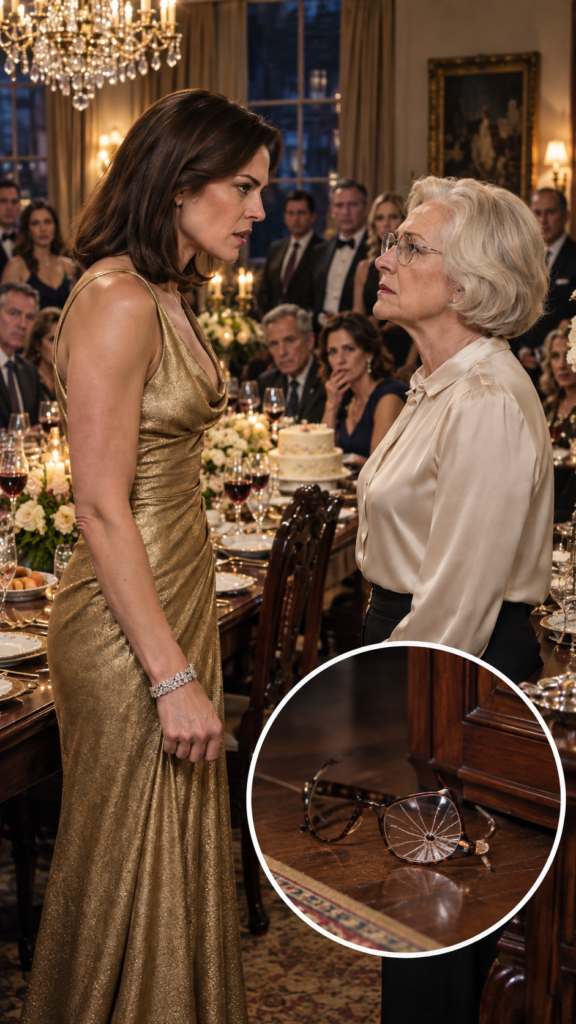
The words had barely crossed Valerie Sullivan’s lips when her hand struck Margaret Whitmore across the face.
At her own seventieth birthday dinner, Margaret staggered into the mahogany sideboard. Her glasses fell beneath her and snapped. Blood from her split lip stained the collar of the ivory silk blouse she had saved for the occasion.
Twenty-three guests watched.
Valerie’s in-laws, friends, and her husband’s business associates sat in expensive clothes around Margaret’s dining table. Shock registered on their faces, but nobody stepped forward.
Margaret tasted blood and stared up at the granddaughter she had raised.
Only an hour earlier, she had still believed Valerie was family.
Margaret had spent forty years building Whitmore Publishing from a rented Boston office into one of the East Coast’s most respected independent publishing houses. There had been no inheritance and no wealthy husband financing her ambitions.
There had only been rejected manuscripts, overdue invoices, second mortgages, sleepless nights, and enough coffee to make her hands tremble.
But Margaret had survived all of it.
Then came the loss she could never turn into a business problem she could solve.
Her daughter, Lucy, died of cancer at thirty-nine.
Lucy left behind eight-year-old Valerie, a frightened little girl with braided hair, a private-school uniform, and a stuffed rabbit she carried everywhere.
Margaret became her entire world.
She paid for Valerie’s schools, ballet lessons, summer camps, trips to Cape Cod, college tuition at NYU, and later her master’s degree in London.
When Valerie married Richard Sullivan, the son of a wealthy Connecticut real estate family, Margaret provided the down payment for their Greenwich home.
When Valerie dreamed of starting a literary agency, Margaret gave her a seven-figure fund.
Then she made Valerie vice president of Whitmore Publishing.
Not because Valerie had demanded it.
Because Margaret loved her.
Whenever she looked at her granddaughter, some part of her still saw the eight-year-old crying against her sweater at Lucy’s funeral.
That illusion began dying the moment Valerie arrived forty minutes late for Margaret’s birthday dinner.
She entered the Beacon Hill brownstone wearing a gold dress, towering heels, and the diamond bracelet Margaret had given her for her thirtieth birthday.
No hug.
No “Happy birthday.”
Instead, Valerie surveyed the dining room with an unsettling detachment, her eyes lingering on the old walls and furniture as though the house already belonged to someone else.
Then Margaret noticed the place cards.
Her seat at the head of the table had been moved.
Valerie was sitting there instead.
Margaret had been placed near the kitchen door.
She swallowed the insult and said nothing.
Dinner continued beneath a strained veneer of civility. Roasted chicken, garlic mashed potatoes, green beans, warm rolls, red wine, and the vanilla buttercream cake Margaret had ordered from Valerie’s favorite childhood bakery filled the table.
Halfway through the meal, Valerie stood.
She raised her wineglass.
“Richard and I have decided Whitmore Publishing needs fresh leadership.”
Margaret’s fork stopped.
Valerie continued calmly.
“Starting Monday, I’ll be taking over as CEO. My grandmother did what she could, but she doesn’t understand the modern world anymore.”
Conversations died around the table.
“Valerie,” Margaret said, keeping her voice low. “This is not the time.”
A small smile appeared on Valerie’s face.
“Actually, it is.”
She glanced toward the guests before looking back at Margaret.
“Everyone here is tired of pretending you’re still necessary.”
Margaret slowly set down her fork.
“You’re a burden,” Valerie added.
This time Margaret stood.
“Apologize.”
The smile vanished.
Valerie crossed the dining room, stopping close enough for Margaret to see the fury behind her carefully polished appearance.
“Do you know what it’s like,” Valerie whispered, “to spend your whole life waiting for an old woman to finally get out of the way?”
Margaret stared at her.
Then Valerie said the sentence that explained more than she probably intended.
“While you’re still alive, I’ll never be anyone.”
Her hand came up.
The slap sent Margaret backward.
Now, sitting against the sideboard with broken glass beneath one hand and blood filling her mouth, Margaret finally understood what years of generosity had prevented her from seeing.
Valerie did not consider herself fortunate.
She considered herself delayed.
Hours later, the last guest had gone. The birthday candles remained unlit, and the cake sat untouched.
Margaret entered her study alone.
Her lip was swollen. One lens of her damaged glasses was cracked. Beside her desk stood an old photograph of Lucy.
Margaret looked at her daughter’s face for several seconds.
Then she unlocked the bottom file drawer.
Inside were the documents Valerie had apparently never thought worth reading.
Company bylaws.
Trust papers.
Property deeds.
Bank authorizations.
Margaret spread them across the desk one by one.
Valerie had spent years behaving as though generosity were ownership, as though every privilege Margaret provided had already become permanent.
But Margaret had built Whitmore Publishing before Valerie was born.
And she had protected what she built.
Her fingers stopped on one provision her attorney had repeatedly insisted she retain.
Margaret read it once.
Then again.
The clause had seemed unnecessarily cautious when it was drafted.
Tonight, it looked very different.
It meant Margaret still possessed the authority to reclaim almost everything Valerie believed was already hers.
No permission from Valerie.
No warning.
No family vote.
Margaret touched her swollen lip, then looked toward Lucy’s photograph.
For the first time that evening, her hands were perfectly steady.
She reached for the telephone and dialed.
Someone answered.
Margaret looked down at the clause beneath her fingertips.
“I need you to do something for me before sunrise,” she said.
There was a long silence on the other end.
Margaret could hear the faint rustle of sheets, then the sharper sound of a lamp clicking on. Her attorney had known her for thirty-one years. He had heard her negotiate acquisitions at midnight, dictate emergency statements from hospital waiting rooms, and once calmly restructure a division while firefighters were still clearing smoke from the floor beneath it.
He had never heard her voice sound quite like this.
“Margaret?”
She closed her eyes.
“I’m here.”
“What happened?”
Her fingers moved toward the cracked lens of her glasses and stopped before touching it.
“That is not the first thing I need you to handle.”
Another silence.
Then his voice changed. The sleep disappeared from it.
“All right.”
Margaret looked at the spread of documents.
“Tell me exactly what the provision allows.”
He did.
Slowly.
No comforting language. No assumptions.
Valerie’s completed gifts remained completed gifts. Margaret could not simply take back a house because she regretted helping buy it. She could not erase money legally transferred years before or rewrite history because she had finally understood the person who benefited from it.
Margaret had no desire to.
But the things Valerie had mistaken for inevitabilities were another matter.
Her executive authority at Whitmore Publishing.
Her company signing privileges.
Her access to corporate accounts.
Her voting proxies.
Future trust distributions that had never vested.
Succession rights Valerie had spoken about as though Margaret’s death were merely an administrative inconvenience.
Margaret listened without interrupting.
When he finished, she asked, “And the CEO position?”
“You are CEO.”
Margaret’s eyes moved to Lucy’s photograph.
“I know.”
“No one can announce a succession simply by announcing it at dinner. The board has not voted. You have not resigned. You have not executed a transfer.”
“She told twenty-three people she was taking over Monday.”
“She was wrong.”
The simplicity of it nearly hurt.
Margaret looked down at her hand.
A thin line of dried blood had settled near one knuckle where broken glass had nicked the skin.
“I want every authority I legally granted her suspended before the office opens.”
There was another pause.
“Do you want her terminated?”
Margaret stared at the photograph.
Eight years old.
Braided hair.
Stuffed rabbit pressed beneath one arm.
The memory rose so quickly that for one brutal second she could smell rain on cemetery grass again.
“No,” Margaret said.
Her attorney waited.
“I want an emergency board meeting at nine.”
“That gives us very little time.”
“I know.”
“And Margaret?”
“Yes?”
“What happened?”
She looked toward the dark window.
Boston had gone quiet outside. Somewhere down the street, a car crossed wet pavement. The sound faded almost immediately.
“My granddaughter hit me.”
Nothing came through the telephone.
Margaret continued before he could answer.
“In front of everyone.”
His inhale was slow.
“Are you safe?”
Margaret looked around her own study as if considering the question for the first time.
“Yes.”
“Is Valerie still there?”
“No.”
“Did anyone call the police?”
“No.”
“Do you want me to?”
Margaret pressed her tongue carefully against the cut inside her lip.
“I want tonight documented. I want the people who saw it asked for written statements. Nothing more without speaking to me first.”
“All right.”
“And one more thing.”
“Yes?”
“Do not protect me from knowing what she has done inside the company.”
His silence lasted half a second too long.
Margaret’s back straightened.
“What does that mean?”
“I’ll have the files pulled.”
“That was not my question.”
“I know.”
A pressure colder than the winter glass settled beneath Margaret’s ribs.
“You know something.”
“I know there have been complaints.”
Her fingers curled around the telephone cord.
“About what?”
“Her management style. Her use of your name. Promises she made about the succession. I do not know yet whether any of it crossed a legal line.”
Margaret said nothing.
“I should have told you sooner,” he added.
“Yes.”
“I thought you knew.”
“No.”
The word was barely louder than breath.
He did not defend himself.
That, more than an apology would have, kept Margaret on the telephone.
“I’ll be at the office before eight,” he said.
“So will I.”
“You need a doctor.”
“I need both.”
“Margaret—”
“I said both.”
For the first time that night, something almost like her old voice returned.
He heard it.
“All right.”
When the call ended, Margaret remained seated.
The room felt enormous.
She had expected action to make her feel stronger.
Instead, the moment the receiver touched its cradle, her body began to shake.
Not dramatically.
Not all at once.
First her left hand.
Then her shoulders.
Then her breath came apart in small, humiliating pieces she could not organize.
Margaret bent forward and pressed both palms to the edge of the desk.
She had been slapped.
By Valerie.
The sentence would not fit inside her mind.
She stared at Lucy’s photograph.
“I’m sorry,” she whispered.
The words surprised her.
She did not know whether she was apologizing for failing Valerie, for loving her too blindly, or for spending years confusing rescue with devotion.
Lucy’s photographed smile remained unchanged.
Margaret lowered her forehead to one hand.
And finally, alone in the room where no employee, board member, creditor, author, or granddaughter could see her, she cried.
Not for the company.
Not for the money.
For the little girl with the rabbit.
For the woman that little girl had become.
For the terrible fact that both of them could be real at once.
At seven thirty the next morning, Boston was pale with winter light.
Margaret entered Whitmore Publishing through the same glass doors she had walked through thousands of times, wearing dark trousers, a navy coat, and the ivory blouse from the night before beneath it.
She had considered changing.
Then she had looked at the faint bloodstain on the collar and decided not to.
Her doctor had cleaned the cut, checked her cheekbone, and told her the swelling would worsen before it improved.
Margaret had thanked him.
Then she had gone to work.
People looked up as she crossed the lobby.
Some recognized the bruising immediately.
Nobody asked.
The elevator doors closed around her.
On the twelfth floor, her attorney waited outside the boardroom with two thick folders and a paper cup of coffee he had clearly forgotten to drink.
His eyes went first to her face.
Margaret watched him make himself look away.
“What did you find?”
“Enough for questions.”
“Not conclusions?”
“Not yet.”
“Good.”
She took one folder.
Inside were emails.
Internal notes.
Copies of meeting agendas.
No secret embezzlement.
No hidden crime waiting conveniently to solve Margaret’s pain.
What she found was, in some ways, worse because it was so ordinary.
Valerie had spent almost two years introducing herself to certain industry contacts as “the incoming CEO.”
She had redirected meetings away from Margaret without authorization.
She had told senior employees that major decisions would soon require her approval.
She had spoken of Margaret’s retirement as settled fact.
Several managers had objected privately.
Two had nearly resigned.
One email from a longtime editor made Margaret stop breathing for a moment.
I do not know whether Margaret is aware of how her granddaughter speaks about her when she is not in the room.
Margaret closed the folder.
“How did I miss this?”
Her attorney did not answer quickly.
“You trusted her.”
“That is not an answer.”
“No,” he said. “It is the reason.”
At eight fifty-eight, the boardroom door opened.
Valerie entered wearing cream trousers, a camel coat, and sunglasses.
She removed them halfway across the room.
Then she saw Margaret.
Her steps faltered.
For one instant, the confidence from the birthday dinner vanished.
“You came in?”
Margaret looked at her.
“I work here.”
Valerie’s eyes moved to the bruise along Margaret’s cheek.
Something flickered across her face.
Not remorse.
Calculation.
“You should be resting.”
Several board members had already taken their seats.
Margaret watched Valerie notice them one by one.
“What is this?”
“Sit down.”
Valerie gave a small laugh.
“Grandma, if this is about last night—”
“Sit.”
The room went still.
Valerie stared at her.
Then she sat.
Margaret remained standing.
Her attorney placed a document in front of each board member.
Valerie looked down at hers.
Her mouth tightened.
“What is this supposed to be?”
“A suspension of your executive authority pending this meeting,” Margaret said.
“You cannot do that.”
“I already did.”
Valerie looked around the table.
No one met her eyes.
“You’re letting her do this?”
Margaret felt something inside her settle.
There it was.
Not Grandma.
Her.
An obstacle again.
Valerie pushed the paper away.
“This is insane.”
Margaret opened the first folder.
“For almost two years, you have described yourself outside this company as its incoming CEO.”
Valerie’s face changed.
“Because that was the plan.”
“Whose plan?”
“Ours.”
“No.”
Valerie looked directly at her.
“You told me I would inherit this company.”
“I told you there would always be a place for you here if you earned it.”
“That is the same thing.”
“No,” Margaret said quietly. “It never was.”
A chair shifted near the far end of the table.
Valerie turned toward the sound.
Richard Sullivan stood in the doorway.
His face looked gray from lack of sleep.
Valerie went perfectly still.
“What are you doing here?”
Richard did not move farther into the room.
Margaret had not invited him.
Neither had her attorney.
He looked at Valerie, then at Margaret’s bruised face.
“I asked reception if the meeting had started.”
Valerie rose halfway from her chair.
“Why?”
Richard swallowed.
“Because you used my name last night.”
A strange stillness moved through the boardroom.
Valerie’s expression hardened.
“What are you talking about?”
Richard’s eyes dropped for one second.
Then he looked at Margaret.
“When Valerie said, ‘Richard and I have decided Whitmore Publishing needs fresh leadership’—that wasn’t true.”
Margaret heard nothing for several heartbeats.
Not the ventilation.
Not the traffic below.
Nothing.
Valerie stood.
“Richard.”
He looked at her.
“I never agreed to that.”
“You knew we talked about it.”
“We talked about you wanting it.”
“You said she couldn’t run the company forever.”
“I said nobody runs anything forever.”
His voice cracked.
“I never said you were taking it from her.”
Valerie stared at him as if he had struck her.
“You’re humiliating me.”
Richard’s face tightened.
“No.”
He glanced at Margaret.
“I did that last night when I sat there and said nothing.”
Margaret looked away.
The admission hurt more than she expected.
Richard stepped farther into the room.
“I should have stopped it before you touched her.”
“Don’t pretend you’re innocent.”
“I’m not.”
That answer silenced Valerie.
Richard’s hands hung uselessly at his sides.
“I liked what Margaret gave us,” he said. “The house. The connections. The doors that opened because people knew her name. And every time you talked about what would be ours someday, I let you talk.”
Valerie’s eyes shone.
“So now you’re choosing her?”
Richard shook his head.
“I’m choosing to stop lying.”
Valerie turned back toward Margaret.
Something frantic had entered her face.
“This is because I slapped you.”
Margaret held her gaze.
“No.”
Valerie blinked.
“This meeting is because of what you did inside this company.”
Margaret placed one hand on the second folder.
“The slap is why I finally looked.”
The words landed with more force than shouting could have.
Valerie sat down.
For the next forty minutes, no one raised a voice.
That made it worse.
The board reviewed the emails.
The representations.
The unauthorized promises.
The employees who had been told to prepare for a leadership transition that had never been approved.
Valerie argued each point.
Then minimized it.
Then blamed misunderstanding.
Then blamed Margaret’s unwillingness to discuss succession.
Finally, when there was nowhere left to move, she leaned back in her chair and folded her arms.
“So what?”
Margaret stared at her.
Valerie’s eyes were wet now, but her voice remained sharp.
“You were going to die eventually.”
A board member near the window closed his eyes.
Richard looked at the floor.
Margaret felt the old instinct rise.
Protect her.
Excuse it.
Find the wound beneath the cruelty.
She waited for the instinct to pass.
Then she said, “Yes.”
Valerie seemed startled.
“I am going to die eventually.”
Margaret’s voice remained even.
“That does not make my life a waiting room for yours.”
Valerie’s mouth opened.
Nothing came out.
Margaret looked around the table.
“I move that Valerie Sullivan be removed as vice president effective immediately.”
The vote was not dramatic.
No speeches.
No triumphant music.
Hands rose.
One after another.
Unanimous.
Valerie watched them.
Her face emptied.
Margaret had imagined satisfaction.
She felt none.
Only grief.
Valerie looked at her grandmother.
“You did this to me.”
Margaret shook her head.
“No.”
She touched the folder.
“You did this in rooms where you believed I would never look.”
Valerie’s breathing became uneven.
“You gave me that position.”
“Yes.”
“You funded my agency.”
“Yes.”
“You gave us the house.”
“Yes.”
“And now you’re taking everything because I lost my temper once?”
Margaret’s eyes did not leave hers.
“The house is yours. Gifts I gave you are yours. I will not rewrite generosity into debt because I am angry.”
Valerie hesitated.
Margaret continued.
“But the company is not yours.”
Her voice lowered.
“My voting rights are not yours. My future estate is not yours. My name is not yours to use as proof of authority you were never given.”
Valerie’s face crumpled for one second before she forced it still.
“And the trust?”
“Future distributions have been suspended under the terms I retained.”
“You can’t.”
“I can.”
“You wouldn’t.”
“I already have.”
Valerie looked around the boardroom.
At Richard.
At the directors.
At the people who, twelve hours earlier, had existed in her mind as an audience to a coronation.
There was no audience now.
Only witnesses.
The power went out of her shoulders.
For a moment, Margaret saw the eight-year-old again.
Lost.
Terrified.
Waiting for someone to tell her the world had not ended.
Margaret gripped the back of her chair.
She did not go to her.
Love moved through her anyway.
Sharp enough to feel like injury.
Valerie whispered, “You chose a company over me.”
Margaret’s eyes filled.
“No.”
She let the silence remain between them.
“I chose to stop letting you destroy both.”
Valerie flinched.
Then she picked up her sunglasses.
Richard stepped aside as she walked toward the door.
She stopped beside him.
“Are you coming?”
Richard’s face twisted.
“No.”
Valerie stared at him.
He could barely hold her gaze.
“I’m going back to Greenwich later,” he said. “But not with you.”
The color left her face.
“What does that mean?”
“It means we need to live separately while I decide what I’m willing to keep pretending about.”
Valerie’s jaw trembled.
For one second, Margaret thought she might say something cruel enough to burn the room behind her.
Instead she opened the door.
And left.
Nobody moved.
The latch clicked softly into place.
The silence afterward was enormous.
Margaret sat down.
Her knees had begun to shake.
A board member quietly pushed a glass of water toward her.
She wrapped both hands around it.
No one congratulated her.
She was grateful.
There are victories that feel like doors opening.
This one felt like a funeral.
Richard remained near the wall.
When the others had finally gone, he approached the table but stopped several feet from Margaret.
“I’m sorry.”
Margaret looked at him.
“For which part?”
His eyes reddened.
“That I knew she was angry at you and told myself it was normal.”
Margaret waited.
“That I heard her talk about your money as though it was already hers.”
His throat tightened.
“That I saw her move your place card last night.”
Margaret’s fingers tightened around the water glass.
“And?”
Richard looked down.
“And I said nothing because it was easier to let you absorb the insult than risk an argument with my wife.”
The honesty hurt.
But it was clean.
Margaret nodded once.
“I don’t forgive you today.”
“I know.”
“I may not forgive you tomorrow.”
“I know.”
He looked toward the door Valerie had used.
“I’m not asking you to.”
Margaret studied him.
For the first time since he had married Valerie, he looked neither like the polished son of a wealthy family nor the smooth husband accompanying her granddaughter through expensive rooms.
He simply looked ashamed.
“Then do something useful with the shame,” Margaret said.
Richard nodded.
He left without another word.
The weeks that followed were quieter than the dinner and harder than the board meeting.
Valerie did not call.
Margaret did not call either.
Written statements arrived from thirteen of the dinner guests.
Then six more.
Each described the slap.
Several apologized for remaining seated.
One woman wrote only three sentences before admitting she had been afraid that helping Margaret would offend Valerie and Richard’s family.
Margaret read that sentence twice.
Then filed it away.
The truth was not that everyone had approved.
It was that comfort had made cowards of them.
Margaret understood something about that.
She had done her own version for years.
Every time Valerie became demanding, Margaret had paid.
Every time entitlement showed itself, Margaret renamed it grief.
Every time someone cautiously suggested that Valerie treated her generosity as expectation, Margaret defended the child who had lost Lucy.
The child had been real.
So was the adult.
Healing began when Margaret stopped forcing herself to choose between those truths.
Three months later, she walked into the dining room of the Beacon Hill house and stood beside the mahogany sideboard.
The scratch from her glasses striking the floor was still visible.
She could have had it repaired.
She had not.
The birthday cake was long gone.
The ivory blouse had been cleaned, though a faint shadow remained at the collar if the light struck it a certain way.
Margaret kept it.
Not as evidence.
As memory.
Her attorney arrived that afternoon carrying a narrow archival envelope.
“I found something while reviewing the old trust file.”
Margaret looked up from the tea she had been pouring.
“What?”
He sat across from her.
For once, the man who could explain two hundred pages of corporate language without hesitation seemed uncertain where to begin.
“You asked me why I insisted on that protective provision.”
Margaret slowly lowered the teapot.
“You said it was prudent.”
“It was.”
“That is not the whole answer.”
“No.”
He placed the envelope on the table.
The handwriting on the front made Margaret stop breathing.
Mom.
One word.
Lucy’s handwriting.
Margaret did not touch it.
“Where did you get this?”
“Lucy gave it to me.”
The room shifted beneath her.
“When?”
“During the last year of her illness.”
Margaret stared at him.
“You saw her without telling me?”
“She asked to meet. She was worried about you.”
A broken laugh escaped Margaret.
“About me?”
He nodded.
“She said you had spent your entire life believing love meant being the person who could fix everything.”
Margaret looked down.
The attorney pushed the envelope toward her.
“She was afraid that after she was gone, you would try to fill the hole by giving Valerie everything before Valerie was old enough to understand what any of it meant.”
Margaret pressed her fingers to her mouth.
“She never asked me to keep Valerie from inheriting,” he said. “She never imagined any of this.”
His eyes moved around the room.
“She asked me to make sure you kept enough authority to protect yourself from your own grief.”
Margaret finally touched the envelope.
Her hands began to tremble.
“The clause?”
“Her concern was why I first recommended it.”
Margaret shut her eyes.
All those years she had thought the provision represented her attorney’s excessive caution.
All those years she had nearly removed it because protecting herself had felt like distrusting Valerie.
Lucy had been there inside it.
Not protecting Margaret from her daughter.
Protecting Margaret from the part of herself that disappeared whenever someone she loved needed something.
Margaret opened the envelope.
The letter was short.
She read it once.
Then again.
By the third line, she could no longer see clearly.
Lucy had written about ordinary things.
Margaret forgetting to eat when she was worried.
Margaret paying other people’s bills before buying herself a winter coat.
Margaret insisting she was fine whenever she was most exhausted.
Then, near the end, one sentence stopped her completely.
Please make sure there is always one door Mom can close and know the room on the other side still belongs to her.
Margaret covered her mouth.
A sound escaped her that was half sob, half laugh.
Her attorney looked away.
For seventy years, Margaret had thought safety was something she provided.
It had never occurred to her that Lucy had once tried to provide it for her.
She pressed the letter against her chest.
And for the first time since the birthday dinner, the memory of her daughter did not feel like a wound.
It felt like an arm around her shoulders.
Spring arrived slowly in Boston.
Margaret remained CEO, but something in the way she led changed.
She stopped treating succession as a private family matter.
She created a formal leadership committee.
Senior editors, finance staff, younger executives, and longtime employees were invited into rooms that had once revolved almost entirely around her.
No one inherited authority by proximity anymore.
They earned it.
Margaret also established a fellowship for young editors who had talent but lacked money, family connections, or the kind of introductions that opened publishing doors.
She named it for Lucy.
The first time the brass plaque went up, Margaret stood in the lobby before anyone else arrived.
THE LUCY WHITMORE FELLOWSHIP.
She touched the edge of the plaque.
Then she smiled.
Richard eventually moved out of the Greenwich house.
He sent Margaret one letter.
Not an apology disguised as an explanation.
A real apology.
He admitted that he had enjoyed benefiting from her generosity while pretending Valerie’s entitlement was none of his concern.
He wrote that separation had forced him to understand how often silence could become participation.
Margaret answered with four lines.
She thanked him for telling the truth.
She wished him well.
She did not absolve him.
It was enough.
Valerie remained gone.
Her dismissal from Whitmore Publishing became permanent.
Without the title, without Margaret’s implied succession, and without the future trust distributions she had assumed would one day support her ambitions, the life she had built around inevitability changed.
Her literary agency continued because it had clients and employees of its own, but Valerie could no longer introduce herself as Whitmore Publishing’s future.
For the first time, she had to stand behind only what she had personally built.
Margaret heard fragments through attorneys.
Valerie was angry.
Then furious.
Then quiet.
Months passed.
One rainy afternoon, nearly a year after the birthday dinner, Margaret returned home to find a small cardboard box outside her study.
No note.
Inside lay a stuffed rabbit.
Its fur had once been white.
Now it had gone gray with age.
One ear leaned permanently sideways where Margaret herself had stitched it back on after Valerie dragged it beneath a bicycle wheel at nine.
Margaret sat down.
She touched the crooked seam.
Her breath caught.
Beneath the rabbit was a single sheet of paper.
Valerie’s handwriting.
I found this while packing.
I thought it belonged with you.
Nothing else.
No apology.
No demand.
No request to come home.
Margaret held the rabbit in both hands.
And strangely, that was when she knew she would survive all of it.
Because Valerie had not thrown the rabbit away.
Somewhere inside the woman who had raised her hand at that dinner, the child Margaret remembered had not been entirely erased.
But Margaret no longer needed that child to return in order to justify protecting herself from the adult.
Both truths could live in the same room.
Margaret placed the rabbit beside Lucy’s photograph.
She did not call Valerie.
She did not chase reconciliation.
She did not confuse the smallest gesture with transformation.
She simply allowed it to be what it was.
A door left unlocked.
Not open.
Not yet.
On Margaret’s seventy-first birthday, there were no twenty-three guests.
There were twelve.
Two editors who had worked beside her for decades.
Three younger employees from the fellowship.
Her attorney and his wife.
A longtime neighbor.
Several old friends who had known Lucy.
People who arrived because they loved Margaret rather than because proximity to her meant something.
The dining table was still polished.
The mahogany sideboard still bore its small scratch.
The same bakery delivered the cake.
Vanilla buttercream.
Margaret laughed when she saw it.
“Of course,” she murmured.
This time, when the cake was carried into the dining room, the candles were burning.
No one moved Margaret’s place card.
There was no place card.
Her chair waited at the head of the table because she had chosen to sit there.
Before everyone sang, Margaret looked around the room.
For years, she had believed family was defined by how much of herself she was willing to give away.
Money.
Time.
Authority.
Forgiveness.
Silence.
Now she understood something quieter.
Love did not require disappearing.
Across the room, Lucy’s photograph stood on a small table beside the old stuffed rabbit.
The sight still hurt.
But the hurt had changed.
It no longer asked Margaret to sacrifice herself as proof that Lucy had mattered.
She reached for the candle nearest her.
“Make a wish,” someone said.
Margaret smiled.
“I already did.”
She leaned forward.
Then the doorbell rang.
The room quieted.
Margaret straightened.
For one brief second, the old fear returned.
An employee nearest the hall glanced toward her.
“Are you expecting anyone?”
Margaret shook her head.
She walked to the door herself.
When she opened it, Valerie stood on the other side.
No gold dress.
No towering heels.
No diamond bracelet.
Just a dark coat damp from the rain and a face Margaret knew better than her own.
Valerie held nothing in her hands.
She looked older.
Not dramatically.
Just human.
For several seconds neither woman spoke.
Valerie’s eyes moved to Margaret’s face.
The bruise had vanished long ago.
Her gaze dropped anyway.
“I know I shouldn’t have come without asking.”
Margaret waited.
Valerie swallowed.
“I can leave.”
Margaret still said nothing.
The rain whispered against the steps behind her.
Valerie’s fingers tightened once at her sides.
“I’m not here for the company.”
Silence.
“I’m not here for the trust.”
Margaret’s throat tightened.
Valerie looked directly at her.
“I’m not here for anything you can give me.”
Her voice broke on the final word.
Margaret felt the past year press into the doorway between them.
Every invoice she had paid.
Every ballet shoe.
Every school uniform.
Every birthday.
Every entitlement she had excused.
Every cruel word.
The slap.
The rabbit.
Lucy.
Valerie’s eyes filled.
“I wanted to tell you that what I did was unforgivable.”
Margaret’s breath stopped.
Valerie continued before courage failed.
“And I kept waiting to find a way to say it that would make me sound less terrible.”
A tear slipped down her cheek.
“There isn’t one.”
Margaret looked at her.
Valerie did not wipe the tear away.
“I hit you.”
Her voice was barely audible now.
“I humiliated you in your own home because I had spent so long treating your life like something standing between me and mine.”
Margaret closed her eyes for one second.
When she opened them, Valerie was still there.
“I’m sorry.”
No excuse followed.
No mention of grief.
No accusation.
No but.
Margaret’s hand remained on the door.
“I believe you are sorry.”
Valerie’s face crumpled.
Margaret continued gently.
“That does not put us back where we were.”
“I know.”
“And you will never have the place in my company you had before.”
“I know.”
“The trust is not being restored.”
“I know.”
Margaret studied her granddaughter.
“Then why are you here?”
Valerie looked past her.
The warm dining-room light reached the hallway.
Somewhere behind Margaret, a candle flame flickered.
Valerie’s voice shook.
“Because it’s your birthday.”
Margaret could not speak.
“And last year,” Valerie whispered, “I made sure you never got to have one.”
A sob caught in her throat.
“I didn’t want this day to pass again without telling you that I remember what you did for me.”
Margaret’s eyes burned.
Valerie shook her head.
“Not the money.”
Her voice became smaller.
“You used to sit outside my bedroom after Mom died because I was afraid to sleep alone.”
Margaret’s fingers slipped slightly on the edge of the door.
“You thought I was asleep, but I knew you were there.”
The hallway blurred.
Valerie pressed her lips together.
“I remembered that before I remembered the house. Before the schools. Before any of it.”
Margaret heard Lucy’s letter in her mind.
One door Mom can close.
A room that still belongs to her.
She looked at Valerie for a long time.
Then she stepped aside.
Not far.
Just enough.
“You may come in for cake.”
Valerie covered her mouth.
Margaret lifted one hand.
“Cake.”
A faint, trembling smile passed through Valerie’s tears.
“Not the company.”
Valerie nodded quickly.
“Not the trust.”
Another nod.
“Not forgiveness all at once.”
“I understand.”
Margaret studied her.
“Good.”
Valerie crossed the threshold.
No one in the dining room applauded.
No one rushed toward them.
Margaret was grateful for that too.
Healing did not need witnesses cheering.
It needed room.
Valerie stopped when she saw the stuffed rabbit beside Lucy’s photograph.
Her face folded.
Margaret stood beside her.
Neither reached for the other.
Not yet.
Then Valerie whispered, “You fixed that ear.”
“I did.”
“I ruined it with my bike.”
“You insisted the rabbit wanted to ride in the basket.”
A watery laugh escaped Valerie.
“He did.”
Margaret looked at her.
For a second, the years between eight and thirty-something softened.
They did not disappear.
They simply stopped shouting.
Margaret returned to the dining room.
Valerie followed.
A chair was brought from the wall.
Not the head of the table.
Not beside the kitchen door.
Just a chair among the others.
Someone cut the cake.
Conversation began carefully, then naturally.
Margaret watched Valerie listen more than she spoke.
It was not proof of permanent change.
It was not redemption completed in an evening.
Margaret had finally learned not to mistake beginnings for guarantees.
But beginnings still mattered.
Later, after everyone had gone, two plates remained on the table.
Margaret carried them into the study.
Valerie followed with the coffee.
The old photograph of Lucy stood beneath the lamp.
The rabbit leaned against its frame.
Margaret took Lucy’s letter from the drawer.
She handed it to Valerie.
“Your mother wrote this.”
Valerie stared at the envelope.
“When?”
“Before she died.”
Valerie read.
Halfway down the page, she sat.
By the final sentence, tears were falling soundlessly onto her hands.
Margaret did not rush to comfort her.
She simply remained in the other chair.
Present.
When Valerie finally looked up, her face looked stripped of every defense Margaret had known.
“She was protecting you.”
“Yes.”
Valerie looked toward the rabbit.
“And you spent all those years protecting me.”
Margaret nodded.
Valerie lowered the letter.
“I’m sorry you thought you had to choose.”
Margaret’s throat tightened.
“So am I.”
A long silence followed.
Then Valerie held the letter carefully across the space between them.
Margaret took it.
Their fingers touched.
Neither woman moved away.
Margaret turned her hand over.
Valerie looked at it.
Slowly, almost like someone approaching a frightened animal, she placed her hand inside her grandmother’s.
Margaret closed her fingers.
Not because everything had been repaired.
Not because the past had vanished.
Because boundaries and love had finally stopped being enemies.
Outside, rain softened over Beacon Hill.
Inside the study, the house was quiet.
The company was safe.
Margaret was safe.
Lucy’s photograph rested beside the rabbit with the crooked ear.
And beneath the warm circle of lamplight, grandmother and granddaughter sat without money, titles, inheritance, or expectation between them, holding hands until neither one needed to say anything more.






