“Finally,” Rachel whispered beside my hospital bed. “The money, the houses, the land will be ours.”
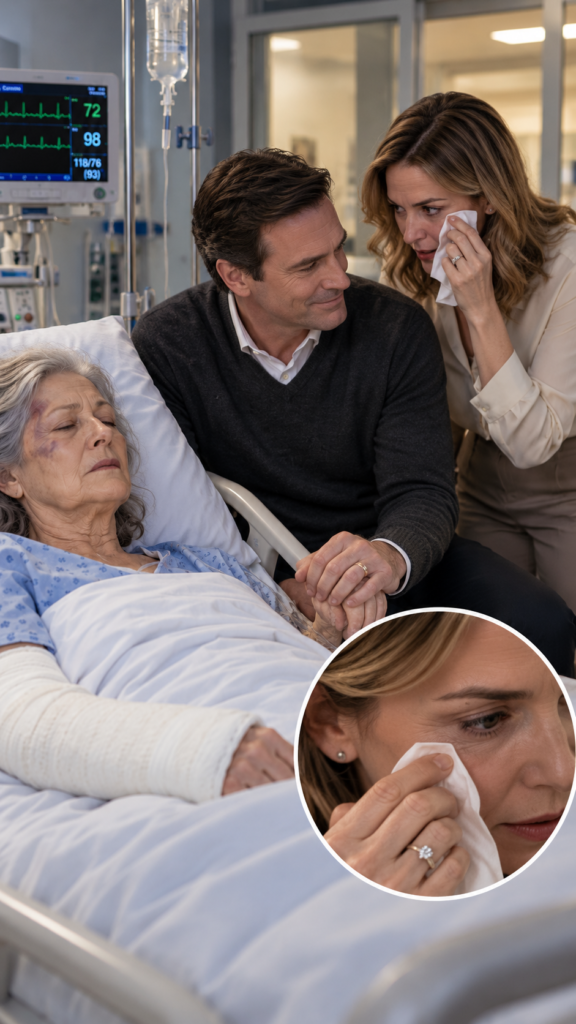
My son smiled while the heart monitor counted my breaths.
I kept my eyes half-shut beneath the harsh Los Angeles hospital lights.
My body felt broken in five different places.
My ribs burned with every shallow breath.
My left arm lay heavy under a white cast.
A bruise pulsed near my temple.
But my ears still worked.
Rachel leaned closer to Mark and dabbed a tissue under her eyes.
The tissue was dry.
Her face was not wet.
Her mouth trembled for the nurse outside the glass door.
But when she looked at my son, her sadness vanished.
“Three days,” she whispered. “That’s what the doctor said.”
Mark stared at me.
For one terrible second, I searched his face for pain.
I found relief instead.
He squeezed my hand.
His grip was warm, familiar, and monstrous.
“It’s finally happening, Mom,” he murmured.
The words slid into my chest colder than any needle.
“You don’t have to struggle anymore,” he added.
Rachel almost laughed.
Then she did laugh, softly enough to hide it from the hallway.
I wanted to open my eyes.
I wanted to ask what kind of son smiled beside his dying mother.
But I stayed still.
I let the machine speak for me.
Beep.
Beep.
Beep.
Rachel bent over me, blocking the hallway view.
“Five million,” she said. “Maybe more, once the market recovers.”
Mark’s thumb rubbed my knuckles.
It felt like a thief polishing silver.
“The Aspen house alone could clear everything,” he said.
Everything.
That word stayed in the room like smoke.
Rachel touched the diamond on her finger.
“We can sell the penthouse first,” she said.
Mark nodded.
“The furniture, too,” he said. “Some of that old stuff is worth a fortune.”
I opened my eyes.
Not quickly. Not dramatically. Just enough to watch Mark’s thumb stop moving against my skin.
Rachel saw it first.
The smile disappeared from her face so completely that for a moment she looked like someone had switched off a light behind her eyes.
Mark followed her stare.
His fingers loosened around mine.
“Mom?”
My throat was raw. The word I wanted to say arrived as little more than air.
“Everything?”
Neither of them moved.
The heart monitor seemed suddenly louder.
Mark’s face changed in pieces. First confusion. Then fear. Then the desperate, childlike calculation of someone trying to decide how much another person had heard.
Rachel recovered faster.
She stepped toward the bed.
“You’re awake.”
I looked at the dry tissue still folded between her fingers.
“Yes.”
Her hand slowly lowered.
Mark stood so abruptly that his chair scraped backward across the floor.
“Mom, the doctor said you were sedated.”
“I was.”
My ribs punished me for every syllable, but I kept looking at him.
“I’m not now.”
The glass door behind them slid open.
A nurse entered carrying a small tray, took one look at the room, and stopped.
Rachel’s expression transformed before my eyes.
Her mouth softened.
Her shoulders folded inward.
She looked suddenly devastated.
“Oh, thank God,” she breathed, pressing the dry tissue to her cheek. “She’s awake.”
I turned my head toward the nurse.
“Please ask them to leave.”
The silence that followed was so clean I could hear the faint rush of air through the vent above me.
Mark stared.
“Mom.”
“I need to rest.”
Rachel stepped closer.
“You don’t understand what you heard.”
I kept my eyes on the nurse.
“Please.”
The nurse put the tray down.
Her voice was calm.
“Mrs. Rachel, Mr. Mark, she’s asking for privacy.”
Mark’s face tightened.
“I’m her son.”
“And she is conscious and able to make her own decisions.”
That sentence landed harder than any accusation I could have made.
Rachel looked at Mark.
For the first time since I had opened my eyes, neither of them seemed to know what to do.
Mark leaned toward me.
“We weren’t talking about what you think.”
My chest hurt when I laughed, so I stopped almost immediately.
“You were discussing which of my homes to sell.”
His mouth opened.
Nothing came out.
Rachel tried next.
“We’re terrified. We’ve been here for days. People say strange things when they’re under stress.”
“You laughed.”
Her face went still.
I watched the pulse flicker in her throat.
The nurse moved between the bed and the door without making it theatrical.
“You need to leave now.”
Mark looked at me for another long second.
There was something in his eyes I had wanted desperately to see ten minutes earlier.
Pain.
But now I could no longer tell whether it was pain over losing me or pain over being caught.
He walked toward the door.
Rachel followed.
Just before she reached the hallway, she turned.
“Please don’t make any decisions while you’re upset.”
I looked at the diamond she had been turning while pricing my life.
“Get out.”
The door closed behind them.
My hand remained open on the blanket where Mark had been holding it.
I stared at the empty space between my fingers.
Then I began to shake.
Not dramatically.
My teeth didn’t chatter. I didn’t sob.
The trembling started somewhere deep inside my shoulders and moved down my arms as if my body had waited for the room to empty before admitting what had happened.
The nurse came beside me.
“Do you want the doctor?”
“No.”
“Pain medication?”
“In a minute.”
She waited.
I looked at the glass door.
“Can they come back in without my permission?”
“No.”
“Can you put that in my chart?”
“Yes.”
“And I want a different emergency contact.”
She didn’t ask why.
She simply nodded.
That small kindness nearly broke me.
I closed my eyes.
For years I had imagined that when age finally reduced me to a hospital bed, Mark would be the person I trusted without thinking.
I had never understood how much of love was built on assumptions until one of mine collapsed.
The nurse returned with a clipboard.
We changed the contact information.
We changed the visitor permissions.
Then, with my good hand, I asked for my phone.
There was one person I needed to call before exhaustion stole the strength from me.
My attorney, Daniel Price, answered on the fourth ring.
He had handled my property and estate planning for nearly sixteen years.
He knew the Aspen house.
He knew the penthouse.
He knew the land Rachel had already mentally divided before my body was cold.
When he heard my voice, his own dropped.
“You sound terrible.”
“I need you here.”
A pause.
“Are you safe?”
I looked through the glass.
Mark stood in the hallway twenty feet away, both hands in his pockets.
Rachel was whispering furiously beside him.
“For the moment.”
Daniel arrived two hours later.
By then the pain medication had softened the edges of the room but not the memory.
He sat beside me with a yellow legal pad resting unopened on his knee.
He did not begin with documents.
He did not mention money.
He asked me to tell him exactly what had happened.
So I did.
I repeated Rachel’s words.
The money.
The houses.
The land.
Five million.
The market.
Aspen.
The penthouse.
The furniture.
And finally that single word Mark had used.
Everything.
Daniel wrote it down.
When I finished, he remained silent.
“What?” I asked.
He looked at me carefully.
“There’s something I need to tell you.”
My stomach tightened.
“Tell me.”
“Three weeks ago, Mark called my office.”
For a moment the hospital room seemed to tilt.
“About what?”
“He asked whether your estate plan included restrictions on the sale of the Aspen property.”
I stared at him.
Daniel continued.
“My assistant told him we couldn’t discuss your plan without your authorization.”
“Did he say why he wanted to know?”
“He said you’d been talking about simplifying your holdings.”
“I never said that.”
“I know.”
The monitor continued its patient rhythm beside me.
Daniel turned one page on his pad.
“There’s more.”
I closed my eyes briefly.
Of course there was.
“Rachel contacted a real-estate broker in Colorado.”
My eyes opened.
Daniel held up one hand.
“She didn’t have authority to list anything. Nothing was sold. But the broker knows our office because of prior transactions involving the property. He called me when Rachel began asking questions about valuation, commission, and how quickly a private sale could close after an owner’s death.”
A pressure gathered beneath my sternum that had nothing to do with my ribs.
“When?”
“Eight days ago.”
Eight days ago.
Before the accident.
Before the doctors.
Before anyone had whispered three days beside my bed.
They had not invented their plan in grief.
They had arrived carrying it.
I looked toward the glass door.
Mark was gone.
Rachel was gone.
For the first time, I was grateful.
Daniel’s voice softened.
“There’s one more thing.”
I almost smiled.
“Apparently everyone saved the worst for last today.”
He did not smile back.
“Mark has debt.”
There it was.
Everything.
“How much?”
“I don’t know exactly.”
“But you know enough.”
“Yes.”
He hesitated.
“He tried to borrow against his expected inheritance.”
My hand tightened around the blanket.
“Expected.”
Daniel nodded.
“A private lender contacted our office to verify certain representations Mark had made about future assets. We refused. I was going to speak to you after your trip.”
“What representations?”
“That he was the primary beneficiary of your estate and that several properties would pass to him without restrictions.”
I looked at the ceiling.
For years, I had told myself that Mark was careless with money but fundamentally decent.
Careless.
That was the word mothers used when they were not yet ready to use the correct one.
Daniel leaned forward.
“I need you to understand something. None of this gives him control over your assets. Your estate plan is still yours. The properties are still yours.”
I turned my head toward him.
“But he was already spending them.”
Daniel said nothing.
He didn’t have to.
That evening Mark asked to see me.
I almost refused.
Then I remembered the smile beside my bed.
I needed to know how deep it went.
The nurse allowed him in alone.
No Rachel.
He stood near the door at first.
Without her beside him, he looked smaller.
Older.
For several seconds he stared at the floor.
Then he said, “I’m sorry.”
I waited.
He took another step.
“I know how it sounded.”
“How it sounded?”
His eyes lifted.
“That isn’t what I meant.”
I looked at him until he shifted.
“Tell me what ‘everything’ means.”
His shoulders tightened.
“Mom—”
“Tell me.”
He dragged a hand over his face.
“We made some bad decisions.”
“We?”
“Rachel and me.”
“What decisions?”
He looked toward the monitor.
Anywhere but at me.
“We borrowed.”
“How much?”
“I don’t know the exact number anymore.”
That frightened me more than a number would have.
“You don’t know?”
“There are different loans.”
“How many?”
His jaw flexed.
“Several.”
“And you thought my death would clear them.”
“No.”
The answer came too quickly.
I said nothing.
Mark sat in the chair beside my bed.
The same chair he had occupied while smiling.
His hands rested between his knees.
“We thought if something happened someday, eventually, then I would have options.”
“Rachel called a broker eight days ago.”
His face emptied.
That was my answer.
I watched him realize Daniel had spoken to me.
“Mom.”
“She asked how quickly Aspen could be sold after I died.”
“She was panicking.”
“I wasn’t dying eight days ago.”
Silence.
“Were you?”
His eyes filled.
Not with tears yet.
With shame.
“No.”
I breathed as deeply as my ribs allowed.
“Why did you let her do that?”
He pressed both hands together until the knuckles whitened.
“Because we were desperate.”
“Desperate enough to wait for me to die?”
His face crumpled.
“Don’t say it like that.”
“How would you prefer I say it?”
He stood.
Then sat again.
The movement looked almost involuntary.
“We lost money.”
“How?”
“Investments first. Then Rachel’s business expansion. Then we borrowed to cover those losses. Then rates changed. Then—”
He stopped.
Every sentence had begun with then.
A staircase built downward.
“How long?”
“Two years.”
I stared at him.
Two years.
Birthdays.
Christmas calls.
Lunches.
Messages asking whether I had updated my insurance.
Questions about whether Aspen was becoming too much work.
Small conversations I had interpreted as concern.
I felt cold despite the blanket.
“You could have told me.”
His mouth trembled.
“I was ashamed.”
“So instead you made plans for my property.”
“We never touched anything.”
“You tried.”
He lowered his head.
That was the moment something inside me finally stopped bargaining.
Until then, a part of me had still been searching for a sentence that would return my son to me.
There wasn’t one.
Not that night.
“I’m changing my estate plan.”
His head snapped up.
Fear moved openly across his face.
“Mom.”
“You will not inherit the houses.”
He stood again.
“Please don’t do this angry.”
“I’m not angry.”
That surprised both of us.
I was hurt beyond anger.
“I’m awake.”
He stared at me.
Then the tears finally came.
One rolled down his face, and unlike Rachel’s tissue, it had something real to wipe away.
“I love you.”
I closed my eyes for one second.
“I believe that part of you does.”
He flinched.
“But love that waits for a death certificate is not love I can trust.”
He left without asking about the money again.
Rachel came the following morning.
She was not permitted inside.
She sent messages instead.
At first they were soft.
We are worried about you.
Please don’t let one awful conversation destroy this family.
Mark is devastated.
Then the tone shifted.
You are being manipulated while medicated.
Daniel has always wanted control.
You are punishing your own son for being scared.
By afternoon, the messages became sharper.
You can’t erase Mark because of a misunderstanding.
You will regret making permanent decisions in an emotional state.
I read that one twice.
Then I blocked her number.
Daniel returned with documents two days later.
The doctor had confirmed I was alert, oriented, and capable of making decisions.
Daniel insisted another attorney from his firm review everything independently.
He wanted no question later.
I appreciated that.
We changed the estate plan.
Then I went further.
I removed Mark from every financial role.
Every medical role.
Every authority that could place my body, property, or future in his hands.
I did not leave him nothing out of revenge.
I simply stopped allowing my death to function as his financial strategy.
The Aspen house would be sold when I was strong enough to oversee it.
So would the penthouse.
The proceeds would not become a pile of money waiting for someone to calculate my final breath.
Daniel helped me establish an irrevocable charitable fund centered on rehabilitation care, temporary housing for families of injured patients, and emergency support for people who could not afford to remain near someone they loved in the hospital.
Once transferred, those assets could never become Mark’s inheritance.
The decision became legally permanent.
When Daniel asked whether I was certain, I looked around the hospital room.
At the chair.
At the glass door.
At the monitor that had counted every second while two people discussed what my death was worth.
“Yes.”
The Aspen house cleared everything.
Just not what Mark had imagined.
Rachel discovered the change before I left the hospital.
Mark told her.
He later admitted they fought for nearly six hours.
She accused him of ruining their future.
He asked her whether their future had ever contained anything except my money.
That question ended more than the argument.
Three weeks after my discharge, Rachel filed for separation.
By then the broker she had contacted in Colorado had provided written records of her inquiries.
No crime had been completed.
No property had been stolen.
But the truth no longer needed a courtroom to be devastating.
She had researched selling my house while I was alive.
Mark had tried to leverage money he did not own.
And both of them had sat beside my hospital bed believing death was finally solving their problems.
Their power vanished the moment I survived long enough to hear them.
The financial consequences came afterward.
Without the inheritance Mark had represented to lenders, restructuring his debt became brutal.
He sold his car.
Then his house.
Then several things he had bought during years when appearances mattered more than solvency.
Rachel fought over what remained.
Their marriage ended before the year did.
I did not celebrate.
That surprised me.
I had imagined justice would feel hot.
Triumphant.
Instead, it felt like walking through a house after someone had died.
Quiet rooms.
Familiar objects.
An absence where something once lived.
Mark called me every Sunday.
For the first month, I did not answer.
He kept calling.
He never left messages about money.
The first voicemail said, “I know you don’t want to hear from me. I just wanted to know if your ribs are healing.”
The second said, “I found the blue mug you always use when you stay here. I’m putting it in a box. I won’t throw anything away.”
The third was mostly silence.
Then, “I’m sorry I became someone you had to protect yourself from.”
I saved that one.
I still did not call back.
Healing was slow.
My left arm came out of the cast before I stopped waking at night hearing Rachel whisper five million.
Physical therapists taught me how to lift, turn, stretch, balance.
My body improved because pain had rules.
You did the exercise.
You rested.
Tissue repaired.
Bone strengthened.
Betrayal had no such schedule.
Some mornings I missed Mark before I remembered what he had done.
Those were the hardest mornings.
Six months after the hospital, I agreed to meet him.
Not at my house.
Not at his.
At a small café with wooden tables scarred by years of cups and elbows.
He arrived twenty minutes early.
I knew because I had arrived ten minutes early and saw him already sitting there.
He stood when I entered.
He did not hug me.
That mattered.
He waited for permission.
I sat across from him.
He looked thinner.
There were new lines beside his mouth.
For a few moments neither of us spoke.
Then he placed an envelope on the table.
I looked at it.
“What is that?”
“A payment plan.”
“For what?”
“Everything I borrowed after I started assuming you would rescue me someday.”
I frowned.
“You didn’t borrow from me.”
“No.”
His fingers rested beside the envelope.
“But I built my life around money I thought would eventually be mine.”
He swallowed.
“I’m paying the debts myself. I wanted you to know.”
I left the envelope unopened.
“That isn’t why I came.”
“I know.”
“Why do you think I came?”
He looked at me.
“Because some part of you still loves me.”
My throat tightened.
He continued before I could answer.
“And because loving me doesn’t mean trusting me.”
The café blurred for a second.
I looked down at my hands.
The left one still felt stiff on cold mornings.
“That’s the first honest thing you’ve said to me in a long time.”
He nodded.
“I’m trying to make honesty less unusual.”
We talked for ninety minutes.
He did not ask for forgiveness.
He did not blame Rachel.
That was important too.
When I asked why he had smiled beside my hospital bed, he stared at the table for so long I thought he might refuse to answer.
Then he said, “Relief.”
The word hurt even though I already knew.
He forced himself to continue.
“I had spent so long being afraid of the debts, the calls, the letters, the next payment. When the doctor said you might not make it, something horrible in me thought the fear might finally stop.”
He covered his mouth with one hand.
“I hated myself before you even opened your eyes.”
I watched him.
“Then why did you keep talking?”
“Because once Rachel started calculating, I joined her.”
His eyes reddened.
“I wish I had a better answer.”
There wasn’t one.
But there was truth.
Sometimes truth was not beautiful.
Sometimes it was merely solid enough to stand on.
We met again two months later.
Then again.
I did not give him keys.
I did not restore him to my documents.
I did not change the trust.
The consequences remained.
So did the love.
That was the complicated part.
Rachel contacted me once after the divorce became final.
A letter.
No tissue.
No performance.
She wrote that she was sorry for what she had said in the hospital.
Then she spent three pages explaining why she had been under impossible pressure.
I read the whole thing.
At the end, she asked whether I would reconsider excluding Mark because he had “already suffered enough.”
I folded the letter and placed it back in the envelope.
I never answered.
Mark’s healing could not depend on receiving what had corrupted him.
Mine could not depend on Rachel understanding what she had done.
A year after the accident, the Aspen house sold.
I expected grief when Daniel called with the final number.
Instead, I felt strangely light.
The house had been beautiful.
Snow against the windows.
Morning sunlight across the kitchen.
Long evenings when the mountains turned purple.
But it had become something else in that hospital room.
A price.
A solution.
A reason for someone to smile too soon.
I signed the transfer papers with my left hand.
The signature was shakier than it had been before the accident.
I liked it better that way.
It looked earned.
The first grants from the new fund went out that winter.
One paid for a mother to stay near her injured daughter for six weeks.
Another covered rehabilitation sessions for an older man whose insurance had stopped paying before his body had finished healing.
A third helped a family remain in Los Angeles while their teenage son recovered from surgery.
Daniel sent me the reports.
I read every one.
No names at first.
Just circumstances.
Days covered.
Sessions funded.
Rooms paid for.
Meals provided.
Lives made slightly less frightening.
Five million.
Maybe more.
The words returned sometimes.
But they no longer sounded like Rachel.
They sounded like wheelchairs moving down rehabilitation hallways.
Elevator doors opening.
Families sleeping somewhere safe instead of in hospital chairs.
People being given time.
The penthouse sold the following spring.
Much of the furniture went too.
Some of it really was worth a fortune.
Mark came over before the auction company arrived.
He walked through rooms where he had spent holidays, birthdays, ordinary Tuesdays.
He stopped beside an old walnut side table.
A pale scratch crossed one corner.
“I did that,” he said.
I looked at him.
“When?”
“I was nine. I crashed that metal airplane into it.”
I remembered.
I had been furious.
He had cried.
Then his father and I had spent an hour pretending furniture repair was a form of emergency medicine.
Mark touched the scratch with one finger.
“Are you selling this too?”
“Yes.”
He nodded.
Then he walked away.
Ten minutes later, I changed my mind.
Not about the estate.
Not about the trust.
About one table.
I called the auction manager and removed it from the list.
Months passed.
Mark found work that paid less than he had once earned and demanded more from him.
He kept it.
He rented a modest apartment.
He stopped talking about investments.
When we ate together, he paid for his own meal.
Small things.
Almost embarrassingly small.
But trust returns in small denominations.
Two years after the hospital, I invited him to dinner at my new home.
Not Aspen.
Not the penthouse.
A smaller house west of the city with enough windows to catch the evening light and a garden I could manage without help.
He arrived carrying bread.
No flowers.
No expensive wine.
Bread.
I laughed when I saw it.
“What?”
“Nothing.”
He looked suspicious.
“You’re laughing at the bread.”
“I’m appreciating the bread.”
Dinner was simple.
Soup.
Salad.
The loaf he brought.
For the first time in years, there was nothing in the room expensive enough to become a motive.
After we ate, I led him into the small sitting room.
The walnut table stood beside the window.
Mark stopped.
His face changed.
“You kept it.”
“I did.”
He walked toward it slowly.
His finger found the old scratch.
“Why?”
I looked at the mark he had made when he was nine.
Because that was the final truth I had needed time to understand.
People could become terrible versions of themselves without every earlier version becoming false.
The boy who had crashed a metal airplane into my furniture had loved me.
The man who smiled beside my hospital bed had betrayed me.
Both were my son.
Forgiveness did not require pretending one of them had never existed.
“I kept the part that was mine to keep,” I said.
He lowered his head.
His shoulders shook once.
Then again.
I waited.
When he finally looked at me, his eyes were wet.
“I don’t deserve that.”
“The table?”
He almost laughed.
“No.”
He wiped his face.
“This.”
He gestured between us.
I considered him for a moment.
“You don’t deserve the old trust.”
He nodded.
“You don’t have it.”
“I know.”
“But you’ve been building something else.”
His mouth tightened.
“I don’t know if it’s enough.”
“It doesn’t have to be enough all at once.”
For a long moment neither of us moved.
Then I opened my arms.
He crossed the room.
The hug was careful at first.
As though he still remembered broken ribs that had healed years ago.
Then his arms tightened.
Not around an estate.
Not around a future inheritance.
Around his mother.
I rested my cheek against his shoulder.
Outside, the last sunlight moved through the garden.
There was one final surprise Daniel had saved for me.
The rehabilitation fund had grown faster than expected.
The sale proceeds had been invested conservatively, and several people who heard what the program was doing had contributed their own money.
What began with one hospital room and one act of betrayal had become large enough to continue long after I was gone.
Daniel asked whether I wanted my name attached to it.
I said no.
He asked whether I was certain.
I was.
I did not want a building with my name carved into stone.
I wanted strangers to receive help without ever needing to know who had once been hurt badly enough to create it.
The hospital eventually opened a quiet family room near the rehabilitation floor using money from the fund.
There were couches long enough to sleep on.
Lockers.
Showers.
A little kitchen.
Windows facing west.
On one wall hung a simple sentence chosen by the staff.
No donor name.
No explanation.
Just four words.
Stay close. You have time.
The first time I visited, I stood in the doorway longer than I meant to.
A woman sat asleep on one couch with her shoes still on.
A paper cup rested in her hand.
Across the room, a man warmed soup in the little kitchen while talking quietly on the phone.
Nobody knew me.
That was perfect.
Mark stood beside me.
He had asked if he could come.
I had said yes.
He read the words on the wall.
Stay close. You have time.
His face tightened.
“I almost took that from you.”
I looked at him.
“Yes.”
He did not defend himself.
He nodded once.
“I’m glad you stayed.”
We walked toward the elevators together.
At the end of the corridor, a heart monitor sounded faintly from an open room.
Beep.
Beep.
Beep.
I stopped.
For one second I was back beneath the harsh lights, my hand trapped inside Mark’s, Rachel whispering numbers while I pretended not to hear.
Then the elevator doors opened.
Mark waited.
He did not reach for me.
He did not assume.
I held out my hand.
He looked down at it before taking it.
His grip was warm.
Familiar.
But no longer monstrous.
We stepped into the elevator together, and as the doors closed on that hospital corridor, I understood at last that surviving had never been about keeping the houses, the land, or the things everyone thought were worth a fortune.
It was about living long enough to decide what was truly worth saving.
And when I went home that evening, the walnut table was waiting beside the window, its old childhood scratch glowing softly in the last gold light, while fresh bread cooled on my kitchen counter and my son sat across from me with nothing left to inherit except the chance to stay.






