Laura Vanderbilt believed she had finally put Sophie Miller in her place.
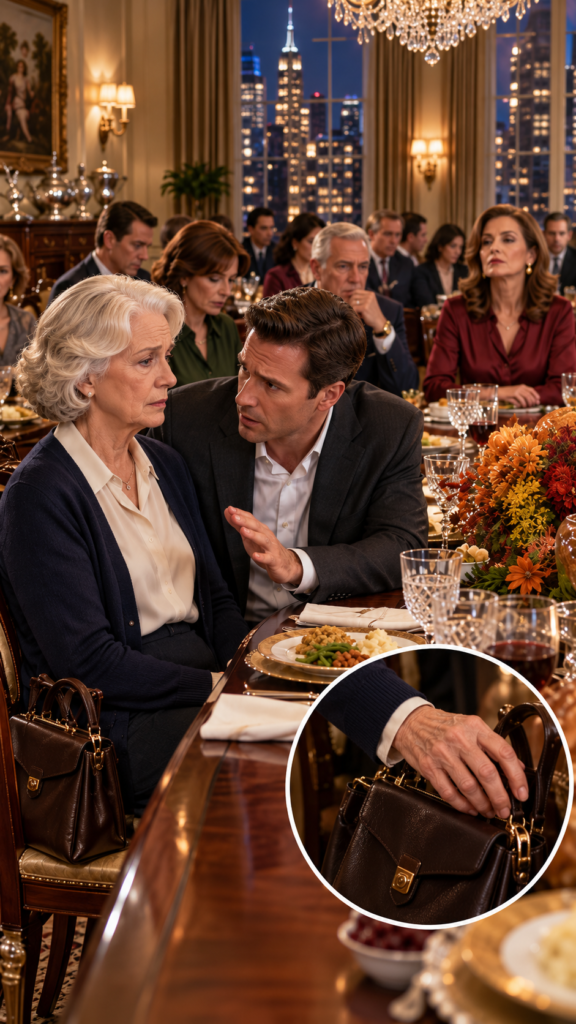
During an extravagant Thanksgiving dinner inside the Vanderbilt family’s Manhattan townhouse, fifteen relatives sat around a magnificent mahogany table. Then Laura publicly humiliated Sophie in front of everyone.
But Sophie’s greatest pain came from the man sitting beside her.
Her only son, Robert.
Instead of defending the woman who had raised him alone in Queens, Robert leaned toward her with panic written across his face.
“Mom, please don’t make this worse. Just behave yourself.”
Sophie stared at him.
Those words reopened decades of sacrifice.
She remembered cleaning Manhattan apartments during the day and sewing dresses late into the night. She remembered skipping meals so Robert could buy textbooks and working until her fingers hurt to cover his NYU tuition.
Everything had been for him.
Now Robert seemed more frightened of embarrassing the wealthy Vanderbilts than of watching his mother being degraded.
Around the table, nobody defended her.
Valerie lowered her eyes.
Ernest Vanderbilt nervously touched his expensive gold watch.
Other relatives suddenly became fascinated by their plates.
Their silence reminded Sophie of every smaller humiliation she had previously tolerated.
Valerie had called her sewing “humble.”
Laura had once hidden the carrot cake Sophie lovingly brought to their first meeting.
At Robert’s luxurious Newport wedding, Sophie had been placed at a distant table.
Even access to her grandson Matthew had been restricted.
For years, Sophie had mistaken silence for dignity.
That night, she finally understood something devastating.
Her silence had taught them that they could continue.
Sophie calmly reached for her handbag.
Robert immediately noticed.
“Mom, don’t.”
His sudden fear changed everything.
Why was he terrified?
Sophie removed her phone.
Laura laughed, apparently convinced the powerless seamstress from Queens could do nothing against the Vanderbilt family.
“Who are you messaging?” Laura mocked. “Your little sewing friends?”
Sophie ignored her.
Weeks earlier, after Robert made a strange midnight call asking about an old filing cabinet containing decades of financial records, Sophie had quietly begun investigating.
She had discovered enough unanswered questions to contact attorneys.
She had even prepared one message in advance.
Three words.
Put the plan into action.
Sophie pressed send.
Robert’s face immediately lost its color.
Laura noticed his reaction.
Her laughter disappeared.
Sophie slowly rose from her chair.
For the first time that evening, Laura was no longer towering over her.
Now Sophie was standing.
The entire table watched.
Laura demanded to know what Sophie had done.
Sophie remained completely calm.
Then Laura asked the question everyone suddenly wanted answered.
“Who did you message?”
Sophie held her gaze.
“My attorneys.”
Silence swallowed the room.
Ernest’s hand froze beside his gold watch.
Valerie finally looked directly at Sophie.
Robert appeared almost sick with fear.
And Laura suddenly understood the truth.
Sophie had not created a desperate plan because of tonight’s humiliation.
She had arrived at Thanksgiving already prepared.
The quiet woman they had underestimated for years had finally stopped protecting them with her silence.
And what those old records could reveal was only beginning to surface…
Robert’s fork slipped from his fingers.
It struck the edge of his plate with a bright, delicate crack that seemed impossibly loud in the silent room.
Laura’s eyes moved to him first.
Not Sophie.
Robert.
That was all Sophie needed to see.
Laura knew exactly why he was afraid.
“What did you tell her?” Laura asked.
Her voice had changed. The polished cruelty was gone, replaced by something thinner and sharper.
Robert stared at the table.
“Robert.”
He swallowed.
Sophie watched her son’s hand close around the linen napkin in his lap. He had done that as a boy whenever he was frightened—twisting cloth between his fingers until his knuckles whitened.
“Look at me,” Sophie said.
He did.
For one painful second she saw the child she had walked to school in the rain, the teenager who used to fall asleep over textbooks at the kitchen table, the young man she had hugged outside NYU while pretending she was not terrified of the tuition bill waiting at home.
Then she saw the man who had told her to behave.
“What did you know?” she asked.
Robert opened his mouth.
Laura cut across him.
“This is absurd. Sophie, sit down.”
Sophie did not move.
Laura’s eyes hardened.
“You’re creating a spectacle over a family misunderstanding.”
“A misunderstanding?”
The question came from Ernest.
Everyone turned.
He had stopped touching his watch.
His face, usually composed to the point of stiffness, had gone strangely still.
“What misunderstanding?” he asked.
Laura looked at him.
“Not now.”
Ernest leaned back slowly.
“When?”
There was no anger in his voice.
That made the question worse.
Laura drew a breath and adjusted the cuff of her blouse as though order could be restored by correcting one wrinkle.
“Sophie found some old paperwork. Apparently she has decided to turn it into a drama.”
Sophie’s phone vibrated once in her hand.
She looked down.
A message from her attorney appeared on the locked screen.
Filed. Preservation notices delivered. Copies secured.
Sophie read it only once.
Then she placed the phone facedown beside her plate.
Robert saw the movement.
His shoulders collapsed.
Laura saw that, too.
“What did they file?” she asked.
Sophie looked at her.
“I’m not discussing legal strategy at Thanksgiving dinner.”
A strange sound escaped Valerie.
Not quite a laugh.
Not quite a sob.
Laura spun toward her.
“What?”
Valerie shook her head.
“Nothing.”
“No. Say it.”
Valerie looked at Sophie, then at Ernest.
“For once,” she said quietly, “maybe we should stop telling her what she’s allowed to say.”
The room changed.
It was subtle.
No one moved toward Sophie. No one suddenly became brave. But several relatives lifted their eyes from their plates.
Laura noticed.
Her face tightened.
“This family has been extraordinarily generous to Sophie.”
Sophie almost smiled.
Not because anything was funny.
Because the sentence was so familiar.
Generous.
As if every invitation had been charity.
As if every insult had been a privilege she should have been grateful to receive.
As if being tolerated near her own son and grandson was a gift.
Robert’s voice broke the silence.
“It wasn’t generosity.”
Laura turned toward him.
“Robert.”
He flinched.
Sophie’s chest tightened.
That flinch told its own story.
Robert had not simply been seduced by money.
He had learned fear here.
That did not excuse him.
But it explained the panic she had been seeing for years and refusing to name.
“What happened?” Sophie asked.
Robert rubbed both hands over his face.
“The cabinet,” he said.
Laura stood.
“Enough.”
Ernest’s palm came down flat against the table.
He did not strike it hard.
He did not need to.
“Sit down, Laura.”
She stared at him.
For perhaps the first time in years, Ernest did not look away.
Laura sat.
Robert breathed through his nose, slowly.
“When I called you that night,” he said to Sophie, “I already knew something was wrong.”
Sophie said nothing.
“I’d seen payments.”
“What payments?”
Robert glanced toward Laura.
Her mouth had become a narrow line.
He looked back at his mother.
“Foundation payments. Vendor payments. They were listed under names I recognized.”
Sophie felt a chill move across her shoulders.
“What names?”
Robert’s eyes filled.
“Yours.”
Nobody spoke.
Sophie could hear the tiny mechanical tick of a clock somewhere beyond the dining room.
“My name?”
“Your old sewing business.”
For a moment, Sophie did not understand.
Then she did.
Years earlier she had registered the smallest possible business so clients could pay her properly for alterations and custom dresses. She had kept every receipt, every tax form, every deposit slip, every invoice.
That was what the filing cabinet contained.
Not wealth.
Proof.
The history of a woman who had survived by accounting for every dollar because there had never been enough dollars to lose.
Robert continued.
“There were invoices from your business in the foundation records.”
Sophie’s hands went cold.
“My business hasn’t issued an invoice in years.”
“I know.”
“How much?”
Laura moved again.
“Robert, you do not have permission to discuss—”
“Permission?”
This time Sophie’s voice cut through the room.
Laura stopped.
Sophie looked directly at her.
“You used my name?”
Laura’s expression barely shifted.
“I did no such thing.”
Robert shook his head.
“Mom’s business was used as a vendor.”
Ernest’s chair creaked as he leaned forward.
“For what?”
Robert stared at him.
“Consulting. Textile restoration. Community outreach. Event work.”
Valerie closed her eyes.
Sophie almost could not breathe.
The words were absurd.
Expensive language wrapped around work she had never done.
“How long?” Sophie asked.
Robert answered so quietly she almost missed it.
“Seven years.”
Her fingers tightened around the back of her chair.
Seven years.
Seven years of being seated far away.
Seven years of being spoken to as though her sewing was embarrassing.
Seven years of Laura smiling at her with that carefully managed pity while Sophie’s own name was apparently useful enough to move money through accounts she had never seen.
Ernest stood now.
“How much money?”
Robert’s eyes moved to Laura again.
“Just over two million.”
Someone at the far end of the table inhaled sharply.
Sophie heard the number.
But what she saw was a small kitchen in Queens at two in the morning.
A needle.
Blue thread.
Her own swollen knuckles.
Robert asleep at the table beside an open economics textbook.
Two million dollars.
She remembered counting coins for groceries.
Laura finally lost control.
“He doesn’t know what he’s talking about.”
Robert turned to her.
“I reviewed the ledgers myself.”
“You reviewed summaries.”
“I reviewed bank transfers.”
“You had no authority.”
“I’m on the finance committee.”
“You were put on that committee because I trusted you.”
Robert stared at her.
Something shifted in his face.
Not courage yet.
But perhaps the first outline of it.
“No,” he said. “You put me there because you thought I’d stay quiet.”
Laura’s face drained.
Sophie looked at her son.
There it was.
The fracture.
The thing Robert had been hiding from himself as much as from everyone else.
Ernest sank back into his chair.
“Where did the money go?”
Robert’s lips trembled.
Sophie already knew he was about to say something that would change the family permanently.
“To an account controlled through one of Laura’s private entities.”
Laura stood so quickly her chair scraped backward.
“That is a lie.”
Robert recoiled.
Laura pointed at him.
“You’re blaming me because you signed the approvals.”
Sophie turned slowly toward her son.
Robert stopped breathing.
The room seemed to tilt.
“You signed them?”
His eyes closed.
“Yes.”
The answer landed harder than Laura’s insults ever had.
Sophie released the chair.
For a second she thought her knees might fail.
Robert rose as if to help her.
She lifted one hand.
He stopped.
“Don’t.”
He looked as though she had struck him.
“You knew my name was being used?”
“At first, no.”
“At first.”
His shoulders folded inward.
“When I realized, I should have stopped it.”
“But you didn’t.”
“No.”
“Why?”
He looked toward Laura, then toward Ernest, then at the room surrounding him—the chandelier, the silver, the paintings, the mahogany table, the life he had spent years trying to belong inside.
When he finally looked at Sophie, there was nowhere left to hide.
“Because I was afraid of losing all this.”
Sophie’s eyes filled.
She did not let the tears fall.
“All this?”
Robert’s face crumpled.
“My position. My marriage. Matthew. The family.”
“I was your family.”
“I know.”
“No.”
Sophie’s voice became very soft.
“You know it now.”
Robert covered his mouth with one hand.
Laura gave a bitter laugh.
“Oh, please. We’re turning financial irregularities into some morality play because Sophie wants revenge for being seated badly at dinner.”
Valerie pushed back her chair.
She stood.
For the first time, she looked directly at Laura without shrinking.
“You hid the cake.”
Laura stared at her.
“What?”
“The first time Sophie came here.”
Valerie’s voice shook, but she continued.
“She brought that carrot cake. You told everyone it had fallen apart in the car.”
Sophie blinked.
Laura’s face hardened.
Valerie looked at Sophie.
“It didn’t.”
Sophie said nothing.
“I found it in the service pantry after dinner. Still wrapped. Still perfect.”
The memory cut unexpectedly deep.
Sophie had spent half a day making that cake.
Robert had told her the Vanderbilts liked things simple, so she had skipped elaborate decoration. She had used the recipe her own mother had taught her, grating the carrots by hand and folding walnuts carefully into the batter.
Laura had told her no one wanted dessert.
Sophie had believed her.
Valerie’s eyes filled.
“You didn’t misunderstand these people, Sophie. We saw what was happening.”
Her voice cracked.
“We just kept choosing the easier silence.”
Ernest looked down.
Several relatives did the same.
Sophie felt no satisfaction.
Only exhaustion.
Her phone rang.
Not vibrated.
Rang.
Every person at the table stared at it.
Sophie answered.
“Hello?”
Her attorney’s voice was calm.
Sophie listened.
No one else could hear the words, but they watched her expression.
The emergency preservation order had been granted.
The relevant accounts were restricted from further transfers pending review.
The foundation’s independent counsel had received the evidence package.
The bank had acknowledged the disputed vendor identity.
And because Robert’s signature appeared on several approvals, his role would also be investigated.
Sophie closed her eyes for half a second.
That was the choice.
The one she had known was coming.
Her attorney asked one final question.
Did she want them to exclude Robert from the complaint until his involvement could be clarified privately?
Sophie looked at her son.
He understood.
She saw it in his face.
He knew she could protect him.
One more time.
One last sacrifice.
Robert whispered, “Mom.”
Sophie’s grip tightened around the phone.
For almost forty years, her first instinct had been to place herself between Robert and pain.
Pay the tuition.
Skip the meal.
Take the insult.
Sit at the distant table.
Accept less access to Matthew.
Stay quiet.
Protect him.
She looked at the man her son had become.
Then she answered her attorney.
“No.”
Robert closed his eyes.
Sophie continued.
“Do not remove anyone because they are related to me. Follow the records wherever they lead.”
Laura stared at her.
Robert lowered his head.
Sophie ended the call.
The silence afterward was different from every silence that had come before.
It no longer protected Laura.
It no longer protected Robert.
It protected the truth.
Robert sat down heavily.
“I’m sorry.”
Sophie looked at him.
“I believe you.”
His head snapped up.
Hope appeared too quickly.
She stopped it.
“Believing you’re sorry is not the same as forgiving what you did.”
His eyes flooded.
“I know.”
“No. You’re going to learn.”
He nodded.
Laura picked up her wineglass.
Her hand was trembling now.
“This family will handle this internally.”
Ernest looked at her.
“No.”
She froze.
He removed his gold watch.
Slowly.
Carefully.
He placed it on the table beside his untouched plate.
Sophie had seen him touch that watch all evening whenever he was nervous.
Now his wrist was bare.
“What are you doing?” Laura asked.
Ernest looked older without the practiced posture.
“For years,” he said, “I have watched you explain cruelty as standards, control as tradition, and fear as loyalty.”
Laura’s eyes widened.
“You’re blaming me?”
“I’m blaming myself, too.”
His voice broke.
“I saw enough to ask questions. I preferred comfort.”
He looked at Sophie.
“I’m sorry.”
Sophie held his gaze.
She did not absolve him.
He seemed to understand.
Ernest turned to Laura.
“Effective tonight, I’m requesting an emergency board meeting. You will be removed from every foundation role I have the authority to influence.”
“You can’t.”
“I can request it.”
“You won’t have the votes.”
Valerie spoke from behind her.
“You will.”
Laura turned.
Valerie’s face was wet with tears now, but her voice was steady.
“I’ll vote for removal.”
One by one, two other relatives quietly spoke.
“So will I.”
“And I.”
Laura looked around the table.
The people who had spent years lowering their eyes were finally looking directly at her.
Her power did not collapse with shouting.
It collapsed with eye contact.
That was worse.
She reached for Robert.
“You know what happens if you let them do this.”
Robert flinched again.
Then he looked at Sophie.
His mother did not nod.
She did not rescue him.
Robert had to make this choice himself.
He turned back to Laura.
“Yes,” he said.
Laura’s expression sharpened.
“And?”
“And I’m done being afraid of it.”
She slapped her napkin onto the table.
“You’ll lose everything.”
Robert’s mouth trembled.
“Then I lose it.”
Laura stared at him.
For the first time that night, she had no reply.
The weeks that followed were not clean.
Truth rarely arrived clean.
There were attorneys, auditors, bank records, interviews, sworn statements, and long conference-room silences beneath fluorescent lights that made everyone look more tired than they felt.
The false vendor records were real.
So were the transfers.
Sophie’s old business identity had been used because it looked ordinary enough to escape attention and legitimate enough to survive basic review.
Her decades of careful bookkeeping became the very thing that exposed the scheme.
Every receipt she had saved mattered.
Every tax return.
Every handwritten ledger.
Every deposit slip from years when she had counted pennies at the kitchen table.
The life Laura considered small had left a paper trail too honest to manipulate.
Robert cooperated fully.
He admitted which approvals he had signed.
He admitted when he first suspected the payments were false.
He admitted that Laura had warned him his marriage, his position, and his access to Matthew could all become complicated if he created trouble.
None of that erased his choices.
Sophie made sure he understood that.
Months later, Robert resigned from the foundation and from the position Ernest had helped him obtain.
He accepted professional sanctions recommended after the investigation.
He repaid compensation connected to the committee work he had failed to perform responsibly.
He did not ask Sophie to intervene.
That mattered.
Laura’s downfall was slower.
Then suddenly complete.
The independent investigation found she had authorized the fake vendor structure and directed transfers through entities she controlled.
The board removed her unanimously.
Civil claims followed.
Then state investigators opened their own case based on the audit.
By the following autumn, Laura entered a plea that permanently barred her from managing charitable organizations or serving in fiduciary roles.
She was ordered to repay misused funds and substantial penalties.
The newspapers reduced years of fear to a photograph and a headline.
Sophie did not save either.
The moment that mattered most happened before any headline.
Laura stood outside a hearing room after signing the agreement that ended her authority over the foundation.
She saw Sophie at the far end of the corridor.
For a second they simply looked at each other.
Laura appeared smaller.
Not physically.
Socially.
The invisible architecture that had always placed her above Sophie had vanished.
“You ruined this family,” Laura said.
Sophie considered her for a moment.
Then she shook her head.
“No.”
Her voice was quiet.
“I stopped helping you hide what you were doing.”
Laura looked away first.
Sophie walked past her.
That was the last conversation they ever had.
Robert’s road back was harder because there was no courtroom order that could repair a mother’s trust.
He began visiting Sophie in Queens every Sunday.
At first she refused to let him inside.
So he sat on the front steps.
Sometimes for twenty minutes.
Sometimes an hour.
He brought no flowers.
No expensive gifts.
No speeches.
One rainy afternoon, Sophie opened the door and found him sitting beneath the narrow awning with water darkening the shoulders of his coat.
“You’ll catch pneumonia,” she said.
Robert looked up.
“That sounds like something my mother would say.”
Sophie almost shut the door.
Almost.
Instead she stepped aside.
“Take your shoes off.”
He did.
The first conversations were terrible.
That was why they mattered.
Robert apologized without explaining.
Sophie interrupted him whenever he tried to soften a fact.
He listened when she described the Newport wedding.
The distant table.
The missed birthdays with Matthew.
Every time Laura made Sophie feel like an intruder and Robert pretended not to notice.
At one point Robert covered his face.
“I kept telling myself I was protecting my marriage.”
Sophie sat across from him at the small kitchen table.
“And what were you asking me to sacrifice to protect it?”
He had no answer.
“Exactly.”
Weeks passed.
Then months.
The apologies became less frequent because Robert finally understood that repetition was not repair.
Repair was behavior.
He stopped asking Sophie when she would forgive him.
He started asking what she needed.
Sometimes the answer was space.
Sometimes groceries carried upstairs.
Sometimes nothing.
One Sunday she handed him a box of tangled thread and told him to sort it by color.
He laughed before he realized she was serious.
For two hours they sat together at the kitchen table, separating reds from burgundies, navy from black, cream from white.
It was the most peaceful afternoon they had shared in years.
Matthew came back into Sophie’s life slowly.
That wound had frightened her more than all the money.
She had spent years wondering whether the boy had stopped asking about her.
The truth arrived one December afternoon when Valerie knocked on Sophie’s door carrying a battered cardboard box.
Sophie stared at her.
“I should have brought this years ago,” Valerie said.
Inside were envelopes.
Dozens of them.
Some addressed in a child’s uneven handwriting.
Some in the cleaner letters of a teenager.
All of them bore Sophie’s name.
Her hands began to shake.
“What are these?”
Valerie looked ashamed.
“Matthew’s letters.”
Sophie sat down.
The room went blurry.
“He wrote to me?”
“All the time.”
Sophie touched the first envelope but could not open it.
“Why didn’t I get them?”
Valerie’s voice dropped.
“Laura intercepted some. Others never got mailed because everyone in that house learned not to challenge her.”
Sophie looked up.
“And you kept them?”
“I told myself I was protecting him.”
Valerie wiped at her cheek.
“Mostly I was protecting myself.”
Sophie looked back at the box.
There were years inside it.
Birthdays.
Christmases.
School plays.
Questions.
Drawings.
A child reaching toward a grandmother he had been taught was too far away.
The door behind Valerie opened.
Matthew stood in the hallway.
He was taller than Sophie remembered.
For one terrible second neither moved.
Then he held up something wrapped in foil.
“I didn’t know if you still liked carrot cake.”
Sophie stopped breathing.
Valerie covered her mouth.
Matthew stepped inside.
“I found the recipe years ago.”
Sophie stared at him.
“What recipe?”
Matthew looked toward Valerie.
She nodded.
He carefully set the cake on the table.
“The first one you brought to the Vanderbilts.”
Sophie’s knees weakened.
Matthew continued.
“Aunt Valerie found it in the pantry.”
Valerie gave a small, embarrassed smile.
“Before Laura had it thrown away, I copied the recipe card that was taped to the bottom of the carrier.”
Sophie pressed both hands against the table.
Matthew’s voice softened.
“She gave me the copy when I was twelve.”
Sophie looked at him.
“You remembered that cake?”
“I ate two slices in the kitchen that night.”
A laugh escaped her.
It broke halfway through and became a sob.
Matthew crossed the room.
This time Sophie did not hesitate.
She pulled him into her arms.
He was no longer a little boy.
But when his face pressed against her shoulder, Sophie felt the years collapse.
“I thought you forgot me,” she whispered.
Matthew tightened his arms around her.
“I thought you stopped coming because you didn’t want me.”
Sophie closed her eyes.
“No.”
The word came out broken.
“Never.”
Behind them, Valerie began crying openly.
Robert had been standing just outside the doorway.
Sophie saw him over Matthew’s shoulder.
He did not come inside.
He looked down.
That restraint was another kind of apology.
Sophie lifted one hand.
Robert looked up.
She did not wave him closer.
Not yet.
But she left the door open.
That was enough.
The following Thanksgiving was nothing like the one before it.
There was no chandelier.
No mahogany table long enough to turn family into opposing armies.
No silver polished so brightly that everyone became afraid to touch it.
Sophie’s Queens dining table barely seated eight.
So Robert brought two folding chairs.
Valerie arrived with flowers in a grocery-store vase.
Ernest brought wine and asked Sophie three times whether he should take his shoes off before she finally laughed and told him to stop behaving like he was entering a museum.
Matthew came early.
He carried the carrot cake.
The smell filled the apartment before dinner even began.
Sophie cooked too much food.
Robert burned the rolls.
Valerie spilled cranberry sauce on the tablecloth.
Ernest tried to carve the turkey and was immediately relieved of duty.
Nobody cared.
Halfway through dinner, Sophie looked around the table.
There were empty places in their lives that would never be filled exactly as before.
Trust did not regenerate because a villain fell.
Years could not be returned.
A child’s letters could not erase the birthdays his grandmother had missed.
An apology could not give Sophie back the nights she had gone home wondering what she had done wrong.
But something else had happened.
The truth had stopped demanding that she carry it alone.
Robert caught her looking at him.
He put down his fork.
“What?”
Sophie studied him.
His suit jackets had disappeared months ago.
He wore a simple gray sweater Matthew had given him.
There were new lines beside his eyes.
He looked less polished.
More like himself.
“Nothing,” Sophie said.
Robert smiled carefully.
She reached across the table.
For one second he looked startled.
Then she placed her hand over his.
“I’m not ready to forget,” she said.
His eyes filled.
“I know.”
“I may never be.”
“I know.”
Her thumb moved once across his knuckles.
“But I don’t want to lose the rest of our lives punishing you for the part we already lost.”
Robert looked down at their hands.
His shoulders began to shake.
Sophie let him cry.
Nobody looked away.
That mattered, too.
Later, after the plates were cleared and Ernest and Valerie had gone home, Robert washed dishes while Matthew dried them.
Sophie sat near the window repairing the loose hem of Matthew’s coat.
The old sewing box rested beside her chair.
Matthew glanced over.
“You know I can just take that to a tailor.”
Sophie looked at him over her glasses.
“And pay someone twenty dollars for five minutes of work?”
Matthew grinned.
Robert laughed from the sink.
The sound stopped Sophie for a moment.
Not because it was unusual.
Because it was familiar.
That was how Robert had laughed as a boy.
Openly.
Before fear and ambition and the need to belong somewhere grander had taught him to measure every expression.
Sophie lowered her eyes to the coat.
She threaded the needle.
Matthew came over and crouched beside her.
“Can you teach me?”
She looked at him.
“To hem?”
“To sew.”
Robert turned off the water.
Sophie stared at her grandson.
Matthew shrugged.
“I figured somebody should know.”
Her throat tightened.
She handed him the needle.
“Not like that. You’ll stab yourself.”
Matthew adjusted his grip.
Sophie guided his fingers.
“Small stitches,” she said. “Don’t rush.”
The room grew quiet.
Not the old silence.
Not the silence that protected humiliation.
This one held the soft scrape of thread through wool, water dripping from the final dish, Robert leaning against the kitchen counter watching his mother teach his son something that had once helped keep both of them alive.
Matthew finished the first crooked stitch.
He frowned at it.
“That’s terrible.”
Sophie smiled.
“So was your father’s first one.”
Robert blinked.
“You taught me?”
“You were seven. You tore your school bag.”
“I don’t remember.”
“I do.”
Matthew made another stitch.
Better this time.
Outside, Queens glowed beneath a cold November night.
Inside, the apartment smelled faintly of coffee, roasted turkey, and carrot cake.
Robert came over and sat on the floor beside Matthew.
“Show me.”
Matthew handed him the needle.
Sophie watched her son struggle to thread it.
After three failed attempts, she finally reached over.
“Give me that.”
Robert laughed.
Matthew laughed.
Sophie did, too.
Then she threaded the needle, placed it back in Robert’s hand, and closed his fingers around it.
Three generations sat together beneath the warm kitchen light, repairing something small.
And for the first time in years, nothing in Sophie’s home needed to be hidden.






