At seventy-seven, I learned my own son had reduced me to a bank account with a heartbeat.
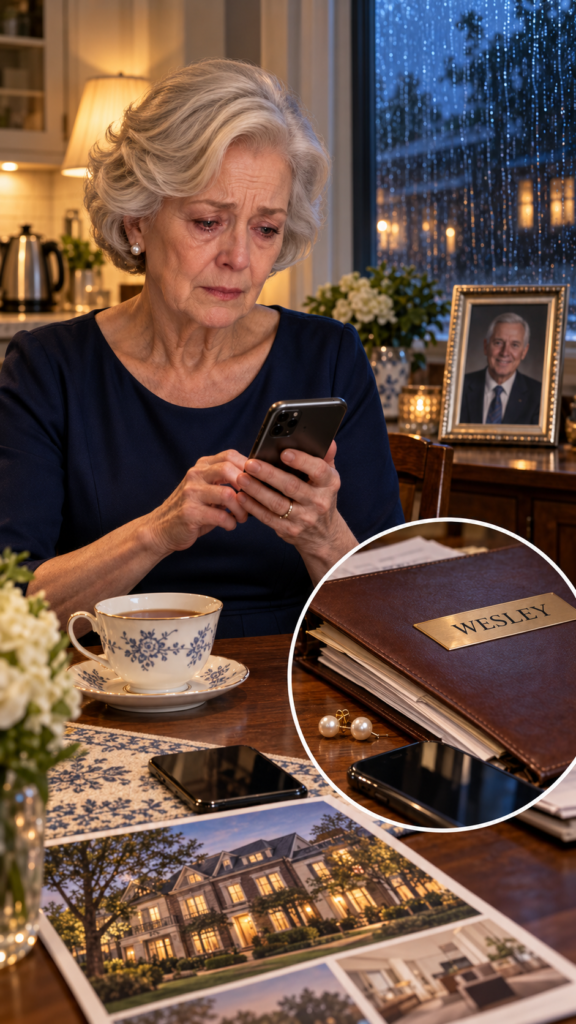
The text arrived at 6:18 p.m., while I sat alone in my kitchen wearing my best navy dress. My pearl earrings waited beside tea that had already gone bitter.
“Mom, the plans changed.”
Before I could rise, another message appeared.
“You weren’t invited. Serena doesn’t want you there.”
Rain tapped against the window. The cooling kettle clicked behind me. On the mantel, my late husband Arthur smiled from a silver frame, looking like a man who still believed our family remembered how to love.
I stared at the pearls, then at the glossy townhouse brochure Wesley had mailed me months earlier.
“For you too, Mom,” he had said. “We want this to feel like a family home.”
I had believed him.
That year alone, I had paid $93,600 toward Wesley’s life. Mortgage support. Insurance. Utilities. School expenses for my granddaughter. Repairs. Emergency transfers that somehow stopped being emergencies and became expectations.
Now, forty-two minutes before dinner in a townhouse I had helped finance, my son was telling me I was not welcome inside it.
Serena had never needed to shout.
Her cruelty wore expensive perfume, smiled across restaurant tables, and spoke softly enough for everyone around her to pretend they had heard nothing.
“Your mother makes things awkward,” she once told Wesley during brunch.
A brunch I paid for.
“She means well,” Serena added, touching his arm. “But still.”
I had laughed because mothers become experts at swallowing humiliation when it arrives disguised as family peace.
That evening, I stopped swallowing.
I crossed the house to Arthur’s old desk and opened the bottom drawer. My fingers found a thick folder marked WESLEY.
Inside were fifteen years of rescue.
Tuition checks. Mortgage drafts. Country club fees. Preschool payments. Insurance premiums. Utility bills. A $6,400 home repair Serena had promised was temporary.
There were emergency transfers and a business credit line I barely remembered approving because Wesley had sounded frightened and desperate when he asked.
I turned page after page.
For years, I had called those payments love.
Sitting there alone, I finally saw something else.
Erasure.
At 6:47 p.m., my granddaughter texted.
“Grandma, are you coming?”
That nearly broke me.
Children rarely understand which adults are building walls around them. They only notice the empty chair and wonder who decided not to come.
I typed carefully.
“Not tonight, sweetheart. I love you.”
Then I reached for the landline.
I did not call Wesley.
I did not call Serena.
I did not ask what I had done wrong or beg for a place at a table financed with my savings and fifteen years of silence.
I called the bank.
After verifying my identity, the woman on the emergency line asked, “Which authorizations would you like to stop?”
I looked across the room at Arthur’s photograph.
“All of them connected to Wesley Hale.”
There was a brief pause.
Then came the quiet tapping of computer keys.
It was an ordinary sound, professional and almost meaningless to anyone else.
To me, it sounded like a door unlocking from the inside.
At 7:03 p.m., I sent Wesley one final message.
“Then you and your wife can start paying your own way.”
I turned off my phone.
Then I removed the pearls.
The next morning, I sat across from Lydia at First National. She had known our family for twenty-two years, long enough to remember when Wesley called me simply because he wanted to hear my voice.
“Are you sure, Mrs. Hale?” she asked.
I placed both hands flat on her desk.
“I am.”
Eight pages came from the printer.
Mortgage drafts. Insurance. Utilities. Club dues. Tuition. Subscriptions. Transfers.
Even the business credit line Wesley had never bothered to tell me remained active.
One hundred seventy-four payments.
I signed the final form.
The scratch of pen against paper was barely audible, but it closed a door I had been holding open for fifteen years.
At 11:26 a.m., the first charge declined.
Then another.
Then another.
I was home drinking tea from the good china when tires tore across the wet gravel outside.
Through the curtain, I saw Serena emerge from the first car in a spotless cream coat, fury tightening every line of her face.
Wesley followed, pale and clutching his phone.
Then another car door opened.
Lydia stepped into the rain, a dark folder pressed against her chest.
Serena saw her.
Wesley saw her.
Whatever accusation had brought them racing to my house disappeared from their faces.
I placed my teacup carefully on its saucer and walked toward the front door.
Wesley stared at me through the glass.
I held his gaze.
“You’re not going to work today,” I said softly.
Wesley blinked, rain gathering on his eyelashes. For one suspended second, he looked like the boy who used to come to me with scraped knees and wait for me to make the world smaller.
Then Serena stepped forward.
“What exactly have you done?”
I looked past her to Lydia.
“Come inside.”
Serena moved with them.
“Not you,” I said.
Wesley lowered his phone. “Mom.”
“You and Lydia. Serena can wait in the car.”
“This is our family business,” Serena snapped.
“Some of it is Mrs. Hale’s banking business,” Lydia said quietly.
Wesley looked between us. Habit pulled one way. Fear pulled another.
“Ten seconds, Wesley.”
He came inside.
Serena did not.
I closed the door on the rain without apologizing.
Wesley stood on the rug dripping water onto the floorboards. Lydia removed her coat, kept the dark folder under one arm, and followed me into the sitting room. Arthur’s photograph was still on the mantel. My pearls were still where I had left them the night before.
Wesley noticed them.
His face changed.
“Mom, I know you’re angry.”
“No,” I said. “Anger would have been easier.”
He looked at the floor.
Lydia sat in Arthur’s old chair but did not open the folder yet. She had the instinct of someone who understood that numbers could wait while a family decided whether it was still a family.
I remained standing.
“Why wasn’t I invited?”
Wesley rubbed one hand over his mouth. “Serena thought—”
“I asked why I wasn’t invited.”
His hand dropped.
“Because I let her decide you weren’t.”
There it was.
Not Serena’s cruelty. Not a misunderstanding. Not a changed reservation.
My son.
I sat down because my knees suddenly felt less certain than my voice.
Wesley took a step toward me.
I lifted my hand.
He stopped.
“I could have survived her not wanting me there,” I said. “What I couldn’t survive was you delivering it like a cancellation notice.”
His eyes filled, but he blinked hard.
“I didn’t know what to say.”
“You knew what to type.”
Silence settled between us.
Outside, a car door slammed. Serena was still there.
Lydia placed the folder on the coffee table.
“There is one item Mr. Hale needs to understand immediately. The business credit line.”
Wesley’s shoulders stiffened.
Lydia opened the folder. “Your mother guaranteed it eleven years ago. She later renewed the guarantee after being told the account would be closed once the balance was cleared.”
Wesley went still.
“The line was never closed,” Lydia said.
“How much?” I asked.
Wesley looked at me. “Mom—”
“How much?”
“Just under forty-two thousand dollars,” Lydia said.
I stared at my son.
I remembered signing papers at this same kitchen table years ago while Wesley paced and told me his business would fail without a little breathing room. I remembered Arthur asking one question after another until Wesley snapped that he was not a child anymore.
Arthur had signed nothing.
I had.
“Forty-two thousand,” I repeated.
Wesley sat down hard on the edge of the sofa.
“It wasn’t all at once.”
“What was it for?”
“Payroll at first. Then taxes. Then the renovation. Then things got tight again.”
“The townhouse?”
His silence answered me.
“The club?”
Another silence.
I looked at Lydia. “Was I making payments on that line too?”
“Yes.”
I turned back to Wesley.
“All this time, when you said you were getting back on your feet, you were standing on mine.”
He covered his face.
For a few seconds, I saw only the crown of his head.
Then the front door opened.
Serena walked in without being invited.
Her cream coat was wet at the shoulders, and fury had sharpened her into something almost unrecognizable.
“This is ridiculous,” she said. “We have bills due today.”
Lydia closed the folder.
I looked at Serena.
“So do I.”
“You don’t have a mortgage like ours.”
“No,” I said. “I only helped pay yours.”
Serena looked at Wesley. “Tell her this has gone far enough.”
He did not move.
“She knows about the credit line,” he said.
Serena stopped.
“He told you?”
“Lydia did.”
“You had no right to discuss our accounts.”
“It is Mrs. Hale’s guaranteed debt,” Lydia replied. “She has every right.”
Serena looked back at me.
Something cold entered her face.
“This is why you make things difficult. You take everything personally.”
I felt an old reflex rise in me—the urge to smooth the room, lower my voice, explain myself until everyone else felt comfortable.
I let it pass.
“You uninvited me from dinner in a house I help pay for.”
“It was one dinner.”
“It was fifteen years.”
Serena’s jaw tightened.
“I never asked you to pay all of that.”
“No,” I said. “You only expected the payments to keep arriving.”
Her cheeks colored.
Wesley stood.
“Stop.”
Serena turned on him. “Excuse me?”
He looked at her, and for the first time since she had entered my life, I saw him speak to her without checking her face first.
“She’s right.”
Serena stared.
Wesley’s voice shook. “She’s right, Serena.”
The room became very quiet.
Then Serena laughed once.
“You are not doing this to me.”
“To you?” he said.
“We built a life.”
“My mother financed half of it.”
The words landed harder than shouting.
Serena looked at him as though he had slapped the table between them.
“You told me she wanted to help.”
“She did.”
“And now she wants to punish us because she didn’t get invited to dinner?”
I stood.
“No. I stopped paying because I finally understood that my money had become the price of being tolerated.”
Serena opened her mouth.
I raised one finger.
“You are going to let me finish.”
She did.
“My granddaughter asked whether I was coming. You knew there would be an empty chair. You knew I was dressed and waiting. You knew this house helped pay for yours. And you still decided I could be discarded forty-two minutes before dinner.”
Wesley’s face crumpled.
Serena’s did not.
That told me more than any confession could have.
She pulled her coat closed.
“Fine. Keep your money.”
“I intend to.”
“We’ll manage.”
“I hope you do.”
“We don’t need you.”
The sentence might once have destroyed me.
Instead, it freed me.
I looked at Wesley.
“Do you agree?”
He stared at his wife for a long time.
Then he said, “No.”
Serena turned.
He swallowed.
“I need my mother.”
Her expression changed from anger to disbelief.
Not because he had chosen me.
Because he had disobeyed her.
She grabbed her handbag from the hall table.
“Then enjoy this.”
She walked to the door.
Wesley called her name.
She stopped but did not turn.
“You come home today,” she said, “or don’t bother coming home at all.”
The old Wesley would have followed.
I saw him almost do it.
His right foot shifted.
Then he looked at Arthur’s photograph.
Something in his face broke.
“I’ll come home when I can tell my daughter the truth.”
Serena turned then.
Fear finally appeared.
“What truth?”
“That Grandma didn’t skip dinner.”
My throat closed.
Wesley continued, each word harder than the last.
“That we told her not to come.”
Serena’s eyes flashed.
“You tell a child whatever keeps the peace.”
“No,” he said. “That’s what I’ve been doing.”
She stared at him for several seconds.
Then she left.
The door shut behind her with a soft click.
No slam.
No dramatic final word.
Just the ordinary sound of a woman discovering that control disappears quietly when people stop cooperating with it.
Wesley stood in the hallway, breathing through his mouth.
I wanted to go to him.
I did not.
Some distances should not be crossed too quickly.
Lydia rose.
“There is one more decision.”
The bank could freeze further advances because I had withdrawn my guarantee for future borrowing, but I remained responsible for the existing debt if Wesley defaulted.
“So I’m not free yet.”
“Not entirely.”
Wesley looked at me.
“I’ll refinance it. I’ll sell the car, cancel the club, sell the townhouse if I have to.”
I looked at him.
“I should have done that before asking you for another dollar,” he said.
It was the first thing he had said all morning that sounded like a man rather than a frightened son.
Lydia closed the folder.
“I can give you thirty days to present a refinancing plan before the account is formally reviewed.”
Wesley exhaled.
“Thank you.”
“Thank your mother,” Lydia said.
He looked at me.
I shook my head.
“No. Don’t thank me for giving you thirty days. Use them.”
He nodded.
Lydia left just before noon.
Wesley stayed.
We sat in the kitchen for nearly three hours.
Not talking at first.
Just sitting.
Rain moved down the window in crooked lines. The tea went cold again. Somewhere upstairs, the old pipes clicked the way they always had in winter.
Finally, Wesley said, “Dad warned me.”
I looked up.
He stared at his hands.
“About what?”
“About making your kindness into a system.”
I could almost hear Arthur’s voice.
Wesley gave a broken smile.
“He told me once that every time you rescued me, I learned less about standing up.”
My eyes burned.
“Why didn’t you listen?”
“Because you kept saying yes.”
The words hurt.
He saw it immediately.
“That sounded awful.”
“It sounded true.”
He leaned back, exhausted.
“I made your love convenient.”
I folded my hands around the cold teacup.
“And I made convenience look like love.”
For the first time that day, neither of us had anywhere to hide.
Wesley cried then.
Quietly.
He bent forward and covered his face while fifteen years of postponed shame finally arrived.
When he could speak again, he said, “I am so sorry.”
I believed him.
I also knew sorry was not repayment.
“I love you,” I said. “And I’m not fixing this.”
He nodded.
“I know.”
“No mortgage.”
“I know.”
“No tuition.”
His head lifted.
“Mom, her school—”
“No.”
He stopped.
I softened my voice, not my answer.
“If you and Serena cannot afford the school you chose, you choose another school. I will not be turned into a payment plan because a child is involved.”
His eyes filled again.
I reached across the table and placed my hand over his.
“I will always be her grandmother. I will not always be her bank.”
He gripped my fingers.
That afternoon, he went home.
He called me at eight that evening.
Serena had packed two suitcases.
She was taking their daughter to her sister’s for the night.
“Don’t chase her,” I said.
“I wasn’t going to.”
It was the first time I heard him make a decision without asking me what decision to make.
The next week stripped their life down quickly.
The country club membership disappeared. Then the second car. Trips and subscriptions vanished. Wesley met repeatedly with the bank and an accountant Lydia recommended. Before the thirty-day deadline, he put the townhouse on the market.
Serena called me.
“You’re taking my home.”
“No,” I said. “You can no longer afford the one you chose.”
“You’ve always wanted Wesley to choose you.”
“I wanted my son to stop making me pay for the privilege of being his mother.”
She hung up.
Three days later, my granddaughter called.
Not texted.
Called.
“Grandma?”
Her voice was small.
“Yes, sweetheart.”
“Did Mom tell you not to come to dinner?”
I sat very still.
I could have lied.
For peace.
For protection.
For habit.
Instead, I said, “Yes.”
She breathed in sharply.
“Dad said he should have stopped her.”
“He should have.”
Another breath.
“Are you mad at me?”
That question broke something open inside me.
“Oh, darling. Never.”
She began to cry.
“I kept your chair.”
I closed my eyes.
“What?”
“At dinner. Mom told me to move your place card because you weren’t coming. I put it back.”
My hand went to my mouth.
“She moved it again,” my granddaughter said. “So I put it in my pocket.”
The room blurred.
“Do you still have it?”
“Yes.”
“Keep it for me.”
“I will.”
That small folded place card became the first beautiful thing to come out of that terrible dinner.
Not because it fixed anything.
Because it proved the empty chair had never meant I was unloved by everyone in that house.
Two months later, the townhouse sold.
There was no profit after the mortgage and fees, but Wesley refinanced most of the business debt into his own name after selling the second car and closing the club account.
He still owed money.
For the first time, he owed it himself.
The day Lydia called to tell me my guarantee had been fully released, I asked her to repeat the sentence.
“You have no further liability on Wesley Hale’s business credit line.”
I sat at Arthur’s desk.
“Again, please.”
“You’re free of it, Mrs. Hale.”
After we hung up, I cried harder than I had the night I was excluded from dinner.
Relief has its own grief. You understand the weight only after it is lifted.
Serena and Wesley separated for several months.
He rented a modest apartment near his daughter’s school, learned to cook, packed lunches, drove carpool, and discovered the price of electricity when nobody else paid it. He also went to counseling.
One afternoon he said, “My counselor says I confuse avoiding conflict with being kind.”
“Your father could have told you that for free.”
“He did.”
We laughed—the first easy laugh between us in years.
Serena changed more slowly. She blamed me, then Wesley, then the bank, until there was no one left to blame. She took a full-time position with the design firm she had previously consulted for only occasionally and moved into a smaller rental.
Consequences did not make her kind.
But they removed the stage on which her old life had performed.
The real change came one cold Saturday in March.
Serena arrived alone in a dark wool jacket, holding something small.
I nearly did not let her in.
Then I saw it.
A folded place card.
My place card.
She placed it on the kitchen table between us.
My name was written across the front in my granddaughter’s careful handwriting.
GRANDMA.
The letters were slightly crooked.
One corner was bent.
“I found it in her coat pocket,” Serena said.
I touched the fold with one finger.
“She told me she kept putting it back.”
Serena looked down.
“I kept moving it.”
There was no defense in her voice.
That was new.
I waited.
“She asked me why I hated you.”
I looked up.
Serena swallowed.
“I told her I didn’t.”
“What did she say?”
“She said, ‘Then why did you make Grandma feel unwanted?’”
Her mouth tightened.
For once, there was no polished answer.
“I didn’t know what to say.”
I thought of Wesley saying the same thing.
I leaned back.
“Children are inconvenient that way.”
A faint, miserable smile touched her face.
Then vanished.
“I was ashamed of you.”
The honesty was ugly enough to be useful.
“Why?”
“Because you saw through our life. You never cared about the club, the address, the right restaurant. I thought you were judging me.”
“I wasn’t.”
“I know.”
She stared at the place card.
“I was judging myself.”
The kettle clicked.
Neither of us moved.
“I made you smaller so I could feel bigger,” she said.
My throat tightened, but I kept my voice steady.
“And Wesley let you.”
“Yes.”
“And I paid for it.”
“Yes.”
There was nowhere else for the truth to go.
Serena lifted her eyes.
“I’m sorry.”
I believed she meant it.
I did not forgive her that day.
That mattered.
Because forgiveness given too quickly can become another kind of erasure.
I told her, “I am glad you came. I am not ready to pretend this is healed.”
She nodded.
“I understand.”
“I don’t want expensive lunches. I don’t want gifts. I don’t want you telling other people we’ve made up.”
Another nod.
“What do you want?”
I looked at the place card.
“Consistency.”
She breathed out.
“That’s fair.”
“Fair is new for us.”
She accepted that too.
By summer, the changes had lasted.
Wesley rented a small house. Serena remained in her apartment. They had not reconciled romantically, and neither tried to make me referee their marriage. They learned to share their daughter without using her as a messenger.
Wesley’s business survived, smaller than before. He paid himself less and worked more.
Every month he sent me a photograph of the remaining refinanced balance.
“You don’t owe me proof,” I told him.
“Yes, I do.”
“No. You owe yourself proof.”
After that, he kept the statements in a folder of his own.
Not mine.
His.
Lydia retired in August.
At her farewell lunch, she hugged me and whispered, “You know, I almost didn’t come to your house that morning.”
I pulled back.
“Why did you?”
She smiled.
“Arthur.”
My breath caught.
“What about him?”
She reached into her handbag and handed me an envelope.
My name was written across the front in Arthur’s handwriting.
For a moment, the restaurant disappeared.
“When he was ill,” Lydia said, “he came into the bank alone. He asked me to keep that with your signature file and give it to you only if you ever came in to remove yourself from Wesley’s accounts.”
I stared at her.
“He knew?”
“He worried.”
My hands trembled as I opened the envelope.
Inside was one sheet of paper.
No legal instructions.
No money.
Just Arthur.
My darling,
If you are reading this, then you finally said no.
I wish I were there to see it.
Do not confuse the ache you feel with guilt. You have spent your whole life opening doors for people you love. Sometimes love is knowing when to close one so they learn how to knock.
Wesley is not lost because you stopped carrying him.
Give him the chance to find his feet.
And please, for once, spend something on yourself without explaining it to anyone.
All my love,
Arthur
I could not finish the last line aloud.
Lydia reached across the table and covered my hand.
For years, I had believed Arthur’s photograph watched me from the mantel like a witness to everything I had failed to prevent.
Now I understood something else.
He had been waiting for me to choose myself.
That was the beautiful cruelty of love: sometimes the person who knows you best cannot save you from your own tenderness.
They can only leave a light on for the day you finally see it.
In September, I spent something on myself.
Not extravagantly.
Arthur would have teased me if I had.
I booked a small cottage by the coast for two weeks.
No family emergency followed me. No mortgage payment waited on my phone. No club dues. No tuition draft. No business line.
I woke to gulls and wind against the glass, drank coffee in a robe until noon, and bought a ridiculous blue hat without checking the price twice.
On my final Sunday there, Wesley drove down with my granddaughter.
Serena came separately.
That had been my condition.
No performances.
No pretending.
Just lunch.
We ate outside beneath a faded umbrella while the sea moved silver beyond the dunes.
My granddaughter sat beside me.
Halfway through the meal, she reached into her backpack.
“I brought something.”
She unfolded the old place card.
GRANDMA.
The crease was softer now from being opened and closed.
She set it in front of my plate.
Nobody spoke.
Wesley looked away toward the water.
Serena lowered her eyes.
I touched the card.
“You kept it all this time?”
My granddaughter nodded.
“I wanted you to have your seat back.”
The words went through me so gently I almost missed how deep they landed.
I looked around the table.
At my son, who no longer needed me to finance his adulthood.
At Serena, who had learned that apology was not a key but a practice.
At the child who had refused to let an empty chair become the final truth.
Then I looked at the ocean.
“I think,” I said, “I already do.”
Wesley reached for my hand.
This time, I let him.
Serena placed her hand on the table too, not touching mine, only close enough to show she understood the difference between asking and taking.
My granddaughter leaned against my shoulder.
The wind lifted the edge of the little place card.
I caught it before it blew away.
For once, nobody needed money from me.
Nobody needed rescuing.
Nobody needed me to make myself smaller so the room could stay peaceful.
They simply wanted me there.
And as the afternoon light warmed the table, I slipped Arthur’s letter from my handbag, folded beneath the place card, and smiled at the family that had finally learned the difference between being supported and being loved.
Then I put both pieces of paper together under my teacup, safe from the wind, and stayed exactly where I belonged.






