My Daughter-in-Law Told Me I Wasn’t Welcome at Christmas Because I “Didn’t Fit In” — My Son Stood Beside Her and Said It Would Be “Easier” If I Stayed Away. So I Smiled, Took Back One Ornament, Walked Outside, and Made a Phone Call They Never Expected.
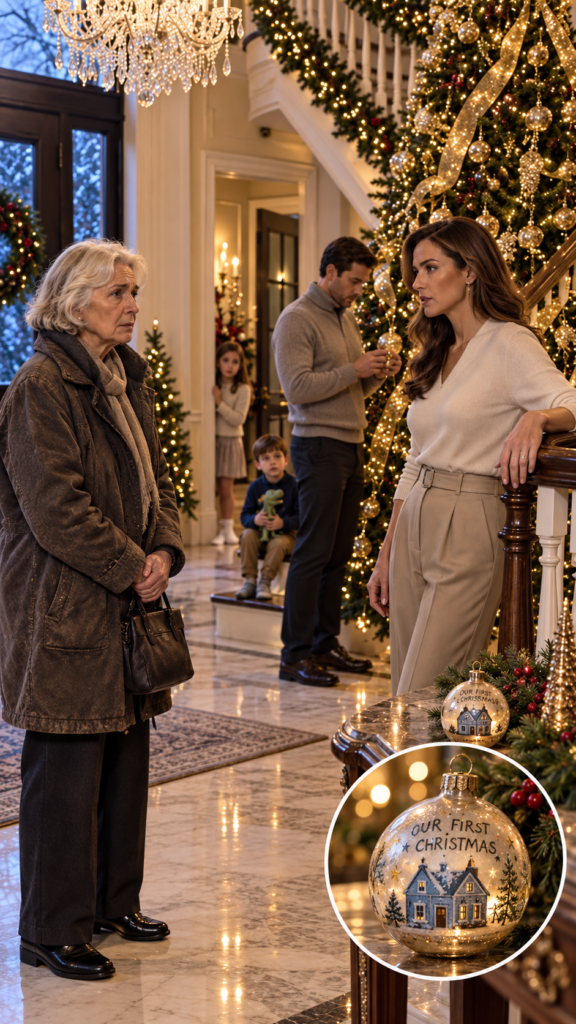
Christmas had not even begun, but my daughter-in-law had already decided which decoration ruined her flawless holiday picture.
Me.
She told me while my son stood barely three feet away, pretending a perfectly straight gold ornament desperately needed adjusting.
Jennifer rested one manicured hand against the staircase banister.
Behind her, a twelve-foot Christmas tree dominated the marble foyer, wrapped in shimmering gold ribbons and hundreds of warm white lights.
Everything sparkled—the polished floor, the crystal chandelier, the expensive garland arranged perfectly along the staircase.
The house looked ready for the cover of a luxury Christmas magazine.
Jennifer’s smile did not.
“Barbara, I really think it would be better if you didn’t come for Christmas this year,” she said calmly.
Then she tilted her head.
“You just don’t fit in.”
Her voice remained soft and almost courteous.
She sounded like someone correcting a misplaced centerpiece rather than excluding her husband’s mother from Christmas.
I looked toward Michael.
My son stood beside the tree wearing an expensive cashmere sweater, slowly turning a gold ornament that had already been hanging perfectly straight.
His fingers treated that fragile glass sphere with remarkable care.
More care, apparently, than he could spare for the woman who had sacrificed almost everything to raise him.
Jennifer watched my face.
She was waiting.
Maybe she expected humiliation.
Maybe tears.
Perhaps she imagined I would apologize for somehow embarrassing her simply by existing.
She probably expected me to lower my eyes, clutch my inexpensive purse, and quietly disappear before my presence spoiled the elegant Christmas she had designed.
Near the hallway, my nine-year-old granddaughter, Lily, peeked around the corner.
One sock had slipped halfway down her heel.
Her younger brother, Owen, sat silently on the bottom stair, squeezing a plastic dinosaur against his chest.
Neither child said anything.
They did not need to.
Both understood that something cruel was happening.
Michael understood it too.
Still, my son remained silent.
Jennifer continued speaking as though she were explaining an inconvenient scheduling conflict.
Her parents, Thomas and Diana Parker, would be hosting Christmas dinner.
There would be professional caterers, wealthy donors, country club friends, business associates, and several other people Jennifer described as “important guests.”
Apparently, those important people might become uncomfortable around my aging winter coat.
Or my inexpensive purse.
Or perhaps the glass pie dish I carried every Christmas, with BARBARA written underneath on an old strip of masking tape.
“You know how those things are,” Jennifer said.
Yes.
I knew exactly how those things were.
I knew how Diana Parker smiled without warmth whenever I entered a room.
I knew how Thomas Parker somehow managed to look directly through me as though I were invisible.
Unless, of course, they needed someone to watch Lily and Owen.
Then I suddenly became remarkably visible.
And I knew precisely what Jennifer meant whenever she described something as “simple.”
My simple clothes.
My simple home.
My simple life.
To Jennifer, simple was merely a polite substitute for poor.
Embarrassing.
Disposable.
Then Michael cleared his throat.
For one foolish second, something dangerous rose inside me.
Hope.
Maybe my son would finally tell his wife she had crossed a line.
Maybe he would remember the mother who had sat beside his hospital bed through every terrifying childhood asthma attack.
The woman who held his small hand while machines beeped and doctors rushed around us.
Maybe he would remember the night his father died.
Michael had sat at my kitchen table asking how he could possibly afford college while Robert’s coffee mug still waited beside the sink.
Maybe he would remember every overnight shift I worked at St. Mary’s Hospital.
Every payment I delayed.
Every exhausted Christmas morning I survived on barely two hours of sleep so my son could wake up to books, new shoes, and opportunities I had never received.
Michael finally spoke.
“Mom, maybe this year…”
He stopped.
His eyes remained fixed on the tree.
“It’s just easier.”
Easier.
One ordinary word.
Yet somehow, it hurt more than everything Jennifer had said.
I stared at the grown man standing before me.
For several seconds, I searched his face for the frightened little boy I had once protected with everything I possessed.
I could not find him.
That little boy was gone.
Standing in his place was a man who would rather humiliate his mother than risk inconveniencing his wife.
So I reached for my purse.
As I turned, the staircase garland brushed against my sleeve.
A single pine needle caught against the cuff of my worn winter coat.
Jennifer immediately noticed it.
Her eyes dropped toward my sleeve.
Then she looked back at my face.
Waiting for the tears.
I gave her something else.
A smile.
“That’s perfectly fine, Jennifer,” I said.
Something shifted behind her eyes.
It lasted less than a second.
But I saw it.
Uncertainty.
For the first time that evening, a tiny crack appeared in Jennifer’s carefully polished confidence.
Michael stepped toward me.
“Mom…”
There was caution in his voice now.
But there was still no apology.
Before walking outside, something on the entry table caught my attention.
A small glass ornament.
Old.
Slightly cloudy around the edges.
Beneath the words OUR FIRST CHRISTMAS was a tiny blue house painted by hand.
Robert had bought that ornament the year Michael was born.
I reached down and carefully picked it up.
Jennifer’s voice immediately changed.
“Barbara, that belongs on our tree.”
I looked at the ornament resting in my palm.
Thirty-four Christmases seemed trapped inside that little piece of glass.
Then I slowly closed my fingers around it.
“No,” I said.
I finally looked directly at Jennifer.
“It doesn’t.”
Silence swallowed the foyer.
Owen stopped tapping his dinosaur against the staircase.
Lily raised both hands over her mouth.
Jennifer stared at me.
Michael stared at the ornament.
And for the first time that evening, genuine uncertainty appeared on my son’s face.
Several minutes later, I was sitting alone inside my car.
Robert’s ornament rested safely inside my scarf on the passenger seat.
My hands trembled against the steering wheel.
Not because of the December cold.
Because after thirty-four years of putting Michael first, I had finally done something that felt almost unfamiliar.
I had chosen myself.
I pulled out my phone.
Then I found the number belonging to Richard Montgomery.
Richard was the only person who knew exactly how much money I had provided.
He knew which documents I had signed.
He knew what remained legally connected to my name.
And most importantly, he knew exactly what Michael and Jennifer had apparently forgotten.
I pressed CALL.
Richard answered on the second ring.
“Barbara?”
I looked through the windshield toward the enormous glowing house behind me.
My voice did not shake.
“It’s time,” I said.
“I want everything stopped.”
Silence came from the other end.
Just briefly.
Then Richard asked one question.
A question that would change what happened to Michael and Jennifer before Christmas morning.
“Everything—including the house?”
I closed my eyes.
For one second, all I could hear was my own breathing and the faint hum of the heater pushing warm air through the vents.
Then I looked at the house again.
The tall windows.
The wreath centered perfectly on the front door.
The gold lights Jennifer had hired someone to wrap around every bare tree lining the driveway.
“Yes,” I said.
Richard did not answer immediately.
He had known me for more than twenty years. He had handled paperwork after Robert died, helped me untangle accounts I had been too numb to understand, and watched me make one financial decision after another with Michael’s future in mind.
So when he finally spoke, his voice was careful.
“Are you certain?”
My fingers tightened around the phone.
Inside the house, a shadow moved past the foyer window.
Michael.
Even from the car, I recognized the shape of my own son.
“I’ve never been more certain.”
Richard exhaled quietly.
“All right.”
Two words.
No celebration.
No shock.
Just acknowledgment.
Then he began explaining what would happen next.
The support account could be frozen that evening.
The automatic transfers I had been making toward household expenses could be stopped immediately.
The property itself required formal notice, because years earlier I had insisted on a written occupancy agreement even when Michael had laughed and told me paperwork between family was ridiculous.
The house had never been transferred to him.
Not fully.
Not even close.
It sat inside the Morgan Family Trust, with me as the surviving trustee.
Michael and Jennifer had been allowed to live there.
They had been allowed to decorate it, renovate it, entertain in it, tell people it was theirs.
But legally, the house belonged to the trust Robert and I had built.
Michael had signed the agreement.
Jennifer had signed it too.
Apparently, marble floors and chandeliers had made signatures easy to forget.
Richard’s voice softened.
“Barbara, if I send notice, this can’t be treated as an argument you cool down from tomorrow.”
“I know.”
“They’ll have time to arrange somewhere else to live. You’re not putting your grandchildren outside on Christmas morning.”
“I would never do that.”
“I know you wouldn’t.”
That sentence nearly broke me.
Not because it was kind.
Because after what had happened inside that house, hearing someone say they still knew who I was felt almost unbearable.
I looked down at Robert’s ornament.
The tiny painted house glimmered beneath the passing light from the dashboard.
“Do it properly,” I said. “No spectacle. No cruelty. Give them the time the agreement requires.”
Richard paused.
“And the transfers?”
“Stop them.”
“All of them?”
I thought of Lily’s loose sock.
Owen’s dinosaur.
“No.”
Richard waited.
“Anything established directly for the children stays exactly where it is.”
His voice changed then.
Almost imperceptibly.
Approval, perhaps.
Or relief.
“Of course.”
“Their school accounts. Their medical funds. Everything Robert and I protected for them.”
“Untouched.”
“They should never pay for what their parents did.”
“They won’t.”
I nodded even though he could not see me.
“Everything else ends tonight.”
When I disconnected the call, I did not drive away immediately.
I sat there with both hands resting in my lap.
For years, I had imagined that choosing myself would feel triumphant.
It did not.
It felt like grief.
The kind that arrives when you finally stop pretending something can still be saved in the form you remember.
My phone lit up.
MICHAEL.
I watched his name vibrate across the screen until it disappeared.
Then it appeared again.
I turned the phone facedown.
The front door opened.
Michael stepped onto the porch without a coat.
Cold air struck him immediately. I saw him fold his arms against his chest and scan the driveway.
His gaze found my car.
He started toward me.
I put the car in reverse.
He stopped.
For one terrible instant, his face looked exactly the way it had when he was ten years old and woke from a nightmare searching for me.
My foot hovered over the brake.
Every instinct I had spent thirty-four years developing screamed at me to stop.
To roll down the window.
To rescue him from discomfort.
Then I remembered his voice.
It’s just easier.
I backed out of the driveway.
For once, I let my son stand in the cold with a consequence I had not rushed to soften.
My cottage was dark when I arrived.
Small.
Quiet.
The porch light flickered twice before staying on, something I had been meaning to fix for months.
Jennifer would have hated it.
The narrow kitchen.
The mismatched chairs.
The old yellow mixing bowl Robert bought at a yard sale because he liked the color.
I stood inside the doorway holding my purse in one hand and the ornament in the other.
Then I began to cry.
Not loudly.
There was no dramatic collapse.
I simply leaned my back against the door while tears ran down my face and soaked into the collar of my worn coat.
I cried for Robert.
I cried for the little boy Michael had been.
I cried for all the times I had told myself that silence was patience when sometimes it had only been fear of losing him.
Then I crossed the room and placed OUR FIRST CHRISTMAS on the small table beside Robert’s old photograph.
“You would have told me sooner,” I whispered.
The room offered no answer.
But looking at his face, I knew I was wrong.
Robert had loved Michael fiercely.
He would have given him every chance I had.
Maybe more.
The difference was that Robert had always understood something I learned too late.
Love could be generous without becoming permission.
At 7:12 the next morning, someone knocked on my door.
I had slept perhaps three hours.
Michael stood outside in yesterday’s cashmere sweater, wrinkled now beneath a dark coat he had thrown on hastily.
His eyes were red.
“Can I come in?”
I stepped aside.
He entered slowly, as though my little cottage had become unfamiliar territory.
His gaze moved across the room.
The secondhand bookshelf.
The old sofa.
Robert’s photograph.
Then the ornament beside it.
He swallowed.
“Richard emailed us.”
I said nothing.
“Jennifer thought it was some kind of mistake.”
“It isn’t.”
“Mom…”
His shoulders dropped.
“What did you do?”
The question struck me harder than I expected.
I looked at him.
“What did I do?”
Michael shut his eyes briefly.
“That came out wrong.”
“No. I think it came out exactly right.”
He stared at the floor.
I waited.
For once, I did not make the silence easier for him.
Finally he sat at my kitchen table.
The same table where, years ago, he had asked how we would pay for college after his father died.
His fingers pressed together.
“Are you really taking the house?”
“I am ending an arrangement that should have ended long before last night.”
“You said it was for us.”
“It was.”
His head lifted.
“Then how can you just—”
“Because helping you was never the same thing as giving you permission to erase me.”
His mouth closed.
The words hung between us.
I pulled out the chair across from him.
“When you and Jennifer wanted that house, you couldn’t qualify for what you wanted without liquidating nearly everything you had. I bought it through the trust. You both signed an occupancy agreement. We discussed it at this table.”
Michael rubbed his forehead.
“I remember.”
There it was.
Not confusion.
Not injustice.
Memory.
“You remember.”
“Yes.”
“And Jennifer?”
His silence answered before he did.
“She remembers too.”
A slow coldness settled inside me.
“So last night, when she told me I didn’t fit in…”
Michael’s jaw tightened.
“She wasn’t thinking about the paperwork.”
“No. She was thinking about whether my coat would embarrass her wealthy friends.”
He flinched.
I leaned back.
“And you were thinking about an ornament.”
“Mom.”
“No. Tell me what you were thinking.”
His eyes finally met mine.
For a few seconds, he looked almost angry.
Then something in him gave way.
“I was ashamed.”
I did not move.
“Of me?”
His face twisted.
“No.”
The answer came too quickly.
He knew it.
So did I.
He looked away.
“Not of you exactly.”
“That is a very convenient sentence.”
His breathing became uneven.
“I was ashamed of where I came from.”
The room went still.
There are truths a mother can suspect for years and still be unprepared to hear.
Michael stared at his clasped hands.
“When I started moving in Jennifer’s circles, everybody seemed to know things I didn’t know. Which wine to order. Which schools mattered. Where to vacation. What clubs their parents belonged to. I always felt like somebody was going to look at me and know.”
“Know what?”
“That I didn’t belong.”
My throat tightened.
He gave a small, miserable laugh.
“And then Jennifer started correcting things. My clothes. The way I talked about money. The stories I told. She’d say she was helping me.”
“And eventually she corrected me.”
He looked at me.
Tears stood in his eyes.
“Yes.”
I had imagined that if Michael ever admitted the truth, I would feel vindicated.
Instead I felt tired.
“So every time she called my life simple, you heard the insult.”
“Yes.”
“Every time her parents treated me like hired help, you saw it.”
“Yes.”
“And last night?”
His lips trembled.
“I saw everything.”
“Then why didn’t you speak?”
He covered his face with both hands.
“Because I became a coward.”
That was the first honest thing he had given me.
I let the silence remain.
When he finally lowered his hands, he looked older.
“I’m sorry.”
I nodded once.
He waited.
Perhaps he expected me to say what I had always said.
It’s all right.
Don’t worry.
You didn’t mean it.
Instead I said, “I believe you’re sorry.”
His eyes searched mine.
“But forgiveness and trust are not the same thing.”
He looked down.
“I know.”
“You don’t know yet.”
Another knock came at the door.
Michael stiffened.
Jennifer stood on my porch.
Perfect makeup.
Perfect coat.
Perfect fury.
Behind her were Thomas and Diana.
I almost laughed at the symmetry of it.
Jennifer did not wait to be invited.
She stepped inside.
“This has gone far enough.”
Michael rose.
“Jennifer.”
“No, Michael. Your mother needs to understand that she cannot destabilize our children because she’s offended over one Christmas dinner.”
My hands went cold.
Not with fear.
With clarity.
I stood.
“The children are protected.”
Jennifer blinked.
“What?”
“Their education accounts. Medical funds. The trusts Robert and I created for them. Nothing belonging to Lily and Owen has been touched.”
Thomas’s head turned toward her.
Diana’s expression changed.
Jennifer recovered quickly.
“That isn’t the point.”
“It is exactly the point,” I said. “You accused me without asking because you assumed I would use children the way you used Christmas.”
Color rose in her face.
“I did not use Christmas.”
“You told their grandmother she was too embarrassing to attend.”
Diana shifted near the door.
“Jennifer,” she said quietly.
Jennifer whipped around.
“Mother, please.”
That one word contained years of practiced command.
Diana did not obey.
“Did you actually tell Barbara she didn’t fit in?”
Jennifer stared at her.
“You knew we wanted a certain kind of dinner.”
“That is not what I asked.”
Thomas looked uncomfortable now.
For the first time since I had met him, he looked directly at me.
“Barbara, did she say that?”
“Yes.”
His face hardened.
Michael stepped forward.
“I was there.”
Jennifer turned toward him.
“Michael.”
“I was there,” he repeated.
The anger drained from her face.
Something more dangerous replaced it.
Fear.
“Don’t do this.”
He gave a short, broken laugh.
“You mean don’t tell the truth?”
Jennifer looked from him to her parents.
Then to me.
“This is absurd. We have invested years into that house.”
“You have lived in it for years,” I said.
“We renovated it.”
“With money transferred from the household account I funded.”
Her mouth opened.
Thomas’s head snapped toward her.
“Household account?”
Jennifer’s eyes flashed.
“This is private.”
I almost admired the instinct.
Even now, her first concern was not what she had done.
It was who was hearing about it.
She stepped closer to me.
“So that’s what this is? You’ve been keeping score?”
“No.”
My voice was quiet.
“That is why you never knew the score existed.”
She stopped.
I continued.
“I never told your friends who paid what. I never corrected anyone when you called it your house. I never demanded gratitude before entering the front door. I never used money to buy authority over your marriage.”
Jennifer’s breathing quickened.
“But you are using it now.”
“No. I am refusing to finance my own humiliation.”
Silence.
Even Thomas lowered his eyes.
Jennifer looked at Michael.
“Say something.”
He did.
“She’s right.”
Her face changed completely.
Not dramatically.
Just a tiny loss of control around her mouth.
“What did you say?”
Michael’s voice shook.
“I said she’s right.”
“You’re choosing her over your family?”
His eyes went toward me, then back to Jennifer.
“My mother is my family.”
Jennifer recoiled as though he had struck her.
“And so are you. And Lily. And Owen. That was supposed to be the point.”
Diana moved toward her daughter.
“Jennifer, apologize.”
Jennifer gave her a stunned look.
“Excuse me?”
“Apologize.”
“For what? Wanting one evening where everything looked right?”
The sentence landed harder than anything else she could have said.
Diana’s face went pale.
Michael closed his eyes.
Thomas slowly removed his glasses.
And Jennifer, hearing herself too late, realized the room had changed.
I thought of my worn coat.
My purse.
My pie dish with masking tape underneath.
Everything looked right.
Except me.
Jennifer’s mouth opened again.
No words came.
That was the moment her power broke.
Not when Richard stopped the transfers.
Not when the notice arrived.
Not when she understood that the house was not hers.
It broke when the people whose approval she had spent years chasing finally saw what she was willing to discard to keep their approval.
Diana stepped backward.
“I won’t be hosting that dinner.”
Jennifer stared at her.
“Mother.”
“No.”
Thomas put his glasses into his coat pocket.
“We’re going home.”
“You can’t be serious.”
“I am.”
“What will we tell everyone?”
Thomas looked at his daughter for a long time.
“The truth would be a start.”
They left without another word.
Jennifer stood in the center of my little living room, surrounded by furniture she would never have chosen, and looked smaller than I had ever seen her.
Michael did not move toward her.
Neither did I.
Finally she picked up her handbag.
“This isn’t over.”
I expected the words to frighten me.
They did not.
“No,” I said. “But this part is.”
She left.
The door shut softly behind her.
Michael remained standing.
His face looked shattered.
I wanted to comfort him.
I did not.
Some pain is not cruelty.
Sometimes it is the first honest sensation after years of numbness.
Christmas morning arrived quietly.
There was no catered dinner.
No country club guests.
No gold place cards.
At 8:40, Lily knocked on my door while Michael stood several feet behind her holding Owen’s overnight bag.
She was still wearing mismatched socks.
When I opened the door, she threw both arms around my waist.
“Grandma.”
One word.
That was all.
I bent and held her.
Owen pressed himself against my side next, dinosaur trapped between us.
“I brought him,” he whispered.
“I see that.”
“He likes your house.”
I laughed into his hair.
“So do I.”
Michael remained on the porch.
“We can go if this is too much.”
I looked at the children.
Then at him.
“You can come in.”
His eyes filled immediately.
I raised one finger.
“This is not everything being fixed.”
“I know.”
“This is breakfast.”
A faint smile appeared.
“Breakfast is good.”
We ate cinnamon toast because I had forgotten to buy anything impressive.
Lily found powdered sugar in the cabinet and covered half the table with it.
Owen made his dinosaur guard the butter.
Michael washed dishes without being asked.
At one point I looked across the kitchen and realized nobody was performing.
Nobody was measuring the silverware.
Nobody cared which glasses matched.
The room was too small.
The toast was slightly burned.
It was the first peaceful Christmas morning I had experienced in years.
Jennifer did not come.
Michael told the children only that their mother needed time.
I respected that.
Whatever Jennifer had done to me, she was still their mother.
I would not teach them cruelty in the name of justice.
The formal notice gave Michael and Jennifer ninety days to leave the house.
Jennifer hired an attorney.
The attorney reviewed the trust, the occupancy agreement, and every signature.
Three weeks later, the challenge disappeared.
There was nothing to challenge.
The documents were clear.
Jennifer moved into her parents’ guesthouse before the deadline.
Michael rented a modest three-bedroom townhouse near Lily’s school.
For the first time in years, his address impressed nobody.
He later told me that was one of the best things about it.
The marriage did not survive.
Not because I ended it.
I want that understood.
A house can expose cracks.
Money can remove cushions.
But neither creates what is not already there.
Michael asked Jennifer to attend counseling.
She went twice.
The third time, she did not show.
Months later, they separated permanently.
Their divorce was quiet.
There were no dramatic accusations, no attempts to turn the children against each other, no public scandal.
Jennifer remained their mother.
Michael remained their father.
They learned, imperfectly, how to exchange Lily and Owen in parking lots without making two children carry adult resentment.
Jennifer changed too, though not in the neat way stories sometimes demand.
She never became warm toward me.
She never appeared at my door asking forgiveness through tears.
But after losing the house, the marriage, and the social image she had protected so fiercely, something in her hardened confidence disappeared.
The first apology came in an email seven months later.
It was five sentences long.
The third sentence said:
I treated your dignity as though it mattered less than my embarrassment.
I read that line several times.
Then I closed the laptop.
I did not answer for three days.
When I finally did, I wrote:
Thank you for saying it clearly.
Nothing more.
It was enough.
Michael’s apology took longer.
Not because he refused to give one.
Because I refused to let him hide inside the word sorry.
Every Sunday afternoon, he began stopping by.
Sometimes we talked.
Sometimes we did not.
He fixed the porch light.
He replaced the kitchen faucet.
I made coffee.
One rainy afternoon, almost six months after that Christmas, he noticed Robert’s old mug in the back of a cabinet.
He took it out.
The handle had a hairline crack.
“I remember this.”
“I know.”
“Dad drank coffee from it every morning.”
“Until the day he died.”
Michael sat down.
He turned the mug between his hands.
“When Dad died, I thought the worst thing that could happen was losing one of you.”
I sat opposite him.
“And then I spent years acting like losing the other one didn’t matter.”
His voice broke on the last word.
I reached across the table.
Not to erase what happened.
Not to tell him it no longer mattered.
I simply placed my hand over his.
He bowed his head.
“I don’t know how to forgive myself.”
“You’re not supposed to do it all at once.”
He looked up.
“What am I supposed to do?”
“Become someone who would not make the same choice again.”
He nodded slowly.
That became our work.
Not forgetting.
Not pretending.
Becoming different.
Lily began spending Friday afternoons with me.
She liked baking.
More accurately, she liked pouring flour too quickly and pretending the cloud was accidental.
One afternoon she saw my old glass pie dish in the cabinet.
“Is that the one Mom didn’t want you to bring?”
Children hear more than adults think.
I took it down.
“Yes.”
She traced the masking tape underneath.
BARBARA.
“Why does it have your name?”
“Church dinners. Hospital potlucks. People kept losing dishes.”
She smiled.
“Can I have it when you die?”
I stared at her.
She immediately looked horrified.
“I mean not soon.”
I burst out laughing.
She did too.
We laughed until tears ran down my face.
Then I told her she could have it someday.
Years and years and years from now.
Owen remained loyal to the dinosaur.
By spring, its tail had been repaired twice with tape.
He told me broken things were better when you could see where they had been fixed.
I wrote that sentence down after he left.
Children sometimes understand healing better than adults.
Richard called me in April.
“The house has sold.”
I stood at my kitchen window watching rain slide down the glass.
I had expected the news to stir something enormous.
Instead I felt still.
“Good.”
“There’s something else.”
I smiled.
“You lawyers always say that before making my day complicated.”
He laughed.
“This one isn’t complicated.”
A week later, he came to the cottage carrying a thick envelope.
We sat at my kitchen table.
He placed it between us.
“What is this?”
“Something I should have given you years ago.”
I frowned.
He opened the envelope and removed an old folded sheet of paper.
Robert’s handwriting appeared immediately.
I stopped breathing.
Richard watched me carefully.
“Robert gave this to me when you two first created the trust.”
I looked up.
“That was before he got sick.”
“Yes.”
“Why did you keep it?”
“Because he asked me to.”
My fingers trembled.
Richard continued.
“He said you would spend your whole life giving Michael everything if someone didn’t occasionally remind you that you were allowed to keep something for yourself.”
A sound escaped me.
Half laugh.
Half sob.
I unfolded the page.
Robert’s handwriting leaned slightly to the right, just as it always had on grocery lists and birthday cards.
Barbara,
If you are reading this because Richard decided you finally need it, then I’m guessing you have once again tried to give away more of yourself than any reasonable person should.
I covered my mouth.
Richard looked toward the window.
I kept reading.
Help Michael.
Love him.
Give him a start when you can.
But promise me one thing.
Never give him the part of you that knows you deserve a home too.
Money can buy a house.
Love makes a home.
And love that requires you to disappear is not love you should pay for.
I could no longer see the page clearly.
At the bottom, Robert had added one final sentence.
Keep something that is yours, Barb.
Even if it is only one ridiculous old Christmas ornament.
I laughed then.
I laughed so hard I had to put the paper down.
Tears fell onto the table.
Richard stared at me.
“He knew?”
“He apparently knew you very well.”
I looked across the room.
The ornament sat inside the little cabinet beside Robert’s photograph.
Thirty-four Christmases.
The house painted beneath the words OUR FIRST CHRISTMAS.
All those months, I had believed taking it back was the first selfish thing I had done.
It wasn’t selfish at all.
It was the one thing Robert had once hoped I would know how to keep.
Then Richard gave me the second surprise.
The money from the house sale was far more than I needed.
I already knew that.
What I did not know was what Robert and I had arranged decades earlier and I had nearly forgotten during the chaos after his death.
The grandchildren’s education trusts were not dependent on Michael’s circumstances.
They had grown quietly for years.
Between those accounts and the funds I had continued adding, Lily and Owen’s college education was already secured.
Completely.
No matter what happened between their parents.
No matter what happened to me.
My simple clothes had never been about poverty.
My cottage had never been proof that I had nothing.
I had simply spent years deciding that security mattered more than appearing wealthy.
And the two children Jennifer had worried might be “destabilized” were, financially at least, safer than anyone knew.
I asked Richard not to tell them yet.
“They’re children,” I said. “Let them dream before money starts telling them what kind of dreams they’re allowed to have.”
He smiled.
“Robert would approve.”
“I know.”
That autumn, Michael brought me a box.
He placed it on my table without explanation.
Inside was my glass pie dish.
The masking tape still read BARBARA.
I looked at him.
“I found it in storage when we emptied the house.”
He rubbed the back of his neck.
“I thought you might want it.”
I ran my thumb over the old tape.
“Yes.”
Then he reached deeper into the box.
A gold ornament.
The same one he had been straightening while Jennifer told me I didn’t fit in.
He placed it beside the pie dish.
“I don’t want this one.”
I understood.
“What are you going to put on your tree?”
He smiled faintly.
“Whatever the kids make.”
That Christmas, one year after the night everything changed, Michael arrived at my cottage carrying a crooked paper star Owen had built from cardboard and too much glue.
Lily carried a pie in my old dish.
The crust had collapsed on one side.
“It tastes better than it looks,” she announced.
“That is our family motto.”
Michael laughed.
Even Jennifer came for an hour.
She stood awkwardly on the porch holding a small wrapped box.
For a moment, neither of us knew what to do.
Then she held it out.
“This is for you.”
Inside was a new roll of masking tape.
I stared at it.
Jennifer’s mouth twitched.
“For the pie dish.”
I laughed before I could stop myself.
So did she.
It did not erase anything.
That was what made the moment real.
She had hurt me.
I had drawn a boundary.
Her life had changed.
My son’s life had changed.
None of us could return to who we had been before.
But for the first time, none of us seemed to be trying.
Jennifer stayed for coffee.
She sat in one of my mismatched chairs.
Nobody commented on her clothes.
Nobody discussed important guests.
When she left, she hugged Lily and Owen, nodded toward Michael, then looked at me.
“Merry Christmas, Barbara.”
“Merry Christmas, Jennifer.”
It was enough.
After dinner, Lily dragged a little artificial tree from the corner and demanded that we finish decorating it.
Owen hung his paper dinosaur ornament so low it almost touched the floor.
Michael added the crooked cardboard star.
I opened the cabinet.
Robert’s ornament waited inside.
For a second, the room disappeared.
I saw a hospital corridor.
A kitchen table after midnight.
A little boy with asthma.
Robert’s coffee mug beside the sink.
A marble foyer.
My son staring at a gold ornament because looking at his mother required more courage.
Then Lily slipped her hand into mine.
“Grandma?”
I looked down.
“Where does that one go?”
I held OUR FIRST CHRISTMAS up to the light.
The glass was cloudier now.
The painted blue house had faded around one tiny window.
It was not perfect.
It was old.
It carried scratches.
It had survived moves, grief, anger, mistakes, and thirty-five Christmases.
I handed it to Lily.
“Somewhere everyone can see it.”
She chose a branch in the middle of the tree.
Michael stepped closer.
His shoulder touched mine.
Not accidentally.
Owen sat cross-legged beneath us with his battered dinosaur.
The pie dish cooled on the kitchen counter.
Robert’s letter rested safely in the drawer beside my chair.
Outside, snow began falling softly over the little porch with the light Michael had fixed.
And beneath the warm glow of that imperfect tree, the tiny painted house on Robert’s ornament caught the light.
For the first time in years, nobody in the room was trying to fit in.
We were already home.






